
California Quail


California Quail (Callipepla californica): Complete Identification, Feeder Guide & Call Library
Quick Answer: How to Attract & Identify California Quail
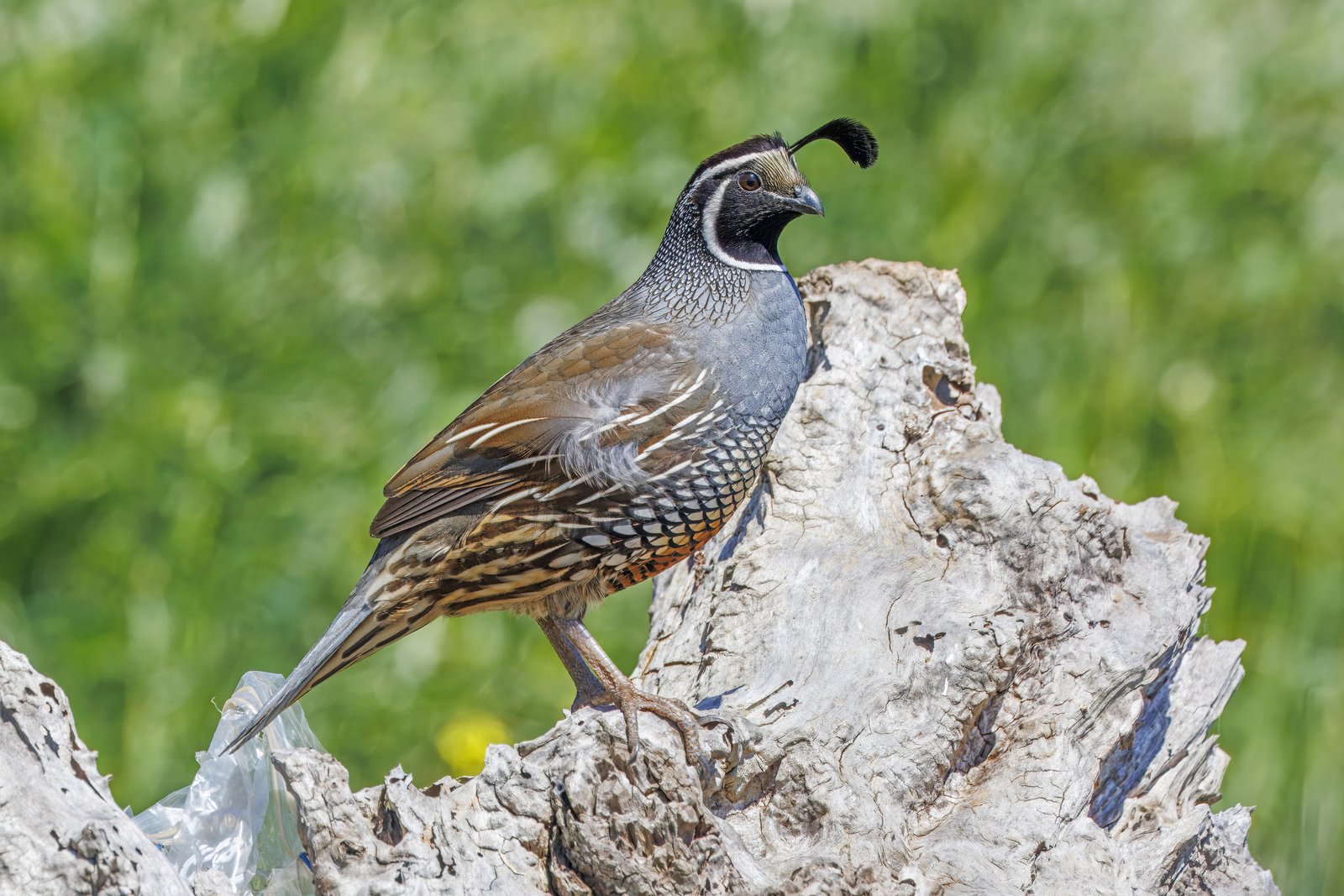
The California Quail (Callipepla californica) — California’s state bird — is the plump, round ground bird of Pacific slope backyards, parks, and chaparral edges, famous for the forward-curling teardrop plume that bobs on its head and a ringing “chi-CA-go” assembly call. The male wears a black face framed in white and a scaled belly; the female is soft brown with a smaller plume. They live in coveys, run rather than fly, and summer brings chick parades trailing their parents across the lawn. Attract them with cracked corn and white millet scattered on open ground within a few feet of dense brush, plus ground-level water and a dust bath patch — they share the spill zone with the Mourning Dove and the House Finch.
Species Physical Profile & Morphometrics
The California Quail belongs to the New World quail family (Odontophoridae) — small, plump, ground-dwelling game birds of the Americas, built like feathered softballs with strong legs for scratching and short, rounded wings for explosive escape flights. It is one of the most recognizable backyard birds in the West.
The identification formula: plump gray ground bird + forward-curling teardrop topknot + scaled belly. Along the Pacific coast there is essentially nothing to confuse it with; in the interior West, Gambel’s Quail is the lookalike — its male has a rusty crown and an unscaled plain belly, and its range barely overlaps. Mountain Quail are bigger with a straight, slender plume. The California Quail’s curled comma of a crest settles it at a glance.
Essential Morphometric Field Marks:
- Body Length & Mass: 9.4 to 10.6 inches (24–27 cm) and 5.0 to 8.1 ounces (140–230 grams) — a plump, round-bodied ground bird with a small head and short tail.
- Wingspan: 12.6 to 14.6 inches (32–37 cm); wings are short and rounded, built for a loud, whirring burst flight into cover — never for distance. Running is the preferred escape.
- Bill Structure & Color: A short, stout black bill — a seed-cracker and leaf-nipper, equally at home on spilled grain and fresh clover.
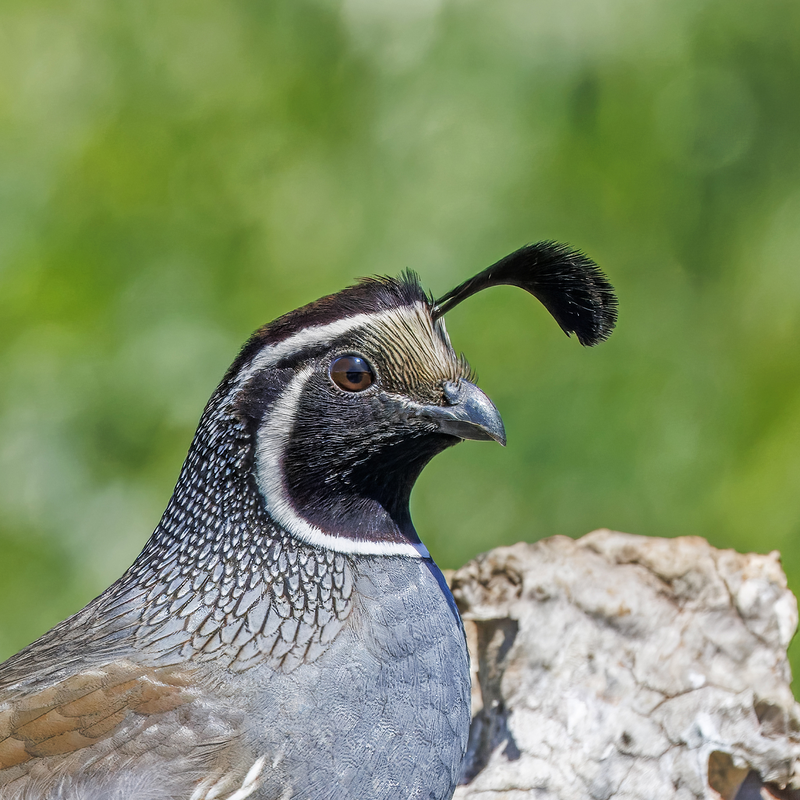
- Color Pattern: Blue-gray breast and flanks, a belly covered in cream-and-buff scales with a chestnut center patch, and brown-streaked upperparts. The male wears a black face framed by a crisp white border and a rich brown cap; the female is soft gray-brown with plainer face markings. Both wear the curled plume.
- Male vs. Female: The male’s black-and-white face mask and long, full plume separate him instantly; the female’s smaller plume and subdued brown head blend with her dusty plumage. Juveniles look like small, shorter-plumed females.
The masked showman: jet-black face outlined in white, chestnut-streaked brown crown, blue-gray chest, scaled belly with a chestnut bullseye, and the longest, fullest teardrop plume in the covey. He calls “chi-CA-go” from fence posts and takes sentinel duty while the group feeds.
Same shape, camouflage paint — soft gray-brown head without the mask, a shorter, thinner plume, and the same beautifully scaled belly. She lays a dozen or more eggs in a hidden ground scrape, and in summer she leads the chick parade across the yard.
California Quail Vocalization Guide (3 Field Recordings)
The California Quail’s signature is the loud, ringing “chi-CA-go” assembly call — three syllables, punch on the middle one — backed up by a vocabulary of contact calls, alarm notes, and covey chatter. All three recordings below are real field audio, shared under commercial-use licenses via Wikimedia Commons and iNaturalist — no simulations. For a deeper library, browse xeno-canto: California Quail.
1. The Assembly Call
2. The Covey Chorus
3. The Northern Outpost
Habitat, Range & the Brushy Edge
The California Quail lives on the brushy edge: chaparral, coastal scrub, open oak woodland, park edges, and suburban yards — anywhere that pairs open feeding ground with dense, thorny cover to dive into. It is one of the most adaptable game birds in the West, as much at home in a San Diego cul-de-sac as in wild chaparral.

Native on the Coast, Adopted Everywhere West
The dark purple ribbon is home: the Pacific slope from Baja California through California and into Oregon. The pale wash across the interior West — Nevada, Utah, Idaho, Washington, British Columbia, and beyond — is where introduced birds took hold so thoroughly that most residents assume they were always there.
For backyard birders the map means one thing: west of the Rockies, any yard with brushy cover and open ground is potential quail country — and because they never migrate, a covey that finds your feeder can become a multi-year neighbor.
Backyard Behavioral Patterns & Social Dynamics
The California Quail is one of the most social birds in the backyard — rarely alone, rarely still, and endlessly entertaining once a covey adopts your yard. Four behaviors explain most of what you will observe:
🪶 The Bobbing Topknot
That comma on the head is a cluster of about six feathers fused into one forward-curling teardrop — longer in males, shorter in females. It bobs with every step, making each bird easy to spot in tall grass and serving as a constant visual beacon that helps the covey stay together.
👨👩👧👦 The Covey System
Outside the breeding season, quail travel in coveys from a handful of birds to dozens, foraging together and roosting communally in trees and dense shrubs. While the group feeds, a sentinel posts up high — on a fence, a log, a low branch — and its alarm note sends the whole covey sprinting for cover in an instant.
🏃 The Runner, Not the Flier
Quail live on their feet: they run — surprisingly fast, heads low, plumes bouncing — across open ground between cover patches. Flight is the last resort: an explosive, whirring burst that carries them just far enough to crash-land in the nearest brush. Watch the paths between your shrubs and you will see their daily commute.
🐤 The Chick Parade
Quail chicks are precocial — downy, open-eyed, and walking within a day of hatching. Both parents lead the brood on daily feeding marches, and neighboring families often merge into joint creches with several adults shepherding a crowd of cotton balls. A June morning can bring a parade of twenty through the flower beds.
Problem: “Quail Flush Before I Ever Get a Look — and the Neighborhood Cats Know It Too. What Should I Do?”
The three most common California Quail worries all have proven answers:
First, the vanishing act: quail feed exposed but think in terms of escape distance — scatter seed within a quick dash of dense shrubs, never mid-lawn, and approach windows and doors slowly; a covey that learns your yard’s rhythm will feed calmly within view for twenty minutes at a stretch. Second, the predators: cats and Cooper’s Hawks hunt ground birds, and a covey under pressure simply leaves — keep pet cats indoors, build or leave brush piles near the feeding area, and let dense shrubs go unpruned so cover sits inches from the seed. Third, the on-again, off-again visits: coveys rotate through a daily circuit of feeding spots — put seed out at the same time every morning and your yard becomes a scheduled stop; reliability, not quantity, is what holds them. Solve these three and the plume-heads will treat your yard as home range for years.
Method 1: Set the Table — Scatter Grain Near Cover
Design for a plump, ground-feeding, cover-loving covey bird:
-
Scatter Cracked Corn & Millet on Open Ground
Cracked corn, white millet, and mixed small grains scattered on bare or short ground is the classic quail spread — sized for their bills and served the way they evolved to eat. A measured morning handful at a set time builds the daily habit.
-
Keep It Within a Dash of Dense Shrubs
The golden rule: seed within two or three feet of thick cover. Quail feed where one sprint reaches safety; an open-lawn scatter gets ignored, the same handful beside a lilac hedge gets a covey every morning.
-
Let Them Clean Up Under Feeders
Don’t sweep the spill zone under hanging feeders — quail relish exactly the millet and cracked grain that finches and Mourning Doves kick down. The area under a busy feeder is a free second station.
-
Offer Ground-Level Water & a Dust Bath
A shallow water dish at ground level gets daily visits, especially in dry summer country, and a dry, dusty patch of bare soil serves the other daily ritual: communal dust bathing, with half the covey wriggling belly-deep at once.
Method 2: Build the Habitat — Brushy Cover & Seed Plants
Feed the habit, not just the bird:
-
Plant (or Keep) Dense, Thorny Shrubs
Dense shrubs and untrimmed hedges — the thicker and thornier the better — are quail real estate: escape cover by day, roosts by night, and favored nesting cover in spring. A yard without brush will never hold a covey; a yard with one good thicket can hold several.
-
Build a Brush Pile
Prunings and holiday-tree limbs stacked loosely in a corner make a five-star quail shelter: instant cover exactly where you want the birds, predator-proof enough to buy them the seconds they need. Place it beside the scatter zone.
-
Let Clover, Lupine & Grasses Go to Seed
Clover patches, lupines, and lawn grasses left standing provide both the seeds and the tender green leaves quail nip daily. A slightly shaggy corner of lawn is a stocked pantry that refills itself.
-
Keep Cats Indoors & Watch from a Distance
Ground birds and outdoor cats do not mix — keeping pet cats indoors is the single biggest safety upgrade you can give a covey, especially during chick season when a dozen slow, fluffy targets trail through the yard. Enjoy the parade from the window; the parents will bring them back tomorrow.
Tool Solution: Recommended Hardware for California Quail
Equipment matched to a ground-feeding, cover-loving covey:
Ground Tray Near Cover
A low, wide tray set beside dense shrubs, filled with cracked corn and millet — keeps seed clean and visible while staying exactly where quail feel safe enough to feed.
- • Seed: Cracked corn, white millet
- • Style: Low ground tray
- • Placement: 2–3 ft from dense cover
Hopper Feeder with Spill Zone
A raised hopper stocked with a millet-forward mix feeds the finches overhead and rains exactly the small grain the covey cleans up below — two bird groups, one station.
- • Seed: Millet-forward mixed seed
- • Style: Wide-tray hopper
- • Bonus: Serves finches & doves too
Shallow Ground-Level Bird Bath
A shallow bath at ground level — heated in winter — serves the covey’s daily drinking rounds and completes the station: grain, water, dust, and cover all within a few yards.
- • Depth: 1–2 in, gently sloped
- • Winter: Thermostatic heater
- • Placement: Near the scatter zone
Frequently Asked Questions
- Species Profile: The California Quail (Callipepla californica) is a plump 9.4–10.6 inch, 5.0–8.1 ounce ground bird (Odontophoridae), band code CAQU — California’s state bird and the signature game bird of Pacific backyards.
- ID in One Look: Round gray body, forward-curling teardrop topknot, and a cream-scaled belly; the male adds a black face framed in white, the female is soft brown with a smaller plume.
- The Sound: A ringing three-syllable “chi-CA-go” assembly call, plus soft contact chatter from the feeding covey; three real field recordings above.
- Range & Habit: Native to the Pacific slope from Baja to Oregon, introduced and thriving across the interior West; strictly non-migratory — coveys live their whole lives around good cover.
- Feeder Formula: Cracked corn and white millet scattered on open ground within 2–3 feet of dense brush, ground-level water, and a dust bath patch; let the spill zone under feeders stand.
- The Covey & the Parade: Fall and winter bring big social coveys with posted sentinels; early summer brings precocial chick parades — keep cats indoors and enjoy the show from the window.
Bird Watching Log
Species: California Quail (Callipepla californica)
| California Quail (Topknot Seen: Yes / No — Covey Size: ___ — “chi-CA-go” Heard: Yes / No — Chicks Seen: Yes / No) | |