
Downy Woodpecker


Downy Woodpecker (Dryobates pubescens): Complete Identification, Feeder Guide & Call Library
Quick Answer: How to Attract & Identify Downy Woodpeckers
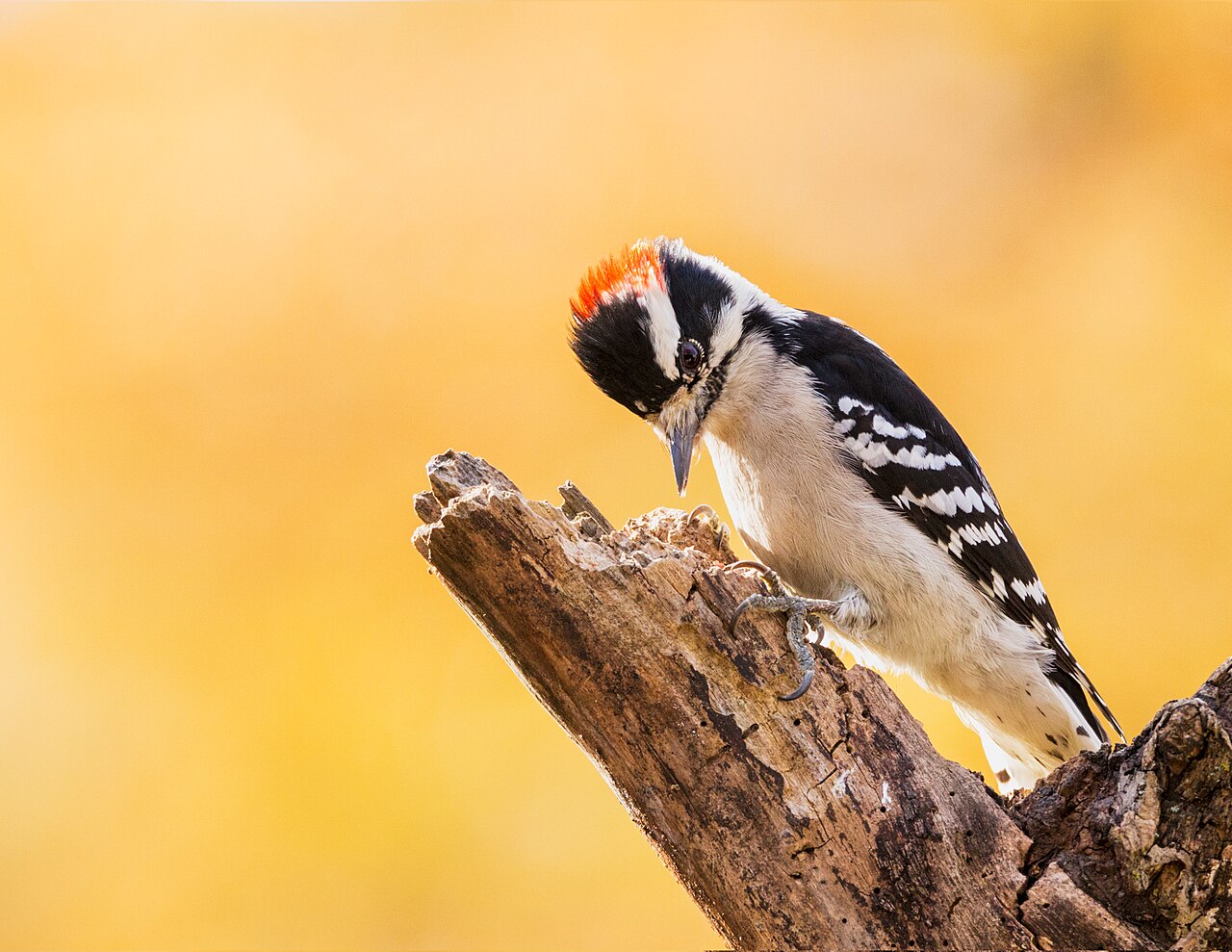
The Downy Woodpecker (Dryobates pubescens) is North America’s smallest woodpecker — sparrow-sized, boldly patterned in black and white, with a white stripe down the back and a short, stubby bill; the male adds a small red patch on the back of the head. A non-migratory resident of wooded yards across nearly the whole United States and Canada, it shares winter feeding stations with the Black-capped Chickadee and the White-breasted Nuthatch. To attract it: hang a suet cage near tree cover, offer black oil sunflower and peanuts, and leave dead limbs and dried plant stems standing. Listen for the sharp “pik” and the descending whinny.
Species Physical Profile & Morphometrics
The Downy Woodpecker belongs to the woodpecker family (Picidae) and is the smallest of the thirteen woodpecker species that breed regularly north of Mexico — barely larger than a House Sparrow, with the family’s classic toolkit: zygodactyl feet (two toes forward, two back), a stiff tail braced against bark, and a straight chisel bill.
The identification formula: tiny size + white back stripe + spotted black wings + short stubby bill, hitching up a tree trunk or balancing on a suet cage.
Essential Morphometric Field Marks:
- Body Length & Mass: 5.5 to 6.7 inches (14–17 cm) and 0.7 to 1.0 ounces (21–28 grams) — about two-thirds the size of its look-alike, the Hairy Woodpecker.
- Wingspan: about 9.8 to 11.8 inches (25–30 cm), with the undulating, bounding flight typical of woodpeckers.
- Bill Structure & Color: A short, stubby chisel bill, barely a third the length of the head — the single best mark against the long-billed Hairy Woodpecker. A small tuft of pale nasal bristles shades the nostrils from wood dust.
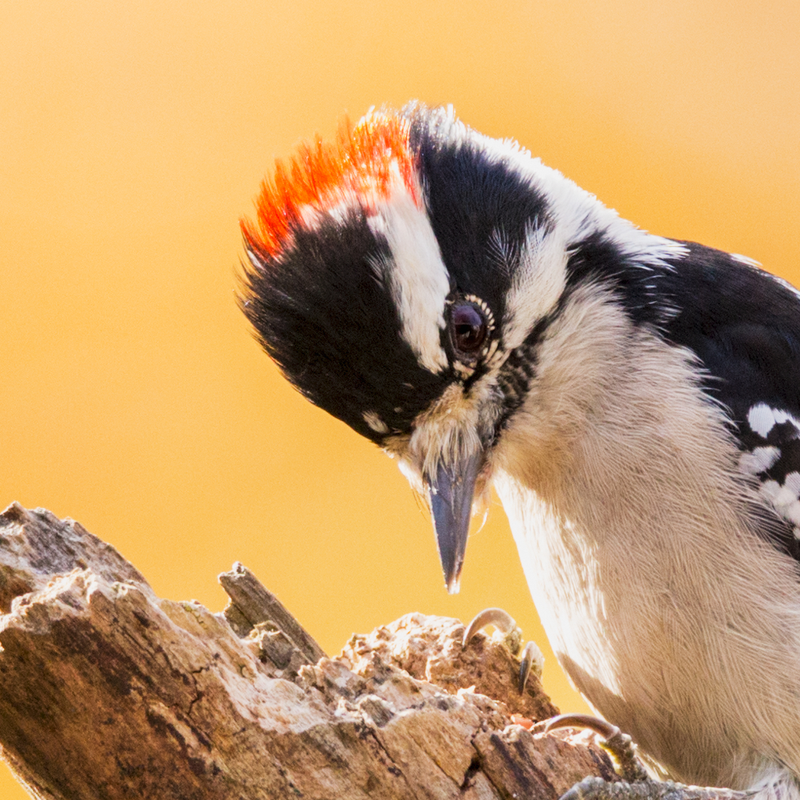
- Color Pattern: Black and white throughout: white underparts, a broad white stripe down the center of the back, black wings checkered with white spots, a boldly striped face, and white outer tail feathers marked with a few black spots. The male’s only color is a small red patch on the back of the head.
- Juveniles: Similar to adults but duller; young males often show the red toward the forehead or crown rather than the nape.
One dab of red: a small scarlet patch on the back of the otherwise black-and-white head. In late winter he advertises by drumming — a fast, one-second roll hammered on resonant dead wood — and both sexes drum to hold the pair’s year-round territory.
Identical pattern, no red: her head is pure black-and-white stripes. She shares excavation of the nest cavity — usually in a dead limb — and works the same suet cage and stems as her mate through every season.
Downy Woodpecker Vocalization Guide (2 Field Recordings + 1 Simulation)
The Downy’s voice is small but distinctive: a sharp, flat “pik” given all year as a contact note, and a descending whinny used when excited or aggressive. And then there is the drumming — not a vocalization at all, but a one-second roll hammered on resonant wood that serves as the species’ springtime song. The first two cards below are real field recordings shared under Creative Commons licenses; the third is a clearly labeled acoustic simulation of the whinny skeleton. For more wild audio, browse xeno-canto: Downy Woodpecker.
1. Real Recording — Pik Calls & Whinny
2. Real Recording — The One-Second Drum
3. Whinny Simulation — Notes That Fall
Habitat, Range & the Year-Round Wooded Yard
The Downy Woodpecker is a bird of open deciduous woodland: forest edges, riverside groves, orchards, parks, cemeteries, and shade-tree neighborhoods — anywhere small trees, snags, and weedy edges mix. It is the woodpecker most likely to live in an ordinary American backyard.

A Resident of Almost Every Wooded Neighborhood
The species lives year-round across most of Canada and Alaska and the entire continental United States, thinning out only in the driest southwestern deserts and the far northern boreal forest. It does not migrate: the bird at your winter suet cage is very often the same individual that nested in a dead limb nearby.
In winter, downies travel with mixed feeding flocks of chickadees, nuthatches, and titmice — a neighborhood patrol that passes through yards daily — then pair off to drum and excavate as spring approaches.
Backyard Behavioral Patterns & Social Dynamics
The Downy Woodpecker is a calm, confiding presence at feeding stations. Four behaviors explain most backyard encounters:
🪶 The Featherweight Acrobat
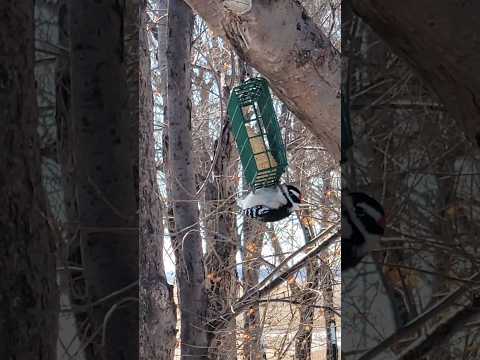
At barely an ounce, this woodpecker forages where larger birds cannot: hanging upside down from twig tips, clinging to goldenrod stalks and sunflower heads, and picking insect larvae from plant galls — acrobatics no Hairy Woodpecker can match.
🥁 The Drummer
On late-winter mornings both sexes drum a fast one-second roll on the most resonant dead branch, signpost, or gutter they can find — a territorial advertisement, not feeding. If your house trim becomes a drum site, the sound is seasonal and stops when nesting begins.
🐦 The Flock Follower
In winter, downies join mixed flocks of chickadees and nuthatches, borrowing the flock’s many eyes for predator warning while they forage. When the chickadees arrive at your feeder, look twice — the downy is often right behind them.
🕳 The Cavity Rooster
Every night, each bird roosts alone in a cavity — a self-excavated hole or an old nest hole in dead wood. Snags and dead limbs left standing in a corner of the yard are both pantry and bedroom for this species.
Problem: “Is This a Downy or a Hairy Woodpecker at My Feeder — and Why Is One Hammering My House?”
The three most common Downy Woodpecker puzzles all have clean answers:
First, Downy or Hairy? Judge structure, not plumage: the Downy is sparrow-sized with a bill about a third the length of its head and usually shows black spots on the white outer tail feathers; the Hairy is robin-sized with a bill as long as its head and pure white outer tail feathers. Second, the house hammering: spring drumming on gutters, siding, or metal caps is advertising, not feeding — it fades once nesting starts; meanwhile, cover favored drumming boards or hang reflective tape, and check that siding has no actual insect problem. Third, the suet bullies: if starlings and grackles empty your suet cage before the downy arrives, switch to an upside-down suet feeder — downies cling underneath with ease, while starlings struggle.
Method 1: Set the Table — Suet, Peanuts & Sunflower
Design for a tiny, clinging, insect-eating woodpecker:
-
Hang a Suet Cage First
A simple wire suet cage mounted on a tree trunk or pole is the single most reliable Downy Woodpecker magnet in North America — high-energy fat carries this tiny bird through cold nights. Choose plain, peanut, or insect-blend cakes.
-
Add Black Oil Sunflower & Shelled Peanuts
Black oil sunflower seeds, sunflower chips, and shelled or chopped peanuts on a platform or in a small hopper give downies a second staple — the thin bill husks black oil seed with ease.
-
Mount Feeders Near Trunk Cover
Place stations within a short flight of trees or large shrubs: downies approach along trunks and branch lines, pause to scan, then dash to the feeder. A feeder marooned in open lawn sees far fewer visits.
-
Offer Water Year-Round
Woodpeckers drink and bathe at shallow baths near trunk cover; in freezing weather a heated bird bath keeps the station open when natural water is locked in ice.
Method 2: Build the Habitat — Dead Wood, Stems & Shelter
Feed the habitat, and the downies follow:
-
Leave Snags & Dead Limbs Standing
Where safety allows, keep a dead limb or small snag: it supplies beetle larvae and ants, a drumming post, a roost hole, and possibly a nest cavity — four resources in one piece of wood.
-
Skip the Fall Garden Cleanup
Dried goldenrod, sunflower stalks, and weedy stems hold galls and overwintering insects that downies mine all winter — and the stems themselves double as perches no larger bird can use.
-
Plant Native Trees & Shrubs
Oaks, birches, maples, serviceberry, and dogwood host the insects and offer the small-branch structure this species forages in; even one or two native shade trees anchor a downy territory.
-
Keep Cats Indoors at Feeding Hours
Small, tame feeder birds are highly vulnerable to outdoor cats — place suet at least five feet up, keep the area under feeders clear of ambush cover, and the resident pair will stay safe and loyal.
Tool Solution: Recommended Hardware for Downy Woodpeckers
Equipment matched to a tiny, clinging suet specialist:
Wire Suet Cage
A simple coated-wire cage holding one standard suet cake, hung on or near a trunk — the classic Downy Woodpecker station. The mesh gives tiny claws and a braced tail exactly the grip they need.
- • Food: Plain, peanut, or insect-blend suet cakes
- • Style: Single-cake wire cage
- • Placement: Tree trunk or pole near cover, 5+ ft up
Upside-Down Suet Feeder
A cage mounted so birds must cling beneath it to feed — effortless for downies and nuthatches, awkward for starlings and grackles. The fair way to keep suet for the birds it was bought for.
- • Food: Standard suet cakes
- • Build: Bottom-access cage with roof
- • Placement: Hung free, near trunk cover
Shallow Bird Bath
A shallow basin set near trunk cover — downies drink and bathe daily, and a heated model keeps water open on freezing nights, when a dependable drink keeps the winter flock anchored to your yard.
- • Depth: 1–2 in, gently sloped
- • Winter: Add a heater or de-icer
- • Placement: Beside trees, visible from the feeder
Frequently Asked Questions
- Species Profile: The Downy Woodpecker (Dryobates pubescens) is a 5.5–6.7 inch, 21–28 gram woodpecker (Picidae) — the smallest in North America — with zygodactyl feet, a braced tail, and a short chisel bill.
- ID in One Look: Black-and-white with a white stripe down the back, spotted wings, and a stubby bill a third the head’s length; the male adds a small red nape patch. Spotted white outer tail feathers separate it from the larger Hairy Woodpecker.
- A Year-Round Neighbor: Lives in wooded yards across nearly the whole United States and Canada and does not migrate; in winter it roams with chickadee and nuthatch flocks, and roosts nightly in a cavity.
- The Sound: A sharp “pik” contact note, a descending whinny, and — in late winter and spring — a fast one-second drum hammered on resonant wood by both sexes.
- Feeder Formula: A wire suet cage near trunk cover first, then black oil sunflower and shelled peanuts; keep a shallow bath filled, and use an upside-down suet feeder if starlings move in.
- Habitat Bonus: Leave dead limbs and dried plant stems standing where safe — they provide insect prey, drumming posts, roost holes, and nest sites for this loyal backyard resident.
Bird Watching Log
Species: Downy Woodpecker (Dryobates pubescens)
| Downy Woodpecker (Red Nape Patch: Yes / No — Drumming Heard: Yes / No — Suet Cage Visit: Yes / No) | |