
Best Bird Feeders for Backyard Birds

Best Bird Feeders for Backyard Birds: Types, Seeds & Setup — A 30-Year Field Guide
Which bird feeder should you buy first?
Start with a medium tube feeder filled with black oil sunflower seed — it serves chickadees, finches, titmice and nuthatches within days. Add a suet cage for woodpeckers and a platform tray for cardinals and doves, and you own a complete station that covers every common backyard bird in North America. Everything else — nyjer socks, nectar feeders, hopper palaces — is refinement. The sections below walk through all six feeder types, the seed that belongs in each, the birds each one pulls in, and the placement and cleaning rules that decide whether a station thrives or fails.
Why the Feeder Matters More Than the Seed
I hung my first feeder in the early 1990s — a cheap plastic tube that cracked in its first Ohio winter. What I learned that season has held true through thirty years and four states of feeding stations: birds don’t read the seed label, they read the hardware. A Northern Cardinal will ignore the finest black oil sunflower if the perch is too short for its feet. An American Goldfinch will pass over premium nyjer if the ports are clogged with last month’s damp, compacted seed.
A feeder does four jobs at once, and it is worth understanding all four before you spend a dollar:
- It presents food at the right height. Chickadees feed happily at eye level; juncos and towhees want food near the ground; woodpeckers want to cling vertically. One feeder cannot serve all three postures.
- It fits the bird’s body. Perch diameter, port size and clinging surface are physical filters. A tube with half-inch perches quietly excludes every bird bigger than a finch — sometimes that is exactly what you want.
- It keeps seed dry. Wet sunflower grows mold within days, and moldy seed kills birds. A feeder that sheds rain is not a luxury; it is the difference between feeding birds and poisoning them.
- It rations access. Weight-sensitive perches, cages and baffles decide whether the seed goes to a chickadee or to a squirrel, a starling or a grackle. Hardware is your only enforcement tool.
Get the hardware right and even mid-grade seed performs. Get it wrong and the best seed in the store rots untouched — or worse, feeds everything except birds.
The 6 Feeder Types That Cover Every Backyard Bird
Every feeder sold in North America — from a five-dollar tray to a two-hundred-dollar motorized squirrel-proof rig — is a variation of six basic designs. Master these six and you can read any yard at a glance, diagnose any feeding problem, and ignore most of the marketing.
1. Tube Feeder — The Starter
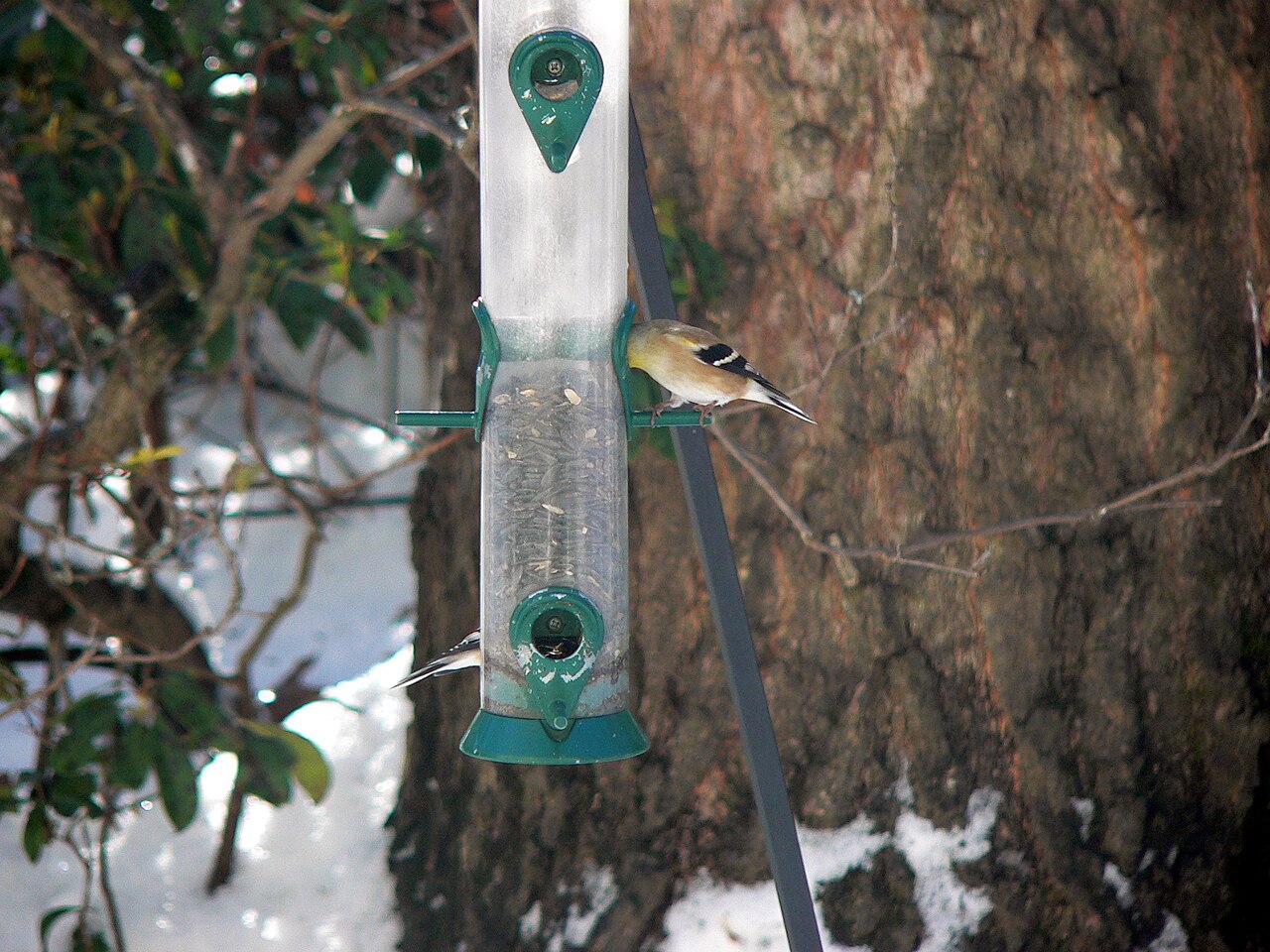
A clear polycarbonate cylinder with two to six metal-ringed ports and short perches. This is the single most versatile feeder ever made, and my first recommendation to every beginner who asks. Hung at eye level near cover, it will have chickadees on it the first afternoon in most neighborhoods.
What separates a good tube from a landfill candidate: metal port rings (squirrels chew through bare plastic in a week), a removable base (so you can actually scrub the bottom where mold starts), UV-stabilized plastic (cheap tubes yellow and crack in two seasons), and a cap that sheds rain away from the top port. A 16-inch, four-port tube in the $25–40 range hits the sweet spot; anything much cheaper fails the winter test, and anything much fancier is decoration for the buyer, not the birds.
Fill it with: black oil sunflower for the widest guest list, sunflower chips for zero mess, or a finch-forward mix. Expect: chickadees, House Finches, titmice, nuthatches and goldfinches. Watch for: seed bridging above the ports in humid weather — tap the tube weekly and never just top off; empty, inspect, refill.
2. Nyjer (Thistle) Feeder — The Finch Magnet
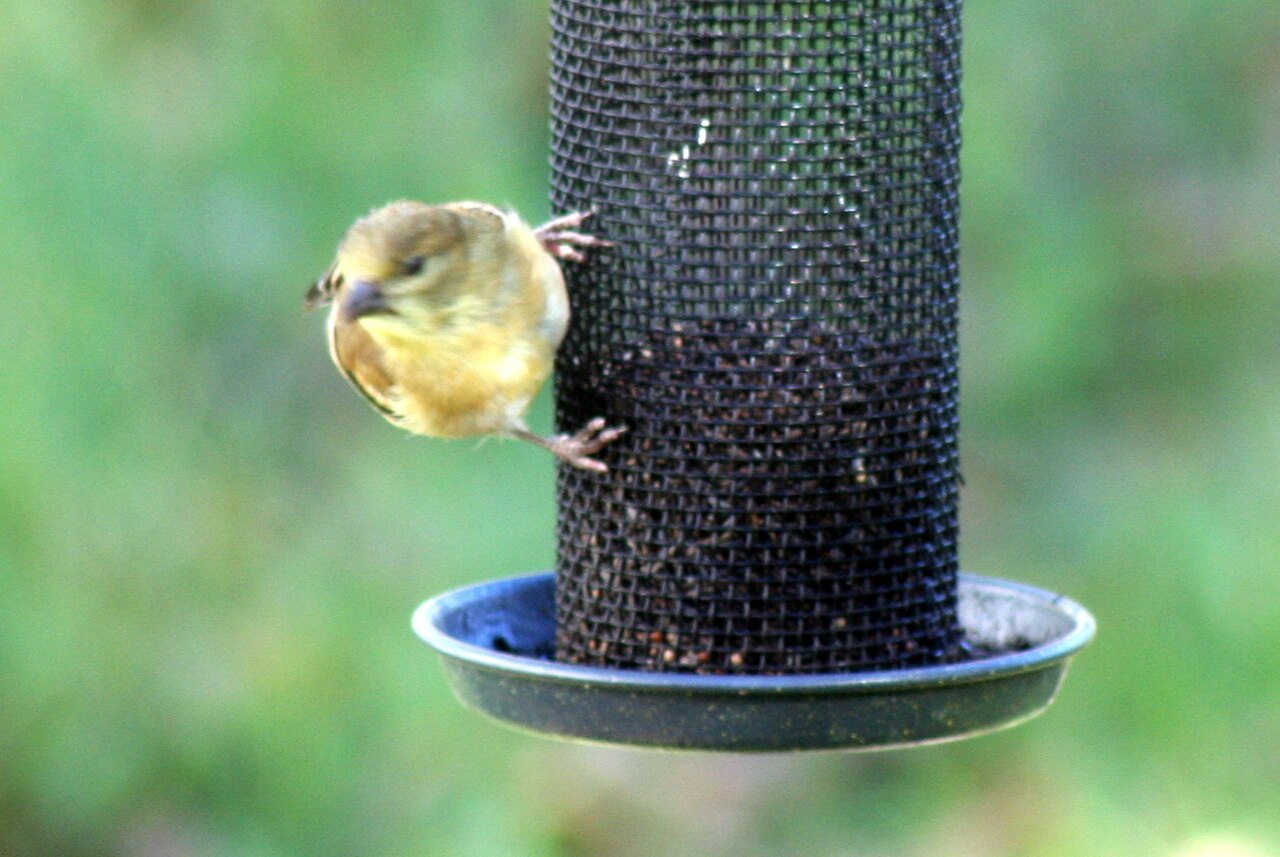
A fine-mesh sock or a tube with pinhead-sized ports holding nyjer — the tiny, oil-rich, heat-sterilized seed from Africa that goldfinches treat like currency. Nothing in bird feeding works faster. I have hung a fresh nyjer sock in a new yard and had American Goldfinches on it before I finished tying the knot.
Two honest cautions from long experience. First, nyjer stales fast — the oil content that finches love oxidizes within three to four weeks of opening the bag, and birds can smell stale nyjer before you can. Buy two-pound bags, not twenty. Second, socks wear out: expect one to two seasons per sock, and retire any sock that shows torn weave, because a ripped seam dumps five dollars of seed on the ground in a day.
Fill it with: nyjer only — never sunflower, which clogs the fine ports instantly. Expect: American and Lesser Goldfinches, Pine Siskins in invasion years, Common Redpolls in northern winters. Bonus: squirrels and bully birds almost universally ignore nyjer, making this the one feeder that needs no defense at all.
3. Hopper Feeder — The Workhorse
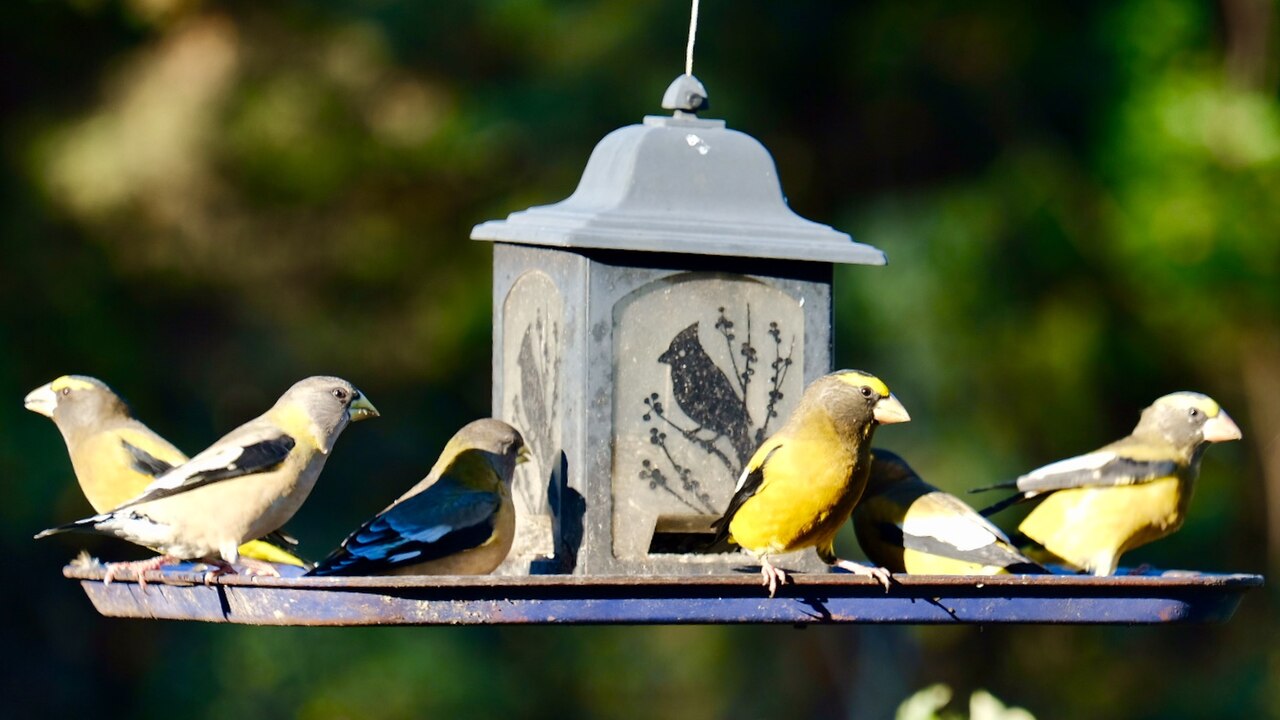
The classic “bird house” design: a central seed reservoir with side panels, a generous floor, and a roof that keeps weather off the seed. Hoppers hold two to five pounds of seed and welcome the bigger, heavier birds that tube feeders exclude by design.
This is the cardinal feeder par excellence. Cardinals prefer to feed facing forward on a solid platform rather than perching sideways on a stick, and a hopper’s floor gives them exactly that stance. Blue Jays, grosbeaks and Mourning Doves all take to hoppers readily. Buy wood or recycled-plastic models with a hinged or magnetic roof for easy filling, and check that the floor has drainage gaps.
Fill it with: black oil sunflower, safflower, or a no-filler mix. Expect: cardinals, jays, grosbeaks, doves, and every tube-feeder regular as overflow. Watch for: the reservoir’s bottom corners, where seed compacts and molds unseen — empty the hopper fully once a week, not just when it looks low.
4. Platform / Tray Feeder — The Crowd-Pleaser
An open flat tray — hanging, pole-mounted or sitting right on the ground. It is the most inclusive feeder design in existence: anything that can land on it or walk onto it can eat from it. It is also the best way to serve the ground-feeding guild — juncos, native sparrows, towhees and doves — that treat elevated perches with suspicion.
The trade-off is total exposure. Rain soaks it, snow buries it, squirrels graze it, and a platform left loaded overnight becomes a rat buffet in most neighborhoods. My discipline after thirty years: feed on a platform only what the birds finish by dusk. Start with a cup of seed, watch, adjust. Choose a tray with a perforated metal bottom — drainage is not optional — and if it mounts on a pole, put the baffle below it.
Fill it with: sunflower, whole peanuts for jays, cracked corn and white millet for the ground guild, fruit halves in season. Expect: the widest species list of any feeder, including everything from cardinals to Pileated Woodpeckers in wooded suburbs. Watch for: overnight visitors — raccoons, rats and deer all read a platform as an open invitation.
5. Suet Cage — The Winter Essential
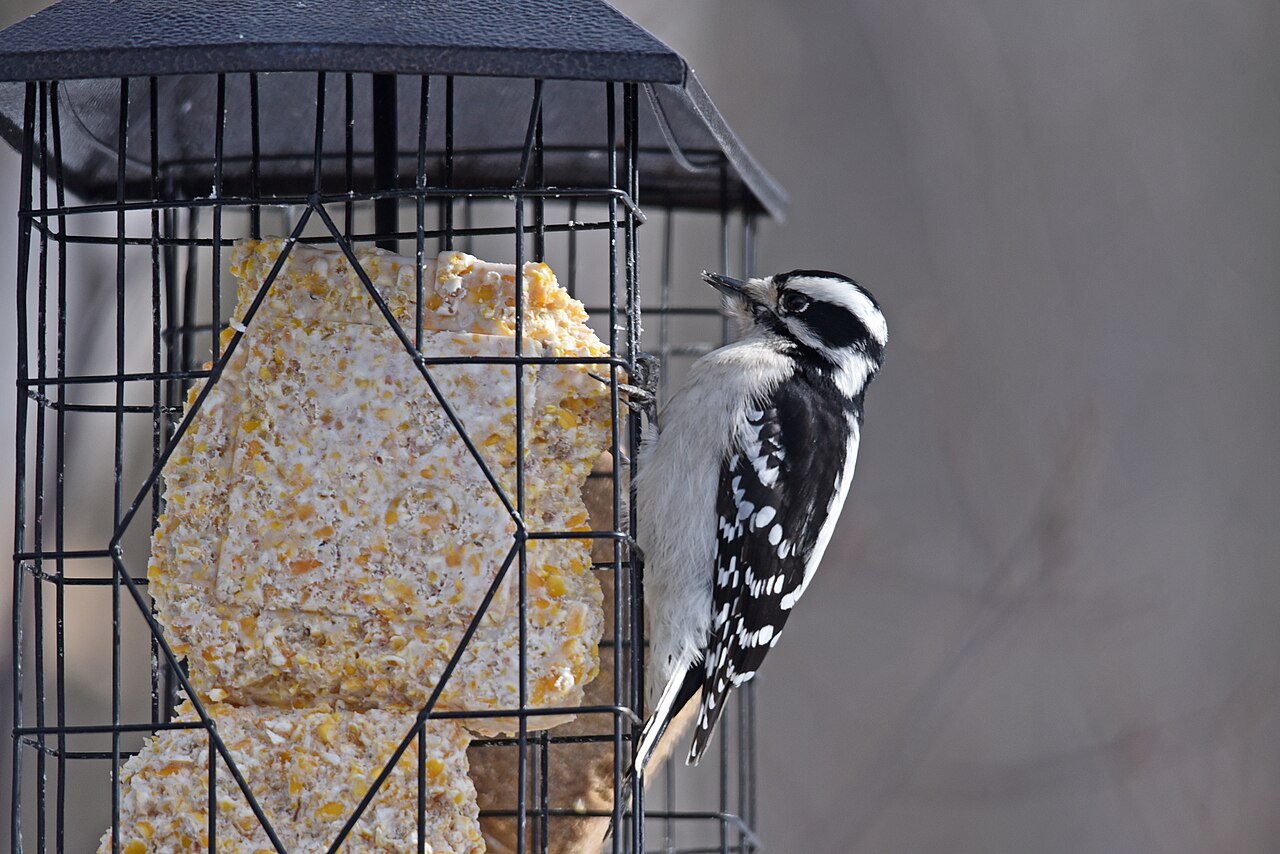
A vinyl-coated wire cage holding a cake of rendered beef fat, hung where birds can cling vertically. In cold months this is the highest-calorie station in the yard — a single suet cake carries the energy of several pounds of seed — and it is the only reliable way to hold woodpeckers at a feeding station.
Suet draws a guild that seed barely touches: Downy and Hairy Woodpeckers, Red-bellied Woodpeckers, nuthatches, chickadees, Carolina Wrens, and in hard winters even warblers and bluebirds. Hang cages about five feet up on a baffled pole or from a baffle-protected branch, and in starling-heavy neighborhoods switch to an upside-down cage — woodpeckers cling underneath happily, while starlings and grackles cannot manage the posture.
Fill it with: plain or peanut suet cakes in winter; no-melt dough blends once temperatures pass 80°F, because raw rendered fat liquifies in summer heat and can mat feathers. Watch for: cakes going rancid in heat — sniff when you swap; if it smells off, it is.
6. Nectar Feeder — The Specialist
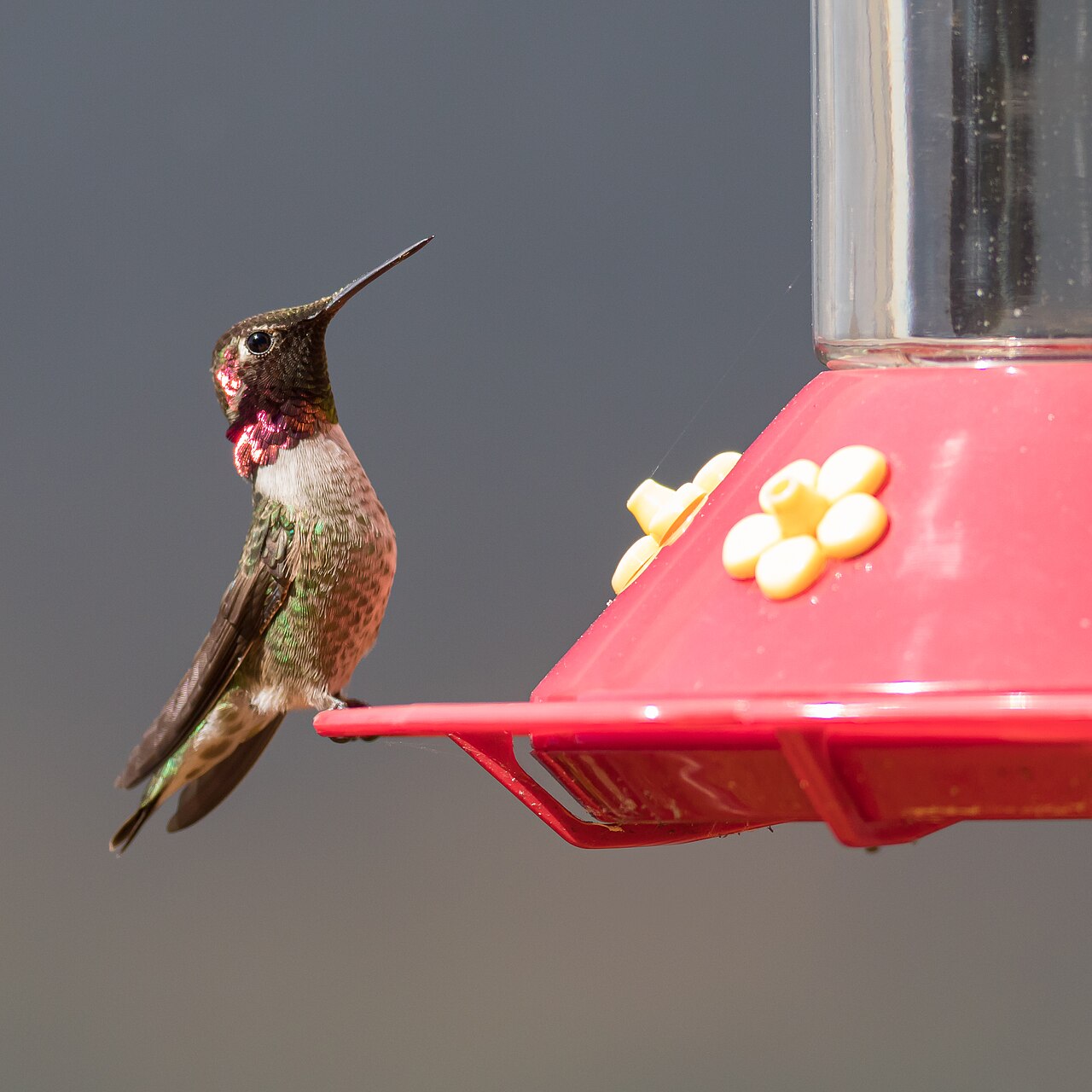
A red reservoir with flower-shaped feeding ports, serving one recipe: one part plain white sugar dissolved in four parts water. That is the entire ingredient list. No honey (it ferments and grows deadly fungus), no brown or raw sugar (iron content harms hummingbirds), no red dye (unnecessary — the red plastic does the advertising — and under legitimate suspicion of harm).
Nectar feeders run on a tighter clock than any other type: sugar water in summer heat grows black mold within days, and hummingbirds — with their tiny, fast metabolisms — are the worst birds in the yard to poison. Change the nectar every two to three days in hot weather, every four to five when cool, and scrub the ports with a bottle brush every time. An ant moat — the little water cup above the reservoir — is not an accessory; without one your feeder is an ant farm by June.
Expect: Ruby-throated Hummingbirds east of the Great Plains; Anna’s, Rufous, Black-chinned and more in the West. Orioles visit nectar feeders too, and many models now sell orange-jelly and mealworm ports alongside — a legitimate two-bird investment in oriole country.
Match the Feeder to the Bird You Want
This is the table I wish someone had handed me in 1993. Find your target bird, buy the matching feeder, fill it with the matching food. Bird feeding really is that direct when the hardware is right — the “Expect Them In” column reflects what I’ve seen repeatedly across four states, assuming the placement rules later in this guide are followed.
| Bird You Want | Feeder Type | Best Offering | Expect Them In |
|---|---|---|---|
| American Goldfinch | Nyjer sock or fine-port tube | Fresh nyjer seed | Days — they find it astonishingly fast |
| Northern Cardinal | Hopper or platform | Black oil sunflower, safflower | Within a week |
| Black-capped Chickadee | Any tube feeder | Sunflower, peanut pieces | Often the same day |
| Tufted Titmouse | Tube or hopper | Sunflower, whole peanuts | Days |
| White-breasted Nuthatch | Tube or suet cage | Sunflower, suet | Days |
| Downy Woodpecker | Suet cage | Suet cake, bark butter | 1–2 weeks |
| Red-bellied Woodpecker | Suet cage, platform | Suet, whole peanuts | 1–2 weeks |
| Blue Jay | Platform or wide hopper | Whole peanuts in shell | Days — jays scout constantly |
| Dark-eyed Junco | Low platform or ground tray | White millet | Days, October onward |
| Mourning Dove | Platform or ground | Millet, cracked corn | Days |
| Ruby-throated Hummingbird | Nectar feeder | 4:1 sugar water | Days in season (April–Sept.) |
| Baltimore Oriole | Nectar or jelly dish | Orange halves, grape jelly | Within days of spring arrival |
| Eastern Bluebird | Covered dish feeder | Live or dried mealworms | 2–4 weeks of consistent offering |
| Rose-breasted Grosbeak | Hopper or platform | Black oil sunflower | May migration window |
Seed, Short and Honest
Walk into any feed store and you face a wall of bags with sunset photography and bold promises. After thirty years, my buying list fits on an index card. Here it is, with the reasons:
- Black oil sunflower — the single best bird seed, full stop. The shell is thin enough for a chickadee’s bill, the kernel is roughly 40% fat, and more species accept it than everything else on this list combined. If you buy one bag, buy this.
- Striped sunflower — the same plant in a heavier coat. Cardinals, jays and grosbeaks handle it easily; small finches struggle. I use it deliberately in mixed yards — it slows the big birds down and leaves the black oil for the small ones.
- Sunflower chips (hearts) — hulled sunflower. Zero shell, zero mess, every bird takes it, and it spoils fastest. Use it in sheltered feeders only, and in small daily quantities on platforms.
- Nyjer — goldfinch currency. Small bags, fresh stock, fine-port feeders only.
- Safflower — the cardinal’s favorite and the squirrel’s disappointment. The bitter white seed most mammals and grackles reject after one taste. My front-line strategy in squirrel country for twenty years.
- White proso millet — the ground-feeding seed. Juncos, native sparrows, towhees and doves clean it up eagerly. Scatter it low or on a ground tray — never in a tube, where it mostly falls through the ports.
- Cracked corn — cheap filler with a purpose: the decoy station. A ground tray of cracked corn at the yard’s far edge occupies squirrels, doves and grackles away from your premium feeders.
- Peanuts — shelled pieces for tubes and titmice; whole in-shell on platforms for jays, whose caching shows are worth the price alone. Unsalted, always.
- Suet — winter’s survival ration; no-melt dough in summer. Plain and peanut blends outperform the berry-and-cricket novelty cakes in my yard every year.
- Mealworms — the bluebird key, and a magnet for wrens, robins and phoebes. Live works fastest; dried works with patience and a soak.
One more discipline that pays for itself: store seed like food, because it is. Metal cans with tight lids, in the garage or shed, never on a damp floor. Seed moths and weevils arrive free in most bags; a week in the freezer kills every egg, and sealed metal defeats every rodent.
Squirrels & Bully Birds: What Actually Works
I have lost more seed to gray squirrels than to birds in some years, and I have tested, watched fail, or retired nearly every gadget marketed to desperate feeders of birds. What survives three decades of testing is boring and bulletproof:
- Follow the 5-7-9 rule. Hang feeders at least 5 feet off the ground, 7 feet from anything a squirrel can launch from sideways (trunk, fence, deck rail), and 9 feet below any overhanging branch. An athletic gray squirrel jumps about 4 feet straight up, 7 feet across, and will happily drop 9 feet onto a feeder roof. Respect those numbers and you have already won most of the war.
- Add a baffle. A smooth dome baffle above a hanging feeder, or a stovepipe baffle wrapped on the pole below it, closes the routes placement misses. Placement plus baffle has held every yard I have ever set up — no motors, no batteries, no spinning perches.
- Change the seed before the hardware. Safflower and nyjer bore most squirrels senseless. Often the cheapest fix is swapping what’s inside the feeder, not the feeder itself.
- Understand capsaicin seed honestly. Hot-pepper-coated seed works — birds feel no heat, mammals do — and I use it occasionally. But it washes off in rain, coats your hands at filling time (never touch your eyes), and determined squirrels habituate. Treat it as a supplement, not a system.
- For bully birds, shrink the access. Weight-sensitive perches close ports under a grackle’s weight; caged feeders with 1.5-inch openings admit chickadees and finches while physically excluding starlings, House Sparrows and doves. Upside-down suet cages beat starlings by posture alone.
- Run a decoy station. A ground tray of cracked corn at the yard’s far edge keeps squirrels, doves and blackbirds fed and honest. I’ve run this two-station system for twenty years: premium seed close to the house under full defense, cheap corn far away as a peace treaty.
Placement: The Three Distances That Matter
Where a feeder hangs decides both how many birds use it and how many die trying. Three distances do nearly all the work:
- Windows — under 3 feet or over 30 feet. A feeder within 3 feet of glass lets a flushing bird build only harmless speed before it touches the window; beyond 30 feet, birds can read the glass and maneuver. The band between roughly 10 and 20 feet is the kill zone — birds flush at full speed into glass they never saw. I will not hang anything in that zone, and neither should you. Window strikes kill hundreds of millions of North American birds a year; feeder placement is the one part of that number you control directly.
- Cover — about 10 feet. Birds want a shrub or small tree within one quick dart of the feeder: close enough to escape a hunting Cooper’s Hawk, far enough that a house cat cannot launch an ambush from inside it. Ten feet is the compromise three decades of trial settled on.
- Water — within sight. A shallow bath (one to two inches deep, rough-bottomed) near the station doubles traffic. Birds that come for seed stay to drink; birds that come for water discover the seed. In freezing country a heated bath in January outdraws every feeder in the yard.

Two placement habits worth stealing: put the main station where you can see it from your favorite chair — the point of all this is watching — and spread feeders apart. Three feeders clustered at one pole look tidy and underperform; the same three feeders twenty feet apart let subordinate birds feed out of the boss’s sightline, and your species count climbs.
Cleaning & Hygiene: The Chore That Keeps Birds Alive
Here is the uncomfortable truth of this hobby: a dirty feeder kills more birds than it feeds. Feeders concentrate birds beak-to-beak in a way nature never does, and three diseases ride that concentration hard — House Finch eye disease (mycoplasmal conjunctivitis, the crusty-eyed finch at your tube), salmonellosis (the lethargic, fluffed birds under the platform during siskin years), and aspergillosis (a mold pneumonia from spoiled seed). Every one of them is a station-hygiene failure before it is bad luck.
- Every two weeks — weekly in wet weather — empty seed feeders completely. Not topped off: emptied. Scrub with hot soapy water, working into the port hoods and the bottom seam where fines and droppings collect.
- Disinfect with a 1:9 bleach solution — one part household bleach to nine parts water. Soak or swab every surface, rinse thoroughly, and dry fully before refilling. Damp seed molds within days, and you are back to square one.
- Nectar feeders run on a faster clock: every 2–3 days in summer heat, every 4–5 days in cool weather, immediately at any cloudiness or black speck in a port. Hot water and a bottle brush; skip soap residue. Never “top off” sugar water — empty, scrub, refill.
- Rake the ground below the station monthly and move pole systems yearly. Hulls and droppings accumulate into a contaminated mat that ground-feeding juncos and doves then work through beak-first.
- See a sick bird? Close the station for two weeks. A puffed finch with crusty, swollen eyes or a bird too weak to flush means every feeder comes down, gets the full bleach treatment, and stays down. It feels cruel for a fortnight; it saves the local flock for years.
The Year-Round Feeding Schedule I Follow
| Season | What Goes Out | Why |
|---|---|---|
| Winter (Dec–Feb) | Suet, black oil sunflower, nyjer, peanuts, heated bath | Maximum calories against minimum daylight. Natural seed is buried or stripped; your station is now survival infrastructure for chickadees, woodpeckers and finches. |
| Early spring (Mar–Apr) | Everything from winter, plus mealworms and a clean nectar feeder by mid-April | Migration waves need fat; nesting pairs need protein. Bluebirds and wrens find the mealworm dish; the first hummingbirds scout for red. |
| Late spring–summer (May–Aug) | Nectar, orange halves and jelly, sunflower chips; no-melt suet only | Orioles and hummingbirds peak. Raw suet liquifies above 80°F; clean everything twice as often in heat. |
| Fall (Sep–Nov) | Sunflower rebuilds, white millet on the ground tray, suet returns | Migrating sparrows and juncos sweep the low tray; residents re-establish the winter route. Feed steadily — birds are deciding right now whose yard makes the winter circuit. |
One honest note on consistency: feeding is optional for birds in summer, but your reliability matters year-round. Chickadees and titmice build daily routes around dependable stations and cache against them. A feeder that stands empty for three weeks doesn’t just lose visitors — it trains the neighborhood to route around your yard entirely.
The 8 Beginner Mistakes I Made So You Don’t Have To
- Buying the seed before the feeder. Hardware first, seed second — the feeder decides which birds can physically eat what you bought.
- Topping off instead of emptying. Fresh seed over old fines is how mold starts at the bottom of every tube. Empty, inspect, refill.
- Hanging feeders in the 10–20 foot window kill zone. Move them inside 3 feet of glass or beyond 30 feet. This one change saves more birds than any other.
- Trusting bargain mix. Red milo and wheat are filler. Read ingredients, not the picture on the bag.
- Fighting squirrels with gadgets instead of geometry. The 5-7-9 rule plus a baffle ends the war permanently; spinning motors end your patience first.
- Feeding platforms at night. Anything left on an open tray after dark feeds rats, raccoons and deer. Feed what birds finish by dusk.
- Adding red dye to nectar. The red feeder does the attracting; dye adds risk without benefit. Four parts water, one part white sugar, nothing else.
- Quitting after two quiet weeks. New stations take two to four weeks to enter the local birds’ route. The cardinal rule of this hobby: the birds are watching you long before you see them.
Frequently Asked Questions
- First feeder: a tube feeder with black oil sunflower — the highest return on ten dollars in all of bird feeding.
- Three types beat six: tube + suet cage + platform covers nearly every backyard bird body plan — perching, clinging and flat-footed.
- Match hardware to the bird: nyjer socks for goldfinches, hoppers and platforms for cardinals, cages for woodpeckers, nectar for hummingbirds.
- Squirrel defense is geometry, not gadgets: the 5-7-9 rule plus a baffle ends the war; motors and plastic owls do not.
- Window safety: under 3 feet or over 30 feet from glass — never in the 10–20 foot kill zone between.
- Hygiene is non-negotiable: 1:9 bleach every two weeks; nectar every 2–3 days in summer; sick bird means two weeks closed.
- Buy seed like food: small fresh bags, metal storage cans, no milo-heavy bargain mixes.
- Patience pays: new stations take two to four weeks to catch on — the birds are watching you first.