
Rose-breasted Grosbeak


Rose-breasted Grosbeak (Pheucticus ludovicianus): Complete US Backyard Identification, Feeder Guide & Vocalization Library
Quick Answer: How to Attract & Identify Rose-breasted Grosbeaks
The Rose-breasted Grosbeak (Pheucticus ludovicianus) is a stocky, robin-sized songbird recognizable by its massive pale-horn seed-cracking beak and striking plumage. Adult males feature a pitch-black hood, crisp white belly, and an electric ruby-rose chevron across the chest, while females resemble large brown-streaked sparrows with bold white eyebrow stripes and yellow wing linings. Unlike permanent resident Northern Cardinals, grosbeaks are long-distance Neotropical migrants that sweep into Eastern and Midwestern US backyards in late April and May (“Mother’s Day birds”). To reliably attract them during their brief spring stopover, mount a wide, stable platform tray or heavy wooden hopper feeder filled with black-oil sunflower seeds, pure safflower seeds, and fresh fruit slices set 5 to 6 feet high near mature deciduous shade trees.
Species Physical Profile & Morphometrics
Belonging to the cardinal family (Cardinalidae), the Rose-breasted Grosbeak derives its common name from the French term grosbec (“large beak”). This heavy, triangular jaw musculature allows the bird to easily shear woody seed pods, crack sunflower hulls, and crush hardwood forest beetles.
In US backyard identification, male grosbeaks are unmistakable, though backyard observers often confuse the camouflaged female with an overgrown Purple Finch or female Red-winged Blackbird. Along the Great Plains transition zone, this species occasionally hybridizes with the western Black-headed Grosbeak.
Essential Morphometric Field Marks:
- Body Length & Mass: Measures 7.1 to 8.7 inches (18–22 cm) with an adult weight between 1.4 and 1.9 ounces (39–54 grams), matching the heavy body class of the Northern Cardinal.
- Wingspan: Measures 11.4 to 13.0 inches (29–33 cm), providing efficient aerodynamic lift for long-distance nocturnal migratory flights across the Gulf of Mexico into the United States.
- Bill Structure: Features an extraordinarily stout, swollen conical beak colored dull chalk-white or pale horn. The cutting edges deliver substantial crushing power.
- Underwing Coverts: Highly diagnostic in flight: adult males show brilliant rose-pink underwing linings, while females and immatures flash warm saffron-yellow underwings.
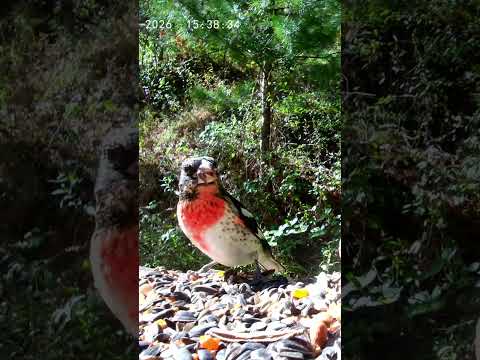
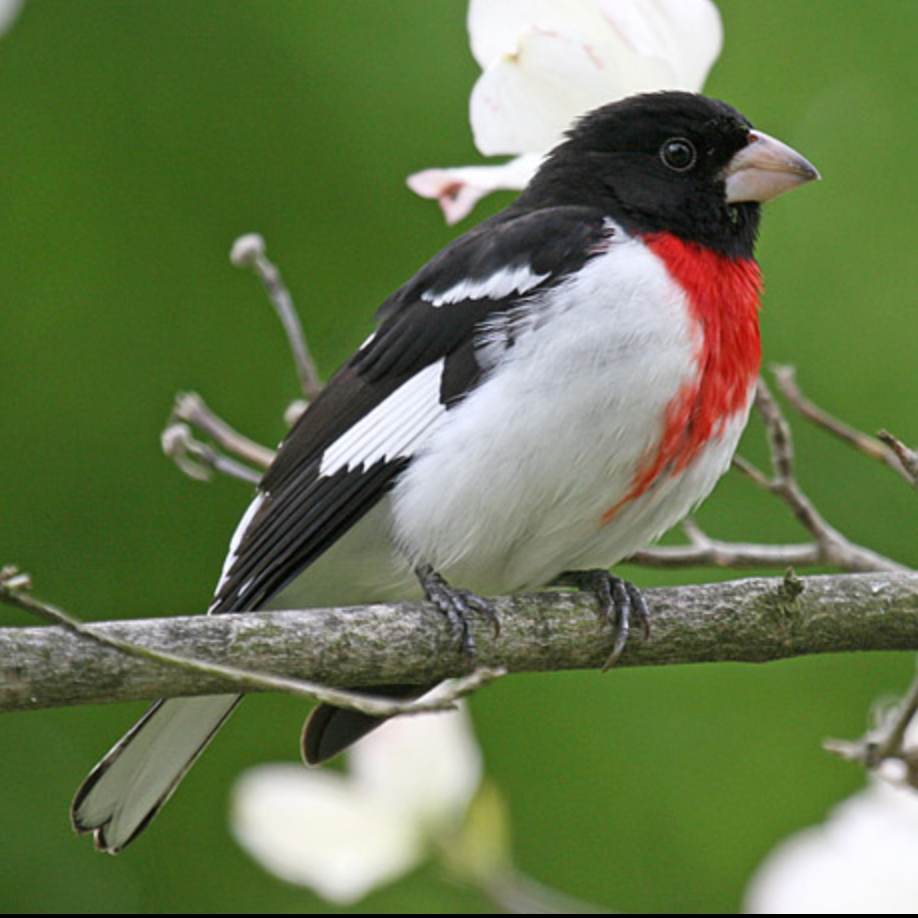
Dressed in a formal tuxedo pattern: velvety jet-black head, back, and wings, contrasted against a blazing ruby-rose triangle pointing down a pure white breast. The primary flight feathers feature prominent white patches and white rump bands visible in flight.
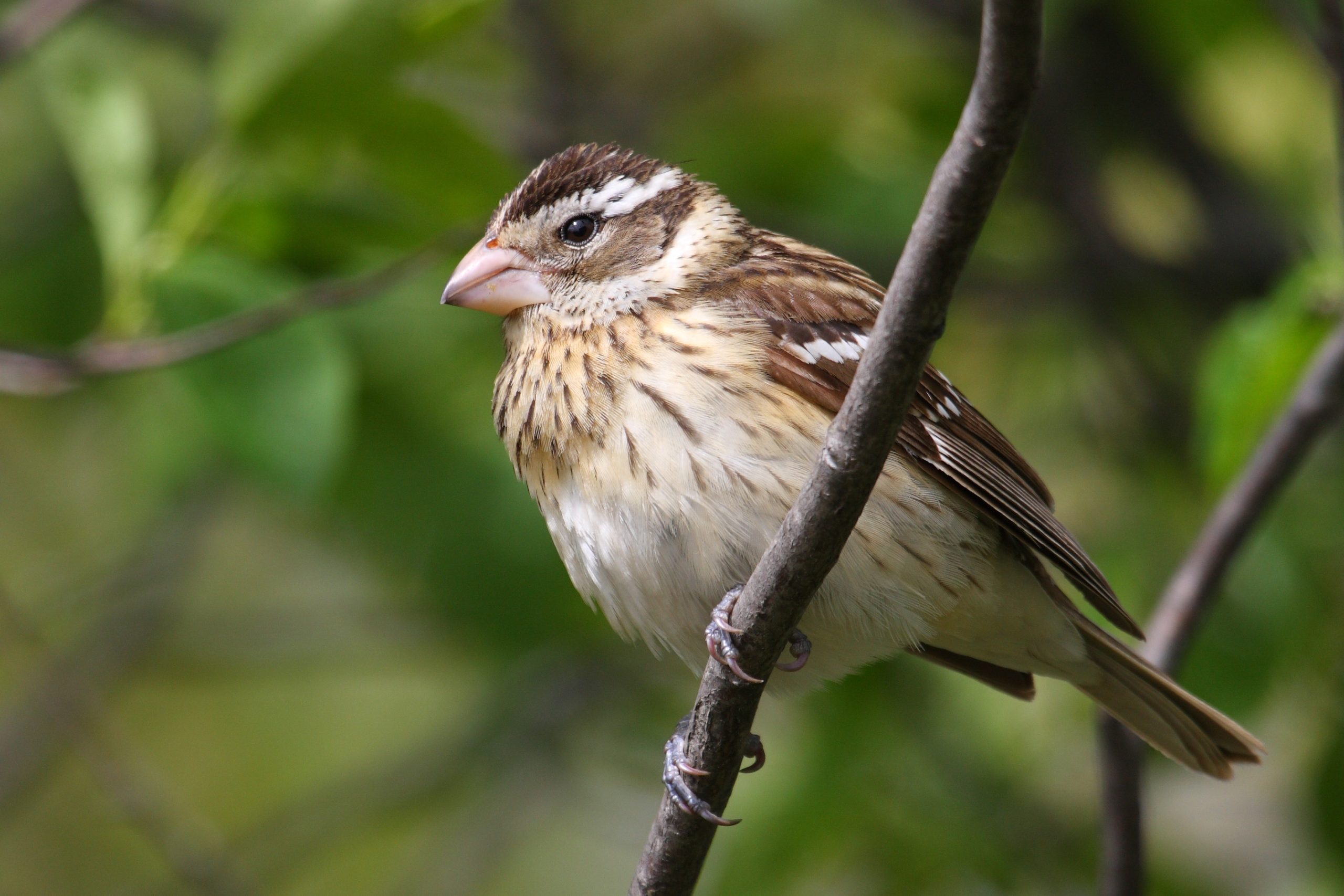
Camouflaged for tree canopy nesting: dense warm-brown and buff streaking across a creamy breast, dark brown wings with two white wing bars, a bold white supercilium (eyebrow stripe), and a pale crown stripe, paired with the identical pale horn-colored beak.
Grosbeak Vocalization Library (4 Key Sounds)
Renowned across American woodlands for its operatic delivery, the Rose-breasted Grosbeak sings a rich, rolling whistled caroling phrase that sounds “like an American Robin who has taken professional opera voice lessons.” In rare fashion among songbirds, both the male and female sing while sitting on the nest during incubation shifts.
1. Operatic Caroling Song
2. Sharp “Chink” Call
3. Female Nest Warble
4. Soft Courtship Whisper
US Range & Neotropical Migration Corridor
In the United States, Rose-breasted Grosbeaks nest in mature deciduous woodlands, oak-hickory forests, suburban river corridors, and leafy parks across the Midwest, Great Lakes, Mid-Atlantic, and New England states.

Blue = Wintering Grounds (Central & South America)
Green = US Spring/Fall Migration Corridor.
Trans-Gulf Flight: The Spring US Stopover Window
Unlike non-migratory Northern Cardinals, Rose-breasted Grosbeaks travel thousands of miles between Central/South American winter grounds and their US breeding range. After crossing the Gulf of Mexico, exhausted flocks touch down in American backyards right as oak leaves begin unfurling in early May.
Because migration depletes their fat stores, grosbeaks often gather in small backyard cohorts (3 to 10 birds) alongside fellow spring migrants such as Baltimore Orioles and Indigo Buntings, before establishing breeding territories in dense tree crowns.
Backyard Behavioral Patterns & Social Dynamics
Observing Rose-breasted Grosbeaks in American yards reveals fascinating routines, from gentle feeding manners to high-canopy singing:
🌿 High-Canopy Arboreal Foraging
Grosbeaks are quintessential tree-top foragers. They spend most of their summer in the upper canopy of oaks, maples, and elms, gleaning leaf-roller caterpillars and wood-boring beetles, swooping down to seed feeders primarily during migration or cold spring snaps.
🤝 Shared Incubation & Nest Singing
While male songbirds usually avoid approaching the nest to avoid alerting predators, male grosbeaks share roughly one-third of daytime incubation duties. Remarkably, the male often carols softly while warming the eggs, answering his mate’s gentle whistled calls from nearby branches.
🫐 Berry, Flower & Fruit Cravings
Beyond seeds, grosbeaks love sugary foods. In early spring, they snip tender flower buds and sip tree sap from sapsucker wells; by late summer, they gorge on elderberries, dogwood fruits, and wild mulberries to fuel their upcoming flight south.
🌎 Great Plains Hybrid Zone
Along the Great Plains river valleys of Nebraska, Kansas, and the Dakotas, Rose-breasted Grosbeaks meet their western counterpart, the Black-headed Grosbeak, occasionally producing fertile hybrid offspring.
Problem: Why Rose-breasted Grosbeaks Bypass Backyard Feeders
Many American homeowners hear grosbeaks singing in their backyard trees in early May, yet the birds never land on their feeders. This feeding avoidance is almost always caused by mechanical feeder mismatches:
At 45 to 54 grams, a grosbeak is nearly triple the weight of an American Goldfinch or Chickadee. Grosbeaks have rigid, forward-facing perching feet and cannot grip swaying wire mesh socks or balance on skinny, 1-inch dowel perches attached to lightweight plastic tube feeders. When a hanging feeder tilts sharply under their weight, grosbeaks feel unsteady and retreat back to the canopy. Furthermore, cheap seed blends loaded with red milo and cracked corn provide insufficient caloric density to restore exhausted migrants.
Method 1: Install Wide-Perch Platform Trays & Heavy Wooden Hoppers
Configure a mechanically stable feeding station that accommodates large-bodied songbirds:
-
Deploy Expansive Open Platform Trays or Fly-Through Feeders
Mount an open wooden platform tray or a cedar fly-through table measuring at least 12 by 12 inches. This provides an unconstrained, stable horizontal landing deck where heavy grosbeaks can land with confidence.
-
Anchor to Rigid 1-Inch Steel Mounting Poles
Do not hang feeders from thin, wind-prone tree branches. Fix your platform or heavy cedar hopper directly onto a rigid 1-inch diameter galvanized steel pole set 5 to 6 feet above the lawn, fitted with a wide squirrel baffle beneath the platform.
-
Provide Canopy Staging Perches
Because grosbeaks are naturally cautious when descending from high branches, position your feeding station within 10 to 15 feet of mature deciduous trees. This provides an intermediate staging branch where birds can scan for safety before landing to feed.
-
Keep Feeders Refilled Prior to Dawn
Migrating songbirds often complete nocturnal flights and begin foraging the moment twilight breaks. Ensure feeders are fully stocked before sunrise during the critical late-April to late-May window.
Method 2: Optimize High-Lipid Seed Formulation & Spring Fruit Trays
Tailor your offerings to match the massive crushing bill and seasonal sugar cravings of grosbeaks:
-
Discard Filler Grains (Milo, Wheat, and Corn)
Grosbeaks completely ignore filler grains found in commercial grocery store seed bags. They discard milo and oats onto the lawn, creating ground waste that invites rodents. Offer only premium single-ingredient seeds.
-
Fill Trays with Black-Oil Sunflower Seeds & Shelled Meats
Black-oil sunflower seed is the single most attractive food for Rose-breasted Grosbeaks. Their heavy bills crack the thin shells effortlessly to access the high-lipid kernel (28% crude fat, 16% protein). For zero lawn mess, provide shelled sunflower hearts.
-
Deploy Pure White Safflower Seed to Deter Competitors
If squirrels, European Starlings, or common grackles overwhelm your feeder, switch to 100% pure white safflower seed (Carthamus tinctorius). Grosbeak bills crush bitter safflower hulls easily, whereas squirrels and blackbirds find the taste unpalatable.
-
Supplement with Fresh Orange Halves, Grape Jelly & Mealworms
During spring migration, grosbeaks frequently visit oriole stations. Pin halved fresh oranges or place small dishes of natural grape jelly alongside your sunflower trays to give these exhausted migrants an immediate fructose rush.
Tool Solution: Recommended Hardware for Rose-breasted Grosbeaks
Heavy-duty backyard equipment engineered for large, heavy-bodied songbirds:
Cedar Platform Feeder with Removable Screen
Heavyweight rot-resistant cedar tray featuring an expanded mesh drainage floor and spacious open perching perimeter.
- • Deck Surface: 15 x 12 in flat landing space
- • Drainage: Rustproof perforated metal mesh
- • Mount: 1-inch Pole Mount & Post Ready
Golden Safflower & Sunflower Heart Blend
A 50/50 blend of thin-hulled nutra-safflower and coarse sunflower hearts delivering instant fuel without lawn mess.
- • Purity: 100% Edible (Zero Waste Shells)
- • Pest Resistance: Squirrel & Grackle Proof
- • Fat Content: 34% Concentrated Lipids
Pedestal Bird Bath with Water Dripper
Shallow textured basin equipped with an active water dripper to attract high-flying migrants via moving water acoustics.
- • Water Depth: 1.5 in (Safe for songbirds)
- • Acoustic Draw: Gentle surface water ripple
- • Perch Rim: Textured slip-free stone edge
Frequently Asked Questions
1. Use Wide Platform or Heavy Hopper Feeders: Grosbeaks weigh up to 54 grams and avoid flimsy, swaying tube feeders. Mount a wide, rigid wooden platform tray or hopper feeder 5 to 6 feet high on a sturdy steel pole.
2. Serve Black-Oil Sunflower & Safflower Seeds: Their massive beaks easily crack black-oil sunflower seeds and sunflower hearts. If squirrels or grackles crowd the feeder, switch to 100% white safflower seeds, which grosbeaks love but pests avoid.
3. Offer Spring Fruits and Nectar: Like Baltimore Orioles, arriving grosbeaks seek quick fructose sugars after crossing the Gulf of Mexico. Place fresh orange halves, dishes of grape jelly, and clean suet cakes on your feeding deck.
4. Provide Moving Water: Install a shallow bird bath equipped with a dripping mister or solar fountain within 10 to 15 feet of mature deciduous trees (such as oaks and maples). The sound of moving water reliably lures high-canopy migrants down to your yard.
• The Melodious Caroling Song: Widely described by birders as sounding like “an American Robin who has taken professional opera singing lessons.” It consists of a fast, rich, fluid series of sweet, whistled musical phrases that rise and fall with remarkable clarity, delivered from the top branches of leafy hardwood trees.
• The Diagnostic “Chink” Call: Even when high in tree foliage, their call is unmistakable—a sharp, metallic squeak resembling the sound of rubber sneakers sliding across a polished hardwood basketball court or wire cutters snipping wire. When you hear this distinct call in May, check your platform feeders immediately.
- Species Profile: The Rose-breasted Grosbeak (Pheucticus ludovicianus) is a robin-sized passerine identified by its massive pale bill, male ruby-carmine breast patch, and female sparrow-like plumage.
- US Neotropical Migrant: Travels thousands of miles between South American wintering grounds and US Eastern/Midwestern breeding woodlands, visiting backyard feeders primarily during the May migration stopover.
- Feeder Mechanics: Large, heavy bodies require wide, firm platform trays or heavy cedar hoppers mounted 5 to 6 feet high on sturdy steel poles rather than light, swinging tube feeders.
- Preferred Fuel: Black-oil sunflower seeds and sunflower hearts provide immediate lipids, while pure white safflower seed repels squirrels, grackles, and starlings.
- Musical Prodigy: Delivers an operatic, rolling whistled caroling phrase and a diagnostic sneaker-squeak “chink” call; both the male and female take turns incubating eggs and singing on the nest.
- Fruit & Water Magnet: Fresh orange halves, grape jelly, and moving water drippers dramatically increase stopover visits during spring flights.
Bird Watching Log
Species: Rose-breasted Grosbeak (Pheucticus ludovicianus)
| Rose-breasted Grosbeak (Subspecies / Notes: ____________________________) | |