
Purple Finch


Purple Finch (Haemorhous purpureus): Complete Identification, Feeder Guide & Call Library
Quick Answer: How to Attract & Identify Purple Finches
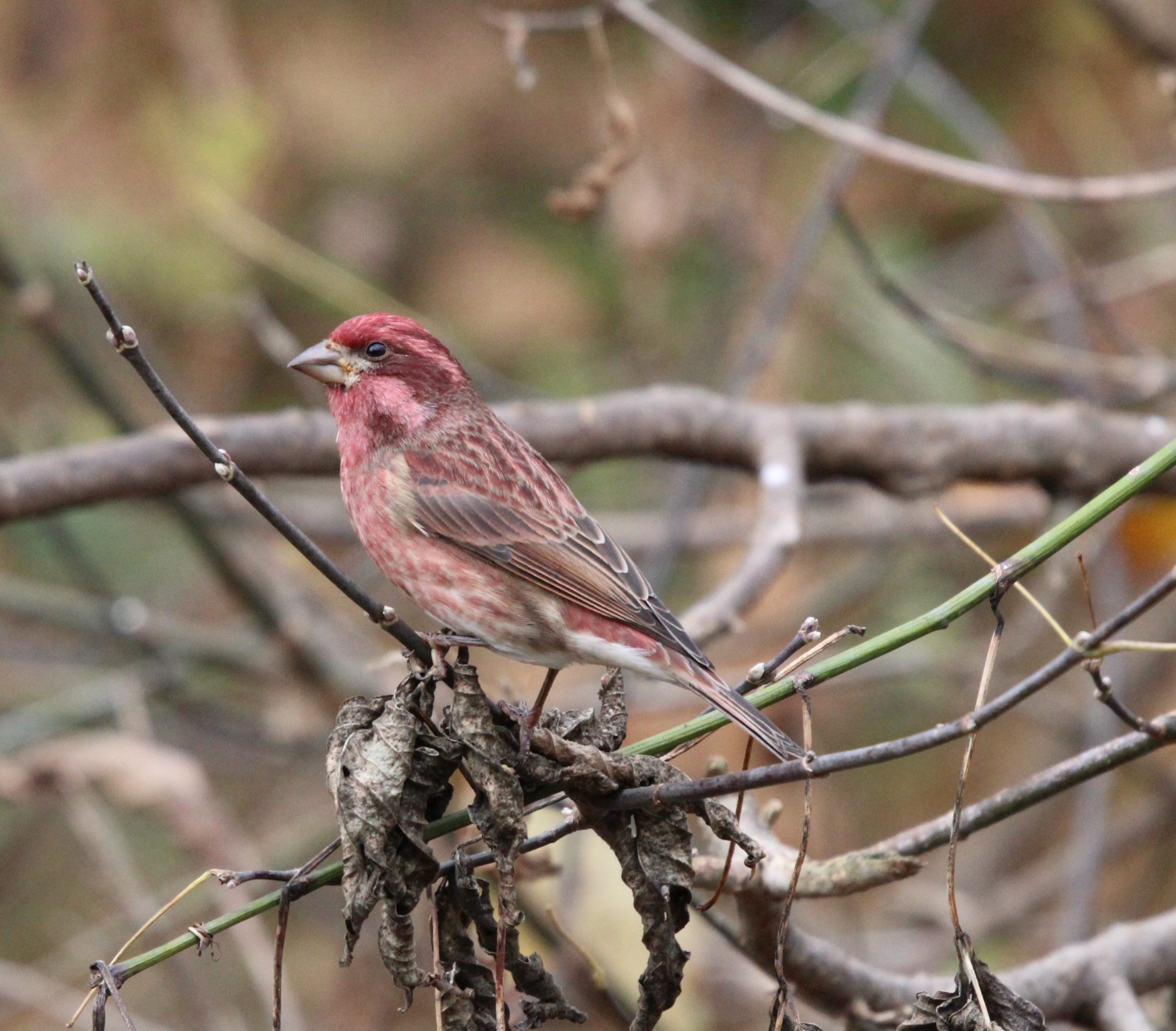
The Purple Finch (Haemorhous purpureus) is the raspberry-red forest finch of northern and mountain woods — a chunky 4.7–6.3-inch bird with a stout conical bill and a short, sharply notched tail. The male looks “dipped in raspberry juice” from crown to breast with unstreaked pink flanks; the female is crisply streaked with a bold white eyebrow, the mark that separates her from the plain-faced female House Finch. It breeds in coniferous and mixed forests across Canada, the Northeast, and the Pacific slope, and in winter it irrupts south in numbers tied to the northern seed crop. The song is a rich, flowing warble — smoother than the House Finch’s — and the flight call is a sharp, metallic “pik.” Attract winter flocks with black oil sunflower in tube or hopper feeders near conifers, and listen for that ticking call overhead.
Species Physical Profile & Morphometrics
The Purple Finch belongs to the true finch family (Fringillidae), genus Haemorhous — the same red-finch genus as the House Finch and Cassin’s Finch, and the source of the classic identification puzzle at American feeders. Despite the name, the bird is not purple: males are a deep, rich raspberry or wine red.
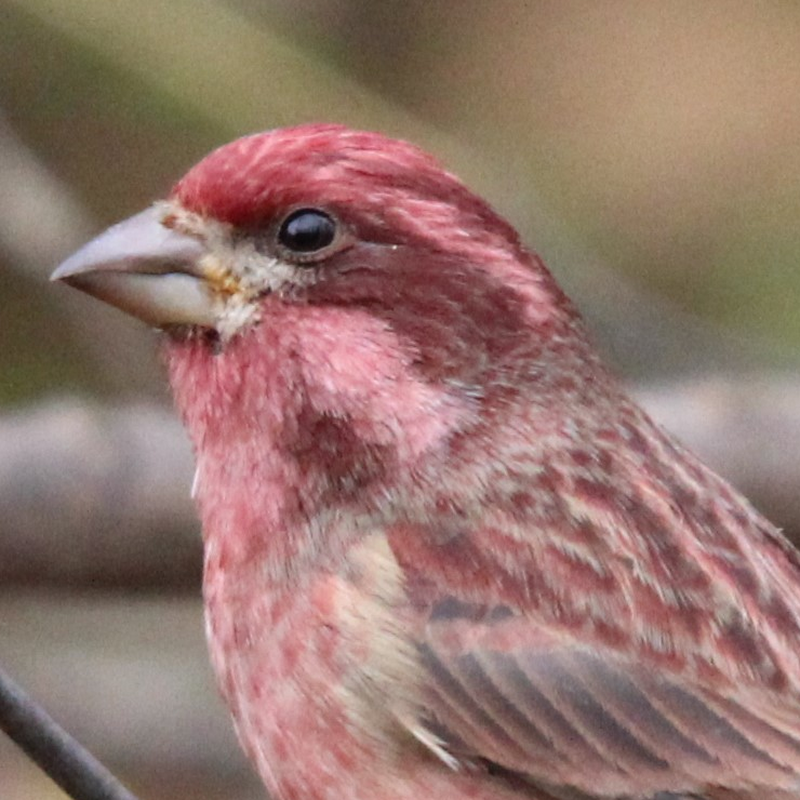
Compared with the House Finch, the Purple Finch is stockier and bigger-headed, with a shorter, more deeply notched tail. The male’s red covers the whole head and back and flows down the flanks in soft pink brushstrokes, with no heavy streaking on the sides — the House Finch keeps red in patches above strongly streaked flanks. The female wears a bold white eyebrow and pale whisker line framing a dark cheek patch, a crisp face pattern the female House Finch entirely lacks.
Essential Morphometric Field Marks:
- Body Length & Mass: Averages 4.7 to 6.3 inches (12–16 cm) with an adult mass of 0.6 to 1.1 ounces (18–32 grams) — noticeably chunkier than a House Finch beside it.
- Wingspan: About 8.7 to 10.2 inches (22–26 cm), with a bounding finch flight between treetops.
- Bill Structure & Color: A stout, deep-based conical bill — heavier than a House Finch’s — built for crushing seeds and nipping buds.
- Color Pattern: Male: raspberry red from crown through back, breast, and rump, softening to pink brushstrokes on the flanks. Female: brown and crisply streaked with a bold white eyebrow and whisker mark. Young males look like females and do not color up until their second fall.
Raspberry red over the entire head, back, and breast, fading to pink on the flanks — no crisp border, no heavy side streaks. Compare the male House Finch: red only on the forehead, throat, breast, and rump, with brown-streaked flanks. If the whole bird looks wine-dipped, it is a Purple Finch.
Brown above, white below with crisp dark streaks, and a striking face: a broad white eyebrow and pale jaw line enclosing a dark cheek patch. That patterned face — not a plain one — is the fastest way to separate her from a female House Finch at the feeder.
Purple Finch Vocalization Guide (1 Field Recording + 2 Simulations)
The male’s song is a rich, flowing, musical warble — sweeter and more continuous than the House Finch’s jumbled effort — delivered from a high perch in the breeding season. The everyday call is a sharp, metallic “pik” or “tek” given in flight, a dry tick that carries remarkably far. The first card below is a real field recording in the public domain; the second and third are clearly labeled acoustic simulations built to published descriptions of the sounds. For more wild audio, browse xeno-canto: Purple Finch.
1. Real Recording — Wilkes County, North Carolina
2. Song Simulation — The Rich Warble
3. Flight Call Simulation — “Pik! Pik!”
Habitat, Range & Irruption Winters
Purple Finches breed in coniferous and mixed forests: across most of Canada, into the northern Great Lakes and Northeast, and down the Pacific coast from Alaska to California, where the slightly darker California subspecies sings a faster song. They nest high in conifers and feed on buds, seeds, and berries along forest edges.

A Winter Visitor That Follows the Cone Crop
Purple Finches are short-distance, irruptive migrants: how far south they travel each fall depends on the northern seed and cone crop. In poor-crop years they flood south and east in big numbers; in rich years many stay near the breeding range.
That is why a backyard in the Northeast or mid-Atlantic can host a dozen Purple Finches one winter and none the next. When they do come, they join House Finches, goldfinches, and chickadees at the sunflower feeder.
Backyard Behavioral Patterns & Social Dynamics
The Purple Finch is a gentle forest finch with a few signature habits. Four behaviors explain most of what you will observe:
🍷 Dipped in Raspberry Juice
Roger Tory Peterson’s famous description still wins: the male looks like a sparrow dipped in raspberry juice. The color washes the whole head and back and runs down the flanks in soft brushstrokes — no sharp borders, no heavy streaks.
🌲 The Cone-Crop Nomad
Winter numbers are tied to northern tree seed crops. When spruces and birches fail, Purple Finches irrupt south in waves and mob backyard feeders; when crops are heavy, they stay home. Your winter flock is a report card on the northern forest.
🎶 A Smoother Songster
The breeding song is a rich, flowing warble — sweeter and more continuous than the House Finch’s jumble, without the harsh slurred finish. Males sing from high conifer perches, and Pacific-coast birds sing a noticeably faster version.
🐦 The Feeder Peacemaker
Purple Finches are less aggressive than House Finches — they often yield perches and wait their turn, one reason biologists think House Finch competition has pushed them out of some eastern areas. A second feeder a few feet away gives them room.
Problem: The Finch That Shows Up Some Winters — and Not Others
The usual Purple Finch report runs: “I had a flock at my feeder two winters ago, and none since.” The reasons are built into the bird’s biology:
First, irruption: winter movement tracks the northern cone crop, so absences are normal — a feeder empty of Purple Finches often just means a good seed year up north. Second, competition: where House Finches are abundant and aggressive at a single crowded feeder, the gentler Purple Finch gets muscled out. Third, misidentification: many “odd red House Finches” at winter feeders are actually Purple Finches — without the raspberry-wash versus patchy-red comparison in mind, the birds get mentally filed away as the commoner species. And fourth, habitat: yards without conifers or tall trees nearby offer neither the cover nor the natural bud-and-seed menu this forest finch prefers. Add a second feeder, plant an evergreen, and learn the white eyebrow — the “missing” birds may have been visiting all along.
Method 1: Set the Table — Black Oil Sunflower, Done Right
Design for a chunky forest finch that arrives in flocks:
-
Make Black Oil Sunflower the Main Course
Black oil sunflower seed is the Purple Finch favorite — thin shells, high fat, perfectly sized for that stout bill. Offer it in a multi-port tube feeder; our lab-tested roundup of the Best Tube Feeders for Small Birds compares proven models.
-
Hang a Second Feeder for Elbow Room
Purple Finches yield to pushier House Finches at a crowded station. A second tube or hopper feeder a few feet away lets both species feed in peace — and doubles your winter flock.
-
Time It for the Cold Months
In most of the country, Purple Finch season at feeders is late fall through early spring. Have the station stocked and clean by October so irrupting flocks find you on their first pass.
-
Offer Water Through Winter
A shallow bath near the feeders serves the whole winter flock. In freezing stretches, a heated bird bath is often the busiest spot in the yard.
Method 2: Keep the Habitat — Conifers & Bud Trees
Feed the forest finch’s natural menu and shelter:
-
Plant or Keep an Evergreen
Spruce, fir, pine, and hemlock supply the cone seeds, nesting sites, and dense winter cover this species is built around. One mature conifer within sight of the feeder makes the whole yard more attractive.
-
Add Bud-and-Seed Trees
Purple Finches eat tree buds in spring and the seeds of elm, maple, and ash, plus berries of dogwood and mountain ash in fall. A mix of native deciduous trees feeds them in the seasons when feeders matter less.
-
Go Easy on Spring Clean-Up
Aphid honeydew, buds, and early seeds are spring staples. An unsprayed, unmanicured tree line is a stocked pantry at exactly the season breeding birds need it most.
-
Keep the Station Clean
Finches crowd shoulder to shoulder at feeders, which spreads disease. Disinfect feeders every week or two and rake up old hulls — a clean station keeps an irruption-year flock healthy all winter.
Tool Solution: Recommended Hardware for Purple Finches
Equipment matched to a chunky, flocking, seed-cracking finch:
Multi-Port Tube Feeder
A sturdy tube feeder with four to six ports, filled with black oil sunflower — the setup Purple Finch flocks queue on from first frost to spring.
- • Seed: Black oil sunflower
- • Ports: 4–6 perches
- • Season: Peak use Oct–Apr
Hopper Feeder with Wide Tray
A covered hopper with a generous tray gives waiting birds a place to land and bigger seeds a dry home — the second station that keeps the peace with House Finches.
- • Seed: Sunflower or mix
- • Roof: Sheds snow and rain
- • Placement: Near the tube feeder
Heated Shallow Bath
A shallow, gently sloped bath with a thermostatic heater — open water in a freeze draws every winter finch in the neighborhood, Purple included.
- • Depth: 1–2 in, gently sloped
- • Winter: Thermostatic heater
- • Placement: Near cover, off the lawn
Frequently Asked Questions
- Species Profile: The Purple Finch (Haemorhous purpureus) is a chunky 4.7–6.3 inch, 18–32 gram true finch (Fringillidae) with a stout conical bill and a short, sharply notched tail — the state bird of New Hampshire.
- Two Looks: Males look dipped in raspberry juice, red from crown to breast with unstreaked pink flanks; females are crisply streaked with a bold white eyebrow — the mark that separates them from plain-faced female House Finches.
- Irruptive Winters: Breeds in northern and mountain coniferous forests; winter movements track the cone crop, so feeder flocks boom in poor-seed years and vanish in rich ones.
- Feeder Formula: Black oil sunflower in a multi-port tube feeder, plus a second feeder for elbow room against pushier House Finches — stocked and clean by October.
- The Forest Nester: Nests high on a horizontal conifer branch; the female incubates 3–5 blue-green speckled eggs for about 13 days while the male feeds her.
- Voice: A rich, flowing warble smoother than the House Finch’s, and a sharp metallic “pik” flight call that betrays flocks passing overhead.
Bird Watching Log
Species: Purple Finch (Haemorhous purpureus)
| Purple Finch (Eyebrow Stripe / Flock Size: ____________________________) | |