
Black-headed Grosbeak vs Rose-breasted Grosbeak
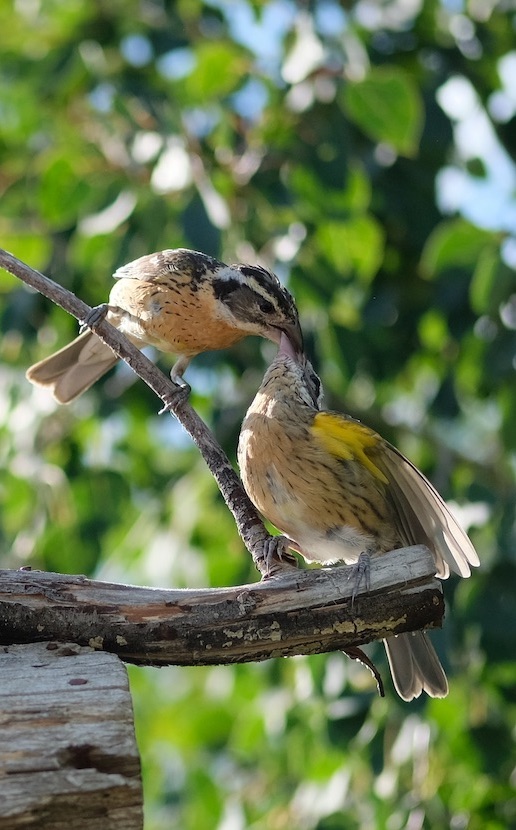


Black-headed Grosbeak vs Rose-breasted Grosbeak (Pheucticus melanocephalus vs Pheucticus ludovicianus): The Complete Backyard Identification Guide
Quick Answer: The Fastest Way to Tell Them Apart
The two Pheucticus grosbeaks split the continent between them. Three rules:
- Check the map first: west of the Great Plains it is a Black-headed; east of the Plains it is a Rose-breasted. Range alone settles most sightings.
- Male breast: rich orange-cinnamon breast and rump = Black-headed; a crisp rose-red triangle on a clean white belly = Rose-breasted.
- Females: nearly identical — Rose-breasted is crisper and whiter with a bolder white eyebrow; Black-headed is buffer and browner. In the Plains, hybrids blur everything.
At-a-Glance Comparison Table
The continental pair, side by side. KEY rows separate fastest.
| Feature | Black-headed Grosbeak | Rose-breasted Grosbeak |
|---|---|---|
| Scientific Name | Pheucticus melanocephalus | Pheucticus ludovicianus |
| Length | 7.1–7.5 in (18–19 cm) | 7.1–8.3 in (18–21 cm) |
| Wingspan | 12.6 in (32 cm) | 11.4–13.0 in (29–33 cm) |
| Weight | 1.2–1.7 oz (34–48 g) | 1.4–1.7 oz (39–49 g) |
| Overall Shape | Stocky songbird with a huge pale triangular bill | Stocky songbird with a huge pale triangular bill |
| Male Plumage KEY | Black head and back, rich orange-cinnamon breast and rump, bold black-and-white wings | Black head and back, clean white belly, and a rose-red triangular breast patch; black-and-white wings |
| Female Plumage KEY | Warm brown with fine streaks, a broad pale eyebrow, and orange-buff underparts; huge pale bill | Brown and crisply streaked with a bold white eyebrow; huge pale bill |
| Bill Shape | Enormous pale-gray triangular seed-and-fruit bill | Enormous pale-horn triangular bill |
| Tail | Medium black tail with white spots visible in flight | Medium black tail with white spots |
| Core Range KEY | Breeds across the western US in open woods and riparian edges; winters mostly in Mexico | Breeds across the eastern and northern US and southern Canada; winters in Central and South America |
| Migration | Long-distance migrant; in the West roughly April–September | Long-distance migrant; eastern feeders see them mainly in May and again in September |
| Feeder Presence | Spring migrants and summer birds visit sunflower and safflower feeders in western yards | May migrants mob sunflower and safflower feeders — a spring highlight in eastern yards |
| Favorite Foods | Sunflower and safflower at feeders; insects, wild fruit and berries in nature | Sunflower, safflower; insects and wild fruit in nature |
| Song KEY | Rich, robin-like warble — faster and more hurried than Rose-breasted | Sweet, mellow, robin-like warble — slower and smoother than Black-headed |
| Flight Call | A sharp, metallic “pik” | A sharp “eek” like a sneaker squeaking on a gym floor |
| Population Trend | Stable and common across the West | Stable; hybridizes with Black-headed where ranges meet in the Plains |
Male Field Marks, Side by Side
Black-headed Grosbeak — Male
- Orange-cinnamon breast (not red) with a black head.
- Bold black-and-white wing patches flash in flight.
- Huge pale bill; orange rump visible as it flies off.
Rose-breasted Grosbeak — Male
- Rose-red triangular patch on a white breast, black head above.
- Striking black-and-white wings; rose wing-linings flash in flight.
- Huge pale bill; clean white belly below the red.
Female & Juvenile Marks, Side by Side
Black-headed Grosbeak — Female
- Warm brown, finely streaked, with a broad pale eyebrow.
- Orange-buff wash below; enormous pale bill gives it away.
- Nearly identical to female Rose-breasted — use range and the buffer, browner tones.
Rose-breasted Grosbeak — Female
- Brown with crisp streaks and a bold white eyebrow.
- Huge pale bill; white throat framed by darker streaks.
- Whiter, crisper look than the buffer female Black-headed.
Part-by-Part Anatomy Breakdown
In the Great Plains contact zone, use every field mark — single characters can come from either parent in hybrids:
| Body Part | Black-headed Grosbeak | Rose-breasted Grosbeak |
|---|---|---|
| Breast (M) | Orange-cinnamon, blending into the belly | Rose-red triangle ending sharply on white |
| Belly (M) | Orange-buff | Clean white |
| Rump (M) | Orange | White, flecked |
| Back (M) | Black, streaked with cinnamon | Solid black |
| Wing Bars (M) | White, often buff-tinged | Pure white |
| Eyebrow (F) | Broad, buff-colored | Bold, crisp white |
| Underparts (F) | Warm buff with fine streaks | Whiter with crisper, darker streaks |
Song & Call Comparison
Black-headed Grosbeak
Song: a rich, robin-like warble, noticeably faster and more hurried than a Rose-breasted Grosbeak’s.
Calls: a sharp, metallic pik.
Rose-breasted Grosbeak
Song: a sweet, mellow, robin-like warble — like a robin that took singing lessons; slower than Black-headed.
Calls: a sharp squeaky eek, like a sneaker on a gym floor.
Range & Seasonal Presence
The Black-headed Grosbeak breeds across the western US — open woods, riparian corridors and mountain valleys — and winters mainly in Mexico.
The Rose-breasted Grosbeak breeds across the eastern and northern US and southern Canada and winters in Central and South America; eastern feeders see them mostly during May migration.
The ranges meet along the Great Plains, where the two species hybridize regularly — mid-continent birds can show intermediate breast color, belly pattern and song.
Feeder Behavior & Favorite Foods
- Black-headed Grosbeak: western yards see them at sunflower and safflower feeders from spring migration through summer; pairs sometimes visit together.
- Rose-breasted Grosbeak: an eastern spring-migration highlight — May flocks drop onto sunflower and safflower feeders for days before moving on; fewer stay to breed near yards.
- Best foods for both: black oil sunflower and safflower on a hopper or platform with sturdy perches — their huge bills handle the biggest seeds with ease.
- Water: both visit birdbaths daily in breeding season; a dripping fountain in a shaded corner is reliable in May and June.
Temperament & Flock Behavior
Black-headed Grosbeaks are deliberate, calm feeder visitors; males sing their hurried warbles from mid-canopy in western oaks and cottonwoods.
Rose-breasted Grosbeaks behave the same way in the East — tame and approachable at feeders during May, singing their slower, sweeter warble from tall hardwoods.
6-Step Backyard ID Checklist
- Check the map. West = Black-headed; East = Rose-breasted; the Plains = look carefully.
- Male breast color. Orange-cinnamon = Black-headed. Rose-red triangle = Rose-breasted.
- Male belly. Orange-washed = Black-headed. Clean white = Rose-breasted.
- Female eyebrow. Bold crisp white = Rose-breasted; broader, buffer = Black-headed.
- Song tempo. Hurried, fast warble = Black-headed; slow, sweet warble = Rose-breasted.
- In the Plains, accept “hybrid”. Mixed breast tones and intermediate patterns are common in the contact zone.
Frequently Asked Questions
- Range First: West = Black-headed; East = Rose-breasted; Plains = scrutinize or expect hybrids.
- Male Breast: Orange-cinnamon = Black-headed; rose-red triangle on white = Rose-breasted.
- Male Belly: Orange-washed vs clean white — the fastest secondary check.
- Female Rule: Bold white eyebrow and crisp streaks = Rose-breasted; buff and blurry = Black-headed.
- Song Tempo: Fast and hurried = Black-headed; slow and sweet = Rose-breasted.
- Hybrid Zone: Intermediate birds in the Plains are real — document and enjoy them.