
Black-headed Grosbeak vs Western Tanager
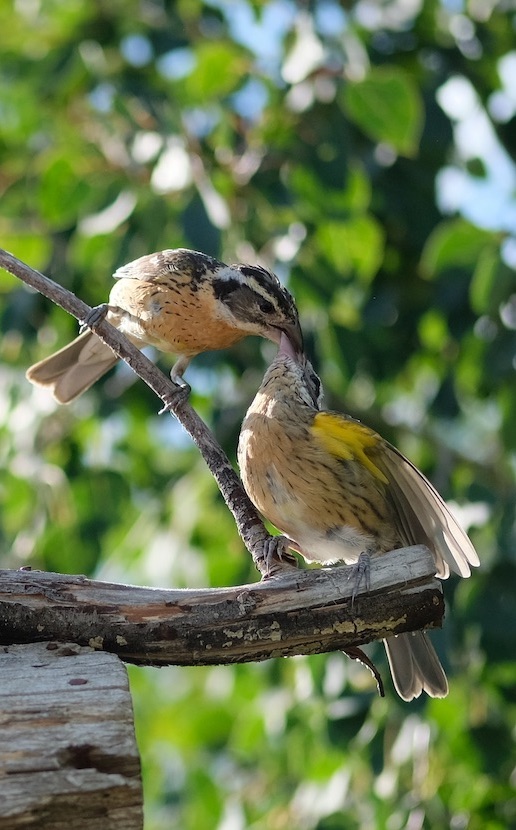


Black-headed Grosbeak vs Western Tanager (Pheucticus melanocephalus vs Piranga ludoviciana): The Complete Backyard Identification Guide
Quick Answer: The Fastest Way to Tell Them Apart
The two orange-and-yellow songbirds of western woods. Three rules:
- Head: black head = grosbeak; red head = tanager.
- Bill: a huge pale seed-crusher = grosbeak; a medium gray bill = tanager.
- Body: orange breast fading to yellow belly = grosbeak; yellow body with black wings = tanager.
At-a-Glance Comparison Table
The seed-crusher and the flame-head, side by side. KEY rows separate fastest.
| Feature | Black-headed Grosbeak | Western Tanager |
|---|---|---|
| Scientific Name | Pheucticus melanocephalus | Piranga ludoviciana |
| Length KEY | 7.1–7.5 in (18–19 cm) | 7.3 in (18.5 cm) |
| Wingspan | 12.6 in (32 cm) | 11.4 in (29 cm) |
| Weight | 1.2–1.7 oz (34–48 g) | 0.8–1.3 oz (23–37 g) |
| Overall Shape | Stocky songbird with a huge pale triangular bill | Stocky songbird with a thick bill and two wing bars |
| Male Plumage KEY | Black head and back, rich orange-cinnamon breast and rump, bold black-and-white wings | Flame-red head, bright yellow body, black wings with yellow wing bars, black tail |
| Female Plumage | Warm brown with fine streaks, a broad pale eyebrow, and orange-buff underparts; huge pale bill | Yellow-gray below, olive-gray above, with two pale wing bars |
| Bill Shape | Enormous pale-gray triangular seed-and-fruit bill | Thick, pale, slightly hooked |
| Tail | Medium black tail with white spots visible in flight | Black (male) or olive (female), medium length |
| Core Range KEY | Breeds across the western US in open woods and riparian edges; winters mostly in Mexico | Western conifer and mixed forests; breeds from the Rockies to the Pacific, winters in Mexico and Central America |
| Migration | Long-distance migrant; in the West roughly April–September | Long-distance migrant; passes through western yards in May and September |
| Feeder Presence | Spring migrants and summer birds visit sunflower and safflower feeders in western yards | Migrants visit orange halves, grape jelly and suet; breeding birds stay in the canopy |
| Favorite Foods | Sunflower and safflower at feeders; insects, wild fruit and berries in nature | Insects, wild fruit; oranges and jelly at feeders during migration |
| Song KEY | Rich, robin-like warble — faster and more hurried than Rose-breasted | A robin-like series of short phrases with a distinctive burry quality |
| Flight Call | A sharp, metallic “pik” | A dry “pit-r-ik” |
| Population Trend | Stable and common across the West | Stable across western forests |
Male Field Marks, Side by Side
Black-headed Grosbeak — Male
- Orange-cinnamon breast (not red) with a black head.
- Bold black-and-white wing patches flash in flight.
- Huge pale bill; orange rump visible as it flies off.
Western Tanager — Male
- Flame-red head (the only western tanager with one).
- Yellow body, black wings with yellow bars.
- Breeds in conifers; migrants drop into yards.
Female & Juvenile Marks, Side by Side
Black-headed Grosbeak — Female
- Warm brown, finely streaked, with a broad pale eyebrow.
- Orange-buff wash below; enormous pale bill gives it away.
- Nearly identical to female Rose-breasted — use range and the buffer, browner tones.
Western Tanager — Female
- Yellow-gray with two pale wing bars.
- Bigger-billed than any warbler; calmer than an oriole.
- Often travels with western warbler flocks in migration.
Part-by-Part Anatomy Breakdown
Every part offers a check:
| Body Part | Black-headed Grosbeak | Western Tanager |
|---|---|---|
| Male Head | Black | Red, flame-orange in shadow |
| Bill | Huge, pale, triangular | Medium, gray, pointed |
| Body | Orange breast, yellow belly | Yellow body |
| Wings | Black with bold white patches | Black with yellow wing bars |
| Female | Brown-buff with bold head stripes | Yellow-gray with two wing bars |
| Song | Rich flowing warble, like a smooth robin | Short robin-like phrases, burry |
| Call | A sharp “spik” | A dry “pit-er-ick” |
Song & Call Comparison
Black-headed Grosbeak
Song: a rich, robin-like warble, noticeably faster and more hurried than a Rose-breasted Grosbeak’s.
Calls: a sharp, metallic pik.
Western Tanager
Song: robin-like phrases with a burry, rough edge — “a robin with a sore throat”.
Calls: a dry pit-r-ik.
Range & Seasonal Presence
The Black-headed Grosbeak breeds in open western woods, streamside groves and yards, migrating to Mexico for winter.
The Western Tanager breeds in conifer and mixed forests across the West, wintering in Central America. Both visit the same western feeders in May — oranges out, sunflower stocked.
Feeder Behavior & Favorite Foods
- Black-headed Grosbeak: black-oil sunflower at hopper and platform feeders.
- Western Tanager: orange halves and grape jelly in migration; suet and mealworms too.
- Migration trick: put orange halves out in late April — passing tanagers stop.
- Winter: both leave the U.S.; feeders quiet down.
Temperament & Flock Behavior
Black-headed Grosbeaks are calm feeder citizens — cracking seeds deliberately and singing rich warbles from mid-canopy.
Western Tanagers are forest gems — foraging high in conifers, dropping to water and oranges during migration.
6-Step Backyard ID Checklist
- Head. Black = grosbeak; red = tanager.
- Bill. Huge and pale = grosbeak; gray = tanager.
- Body. Orange breast = grosbeak; yellow body = tanager.
- Wings. White patches = grosbeak; yellow bars = tanager.
- Call. “Spik” = grosbeak; “pit-er-ick” = tanager.
- Female. Striped head = grosbeak; yellow-gray with wing bars = tanager.
Frequently Asked Questions
- Head: Black = grosbeak; red = tanager.
- Bill: Huge pale = grosbeak; gray = tanager.
- Body: Orange breast = grosbeak; yellow body = tanager.
- Wings: White patches = grosbeak; yellow bars = tanager.
- Feeders: Sunflower = grosbeak; oranges = tanager.
- Call: “Spik” = grosbeak; “pit-er-ick” = tanager.