
Black-capped Chickadee


Black-capped Chickadee (Poecile atricapillus): Complete Identification, Feeder Guide & Song Library
Quick Answer: How to Attract & Identify Black-capped Chickadees
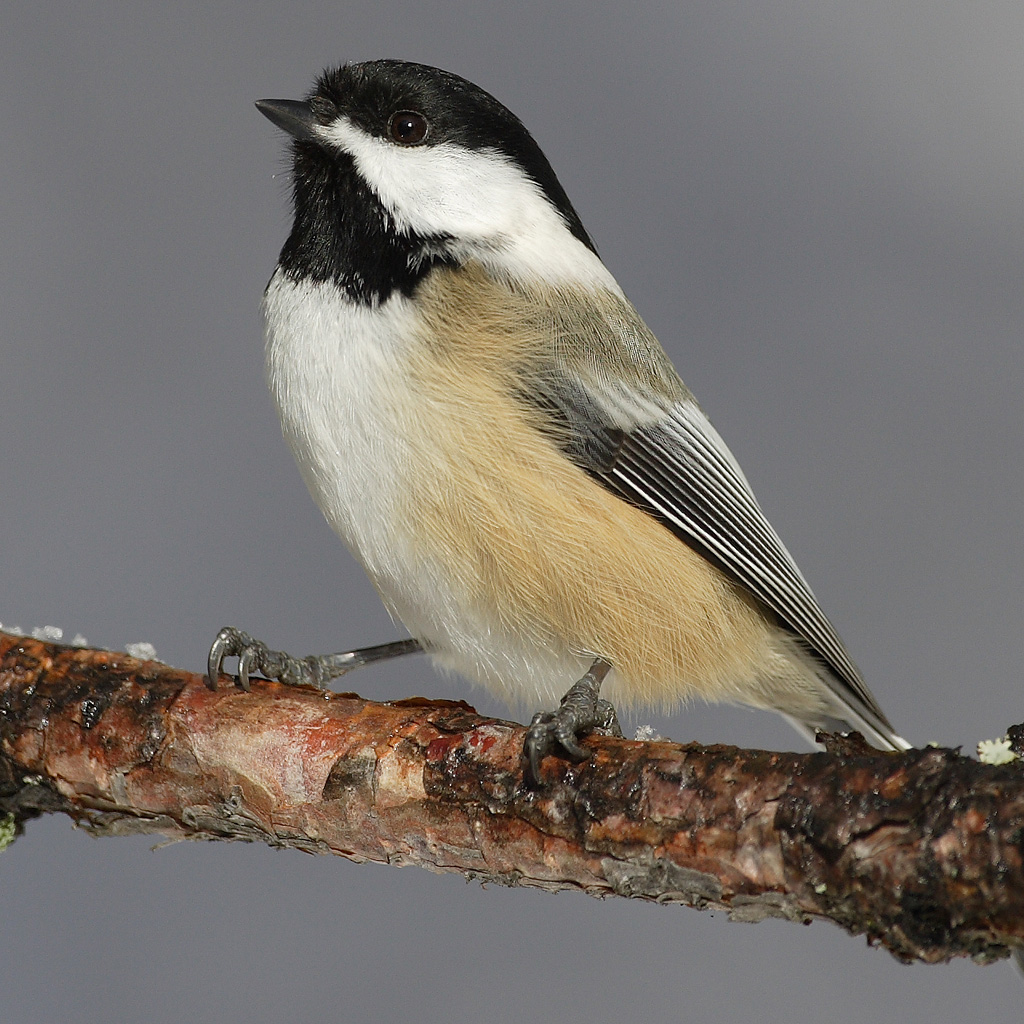
The Black-capped Chickadee (Poecile atricapillus) is a tiny, big-headed songbird recognized instantly by its solid black cap and bib framing bright white cheeks, set against a soft gray back and buffy flanks. It measures just 4.7–5.9 inches and weighs less than half an ounce. This is a non-migratory year-round resident of the northern United States, the Midwest, Alaska, and most of Canada — and the state bird of both Maine and Massachusetts. Its namesake “chick-a-dee-dee-dee” call and clear whistled “fee-bee” song make it one of the easiest backyard birds to learn by ear. Attract chickadees with black oil sunflower seeds, peanut pieces, and suet in a tube feeder placed near tree cover — then expect acrobatic grab-and-go visits, winter flocks, and, with a little patience, birds tame enough to take seed from your open hand.
Species Physical Profile & Morphometrics
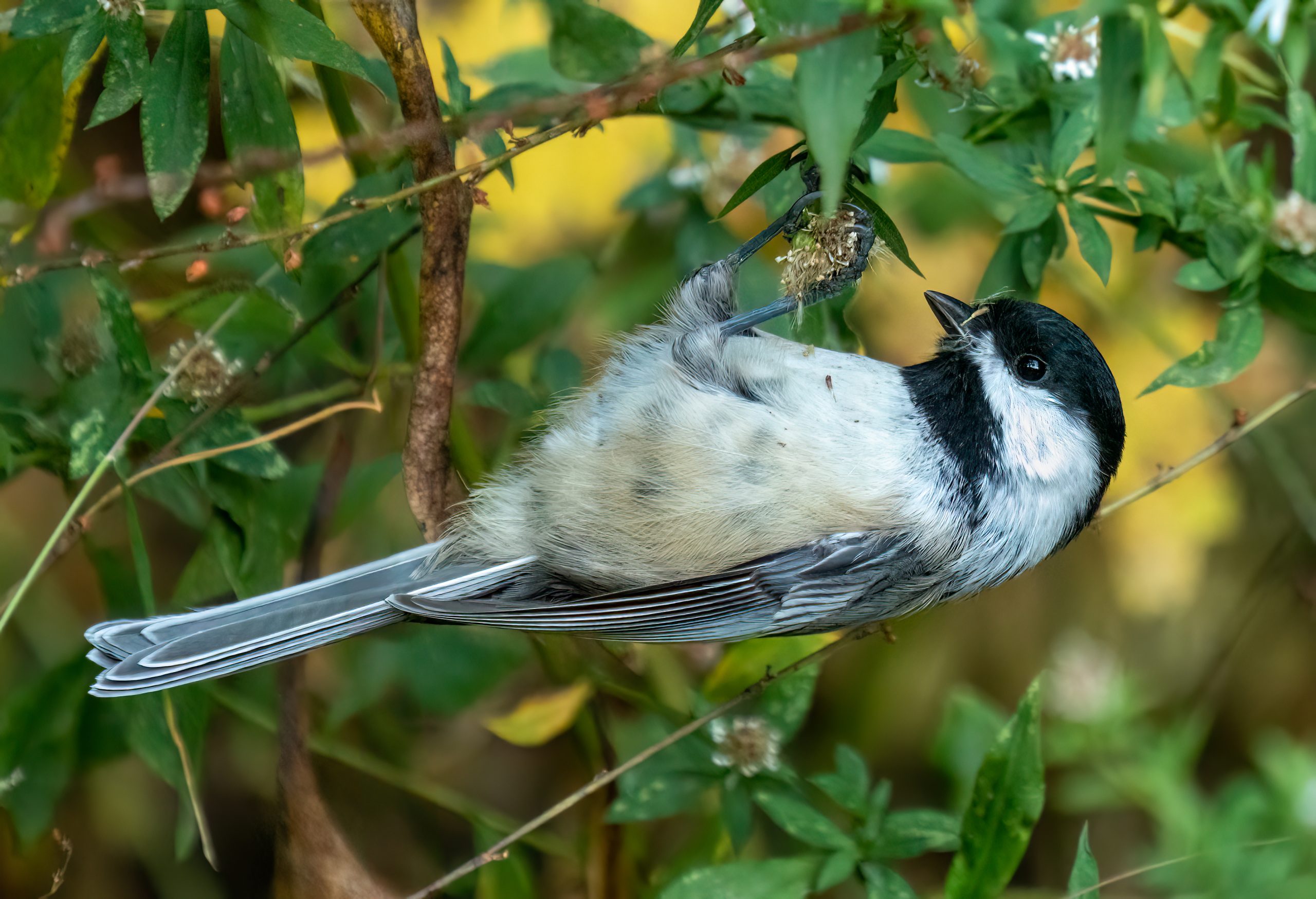
The Black-capped Chickadee has an oversized round head, tiny bill, plump body, and long narrow tail, and it moves with restless, acrobatic energy — hitching along twigs and routinely hanging upside down to pluck insects and seeds other birds cannot reach. It is a member of the tit family (Paridae) and one of the most widespread and familiar birds in North America.
When confirming an identification in the overlap zone of the eastern US, rule out the Carolina Chickadee (slightly smaller, with a duller, more ragged bib edge and a slower four-note song). In the western mountains, the Mountain Chickadee shows a bold white eyebrow stripe that the Black-capped always lacks.
Essential Morphometric Field Marks:
- Body Length & Mass: Averages 4.7 to 5.9 inches (12–15 cm) with an adult mass of only 0.32 to 0.49 ounces (9–14 grams) — one of the smallest birds at any North American feeder.
- Wingspan: Measures 6.3 to 8.3 inches (16–21 cm), with gray wings whose flight feathers carry crisp white edging.
- Bill Structure & Color: A short, stubby, solid black bill — small but strong enough to hammer open sunflower seeds held under one foot.
- Color Pattern: Black cap and bib, bright white cheeks, soft gray back, wings and tail, whitish belly, and buffy (tan-washed) flanks that are richest in fresh fall plumage. Males and females look identical.
Crisp jet-black cap and bib with clean edges, brilliant white cheek patch, cool gray upperparts, and flanks washed with warm buff. Male and female adults are visually indistinguishable — even in the hand, size is the only subtle clue.
Summer juveniles look like fluffier, duller adults: the black cap and bib appear sooty and loose-textured, the cheek patch is creamy rather than bright white, and the overall plumage has a soft, grayish-brown cast until the first fall molt.
Black-capped Chickadee Vocalization Guide (4 Field Recordings)
Few backyard birds are easier to learn by ear: the whistled “fee-bee” song and the “chick-a-dee-dee-dee” call that names the bird cover most of what you will hear. All four recordings below are real field audio hosted on Wikimedia Commons, recorded by Jonathon Jongsma (mirrored from xeno-canto) — no simulations. For a deeper library, browse xeno-canto: Black-capped Chickadee.
1. Whistled “Fee-Bee” Song
2. “Chick-a-Dee-Dee-Dee” Contact Call
3. Gargle Call
4. Scolding Alarm
Habitat, Range & Year-Round Resident Biology
Black-capped Chickadees live in deciduous and mixed woodland, forest edges, willow thickets, parks, and leafy suburbs — almost anywhere with trees. Their range blankets Alaska and most of Canada and covers the northern half of the United States, from New England through the Midwest and along the Appalachians and northern Rockies. The nest-excavating bird in our gallery was photographed in Waterville, Maine — one of two states (with Massachusetts) that claim the chickadee as their state bird.

Residents That Tough Out the Winter
Unlike the irruptive finches, Black-capped Chickadees do not migrate — the same banded individuals may defend the same few acres for years. From October onward they band together in winter flocks with strict social hierarchies, often joined by nuthatches, titmice, kinglets, and Downy Woodpeckers that rely on the chickadees’ sharp alarm calls.
A yard with mature trees, a brushy edge, and a reliable feeder can hold the same chickadee flock twelve months a year. Watch for their daily rhythm: a dawn rush at the feeder, midday foraging through bark and twigs, and a last hard feeding push before dusk.
Backyard Behavioral Patterns & Social Dynamics
Chickadees pack more survival intelligence into 12 grams than almost any other backyard bird. Four signature behaviors explain most of what you will observe:
🧠 A Brain That Grows for Winter
Each autumn, chickadees cache thousands of seeds and insects in bark crevices and needle clusters — and the memory center of the brain, the hippocampus, actually expands in fall to keep track of the hiding places. Individual cache locations can be recalled accurately for weeks.
🌡️ Surviving the Night by Chilling Down
On bitter nights, a chickadee enters regulated hypothermia, dropping its body temperature roughly 10–12°F below normal daytime levels to conserve precious fat. It roosts alone in a tree cavity, dense conifer, or old nest hole — one reason standing dead trees and nest boxes matter in winter.
🚨 The “Dee” Danger Code
The chick-a-dee-dee-dee call is a living alarm system: the more “dee” notes tacked on, the greater the perceived threat. A perched pygmy-owl earns a long string of dees, and nuthatches, titmice, and woodpeckers all eavesdrop on — and join — the chickadee mob.
🪵 Do-It-Yourself Cavity Nesters
Pairs excavate their own nest hole in soft, rotting wood — as the Maine photo in our gallery shows — then line it with moss, fur, and plant down. They readily adopt nest boxes stocked with wood shavings, and in winter they reuse cavities as life-saving overnight roosts.
Problem: Why Chickadees Snatch One Seed and Disappear
Most yards already have chickadees nearby — the real frustration is fleeting, two-second visits or none at all. The usual reasons:
First, chickadees are hard-wired grab-and-go diners: each bird takes a single seed and dashes to a branch to hammer it open or hide it. A feeder hanging in the middle of an open lawn, far from cover, forces a 12-gram bird into the open for too long — and it simply will not risk it. Second, at crowded hopper feeders they are physically bullied by Blue Jays, grackles, and starlings many times their size. Third, stale or filler-padded seed fails inspection — a bird that caches food for weeks checks every kernel, and dusty grocery blends with milo get rejected outright. Fix cover, competition, and freshness, and the two-second visits turn into all-day traffic.
Method 1: Build Stations That Match the Grab-and-Go Style
Design for a tiny, acrobatic bird that eats one seed at a time — in cover, not in the open:
-
Hang a Tube or Mesh Feeder with Small Perches
A squirrel-resistant tube feeder with short perches suits chickadees perfectly — they cling, hang upside down, and extract seeds through mesh with ease, while big bully birds struggle. Our lab-tested roundup of the Best Tube Feeders for Small Birds compares proven models.
-
Place It Within 10 Feet of Trees or Shrubs
Chickadees commute between feeder and cover on every single trip. A station one quick dash from a tree or dense shrub gets heavier, calmer traffic than the same feeder in open lawn — and it gives the flock an escape route from hawks.
-
Offer Fresh Seed in Small, Topped-Up Doses
Fill with less seed, more often. Chickadees inspect kernels before taking them, and a feeder kept perpetually fresh outperforms a large one allowed to go musty — especially in wet fall weather.
-
Add a Suet Cage for Winter Calories
A hanging suet cage near the seed tube gives the flock concentrated fat for surviving subzero nights. Expect chickadees to alternate between sunflower and suet all winter long.
Method 2: Stock the Year-Round Chickadee Pantry
Match the menu — and the real estate — to a caching resident that never leaves:
-
Lead with Black Oil Sunflower and Peanut Pieces
Thin-shelled black oil sunflower is the undisputed favorite — high fat, easy to hammer open, ideal for caching. Unsalted peanut pieces and sunflower chips are close runners-up. Skip blends padded with milo and wheat.
-
Hang a Nest Box with Wood Shavings in Early Spring
A box with a 1-1/8-inch entrance hole, mounted 5–15 feet up at the woodland edge, often gets claimed by March. Add a layer of wood shavings — chickadees strongly prefer to finish “excavating” the box themselves rather than move into a bare one.
-
Keep Water Available in Every Season
A shallow bath — heated in northern winters — pulls chickadees down for quick drinks between foraging runs. See the Best Heated Bird Baths for winter-proof options.
-
Grow Native Trees and Skip the Pesticides
In summer, chickadees raise their young almost entirely on caterpillars and insects. Native oaks, birches, and willows host the most caterpillars, and a pesticide-free yard keeps that protein pipeline flowing to the nest box.
Tool Solution: Recommended Hardware for Black-capped Chickadees
Equipment sized for the smallest — and smartest — regular at your feeder:
Squirrel-Resistant Tube Feeder
Weight-activated ports and short perches that favor acrobatic chickadees while shutting out squirrels and oversized bully birds.
- • Capacity: 2 lbs Black Oil Sunflower
- • Ports: 4–6 metal-reinforced feeding ports
- • Mount: Hang or 1-inch pole mount
Black Oil Sunflower + Peanut Pieces
Thin-hulled, high-fat kernels plus protein-rich peanut bits — the exact foods chickadees prefer to eat and to cache.
- • Purity: No milo or wheat filler
- • Kernel Ease: Thin shells, one-hammer open
- • Cache-Ready: Stores dry for weeks
Chickadee Nest Box (1-1/8″ Entry)
Cedar box sized for Paridae, with a predator-excluding 1-1/8-inch entrance — add wood shavings and let the pair finish the excavation.
- • Entrance: 1-1/8 in (28 mm) round hole
- • Floor: 4 × 4 in interior
- • Mount: 5–15 ft at woodland edge
Frequently Asked Questions
- Species Profile: The Black-capped Chickadee (Poecile atricapillus) is a 4.7–5.9 inch, sub-half-ounce songbird with a black cap and bib, white cheeks, and buffy flanks; males and females look identical.
- Year-Round Resident: It does not migrate — the same flock holds your neighborhood all year across the northern US, Midwest, Alaska, and Canada; it is the state bird of Maine and Massachusetts.
- Feeder Formula: A tube feeder with black oil sunflower and peanut pieces, placed within 10 feet of cover, plus a suet cage in winter — kept consistently stocked.
- Vocal Code: The “chick-a-dee-dee-dee” call encodes threat level in its number of “dee” notes; the song is a clear two-note whistled “fee-bee.”
- Memory & Survival: The brain’s hippocampus expands each fall to track thousands of cached seeds, and regulated hypothermia carries the bird through subzero nights.
- Nesting & Tameness: Pairs excavate their own cavity in rotting wood and accept nest boxes with wood shavings; with patience, chickadees will take seed from an open hand.
Bird Watching Log
Species: Black-capped Chickadee (Poecile atricapillus)
| Black-capped Chickadee (Subspecies / Notes: ____________________________) | |