
White-breasted Nuthatch


White-breasted Nuthatch (Sitta carolinensis): Complete Identification, Feeder Guide & Call Library
Quick Answer: How to Attract & Identify White-breasted Nuthatches
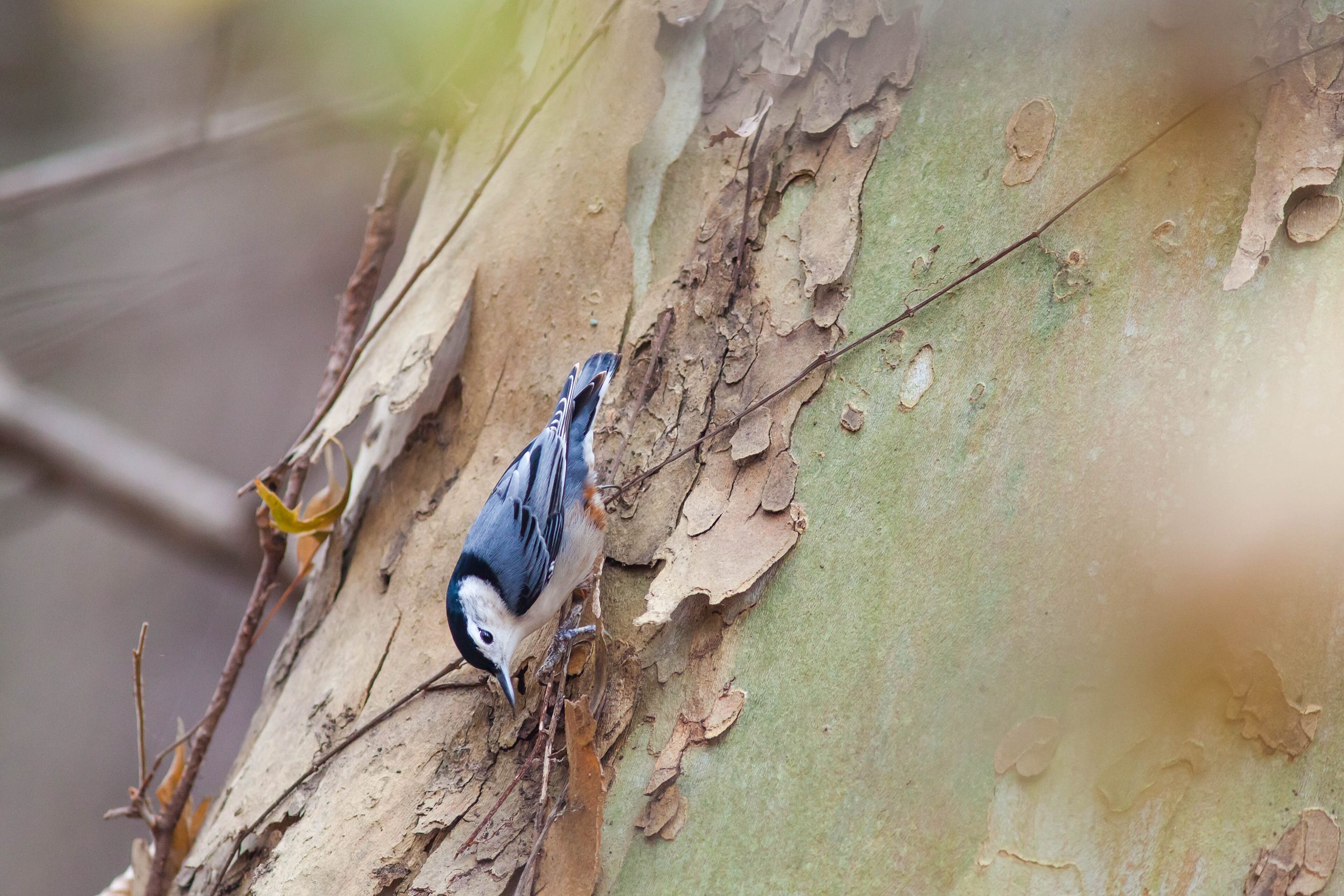
The White-breasted Nuthatch (Sitta carolinensis) is the largest nuthatch in North America — a 5.1–5.5-inch, blue-gray acrobat with a white face and breast, a black cap (grayer on females), a long straight chisel bill, and almost no tail. Its signature is unmistakable: it walks headfirst down tree trunks, propped only by oversized feet. A non-migratory year-round resident of deciduous woods and mature-treed yards across most of the country, it announces itself with a nasal “yank-yank” and a rapid spring song of “whi-whi-whi” notes. Attract the resident pair with suet, whole or shelled peanuts, and black oil sunflower hung near mature trees — expect grab-and-go visits as seeds get wedged into bark and hacked open.
Species Physical Profile & Morphometrics
The White-breasted Nuthatch is the largest of North America’s four nuthatches — stocky, big-headed, short-tailed, and built around two oversized tools: a chisel-straight bill for prying bark, and long-toed, strong-clawed feet that grip bark without any help from the tail. Woodpeckers and creepers brace with their tails; this bird simply hangs on and walks down headfirst.
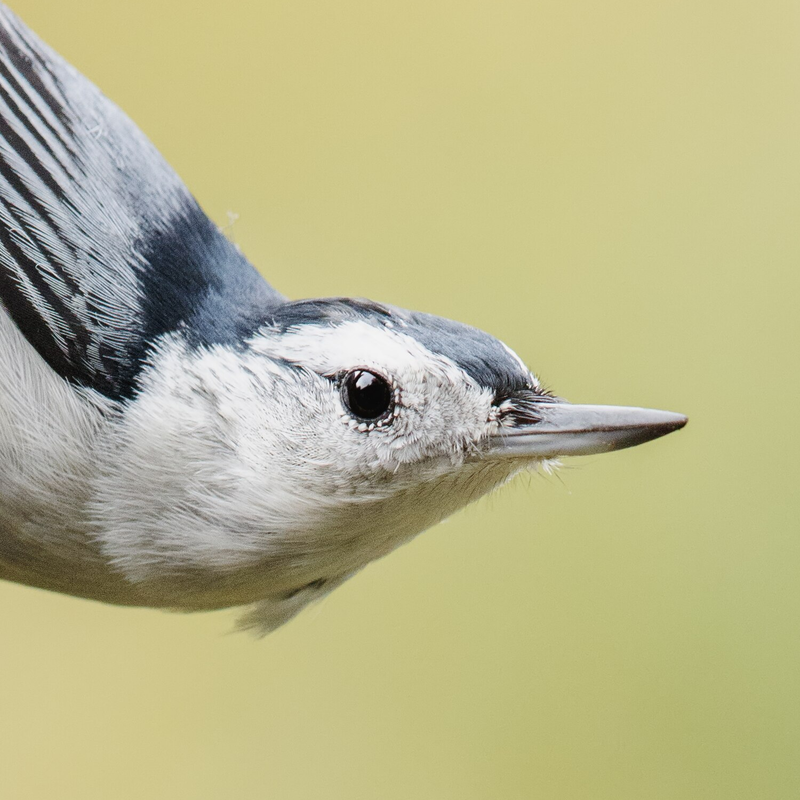
In the field, the pattern is crisp: blue-gray above, clean white face and underparts, chestnut-rust under the stubby tail. Sexing takes a careful look at the cap — jet black and glossy on males, softer gray-black on many females, especially in the interior West. The white of the face wraps up and around the eye, so the dark cap stands out like a hood.
Essential Morphometric Field Marks:
- Body Length & Mass: Averages 5.1 to 5.5 inches (13–14 cm) with an adult mass of 0.6 to 1.1 ounces (18–30 grams) — the heavyweight of the continent’s nuthatches.
- Wingspan: 7.9 to 10.6 inches (20–27 cm), with short rounded wings built for quick dashes between trunk and feeder.
- Bill Structure & Color: A long, straight, slightly upturned chisel bill, dark above and paler at the base — equally good at prying bark flakes and hacking open wedged seeds.
- Color Pattern: Blue-gray upperparts, white face and breast, black or gray-black cap, chestnut undertail coverts, and a short tail marked with white corners that flash in flight.
Glossy jet-black cap wrapping from the bill over the crown to the nape, set off by the bright white face. The blue-gray back is crisply contrasted, and the chestnut under the tail runs rich and deep.
Same pattern in softer focus: the cap is often gray-black rather than jet black (most reliably so in interior Western populations), and the underparts can carry a slightly buffier wash. Eastern females can look nearly black-capped — behavior and the spring duet are surer clues there.
White-breasted Nuthatch Vocalization Guide (3 Field Recordings)
Two sounds cover most of what this species says: the year-round nasal “yank-yank” — a tiny toy-horn of a call that betrays the bird long before you spot it — and the male’s spring song, a rapid series of low whistled “whi-whi-whi” notes on an even pitch. All three cards below are real field recordings with commercial-use licenses, hosted on Wikimedia Commons.
1. Spring Song — “Whi-Whi-Whi”
2. Nasal “Yank-Yank” — Foraging Calls
3. Calls at Close Range — North Carolina
Habitat, Range & Year-Round Resident Biology
White-breasted Nuthatches are birds of mature deciduous and mixed woodland — oak, maple, hickory, and beech forest, wooded river corridors, orchards, and shady older neighborhoods with big trees. The year-round range covers most of the United States and southern Canada, from the Atlantic to the Pacific, and runs south into the highlands of Mexico — matching the map’s broad green band almost tree-for-tree.

A Homebody with a Standing Reservation
These birds never migrate. A mated pair defends the same patch of woodland in every season, roosting overnight in tree cavities and spending cold nights fluffed up out of the wind. The nuthatch at your January suet cage is very likely half of the pair that will nest within earshot come April.
A yard with one or two mature trees, a suet cage, and sunflower or peanuts fits the whole annual budget. In winter the pair often travels with mixed flocks of Black-capped Chickadees, Tufted Titmice, and Downy Woodpeckers — where those birds thrive, this one follows.
Backyard Behavioral Patterns & Social Dynamics
Nuthatches turn tree bark into a three-dimensional highway. Four signature behaviors explain most of what you will observe:
🧗 The Headfirst Specialist
The only common backyard bird that walks down trunks headfirst — hitching downward in short jerky hops, propped by huge feet and never by the tail. From that angle it spots insects in crevices that upward-climbing creepers and woodpeckers miss.
🔨 Wedge & Hack
The name says it: a nuthatch wedges a nut or seed into a bark crevice and hacks it open with its chisel bill — “nut-hack.” Watch a bird leave your feeder with one sunflower seed and you are watching the first step of the ritual.
💾 The Cacher
Surplus seeds get tucked into bark crevices and covered with a flake of bark or lichen for later retrieval — a scatter-hoarding habit that carries the pair through lean weeks. One bird can stash hundreds of seeds in a good autumn.
🧹 The Bill-Sweeper
At the nest, pairs perform a strange ritual: sweeping a crushed insect around the cavity entrance with the bill — a chemical “do not enter” sign thought to discourage squirrels and other nest rivals.
Problem: Why Nuthatches Visit Once — Then Vanish for Weeks
The familiar report runs: “a nuthatch found my feeder, took one seed, and I haven’t seen it since.” The reasons are predictable:
First, this species is a grab-and-go forager: one seed per visit is normal, not a snub — the bird is flying off to wedge, hack, or cache it. Second, the menu matters: cheap mixes heavy in milo and cracked corn get a single inspection and a permanent pass; this bird shops for suet, peanuts, and black oil sunflower. Third, anchor trees matter: a feeder hanging in the open, far from any trunk the bird can work, asks a bark-forager to feed in mid-air with no escape route — most yards with no mature tree within a short dash simply never make the territory’s daily circuit. Put the right food beside real bark and the pair will add you to the route for good.
Method 1: Set the Table — Suet, Peanuts & Seeds
Design for a bark-clinging acrobat that eats one item at a time:
-
Hang a Suet Cage Near the Trunk
A wire suet cage stocked with a nut or insect blend is the fastest way to win a nuthatch’s loyalty — clingable on every face, just like bark. Our lab-tested roundup of the Best Suet Feeders & Cakes compares proven models.
-
Offer Peanuts, Whole or Shelled
Unsalted peanuts — in the shell on a platform, or chopped in a mesh feeder — are premium nuthatch fare: high-fat, wedgeable, and cacheable. Expect each peanut to leave the yard one at a time, carried like a trophy.
-
Anchor with Black Oil Sunflower
A hopper or tube feeder filled with black oil sunflower covers the daily staple. Thin shells suit the hacking bill perfectly. See the seed-buying breakdown in our Sunflower Seeds for Birds Guide.
-
Keep Water Available Year-Round
A shallow bird bath near tree cover rounds out the station. In freezing months a heated bird bath keeps the pair coming when every puddle is locked in ice.
Method 2: Keep Them Year-Round — Mature Trees & Cavities
Turn a visiting pair into permanent residents:
-
Protect Mature Trees & Safe Snags
Big, barky, older trees are the species’ whole world — feeding ground, nest site, and winter roost in one. Where safety allows, leave dead limbs and standing snags: natural cavities are the scarcest resource in a tidy yard.
-
Hang a Nest Box in Late Winter
A box with a 1-1/4-inch entrance hole mounted 12–20 feet up on a mature tree is prime real estate by March. Leave it up all year — it doubles as a cold-weather roost.
-
Offer Nesting Fibers in Spring
The female lines the cavity with bark strips, grass, hair, and feathers. A small wire cage of clean pet fur hung near the box gets raided strand by strand as nest-building starts.
-
Feed Through Every Season
Because the pair never leaves its territory, summer reliability matters as much as winter. Keep suet and sunflower stocked and skip pesticides, so the bark stays full of the insects that feed the nestlings.
Tool Solution: Recommended Hardware for White-breasted Nuthatches
Equipment matched to a trunk-clinging, seed-caching resident:
Hanging Suet Cage
Clingable on every face like natural bark — the fastest loyalty-builder in the lineup. Stock with nut or insect blends.
- • Cake: Nut or insect blend
- • Access: Clingable wire mesh
- • Mount: Hook near a mature trunk
Platform Feeder + Peanuts
Whole in-shell or shelled peanuts on a roomy platform — grab-and-go service for a bird that carries every prize off to a bark crevice.
- • Nuts: Unsalted, whole or shelled
- • Seeds: Black oil sunflower
- • Drainage: Screened floor
Nuthatch Nest Box (1-1/4″ Entry)
Cedar box sized for small cavity nesters — mount it high on a mature trunk, add wood shavings, and leave it up all year as a winter roost.
- • Entrance: 1-1/4 in (32 mm) round hole
- • Floor: 4 × 4 in interior
- • Mount: 12–20 ft, on a mature tree
Frequently Asked Questions
- Species Profile: The White-breasted Nuthatch (Sitta carolinensis) is a 5.1–5.5 inch, 18–30 gram songbird — blue-gray above, white-faced below, chestnut under the tail, with a long chisel bill and almost no tail; the largest nuthatch in North America.
- Nationwide Resident: Non-migratory across most of the United States, southern Canada, and the Mexican highlands; mated pairs hold the same territory all year.
- The Headfirst Tell: Walks down trunks headfirst on oversized feet — no tail prop — a field mark no other common backyard bird shares.
- Feeder Formula: Suet, whole or shelled peanuts, and black oil sunflower near mature trees — served grab-and-go style, one item per visit, wedged into bark or cached for later.
- Cavity Nester: Nests in natural cavities, old woodpecker holes, and nest boxes with a 1-1/4-inch entrance; the female lines the cup with bark, hair, and feathers.
- Know the Voice: A nasal, toy-horn “yank-yank” year-round, plus a rapid whistled “whi-whi-whi” spring song — find the bird by ear, then look for the one walking down the trunk.
Bird Watching Log
Species: White-breasted Nuthatch (Sitta carolinensis)
| White-breasted Nuthatch (Cap Color / Behavior: ____________________________) | |