
Hairy Woodpecker



Hairy Woodpecker (Dryobates villosus): Complete Identification, Feeder Guide & Call Library
Quick Answer: How to Attract & Identify Hairy Woodpeckers
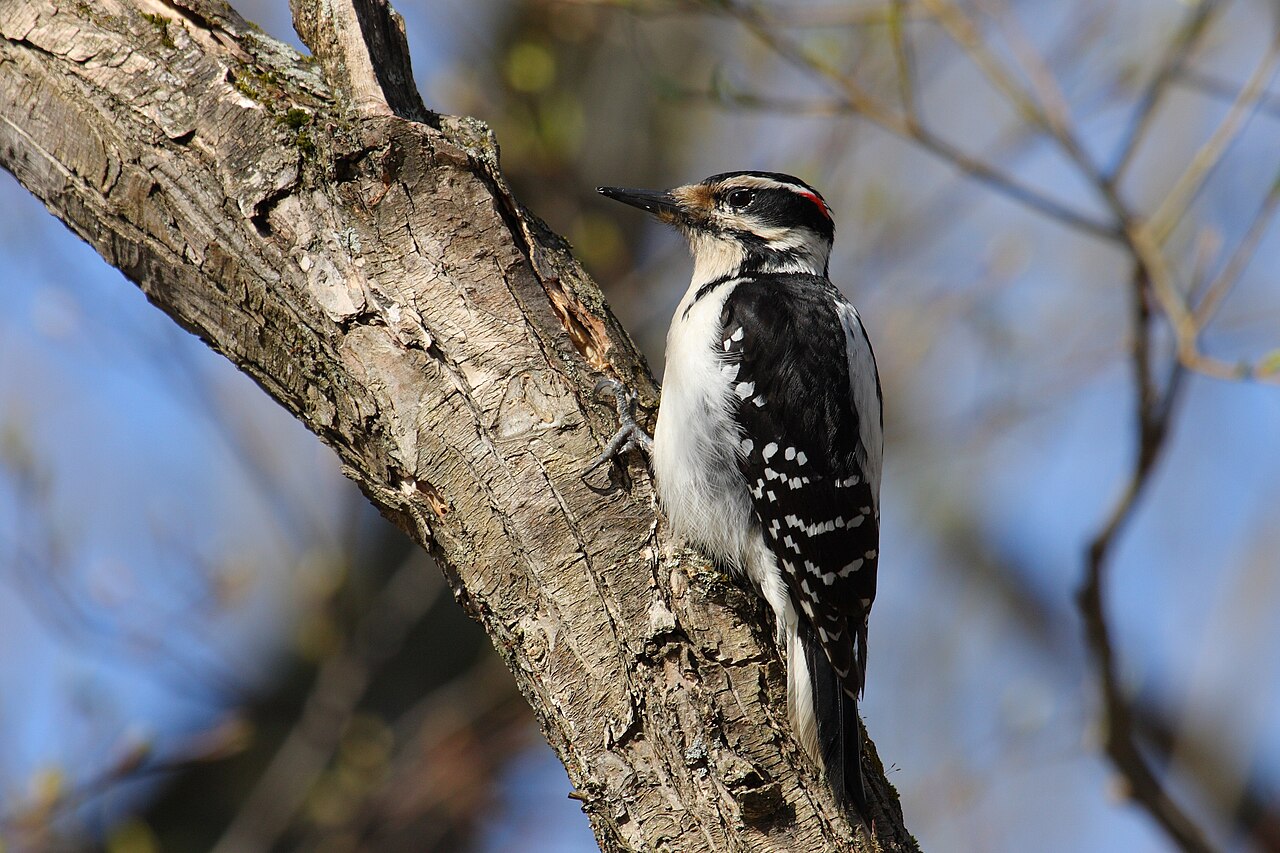
The Hairy Woodpecker (Dryobates villosus) is the robin-sized, long-billed double of the Downy Woodpecker — bold black-and-white plumage, a white stripe down the back, pure unspotted white outer tail feathers, and a chisel bill as long as the head; the male adds a small red patch on the back of the head. A year-round resident of mature woods and big-tree neighborhoods across nearly all of North America, it shares suet stations with the Downy Woodpecker and the White-breasted Nuthatch. To attract it: hang a large or tail-prop suet feeder near mature trees, offer whole peanuts and black oil sunflower, and keep dead limbs standing where safe. Listen for the loud, ringing “peek!”.
Species Physical Profile & Morphometrics
The Hairy Woodpecker belongs to the woodpecker family (Picidae) and is essentially a scaled-up, stronger-billed version of its tiny cousin: zygodactyl feet (two toes forward, two back), a stiff tail braced against bark, and a long, straight chisel bill built for excavating trunks, not just twigs. “Hairy” refers to the fine, hair-like nasal bristles over the bill base.
The identification formula: robin size + bill as long as the head + pure white outer tail feathers, working main trunks and big limbs of mature trees.
Essential Morphometric Field Marks:
- Body Length & Mass: 7.1 to 10.2 inches (18–26 cm) and 1.4 to 3.4 ounces (40–95 grams) — roughly a third longer and up to three times heavier than the Downy Woodpecker.
- Wingspan: about 13.0 to 16.1 inches (33–41 cm), with the same bounding, undulating woodpecker flight.
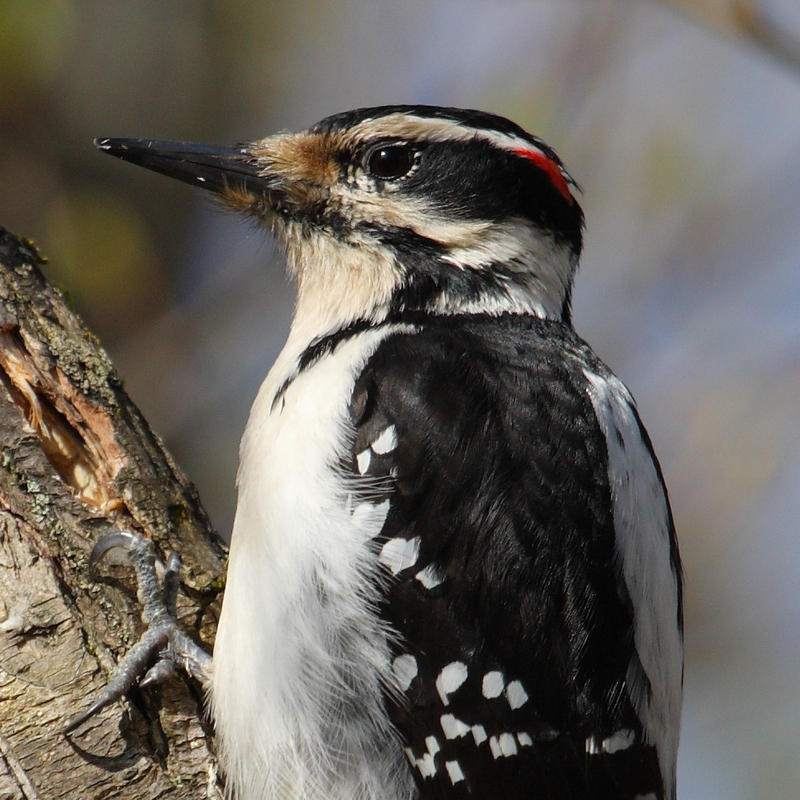
- Bill Structure & Color: A long, straight, powerful chisel bill, about as long as the head is deep — the single best mark against the stubby-billed Downy. Gray-black; fine pale nasal bristles cover the nostrils.
- Color Pattern: Black and white throughout: white underparts, a broad white stripe down the center of the back, black wings checkered with white spots, a striped black-and-white face, and pure white outer tail feathers without spots. The male’s only color is a small red patch on the back of the head.
- Juveniles: Duller than adults, sometimes with a lightly spotted breast; young males may show red toward the crown before the nape.
Red badge, long bill: a small scarlet patch at the back of the head on an otherwise black-and-white bird. In late winter he advertises with a fast, rolling drum on resonant dead wood — about twenty-five beats per second — louder and faster than the Downy’s.
Same suit, no red: her head is pure black-and-white stripes. She shares the heavy excavation work — the pair chisels a fresh nest cavity in dead wood each spring — and drums as readily as her mate.
Hairy Woodpecker Vocalization Guide (2 Field Recordings + 1 Simulation)
The Hairy’s everyday voice is a loud, sharp “peek!” — stronger and lower than the Downy’s “pik” — plus a rattling whinny when excited. Its spring advertisement is the drum: a fast, even roll hammered on resonant dead wood. The first two cards below are real field recordings shared under Creative Commons licenses; the third is a clearly labeled acoustic simulation of the drumming rhythm. For more wild audio, browse xeno-canto: Hairy Woodpecker.
1. Real Recording — The Ringing “Peek!”
2. Real Recording — Calls from the Canopy
3. Drumming Simulation — The Fast Roll
Habitat, Range & the Mature-Tree Neighborhood
The Hairy Woodpecker is a bird of mature forest and big trees: deciduous and mixed woods, wooded riversides, old orchards, shaded parks, and established neighborhoods with large oaks, maples, and pines. It needs trunks and limbs thick enough to excavate — and visits yards that offer them.

A Continent-Wide Resident of Big Woods
The species lives year-round from Alaska and Canada through the entire continental United States, Mexico, and into Central America — one of the widest-ranging woodpeckers in the Americas. It does not truly migrate; some northern birds simply shift south a short distance in harsh winters.
Burned and beetle-killed forests draw it in numbers: Hairy Woodpeckers are front-line controllers of bark-beetle outbreaks, chiseling out the larvae that would otherwise kill more trees — a service worth remembering when one adopts your woods.
Backyard Behavioral Patterns & Social Dynamics
The Hairy Woodpecker is a quieter, warier feeder guest than the Downy — but a loyal one. Four behaviors explain most backyard encounters:
🌳 The Trunk Specialist
Where the Downy works twigs and weed stems, the Hairy hitch-climbs main trunks and big limbs, braced on its stiff tail, chiseling bark for beetle larvae. Watch the trunk of your largest tree, not the feeder pole, for its between-meal foraging.
🥁 The Power Drummer
Both sexes drum a fast, even roll — about twenty-five beats a second — on the most resonant dead limb, sign, or gutter available. The advertisement peaks in late winter and fades once the pair settles to excavate a nest cavity.
💧 The Sap Borrower
Hairies readily visit the sap wells drilled by sapsuckers for sweet sap and trapped insects, and they occasionally sip from hummingbird feeders — a trick that surprises many backyard watchers.
🥜 The Cache-and-Carry Guest
At a peanut feeder, a Hairy often grabs a whole peanut and flies off to wedge it into bark, hammering it apart in privacy — or caching pieces against lean times. A single bird may make dozens of round trips an hour.
Problem: “A Big Black-and-White Woodpecker Shows Up and the Downies Scatter. Is It a Hairy — and Should I Worry?”
The three most common Hairy Woodpecker puzzles all have reassuring answers:
First, Hairy or Downy? Judge structure: the Hairy is robin-sized with a bill as long as its head and pure white, unspotted outer tail feathers; the Downy is sparrow-sized with a stubby bill and spotted outer tail feathers. Size at the suet cage is decisive — the Hairy dwarfs it. Second, the pecking on the house: spring drumming on gutters and trim is territorial advertisement, not destruction, and it stops when nesting begins; persistent chiseling into siding, however, can signal insects in the wood worth checking. Third, the feeder politics: a Hairy may briefly displace smaller birds at suet, but it eats modestly and leaves — its presence is a sign of a mature, healthy feeding station, not a problem to solve.
Method 1: Set the Table — Suet, Whole Peanuts & Sunflower
Design for a big, strong-billed, trunk-clinging woodpecker:
-
Hang a Generous Suet Feeder
A large wire cage — or better, a tail-prop suet feeder — suits the Hairy’s size: the extended base lets it brace its stiff tail exactly as it would on a trunk. Plain, peanut, or insect-blend cakes all work.
-
Offer Whole & Shelled Peanuts
Whole in-shell peanuts in a wreath or mesh feeder, or shelled peanuts on a platform, are prime Hairy fare — expect carry-off caching into bark crevices, a behavior worth watching.
-
Add Black Oil Sunflower
Black oil sunflower in a sturdy hopper or on a platform rounds out the menu — the strong bill cracks seeds the Downy must work harder at, and the same station serves the winter flock.
-
Mount Feeders on or Near Trunks
Hairies approach along trunks and major limbs; a feeder mounted on a big tree trunk — or a pole beside it, 5+ feet up — draws far more visits than one hung in open lawn.
Method 2: Build the Habitat — Mature Trees, Snags & Water
Feed the habitat, and the hairies follow:
-
Value Big, Old Trees
Mature oaks, maples, pines, and hickories are the core of a Hairy territory — foraging substrate, drumming posts, and nest sites in one. Every large tree you keep raises the odds a pair adopts your block.
-
Leave Snags Where Safe
A dead limb or standing snag away from the roof is pantry, drum, roost, and potential nest cavity — the single best habitat feature for this species, and the one most yards lack.
-
Skip the Insecticides
Bark beetles and wood-boring larvae are the Hairy’s living — a pesticide-free yard with honest deadwood keeps its natural prey base intact and the woodpecker working for you.
-
Keep Water Open Year-Round
A shallow birdbath near trunk cover is visited daily; in freezing weather a heated bird bath keeps the station — and the resident pair — anchored to your yard.
Tool Solution: Recommended Hardware for Hairy Woodpeckers
Equipment matched to a big, trunk-adapted suet specialist:
Tail-Prop Suet Feeder
A suet cage with an extended wooden base that props the tail — the design that lets a Hairy feed exactly as it works a trunk, comfortable for minutes instead of seconds. Downies and nuthatches share it happily.
- • Food: Plain, peanut, or insect-blend suet cakes
- • Style: Cage with tail-prop base
- • Placement: Trunk or pole near mature trees
Whole-Peanut Feeder
A wreath or mesh tube holding whole in-shell peanuts — expect the Hairy to extract a nut, fly to a bark crevice, and hammer it open or cache it. Shelled peanuts on a platform work for quick feeding too.
- • Food: Whole in-shell or shelled peanuts
- • Build: Mesh or wreath, weather-resistant
- • Placement: Near trunks, 5+ ft up
Shallow Bird Bath
A shallow basin with gently sloped sides set near trunk cover — hairies drink and bathe daily, and a heater keeps water open on freezing nights when every liquid source is locked in ice.
- • Depth: 1–2 in, gently sloped
- • Winter: Add a heater or de-icer
- • Placement: Beside trees, visible from the feeder
Frequently Asked Questions
- Species Profile: The Hairy Woodpecker (Dryobates villosus) is a 7.1–10.2 inch, 40–95 gram woodpecker (Picidae) — robin-sized, with a long chisel bill, zygodactyl feet, and a braced tail.
- ID in One Look: Black-and-white with a white back stripe, a bill as long as the head, and pure unspotted white outer tail feathers; the male adds a small red nape patch. Bigger body, longer bill than the Downy Woodpecker.
- A Year-Round Resident: Lives in mature woods and big-tree neighborhoods from Alaska and Canada through the United States to Central America, with no true migration.
- The Sound: A loud, ringing “peek!” stronger than the Downy’s “pik,” a rattling whinny, and a fast drum of about twenty-five beats per second on resonant dead wood.
- Feeder Formula: A large or tail-prop suet feeder on or near a trunk, plus whole peanuts and black oil sunflower — then leave dead limbs standing where safe.
- Quiet Ally: A front-line natural controller of bark beetles, including after fires — the Hairy at your suet is also working pest control in your trees.
Bird Watching Log
Species: Hairy Woodpecker (Dryobates villosus)
| Hairy Woodpecker (Red Nape Patch: Yes / No — Drumming Heard: Yes / No — Long Bill Noted: Yes / No) | |