
Common Redpoll


Common Redpoll (Acanthis flammea): Complete Identification, Feeder Guide & Call Library
Quick Answer: How to Attract & Identify the Common Redpoll
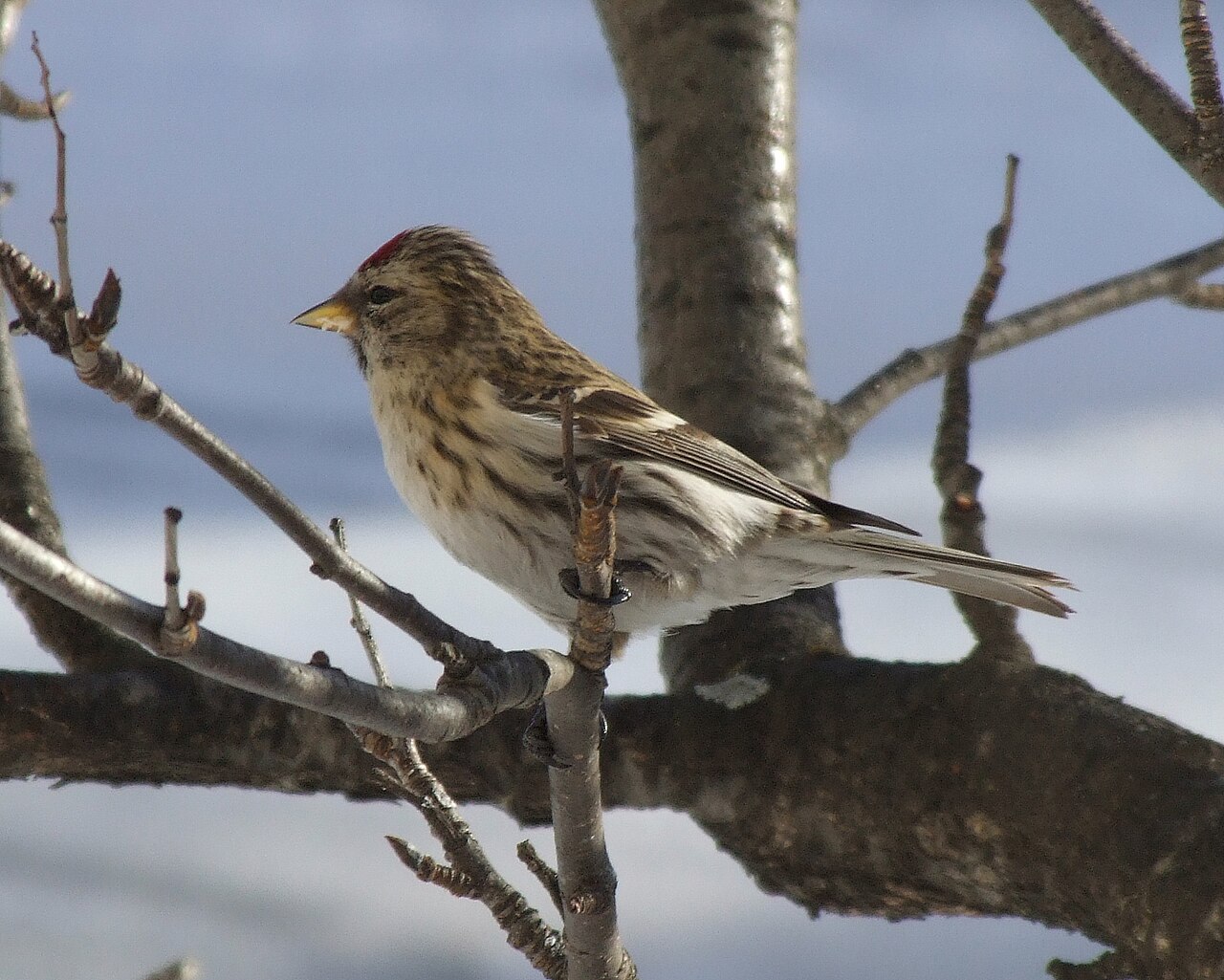
The Common Redpoll (Acanthis flammea) is the tiny Arctic finch that pours into northern and midwestern backyards in irruption winters — a streaky brown bird the size of a goldfinch with a crimson forehead patch, black chin, and (on males) a raspberry-pink breast. In invasion years, flocks of dozens to hundreds swarm Nyjer (thistle) feeders and hulled sunflower, chattering constantly with their dry che-che-che calls. They are remarkably tame and feed alongside the American Goldfinch and the Pine Siskin. Watch the birch trees: catkins are their natural feeder.
Species Physical Profile & Morphometrics
The Common Redpoll belongs to the finch family (Fringillidae) — the same seed-cracking clan as the goldfinches and siskins it joins at winter feeders. It is one of the smallest and hardiest: a bird that breeds in the subarctic scrub of Alaska and northern Canada and endures temperatures that send other songbirds south.
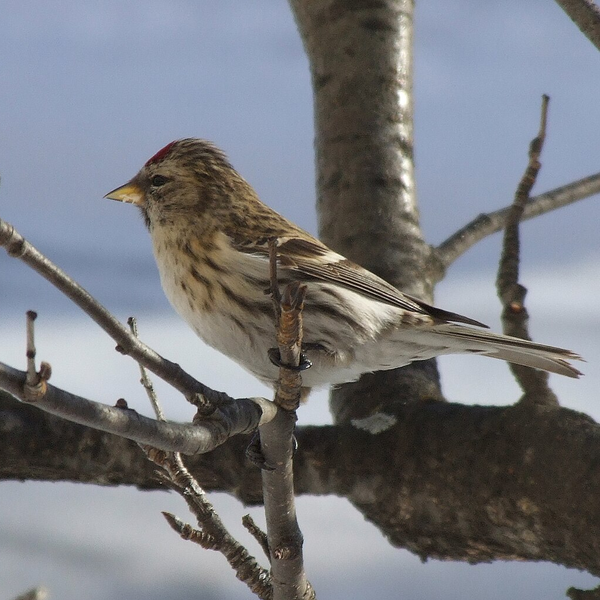
The identification formula: tiny streaked finch + red forehead + black chin patch. Males add a pink-to-raspberry wash across the breast and rump; females and young birds are plainer but keep the red poll and black chin. The Hoary Redpoll is the rare lookalike traveling in the same flocks — it is frostier, whiter, and smaller-billed, with an unstreaked white rump. At a busy feeder, redpolls read as darker, streakier, and more restless than goldfinches.
Essential Morphometric Field Marks:
- Body Length & Mass: 4.7 to 5.5 inches (12–14 cm) and just 0.4 to 0.7 ounces (11–20 grams) — goldfinch-sized but even more compact, with a short notched tail.
- Wingspan: 7.5 to 8.7 inches (19–22 cm); flight is bouncy and undulating, flocks twisting in tight unison like a single organism.
- Bill Structure & Color: A small, stubby yellow conical bill — finer than a goldfinch’s — evolved for extracting tiny birch and alder seeds and shelling Nyjer at speed.
- Color Pattern: Heavily streaked brown-and-white overall, with a crimson-red forehead patch (the poll), a small black chin, and two pale wing bars. Adult males wash the breast and rump in raspberry pink.
- Male vs. Female: The male’s rosy breast and rump are the giveaway; the female is gray-brown and streaked below with the same red forehead and black chin. Juveniles may lack the red poll entirely in their first fall.
The raspberry-stained singer: streaked brown above, a crimson forehead, black chin, and a soft pink-to-red wash across the breast and rump — brightest in the breeding season, when he performs fluttering song-flight displays over the Arctic scrub.
Same red poll, plainer dress — gray-brown and streaked below without the pink wash. She alone incubates, tucked into a tiny cup nest insulated with ptarmigan feathers and plant down, in willow scrub at the edge of the tundra.
Common Redpoll Vocalization Guide (3 Field Recordings)
The Common Redpoll’s signature is a dry, rapid che-che-che flight call, delivered constantly by feeding and flying flocks, plus a rising sweeet and a twittering song of trills and buzzes. All recordings below are real field audio via Wikimedia Commons — no simulations. For a deeper library, browse xeno-canto: Common Redpoll.
1. The Flock Chatter
2. Song and Calls
3. The Feeding Swarm
Habitat, Range & the Irruption Cycle
The Common Redpoll breeds in subarctic scrub — dwarf birch and willow thickets across Alaska and northern Canada — and winters across southern Canada and the northern United States, reaching deep into the Midwest and Northeast in irruption years. At feeders it is a bird of northern-tier backyards: anywhere within a day’s flight of the boreal forest can host a redpoll swarm when the northern seed crop fails.

The Boom-and-Bust Winter Visitor
The map tells two stories: a vast breeding range ringing the subarctic, and a winter range that flexes wildly year to year. Redpolls key on birch seed crops — in boom years they winter far north; when the crop fails, the whole population floods south in an irruption.
For backyard birders the rule is simple: watch the winter finch forecast each fall. In irruption years, Nyjer feeders from Minnesota to Maine can host dozens of redpolls at once; in quiet years you may see none at all. Either way, birch and alder in the yard are a natural invitation.
Backyard Behavioral Patterns & Social Dynamics
The Common Redpoll is a marvel of cold-weather engineering wrapped in an ounce of feathers — social, restless, and astonishingly tame. Four behaviors explain most of what you will observe:
❄️ The Snow Tunneler
Redpolls survive Arctic nights that kill larger birds: they tunnel into snow to roost, insulated from the wind, and can temporarily raise their metabolic rate to burn seed faster — a furnace strategy that demands constant daytime feeding.
👥 The Swarm
Winter redpolls travel in restless flocks from a dozen to several hundred, swirling between birch tops and feeders in tight synchrony. One flock at your Nyjer feeder can empty it in a day — budget seed accordingly in irruption years.
🌿 The Catkin Acrobat
Their natural feeder is the birch tree: redpolls hang upside down from the thinnest twigs, picking seeds from catkins, sometimes clipping a whole catkin and holding it with one foot — goldfinch acrobatics in miniature.
🧊 The Seed Storer
Redpolls possess an expandable esophageal pocket — they can bolt seeds quickly at a feeder, then retreat to a sheltered perch to shell and digest them in safety, a rare adaptation among songbirds.
Problem: “Redpolls Mobbed My Feeder for a Week, Then Disappeared. What Should I Do?”
The three most common Common Redpoll puzzles all have proven answers:
First, the disappearing flock: redpolls are nomads by design — they track seed crops across the landscape, and a vanished flock usually found richer natural seed nearby, not a problem with your setup. Keep the Nyjer fresh and they cycle back on their rounds. Second, the no-show years: in non-irruption winters, redpolls simply stay north — no feeder can summon them; check the winter finch forecast each October so you know whether to expect them. Third, the window strikes: swirling redpoll flocks flush in panic and hit glass — place feeders either within 3 feet of windows or more than 30 feet away, and add visible markers to large panes near the feeding station. Their tameness makes them easy to enjoy; it also makes them vulnerable.
Method 1: Set the Table — Nyjer & Fine Seed for an Arctic Flock
Design for a tiny, flock-feeding, seed-specialist finch:
-
Fill Nyjer (Thistle) Feeders
Nyjer in a tube or mesh sock feeder is the redpoll’s number-one draw — exactly the tiny, oil-rich seed their bills are built for. In irruption years, every port will be occupied from dawn to dusk.
-
Add Hulled Sunflower Chips
Sunflower hearts and chips in a second tube or on a platform take pressure off the Nyjer station and feed the flock faster — redpolls shell chips efficiently and waste nothing.
-
Refresh and Stir Seed Often
Nyjer dries out and clumps, and picky finches abandon stale seed. Stir tube contents weekly, top off with fresh seed, and replace anything wet or moldy — a fresh feeder out-pulls a stale one many times over.
-
Provide Open Water in Winter
Even Arctic birds must drink — a heated birdbath in freezing weather attracts redpoll flocks that ignore every other yard, and gives you the best viewing of the season.
Method 2: Build the Habitat — Birches, Alders & Weedy Edges
Feed the seed crop, and the redpolls find you:
-
Plant Birch and Alder
Paper birch, river birch, and alder are the redpoll’s native feeders — their catkins carry the tiny seeds that drive the whole irruption cycle. A yard with birches hosts redpolls before the neighbors’ feeders do.
-
Let Weeds Stand All Winter
Unmowed goldenrod, asters, and grass seed heads feed winter finches for months. A tidy fall cleanup removes exactly what redpolls cross a continent to find.
-
Offer Shelter from the Wind
Winter feeding burns calories fast — a feeding station near a dense evergreen windbreak lets the flock linger and digest between bouts instead of burning seed fleeing every gust.
-
Prevent Window Strikes
Big panicking flocks and glass do not mix: feeders within 3 feet of the window or beyond 30 feet, plus visible tape or screen markers, protect the tamest flock you will ever host.
Tool Solution: Recommended Hardware for Common Redpoll
Equipment matched to a tiny, flocking, seed-specialist finch:
Nyjer Tube or Mesh Sock
A fine-port Nyjer tube or mesh sock — the classic redpoll magnet. Mesh socks let an entire flock cling and feed at once, which is exactly how redpolls want to eat.
- • Seed: Fresh Nyjer (thistle)
- • Style: Fine-port tube / sock
- • Capacity: Size up for irruption years
Sunflower Chip Tube
A second tube with hulled sunflower chips — feeds the flock faster, wastes nothing, and keeps goldfinches and siskins happy alongside the redpolls.
- • Seed: Hulled sunflower chips
- • Style: Medium-port tube
- • Bonus: Goldfinches & siskins too
Heated Bird Bath
Open water at -20°F is the rarest resource in the winter landscape — a thermostatically heated bath pulls in redpoll flocks and every other winter bird within earshot.
- • Depth: 1–2 in, gently sloped
- • Winter: Thermostatic heater
- • Placement: Near feeders, sheltered
Frequently Asked Questions
- Species Profile: The Common Redpoll (Acanthis flammea) is a tiny 4.7–5.5 inch, 0.4–0.7 ounce Arctic finch (Fringillidae), band code CORE — the star of winter irruption years.
- ID in One Look: Streaked brown finch with a crimson forehead, black chin, and stubby yellow bill; males washed raspberry-pink on the breast and rump.
- The Sound: A dry, rapid che-che-che flock chatter plus a twittering trilled song; real field recordings above.
- Range & Habit: Breeds in subarctic scrub; winters erratically across southern Canada and the northern U.S., flooding south in irruption years keyed to the birch seed crop.
- Feeder Formula: Fresh Nyjer in tubes or mesh socks, hulled sunflower chips, and heated open water; expect flocks, not singles.
- The Cold Engine: Redpolls tunnel into snow to roost and bolt seed into a throat pocket to digest later — Arctic survival engineering at your feeder.
Bird Watching Log
Species: Common Redpoll (Acanthis flammea)
| Common Redpoll (Red Forehead Seen: Yes / No — Pink Breast: Yes / No — Flock Size: ___ — On Nyjer: Yes / No — First Arrival Date: ___) | |