
Tufted Titmouse


Tufted Titmouse (Baeolophus bicolor): Complete Identification, Feeder Guide & Call Library
Quick Answer: How to Attract & Identify Tufted Titmice
The Tufted Titmouse (Baeolophus bicolor) is the gray-crested voice of eastern backyards — a 5.5–6.3-inch acrobat with a black forehead, big dark eyes, white underparts, and peach-colored flanks. A non-migratory year-round resident from the Great Lakes and southern New England to Florida and the Gulf Coast, it announces itself in every season with a ringing, whistled “peter-peter-peter.” At feeders it grabs one whole peanut or sunflower seed at a time, carries it to a branch, and hammers it open under one foot. Stock whole peanuts, black oil sunflower, and suet near tree cover, hang a nest box with a 1-1/4-inch entrance, and this bold little bird may even pluck a strand of your hair to line its nest.
Species Physical Profile & Morphometrics
The Tufted Titmouse carries the family blueprint of the tit family (Paridae) — oversized round head, stout little bill, plump body, and restless acrobatic energy — but adds its own signature: a pointed gray crest that rises and falls with the bird’s mood. It is noticeably larger than any chickadee and moves with the same branch-hanging agility.
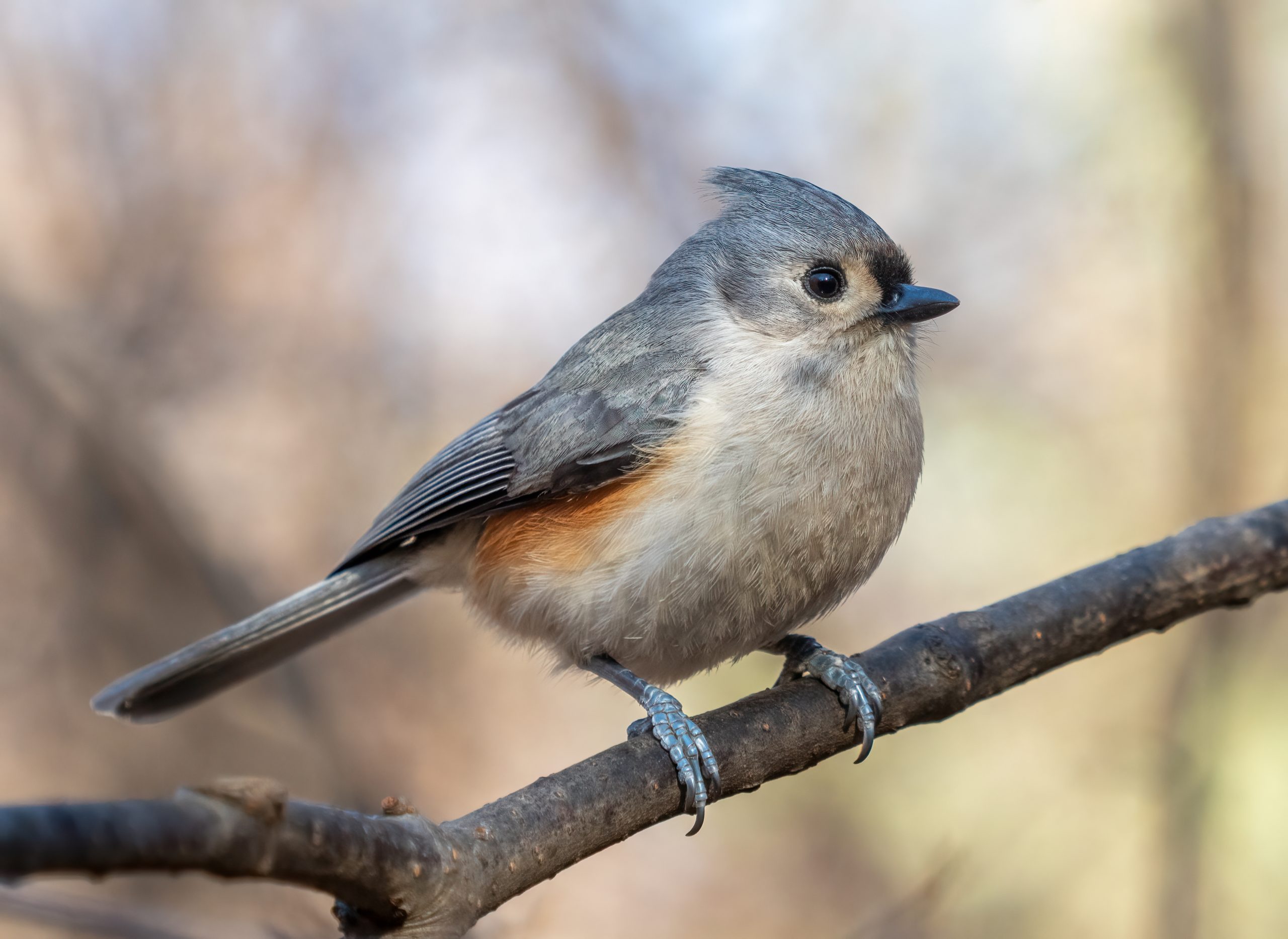
Identification is straightforward in the East: silvery-gray above, clean white below, with rich peach or rusty flanks, a black forehead patch above the bill, and a big dark eye set in a pale face. The similar Black-crested Titmouse of Texas and Oklahoma — once treated as the same species — wears a black crest and white forehead, the exact reverse pattern. Our gallery’s face-on portrait shows the black forehead and huge dark eye that clinch the ID.
Essential Morphometric Field Marks:
- Body Length & Mass: Averages 5.5 to 6.3 inches (14–16 cm) with an adult mass of 0.6 to 0.9 ounces (18–26 grams) — about twice the bulk of a chickadee.
- Wingspan: Roughly 7.9 to 10.2 inches (20–26 cm), with plain gray wings and a longish gray tail.
- Bill Structure & Color: A short, stout black bill built for hammering seeds held under one foot and prying insects from bark crevices.
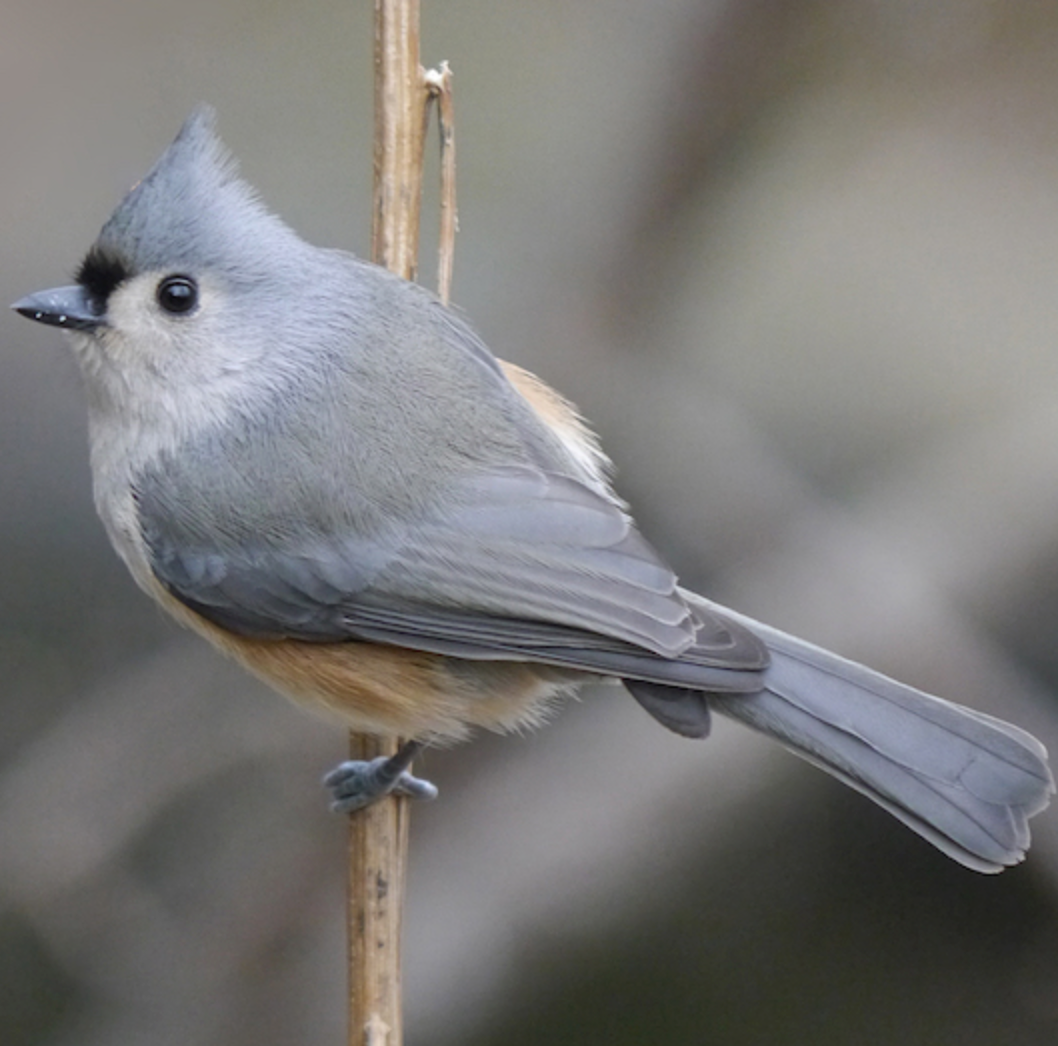
- Color Pattern: Gray crest and upperparts, white face and underparts, peach-rust flanks, and a black forehead; the eye is large and dark. Males and females look identical.
Crisp gray crest and back, clean white breast, and glowing peach flanks, with the black forehead patch standing out against the pale face. Adult males and females cannot be separated in the field.
Summer juveniles look like softer, duller adults: the crest is shorter and fluffier, the forehead patch smudgier, and the flanks a washed-out buff until the first fall molt sharpens the pattern.
Tufted Titmouse Vocalization Guide (2 Recordings + 1 Simulation)
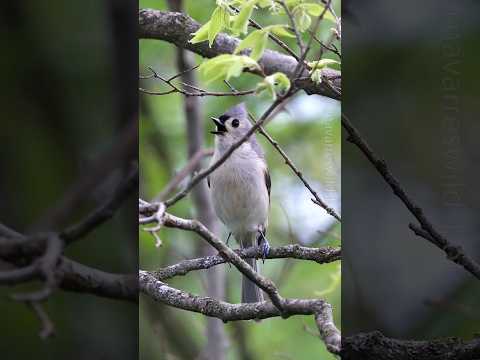
For a 20-gram bird, the Tufted Titmouse is astonishingly loud: its clear, ringing “peter-peter-peter” whistle carries through eastern woods in every season, and its nasal scold call betrays every cat, owl, and hawk in the neighborhood. Both recordings below are real field audio in the public domain, hosted on Wikimedia Commons; the third card is a clearly labeled simulation of the song mnemonic. For more wild audio, browse xeno-canto: Tufted Titmouse.
1. Field Recording — Wilkes County, North Carolina
2. Call Notes — U.S. Fish & Wildlife Service
3. Whistled Song — “Peter-Peter-Peter”
Habitat, Range & Year-Round Resident Biology
Tufted Titmice live wherever the East has trees: deciduous and mixed woodland, forest edges, orchards, riverbottom woods, swamps, parks, and shady suburbs. The range blankets the eastern United States from the Great Lakes and southern New England south to Florida and the Gulf Coast, and west to the eastern Great Plains — where it meets, and occasionally hybridizes with, the Black-crested Titmouse in central Texas.

An Eastern Resident on the Move North
These birds never migrate — a pair may spend its whole life within a few wooded acres. Yet the species as a whole has marched steadily northward over the past century, colonizing the Great Lakes region and New England with the help of bird feeders, winter food, and milder winters. A bird like the Prospect Park titmouse in our gallery would have been a rarity in New York a century ago.
A yard with mature trees, a shrub layer, and a dependable feeder is perfect titmouse habitat. In winter they travel in mixed flocks with chickadees, nuthatches, and Downy Woodpeckers — one well-run station hosts the whole guild.
Backyard Behavioral Patterns & Social Dynamics
Tufted Titmice are bold, curious, and methodical. Four signature behaviors explain most of what you will observe at your station:
🥜 The One-at-a-Time Routine
Watch closely: a titmouse grabs a single peanut or sunflower seed, flies to a nearby branch, pins it under one foot, and hammers it open with its stout bill — exactly like the railing bird in our gallery. It also caches surplus seeds in bark crevices for later, which is why a reliably stocked feeder earns such loyal traffic.
📣 A Voice Bigger Than Its Body
The ringing “peter-peter-peter” seems far too loud for a 20-gram bird — a deliberate trick of a clear, whistled tone that carries through winter woods. Titmice sing in every month, and their nasal scolds summon the neighborhood whenever a hawk or owl is found.
🐑 The Living Hair Snatcher
This species is famous for lining its nest with hair plucked from live mammals — documented from opossums, raccoons, dogs, livestock, and even unsuspecting people standing still. Offer a suet cage of clean pet fur in spring and you may watch the collection happen.
🤝 The Winter Mixed Flocker
From fall through early spring, titmice travel in mixed foraging flocks with chickadees, nuthatches, and Downy Woodpeckers, moving through the woods as one loose convoy. When the flock adopts your feeders, expect every member species within minutes of each other.
Problem: Why Tufted Titmice Pass Over the Wrong Station
Within the range, the usual complaint runs: “titmice in the park across the street, none at my feeder.” The reasons are predictable:
First, a menu mismatch: cheap mixes heavy in milo, millet, or wheat get inspected and rejected — this species is shopping for sunflower, peanuts, and suet. Second, an exposed station: a feeder hanging in the middle of an open lawn forces a long, hawk-visible flight for every single seed, so the birds simply feed elsewhere. Third, bully traffic: Blue Jays, grackles, and starlings can empty an open tray in minutes, and a 20-gram titmouse loses every shoving match. Fix the menu, move the station within a quick dash of trees, and give them feeder space the big birds cannot monopolize — the flock will find you.
Method 1: Set the Table — Peanuts, Sunflower & Suet
Design for a bold but methodical one-item-at-a-time feeder:
-
Put Out Whole Peanuts
Whole in-shell peanuts on a platform, in a mesh peanut feeder, or in a peanut wreath are irresistible — titmice hammer them open piece by piece or carry off entire nuts to cache. Unsalted only.
-
Anchor the Station with Black Oil Sunflower
A hopper or tube feeder with a tray filled with black oil sunflower covers the daily staple. Our lab-tested roundup of the Best Tube Feeders for Small Birds compares proven models.
-
Hang a Suet Cage Nearby
A hanging suet cage — peanut or nut blends are favorites — supplies the concentrated fat that carries titmice and their whole winter flock through cold snaps. Position it where jays and starlings cannot camp on it all day.
-
Place Everything Within a Dash of Cover
Mount the station within 10–15 feet of trees or dense shrubs. Titmice stage in the branches between trips, and a feeder they can reach in one short, covered flight gets visited all day long.
Method 2: Keep Them Year-Round — Cavities, Cover & the Winter Flock
Turn seasonal visits into permanent residence:
-
Hang a Nest Box They Can Actually Use
Titmice cannot excavate their own cavities, so a box with a 1-1/4-inch entrance hole mounted 5–15 feet up near woods is prime real estate in early spring. Add a layer of wood shavings inside.
-
Offer Nesting Hair in Spring
Hang a small wire cage stuffed with clean, undyed pet fur (or natural wool) near the box. This famous fur-collector will pluck it piece by piece to line the nest cup — one of the great backyard spectacles of April.
-
Keep a Shallow Bird Bath Filled
A shallow bath near shrubs draws titmice down to drink and bathe between foraging runs, and in winter a heated bath serves the entire mixed flock that travels with them.
-
Feed Through Every Season
Because titmice never migrate, the pair you feed in July is the pair scolding your cat in January. Keep sunflower and suet stocked year-round and skip pesticides, so the caterpillar supply stays strong for nesting season.
Tool Solution: Recommended Hardware for Tufted Titmice
Equipment matched to a methodical, peanut-loving resident:
Hopper or Tube Feeder with Tray
Holds black oil sunflower dry and dispenses it at perches sized for titmice and chickadees, with a tray for the one-at-a-time crowd.
- • Capacity: 2–3 lbs Sunflower
- • Roof: Weather-shedding lid
- • Mount: Pole or hook near trees
Suet Cage + Whole Peanut Feeder
Peanut-blend suet plus whole in-shell peanuts in a mesh or wreath feeder — the two fastest ways to win a titmouse’s loyalty.
- • Suet: Peanut or nut blend
- • Peanuts: Whole in-shell, unsalted
- • Purity: No milo or wheat filler
Titmouse Nest Box (1-1/4″ Entry)
Cedar box sized for Paridae that cannot excavate their own cavities — hang it near woods, add wood shavings, and offer clean pet fur for the famous fur-lined nest.
- • Entrance: 1-1/4 in (32 mm) round hole
- • Floor: 4 × 4 in interior
- • Mount: 5–15 ft, near tree cover
Frequently Asked Questions
- Species Profile: The Tufted Titmouse (Baeolophus bicolor) is a 5.5–6.3 inch, 18–26 gram songbird with a gray crest, black forehead, white underparts, and peach flanks; males and females look identical.
- Eastern Resident: Non-migratory across the eastern United States — and steadily expanding northward into the Great Lakes and New England with the help of feeders and milder winters.
- A Big Voice: The ringing “peter-peter-peter” song carries in every season; the nasal “tsee-day-day-day” scold rallies the neighborhood against predators.
- Feeder Formula: Whole peanuts, black oil sunflower, and suet at a station within a quick dash of tree cover — one item carried off and hammered open at a time.
- Cavity Nester: Cannot excavate its own hole — it uses natural cavities and nest boxes (1-1/4-inch entrance), and famously lines the nest with hair plucked from live mammals.
- Mixed-Flock Leader: Winter flocks travel with chickadees, nuthatches, and Downy Woodpeckers — one well-run station attracts the entire guild.
Bird Watching Log
Species: Tufted Titmouse (Baeolophus bicolor)
| Tufted Titmouse (Subspecies / Notes: ____________________________) | |