
Eastern Towhee


Eastern Towhee (Pipilo erythrophthalmus): Complete Identification, Feeder Guide & Call Library
Quick Answer: How to Attract & Identify Eastern Towhees
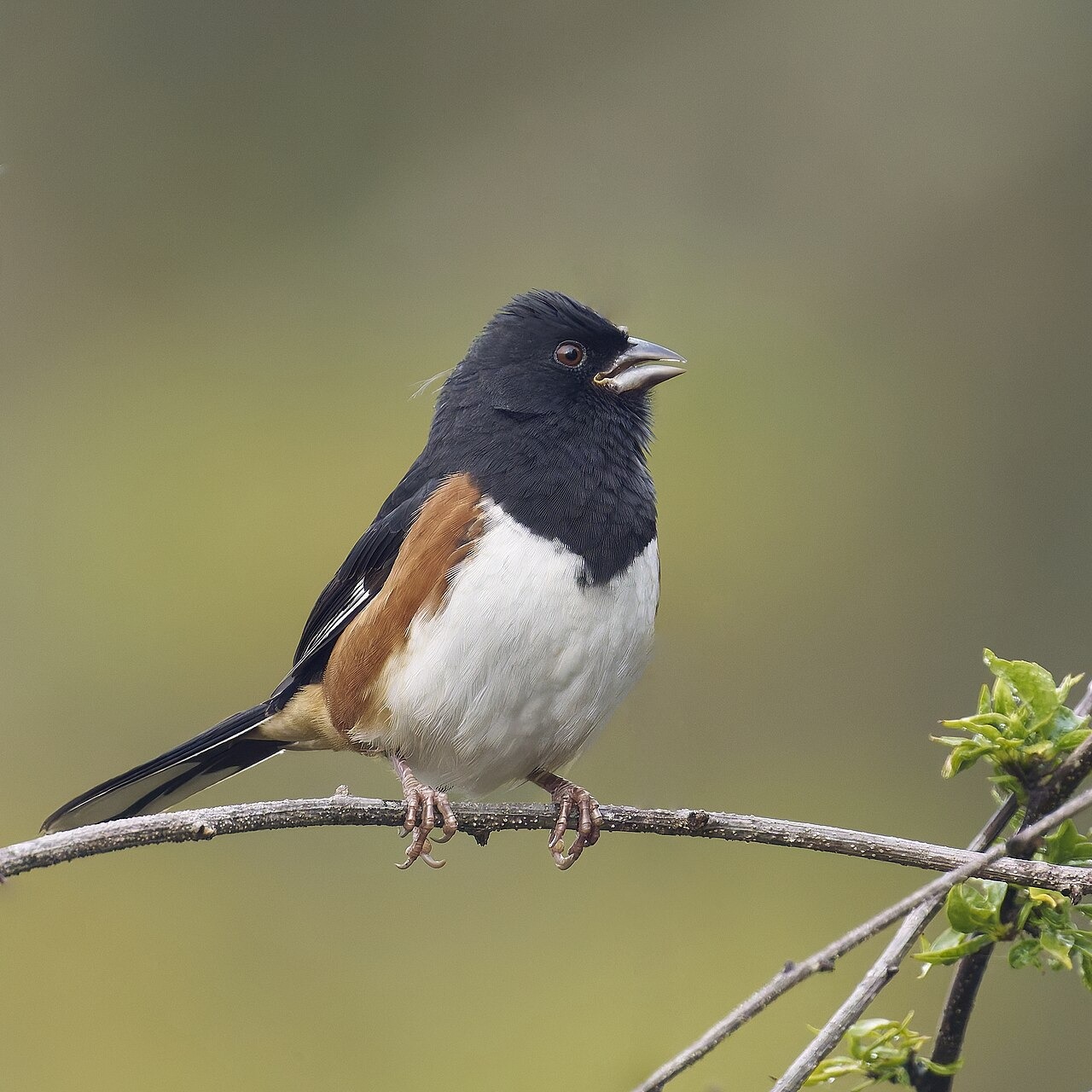
The Eastern Towhee (Pipilo erythrophthalmus) is a big, long-tailed ground sparrow of eastern wood edges — the male wears a jet-black hood and back with rufous-orange sides and a white belly, while the female wears the same pattern in warm chocolate brown. It lives east of the Rockies in brushy yards, forest edges, and overgrown corners, feeding by double-scratching in leaf litter beside birds like the White-throated Sparrow and the Northern Cardinal. To attract it: keep leaves under your shrubs, serve black oil sunflower seeds and unsalted peanuts on the ground or a low platform, and add a shallow birdbath near cover. Listen for the rising “chewink” call and the loud spring song — “drink-your-tea.”
Species Physical Profile & Morphometrics
The Eastern Towhee belongs to the New World sparrow family (Passerellidae) and is one of the largest sparrows in an eastern yard — a chunky body, a thick seed bill, and a long, rounded tail it cocks and fans as it hops.
The identification formula: black (or brown) hood + rufous sides + white belly + long tail flashing white corners, scratching on the ground under cover.
Essential Morphometric Field Marks:
- Body Length & Mass: 6.8 to 8.2 inches (17.3–20.8 cm) and 1.1 to 1.8 ounces (32–52 grams) — about 30% bigger than a Song Sparrow and twice as heavy.
- Wingspan: 7.9 to 11.0 inches (20–28 cm), with short, rounded wings built for darting between thickets rather than long soaring flight.
- Bill Structure & Color: A thick, triangular, conical seed-cracking bill — dark on breeding males, duller gray-brown on females and juveniles.
- Color Pattern: Males are black above and on the head and throat, with rich rufous-orange sides, a clean white belly, and white tail corners visible in flight. Females swap the black for warm chocolate brown. Eyes are red across most of the range — pale yellow in southern Georgia and Florida birds.
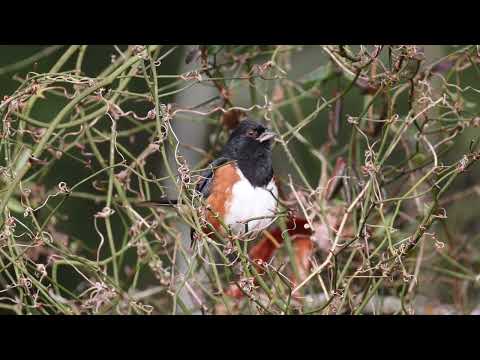
High contrast formal wear: jet-black hood, back, and tail over rufous sides and a white belly — the white tail corners flash like signals when he drops into the shrubs.
Same map, softer ink: every male marking is duplicated in rich chocolate brown — brown hood, brown back, rufous sides, white belly. Juveniles look browner still, with faint streaking below.
Eastern Towhee Vocalization Guide (2 Recordings + 1 Simulation)
This is one of the easiest eastern birds to learn by ear. The song is a loud “drink-your-tea” — sharp opening notes and a fast musical trill — and the everyday call is the rising “chewink” that gives the bird its name. The first two cards below are licensed field recordings via Wikimedia Commons and xeno-canto; the third is a clearly labeled acoustic simulation of the song pattern for practice.
1. Field Recording — “Drink-Your-Tea” Song
2. Field Recording — “Tink” & “Zhree” Calls
3. Song Simulation — The “Drink-Your-Tea” Mnemonic
Habitat, Range & the Eastern Leaf-Litter Corridor
This is a bird of brushy edges: young forest, overgrown fields, hedgerows, powerline cuts, and the shrubby back corners of suburban yards — anywhere dense cover sits beside open ground and deep leaves.

An Eastern Bird, Top to Bottom
The orange breeding band covers the Northeast, Mid-Atlantic, Great Lakes, and southern Canada, where towhees nest in low shrubs or on the ground beneath them. The purple band across the Southeast is year-round territory — towhees on the Florida peninsula and Gulf states never leave.
The blue winter band reaches into eastern Texas and the Gulf Coast, and the narrow yellow corridor marks the migration zone. Wherever it occurs, the habitat rule is the same: shrubs above, leaf litter below.
Backyard Behavioral Patterns & Social Dynamics
The Eastern Towhee is a shy but bold-patterned ground bird. Four behaviors explain most backyard encounters:
🍂 The Double-Scratcher
The signature move: a hop forward, then a kick back with both feet at once, flinging leaves aside to expose seeds and insects. You will often hear the rustle long before you see the bird.
🌿 The Shrub-Edge Skulker
Towhees feed in the open only within a quick dash of dense cover. At any disturbance they dive into the thicket — a yard that is all lawn will not hold them, however good the seed.
🥜 The Low-Tray Feeder
At feeding stations they favor open ground, ground trays, and low platforms over hanging tubes — joining cardinals, juncos, and White-throated Sparrows at the floor-level buffet.
🎵 The Exposed Singer
For a bird that spends its life skulking, the male sings surprisingly boldly — from the top of a shrub or small tree, throwing the “drink-your-tea” over the whole yard on spring mornings.
Problem: “Something Big Is Kicking Around Under My Bushes — I Hear Scratching but Barely See a Bird. What Is It?”
The three most common Eastern Towhee puzzles all have reassuring answers:
First, the invisible rustler: that loud double-scratching in the leaf bed is the bird itself — wait motionless and watch for the black or brown hood, rufous sides, and long tail at the shrub edge. Second, the feeder bypass: towhees ignore swinging tube feeders — sunflower seeds and peanuts on the ground or a low tray beside the shrubs will be found the same day. Third, the western look-alike: the Spotted Towhee of the West wears the same pattern but with white spotting across the back and wings; east of the Great Plains the solid-backed bird is the Eastern.
Method 1: Set the Table — Seeds & Peanuts, Served Low
Design for a big, scratching, floor-feeding sparrow:
-
Keep a Leaf-Litter Feeding Floor
Leave the leaves beneath your shrub border and scatter seed directly into them — the double-scratch foraging is the natural behavior you are feeding, and the rustling flock tells you it is working.
-
Serve Black Oil Sunflower on the Ground or a Low Platform
Black oil sunflower scattered low beside cover is the staple — high-fat, thin-shelled, and exactly the seed this species cracks naturally. A handful each morning builds a daily route.
-
Add Unsalted Peanuts on a Sturdy Tray
Whole or shelled unsalted peanuts on a low, stable platform suit the towhee’s big bill — and will also please cardinals and jays. Keep portions fresh; in wet weather serve only what disappears in a day.
-
Supplement With Millet and Cracked Corn
White millet and cracked corn round out the ground station and serve the sparrow flock that feeds alongside towhees. Rake and rotate the patch weekly to keep it clean.
Method 2: Build the Habitat — Leaf Litter, Cover & Water
Feed the habitat, and the towhees follow:
-
Plant or Keep a Dense Shrub Border
Native shrubs, brambles, and thick foundation plantings supply the quick-escape cover this species requires — sumac, blackberry, viburnum, and dogwood are classic towhee structure.
-
Leave the Leaves — On Purpose
A deliberate leaf-litter bed under the shrubs is pantry and foraging floor in one: seeds fall in, insects live in it, and the birds work it daily. Skip the fall cleanup in at least one corner.
-
Add a Brush Pile
A simple stacked brush pile near the feeding floor gives towhees instant cover from hawks and weather — the cheapest “feeder accessory” you will ever build.
-
Offer a Shallow Bath Near Cover
Towhees drink and bathe readily at shallow water within a quick dash of shrubs. In the northern half of the range a heated bird bath keeps water open for winter visitors.
Tool Solution: Recommended Hardware for Eastern Towhees
Equipment matched to a big, ground-feeding, cover-loving sparrow:
Low Platform / Ground Tray
A wide, stable tray set on or near the ground beside the shrub border, filled with black oil sunflower, millet, and cracked corn — the serving style a double-scratching bird actually trusts.
- • Seed: Black oil sunflower, millet, cracked corn
- • Style: Ground tray or low platform
- • Placement: Open spot beside dense shrubs
Peanut-Serving Platform
A sturdy open tray that can take unsalted whole or shelled peanuts without tipping — big enough for a towhee’s body and the cardinals and jays that share the station.
- • Food: Unsalted peanuts, whole or shelled
- • Build: Rigid, tip-proof, drainable
- • Placement: Within a quick dash of cover
Shallow Bird Bath
A shallow bath with gently sloped sides set near brushy cover — towhees drink and bathe daily, and in northern winters a heater keeps the station open.
- • Depth: 1–2 in, gently sloped
- • Cold snaps: Thermostatic heater
- • Placement: Beside, never far from, shrubs
Frequently Asked Questions
- Species Profile: The Eastern Towhee (Pipilo erythrophthalmus) is a large 6.8–8.2 inch, 32–52 gram New World sparrow (Passerellidae) with a thick triangular bill and long rounded tail.
- ID in One Look: Black (male) or chocolate-brown (female) hood and back, rufous-orange sides, white belly, and white tail corners — scratching on the ground under shrubs.
- An Eastern Edge Bird: Breeds across the Northeast, Mid-Atlantic, and Great Lakes; resident across the Southeast; winters south to the Gulf and eastern Texas.
- The Sound: A loud “drink-your-tea” song from an open perch, plus the rising “chewink” call that names the bird.
- Feeder Formula: Leaf litter left under shrubs, black oil sunflower and unsalted peanuts served low, a brush pile for cover, and a shallow bath nearby.
- Hear It First: Loud double-scratching in the leaves with no bird in view usually means a towhee — wait at the shrub edge and watch for the rufous sides.

Bird Watching Log
Species: Eastern Towhee (Pipilo erythrophthalmus)
| Eastern Towhee (Rufous Sides Seen: Yes / No — Double-Scratching: Yes / No — Singing: Yes / No) | |