
Eurasian Collared-Dove


Eurasian Collared-Dove (Streptopelia decaocto): Complete Identification, Feeder Guide & Call Library
Quick Answer: How to Attract & Identify Eurasian Collared-Doves
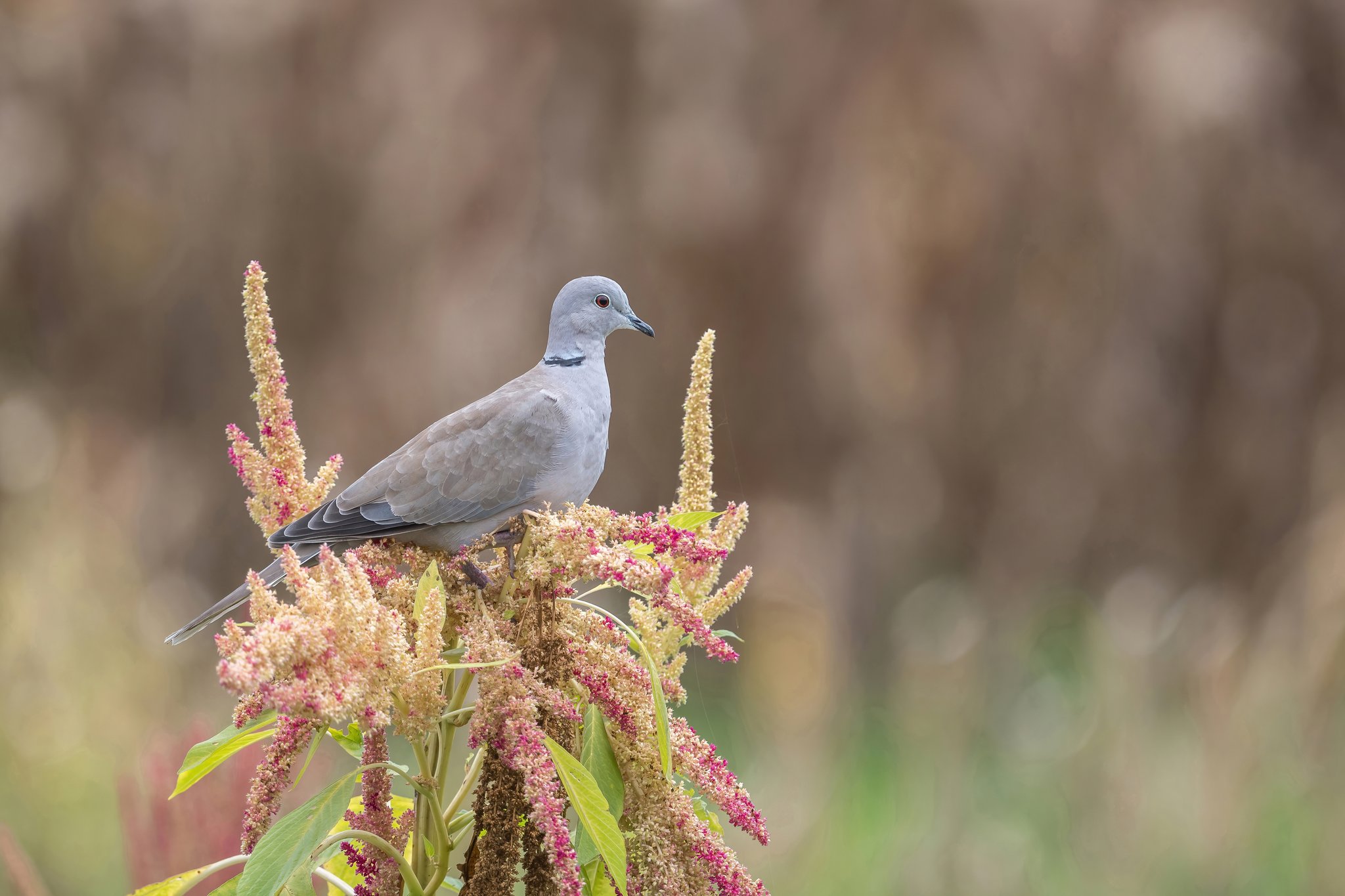
The Eurasian Collared-Dove (Streptopelia decaocto) is the big, pale gray-buff dove of American suburbs, farms, and grain towns — plumper than a Mourning Dove, with a squared-off tail, deep red eyes, and the mark that names it: a neat black half-collar on the back of the neck. Its steady three-note “goo-GOO-gook” — stress on the second beat — is now a soundtrack of parking lots and backyard wires across most of the country. It is not a migrant but a colonizer: pet-trade birds released in the Bahamas in the 1970s reached Florida by 1982 and have spread across most of the continent since. Serve whole corn, sunflower, and mixed grain on a large platform or ground tray, with water at ground level — it shares the feeding patch peaceably with the Mourning Dove and the House Finch.
Species Physical Profile & Morphometrics
The Eurasian Collared-Dove belongs to the pigeon and dove family (Columbidae) — a Streptopelia dove, closer in build to a small Rock Pigeon than to the slim, long-tailed Mourning Dove. It is one of the most successful introduced birds on the continent, and in much of the country it is now among the first birds a new feeder attracts.
The identification formula: big pale dove + squared tail + black half-collar on the nape + red eyes. Three birds cause confusion: the Mourning Dove, which is slimmer and browner with a long pointed tail, a black cheek spot, and no collar; the White-winged Dove of the southern tier, which shows a bold white wing stripe; and the Rock Pigeon, which is bulkier still, with an iridescent neck and a small white cere. None combines the collared-dove’s pale wash, squared tail, and black neck ring.
Essential Morphometric Field Marks:
- Body Length & Mass: 11.4 to 11.8 inches (29–30 cm) and 4.4 to 8.5 ounces (125–240 grams) — a large, heavy-bodied dove, visibly plumper than a Mourning Dove at the same tray.
- Wingspan: About 13.8 inches (35 cm); flight is strong and direct on broad, rounded wings, with a quick clatter on takeoff and a neat fanned-tail landing.
- Bill Structure & Color: A stout black bill with a pale base — built for swallowing grain whole, from millet up to whole kernels of corn.
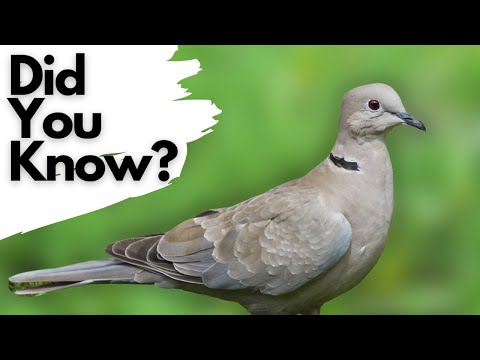
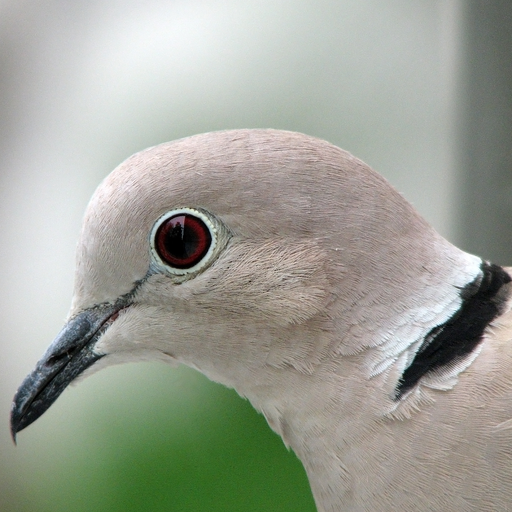
- Color Pattern: Soft pale gray-buff overall, pinkish on the head and breast, with darker primaries; deep red eyes, red legs, and the crisp black half-collar edged in white across the nape. The squared tail is dark below with broad white corners that flash in flight.
- Male, Female & Juvenile: The sexes look alike — males average slightly larger and pinker, but not reliably so in the field. Juveniles lack the black collar entirely and look scaly, with pale buffy fringes on the wing feathers, until their first molt.
The collar is the whole story: pale champagne-gray plumage, pinkish breast, red eyes, and that crisp black half-collar visible from any angle behind the head. Adults coo from rooftops, wires, and treetops — the male delivering the three-note phrase, both sexes giving the harsh “kwaah” when flushed.
Same shape, no collar yet — a young collared-dove is the one bird that genuinely fools Mourning Dove watchers. Look for the scaly pale-edged wing feathers, the still-squared tail, and the bigger, plumper body; the black collar grows in with the first adult molt.
Eurasian Collared-Dove Vocalization Guide (3 Field Recordings)
The collared-dove’s voice is a two-part lesson: the male’s rhythmic three-note “goo-GOO-gook” — endlessly repeated, stress on the middle beat — and the harsh, raspy “kwaah” given in excitement or alarm. All three recordings below are real field audio, shared under commercial-use licenses via Wikimedia Commons and iNaturalist — no simulations. For a deeper library, browse xeno-canto: Eurasian Collared-Dove.
1. The Rooftop Phrase
2. The California Voice
3. The Northern Frontier
Habitat, Range & the Great Expansion
The Eurasian Collared-Dove is a human-landscape specialist: suburbs, small towns, farmyards, grain elevators, livestock feedlots, and city parks — anywhere people grow, store, or spill grain. It avoids deep forest, high mountains, and true desert, which is why its map has holes where America turns wild.

From the Bahamas to Your Backyard in Forty Years
The map tells one of the great bird stories of our time. The species began as a bird of South Asia, then swept across all of Europe on its own during the twentieth century. In the mid-1970s, captive birds escaped or were released in the Bahamas; by about 1982 they had crossed to Florida, and from there the red on the map spread north and west — through every state of the continental U.S., deep into Mexico, and up into the Canadian prairies.
For backyard birders the practical point is simple: if you have grain and open ground, they are either already in your neighborhood or on their way — and once they arrive, they stay. There is no off-season.
Backyard Behavioral Patterns & Social Dynamics
The Eurasian Collared-Dove is a bold, deliberate feeder — calmer than a sparrow, pushier than a Mourning Dove, and completely at home around people. Four behaviors explain most of what you will observe:
🚀 The Great Colonizer
Few birds spread like this one. Collared-doves do not migrate — they disperse: young birds strike out in random directions, settle wherever grain and open ground appear, and breed within a year. That leapfrogging carried them from a handful of Bahamian escapees to most of North America in about four decades, and the expansion is still rolling.
🏘️ The Suburban Specialist
This is a dove of people places — rooftops, parking lots, silos, and feeders. Studies of its spread show it tracks human settlement and backyard bird feeding far more closely than wild habitat. A yard with a stocked platform feeder, a big shade tree, and an open lawn is a complete collared-dove estate.
🎵 The Three-Note Tenor
The male’s “goo-GOO-gook” runs on a metronome — second syllable stressed, phrase after phrase, from an exposed perch. Once you lock onto the rhythm you will never again confuse it with the Mourning Dove’s sorrowful slide. Add the harsh “kwaah” on landing, and a perched display flight with clapping wings and a long glide, and the species announces itself constantly.
🌽 The Big-Grain Diner
Watch closely and you will see why this dove thrives on farms: it swallows whole kernels of corn, wheat, and milo that smaller doves cannot manage, storing them in the crop to digest later on a safe perch. One bird can carry off a surprising share of a grain pile in a single sitting.
Problem: “Big Pale Doves Shove My Mourning Doves Off the Platform — Should I Worry?”
The three most common collared-dove worries all have proven answers:
First, the competition worry: yes, collared-doves are bigger and bolder, and they will shoulder smaller birds off a crowded single feeder. But the fix is geometry, not banishment — add a second feeding station across the yard and scatter part of the seed on open ground, and the two species sort themselves out; researchers tracking the expansion have so far found no evidence of population-level harm to Mourning Doves. Second, the emptied platform: a flock of grain-swallowing doves can clear a tray fast, so serve a measured amount once or twice a day instead of keeping it topped up, and lean on safflower if squirrels join the raid. Third, the mess: big flocks leave droppings under favorite perches and feeding spots — rake or hose the ground patch weekly, and shift the scatter zone every few days so no single spot gets fouled. Solve these three and the big new neighbor becomes just another regular at the table.
Method 1: Set the Table — Big Grains & Multiple Stations
Design for a heavy, ground-feeding grain bird:
-
Serve Whole Corn & Mixed Grain
Whole kernel corn, wheat, milo, black oil sunflower, and white millet — the collared-dove’s menu runs from fine seed up to grains other doves cannot swallow. A cracked-corn-and-millet ground mix keeps everyone fed, but watch a collared-dove carry off a whole kernel and you will understand its farm-country success.
-
Put Out a Large Platform or Ground Tray
A big, stable platform feeder or ground tray is the natural station for a bird this size — room to land, turn, and swallow. The feeder style comparison guide covers platform and hopper options rated for bigger birds.
-
Spread It Around — Multiple Stations
One platform feeds the pushiest bird in the yard; two stations across the yard, plus a ground scatter zone, feed the whole flock — and leave room for your Mourning Doves, Dark-eyed Juncos, and sparrows to work the edges in peace.
-
Keep Water at Ground Level
Like all doves, collared-doves drink by sucking water up in a continuous draft — no head-tipping — and they visit water daily. A shallow ground-level bath near the feeding area, or a heated bath in winter, completes the station.
Method 2: Build the Habitat — Grain Plants & Perch Trees
Feed the habit, not just the bird:
-
Let Sunflowers & Grain Grasses Stand
Sunflowers, millet sprays, sorghum, and garden flowers left standing drop seed collared-doves glean all fall and winter. A slightly shaggy corner of yard is a self-refilling grain elevator.
-
Keep Tall Perches & Rooftop Sightlines
Collared-doves advertise from high, exposed perches — treetops, wires, chimneys, and rooflines — and stage in a tall tree before dropping to feed. A mature shade tree overlooking the feeding area is both billboard and waiting room.
-
Offer a Sturdy Nesting Platform
Like their Mourning Dove cousins, collared-doves build flimsy twig platforms — and they adopt better real estate when offered: a simple platform or nesting cone fixed in a tree fork, or a dense evergreen, gives the pair a base that survives wind, brood after brood of two white eggs.
-
Clean the Patch & Keep Cats Indoors
Big flocks foul a fixed feeding spot fast — rake or hose the scatter zone weekly and rotate it around the yard. And because doves feed on the ground and freeze before they flush, keeping pet cats indoors is the single biggest safety upgrade you can give them.
Tool Solution: Recommended Hardware for Eurasian Collared-Doves
Equipment matched to a big, ground-feeding grain bird:
Large Platform / Ground Tray
A wide, rock-stable tray set low or on a post, filled with whole corn, sunflower, and mixed grain — sized so a plump dove can land, turn, and feed without balancing on a rim.
- • Seed: Whole corn, sunflower, millet
- • Style: Large platform or ground tray
- • Placement: Open, within a dash of cover
Hopper Feeder with Wide Tray
A big hopper with a generous perching tray lets collared-doves feed at a raised station alongside the cardinals — self-refilling, weather-protected grain for the days you are not home to scatter.
- • Seed: Sunflower, safflower, mixed
- • Style: Wide-tray hopper
- • Bonus: Serves cardinals & grosbeaks too
Shallow Ground-Level Bird Bath
A shallow bath near the ground — heated in winter — serves the doves’ daily drinking flights and turns your yard into a complete station: food, water, and cover in one stop.
- • Depth: 1–2 in, gently sloped
- • Winter: Thermostatic heater
- • Placement: Near the ground feeding patch
Frequently Asked Questions
- Species Profile: The Eurasian Collared-Dove (Streptopelia decaocto) is a plump 11.4–11.8 inch, 4.4–8.5 ounce dove (Columbidae) with a squared tail, band code EUCD — an introduced species now found across most of North America.
- ID in One Look: Pale gray-buff overall with a pinkish breast, deep red eyes, red legs, and a crisp black half-collar on the nape; the squared tail flashes white corners from below. Juveniles lack the collar and look scaly.
- The Sound: A rhythmic three-note “goo-GOO-gook” — stress on the second syllable — plus a harsh “kwaah” alarm call; three real field recordings above.
- Range & Story: Native to South Asia; swept across Europe in the 20th century; escaped pets colonized the Bahamas in the 1970s, reached Florida by 1982, and now span most of the continent — non-migratory, spreading by dispersal.
- Feeder Formula: Whole corn, sunflower, and mixed grain on a large platform or ground tray, a second station across the yard for the Mourning Doves, and a shallow ground-level bath.
- Peaceful Coexistence: Bigger and bolder, yes — but research to date shows no population-level harm to Mourning Doves; spread the food around and both species will stay.
Bird Watching Log
Species: Eurasian Collared-Dove (Streptopelia decaocto)
| Eurasian Collared-Dove (Black Collar Seen: Yes / No — Feeder Visits: ___ — Three-Note Coo Heard: Yes / No — Pair Seen: Yes / No) | |