
White-winged Dove



White-winged Dove (Zenaida asiatica): Complete Identification, Feeder Guide & Call Library
Quick Answer: How to Attract & Identify White-winged Doves
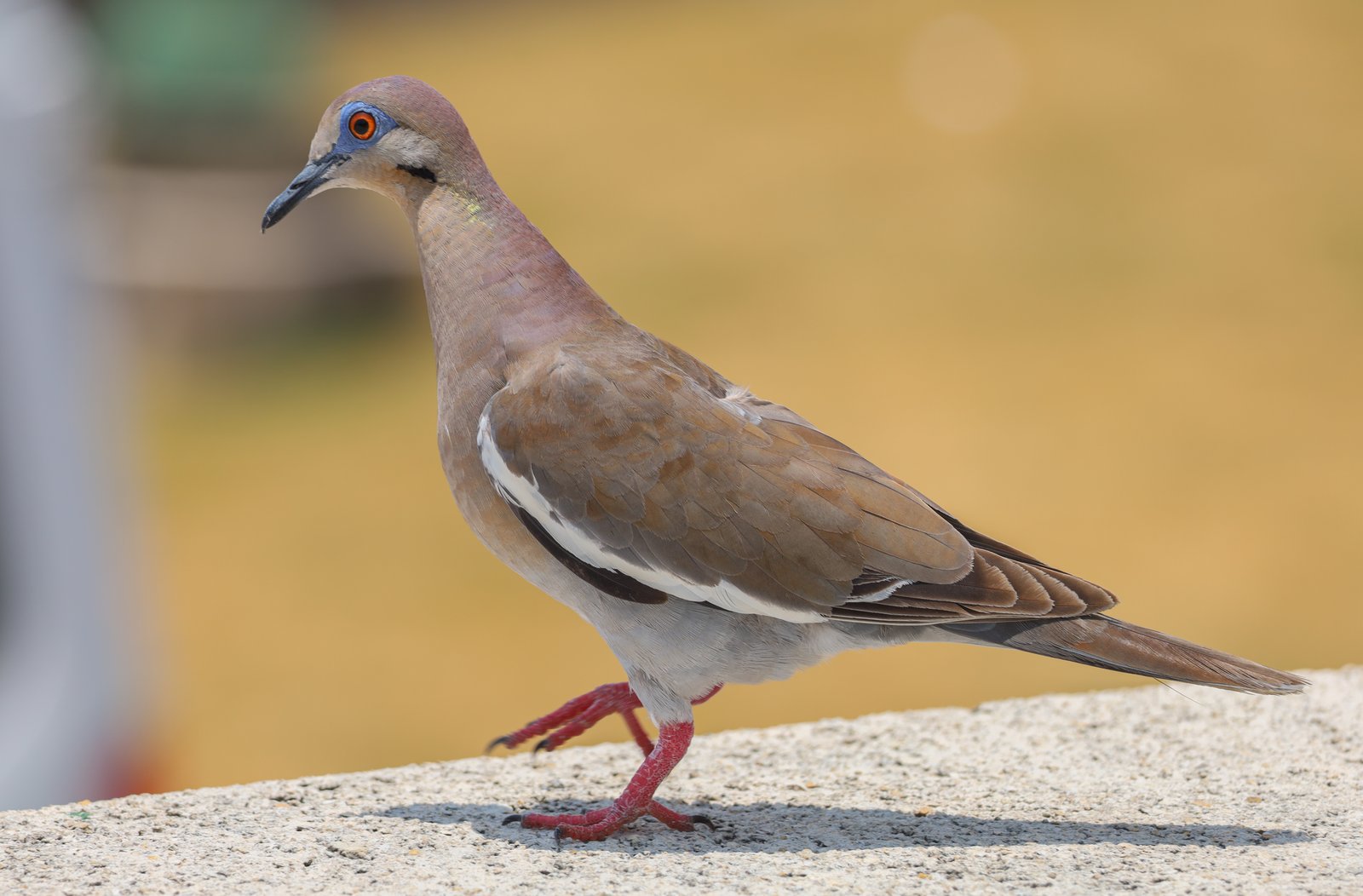
The White-winged Dove (Zenaida asiatica) is the big gray-brown dove of Texas, the Southwest, and — increasingly — the whole southern tier, known for the bold white stripe along its wing that flashes into huge white patches in flight, a blue ring of bare skin around the eye, and a thin black cheek line. Its husky “who-cooks-for-you” is the soundtrack of southern suburbs. Once a bird of saguaro deserts and the Rio Grande Valley, it has expanded through towns and backyards across the Gulf Coast and Florida — powered by backyard feeding. Serve cracked corn, milo, and sunflower on a large platform or ground tray, with a wide, open water dish — it drinks daily. It shares the station with the Mourning Dove and the Eurasian Collared-Dove.
Species Physical Profile & Morphometrics
The White-winged Dove belongs to the pigeon and dove family (Columbidae) — a Zenaida dove, close cousin of the Mourning Dove, but bigger, broader, and built for desert heat. It is one of the largest doves you will see at an American feeder, and one of the easiest to confirm thanks to a single bold mark.
The identification formula: big brownish dove + white stripe on the folded wing + blue skin around the eye + black cheek line. Two birds cause confusion: the Mourning Dove, which is slimmer with a long pointed tail and no white in the wing; and the Eurasian Collared-Dove, which is paler with a black neck collar and a squared tail. Neither flashes huge white wing patches on takeoff — that is the white-wing alone.
Essential Morphometric Field Marks:
- Body Length & Mass: About 11.4 inches (29 cm) and 4.4 to 6.6 ounces (125–187 grams) — a large, heavy dove that visibly outsizes a Mourning Dove at the same tray.
- Wingspan: A broad 18.9 to 22.8 inches (48–58 cm); flight is strong and direct, and the wings clap audibly on takeoff before settling into powerful strokes.
- Bill Structure & Color: A longish dark bill, heavier than a Mourning Dove’s — built for swallowing big seeds and kernels whole, and for plunging deep into cactus fruit in the desert.
- Color Pattern: Soft brownish-gray overall, darker on the wings, with the signature bold white stripe edging the folded wing. The red-orange eye sits in a ring of bright blue bare skin, a thin black line marks the cheek, and the longish, rounded tail shows white corners in flight. Legs are red.
- Male, Female & Juvenile: The sexes look alike — males average slightly bigger and pinker on the breast, but not reliably in the field. Juveniles are duller and scaly, with buffy feather edges and a narrower, less crisp white wing stripe until their first adult molt.
The white stripe does the talking: crisp white edging along the folded wing, blue eye skin, black cheek line, and a rounded white-cornered tail. Adults sing “who-cooks-for-you” from rooftops and snags — the male advertising, both sexes sharing nest duty.
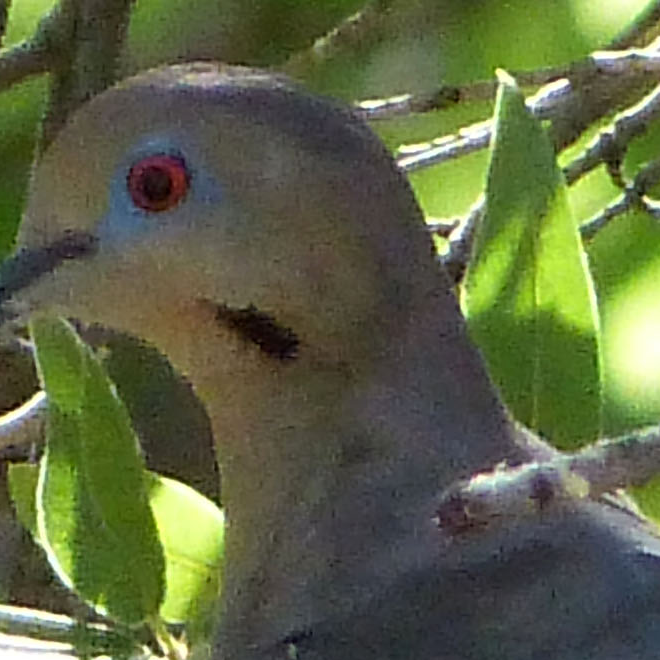
Same shape, softer marks — a young white-wing is scaly-brown with a narrower, duller wing stripe and little blue around the eye. Check the size (still big) and the hint of white in the wing, and it will not fool you for long.
White-winged Dove Vocalization Guide (3 Field Recordings)
The white-wing’s voice is one of the great mnemonic calls of American birding: a husky, rhythmic “who-cooks-for-you, who-cooks-for-youuu”, louder and more insistent than the Mourning Dove’s lament, rolling across southern neighborhoods from dawn to dusk. All three recordings below are real field audio, shared under commercial-use licenses via iNaturalist — no simulations. For a deeper library, browse xeno-canto: White-winged Dove.
1. The Campus Cooer
2. The Desert Voice
3. The Gulf Coast Newcomer
Habitat, Range & the Suburban Expansion
The White-winged Dove began as a bird of desert river valleys, thorn scrub, and saguaro country — the Southwest, Mexico, Central America, and the Caribbean. Today it is equally a bird of shade-tree suburbs, city parks, and backyard feeders, and its map is one of the most dramatic range expansions of any North American dove.

From Saguaro Country to the Gulf Coast — and Beyond
Read the map as a story still being written. The purple core — south Texas, Mexico, Central America, the Caribbean, and now Florida and the Gulf fringe — is year-round country. The orange breeding range pushes into Arizona, New Mexico, Oklahoma, and the southern Atlantic coast, and those northern breeders pull back (blue) in winter. Decade by decade, the colors creep north.
For backyard birders the message is simple: if you live in the southern half of the country and feed big seed, expect them — first as a novelty at the tray, then as a nesting pair down the street, then as a flock at the water dish.
Backyard Behavioral Patterns & Social Dynamics
The White-winged Dove is a confident, sociable feeder — bigger than the Mourning Doves it shares the yard with, and quick to learn a reliable station. Four behaviors explain most of what you will observe:
🌵 The Saguaro Specialist
This dove’s home ground is the Sonoran Desert, where it times its nesting to the saguaro cactus bloom — feeding on saguaro nectar, fruit, and seeds, and serving as one of the giant cactus’s important pollinators. The suburban birds at your feeder carry that desert biology with them: heat-tolerant, water-seeking, big-seed eaters.
🏙️ The Suburban Conqueror
Few native birds have taken to American backyards like this one. Fueled by feeders, shade trees, and mild winters, white-wings have spread from the Rio Grande Valley through Texas, along the Gulf Coast, across Florida, and up the Atlantic seaboard — one of the fastest natural range expansions on the continent, still underway.
🎵 The Who-Cooks-for-You Tenor
The male’s “who-cooks-for-you, who-cooks-for-youuu” is husky, rhythmic, and relentless — delivered from rooftops, wires, and bare snags, often for hours on spring mornings. Once the phrase clicks, you will hear it across the whole neighborhood and never confuse it with the softer Mourning Dove again.
🌽 The Big-Seed Feeder
White-wings swallow seeds whole and can handle large kernels — cracked and whole corn, milo, sunflower — storing them in the crop to digest on a safe perch. A flock works a platform methodically, then retires to a tree to loaf, which is why a busy morning can empty a tray by ten o’clock.
Problem: “A Flock of White-wings Empties My Platform Before the Smaller Birds Get a Turn. What Should I Do?”
The three most common white-wing worries all have proven answers:
First, the emptied platform: a dozen big, crop-stuffing doves can clear a tray fast — so serve a measured amount once or twice a day instead of keeping it topped up, and mix in safflower, which doves eat but squirrels and grackles largely refuse. Second, the crowd-out worry: white-wings are bigger and pushier than Mourning Doves, but the fix is geometry — add a second station across the yard and scatter part of the seed on open ground, and the flock spreads out so smaller birds can work the edges. Third, the noise and mess: a singing male on your chimney at dawn and droppings under the favorite roost tree are the price of admission — rake or hose the ground patch weekly, rotate the scatter zone, and remember the trade: you are hosting one of the great suburban wildlife success stories. Manage these three and a white-wing flock becomes the liveliest clientele in the yard.
Method 1: Set the Table — Big Seeds & Open Water
Design for a big, ground-feeding grain bird that drinks daily:
-
Serve Cracked Corn, Milo & Sunflower
Cracked corn, milo, black oil sunflower, and mixed grain — white-wings are built for big seed and swallow kernels whole. A corn-heavy ground mix is the fastest way to get their attention in expansion-range neighborhoods where they are still scouting for reliable stations.
-
Put Out a Large Platform or Ground Tray
A wide, stable platform or ground tray matches a bird this size — room to land, turn, and feed without perching acrobatics. The feeder style comparison guide covers platform and hopper options rated for bigger birds.
-
Spread Multiple Stations
One platform feeds the pushiest flock in the yard; two stations plus a ground scatter zone feed everyone — white-wings, Mourning Doves, sparrows, and House Finches alike.
-
Offer a Wide, Open Water Dish
White-wings drink daily, sucking water in a continuous draft, and desert-bred birds travel to water in numbers. A wide, shallow ground-level bath or water dish — the more open, the better — can attract a flock even before the feeders do; a heated bath keeps it working in winter.
Method 2: Build the Habitat — Grain Plants & Shade Trees
Feed the habit, not just the bird:
-
Let Sunflowers & Grain Plants Stand
Sunflowers, sorghum, millet, and native grasses left standing drop seed white-wings glean naturally all fall and winter. A slightly shaggy corner of yard is a self-refilling grain station.
-
Keep Tall Shade Trees & Snags
White-wings nest, roost, and sing from tall trees — live oaks, palms, mature shade trees — and stage in the canopy before dropping to feed. A big tree overlooking the feeding area is both billboard and nursery.
-
Offer a Sturdy Nesting Platform
Like their Mourning Dove cousins, white-wings build flimsy twig platforms — and they adopt sturdier bases when offered: a simple platform or nesting cone fixed in a tree fork gives the pair a foundation that survives wind, brood after brood of two cream-white eggs.
-
Clean the Patch & Keep Cats Indoors
Big flocks foul a fixed feeding spot fast — rake or hose the scatter zone weekly and rotate it. And because white-wings feed heavily on the ground and are slow to flush, keeping pet cats indoors is the single biggest safety upgrade you can give them.
Tool Solution: Recommended Hardware for White-winged Doves
Equipment matched to a big, ground-feeding, daily-drinking dove:
Large Platform / Ground Tray
A wide, rock-stable tray set low or on a post, filled with cracked corn, milo, and sunflower — sized so a big dove can land, turn, and swallow without balancing on a rim.
- • Seed: Cracked corn, milo, sunflower
- • Style: Large platform or ground tray
- • Placement: Open, within a dash of cover
Hopper Feeder with Wide Tray
A big hopper with a generous perching tray lets white-wings feed at a raised station alongside the cardinals — self-refilling, weather-protected grain for the days you are not home to scatter.
- • Seed: Sunflower, safflower, mixed
- • Style: Wide-tray hopper
- • Bonus: Serves cardinals & grosbeaks too
Wide Ground-Level Bird Bath
A wide, shallow bath at ground level — heated in winter — serves the white-wing’s daily drinking flights and turns your yard into a complete station: food, water, and cover in one stop.
- • Depth: 1–2 in, wide & open
- • Winter: Thermostatic heater
- • Placement: Near the ground feeding patch
Frequently Asked Questions
- Species Profile: The White-winged Dove (Zenaida asiatica) is a large 11.4 inch, 4.4–6.6 ounce dove (Columbidae) with a bold white wing stripe, band code WWDO — a desert native booming through southern suburbs.
- ID in One Look: Big and brownish-gray with a white stripe on the folded wing that opens into huge white patches in flight; blue bare skin around the red-orange eye, a thin black cheek line, and a rounded white-cornered tail.
- The Sound: A husky, rhythmic “who-cooks-for-you, who-cooks-for-youuu” from rooftops and snags — three real field recordings above.
- Range & Story: Native to the Southwest deserts, Mexico, Central America, and the Caribbean — a saguaro pollinator — now expanded through Texas, the Gulf Coast, Florida, and up the Atlantic seaboard; northern breeders migrate, southern birds stay year-round.
- Feeder Formula: Cracked corn, milo, and sunflower on a large platform or ground tray, multiple stations to share with Mourning Doves, and a wide open water dish at ground level.
- Backyard Neighbor: Bigger and pushier than a Mourning Dove but no villain — portion the seed, spread the stations, and enjoy one of America’s great suburban bird success stories.
Bird Watching Log
Species: White-winged Dove (Zenaida asiatica)
| White-winged Dove (White Wing Stripe Seen: Yes / No — Feeder Visits: ___ — Who-Cooks-for-You Heard: Yes / No — Flock Size: ___) | |