
Bushtit


Bushtit (Psaltriparus minimus): Complete Identification, Feeder Guide & Call Library
Quick Answer: How to Attract & Identify Bushtits
The Bushtit (Psaltriparus minimus) is North America’s tiniest flocking songbird — a 3.9–4.3-inch, 5–6-gram mite of plain gray-brown with a long tail, a tiny stubby black bill, and a flock of ten to forty close behind. The only New World member of the long-tailed tit family (Aegithalidae), it swarms suet cages, hangs upside down to glean insects, and keeps up a constant high, thin “tsee-tsee” chatter instead of a true song. Tell the sexes by the eyes: males dark, females pale yellow. A non-migratory resident of the Pacific coast and interior West, it weaves a hanging sock-shaped nest of spiderwebs and lichen. Attract a flock with suet cages near shrub cover, finely chopped peanuts, and a mister or shallow bath.
Species Physical Profile & Morphometrics
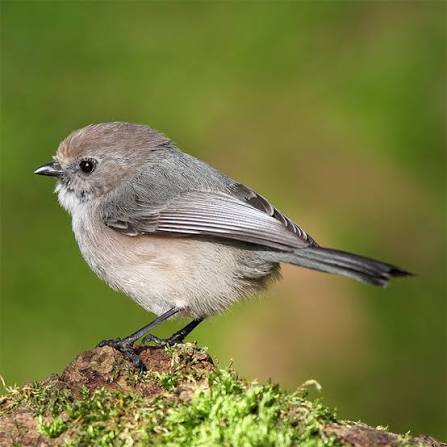
The Bushtit is the only New World member of the long-tailed tit family (Aegithalidae) — a relative of the Eurasian long-tailed tits, not of the chickadees and titmice (Paridae) it is so often mistaken for. One glimpse of the whole bird settles it: a tiny gray-brown puff, a tail that looks too long for the body, and a bill so small it seems borrowed from a warbler.
In the field, watch the eyes and the ears. Adult males have dark brown eyes; adult females have striking pale yellow eyes — one of the easiest ways to sex any backyard bird. In the interior Southwest and Mexico, many males belong to the “black-eared” group (melanotis), wearing a bold black patch on the ear coverts over buffy flanks. And if you see one Bushtit, look again: they are almost never alone.
Essential Morphometric Field Marks:
- Body Length & Mass: Averages 3.9 to 4.3 inches (10–11 cm) with an adult mass of just 0.18 to 0.21 ounces (5–6 grams) — one of the smallest songbirds in North America.
- Wingspan: About 6 inches (15 cm), with short rounded wings and a very long, narrow tail that accounts for much of the bird’s length.
- Bill Structure & Color: A tiny, stubby black bill — an insect-gleaning tool that cannot crack large seeds, which is why crumb-size feeder fare matters.
- Color Pattern: Plain sooty gray-brown above, paler buff-gray below, brownish cap, unmarked face. Coastal birds are brownest; interior birds are grayer.
Dark brown eyes in a plain gray face. Males of the interior Southwest and Mexico (the melanotis group) add a black ear patch and buffier flanks — the “black-eared” Bushtit once treated as a separate species.
Pale cream-yellow eyes — the single fastest field mark on the species. Otherwise identical to the male: plain gray-brown plumage, long tail, tiny stubby bill. Juveniles of both sexes start dark-eyed; young females pale up within their first months.
Bushtit Vocalization Guide (2 Field Recordings + 1 Simulation)
Bushtits have no true song — instead the flock runs a constant commentary of very high, thin contact notes: “tsee,” “tsit,” and rapid “tsee-tsee-tsee” twittering that lets the birds stay coordinated as they flow through the shrubs. Learn that sibilant flock chatter and you will find Bushtits by ear long before you see them. The first two cards below are real field recordings with open licenses; the third is a clearly labeled simulation of the everyday contact call.
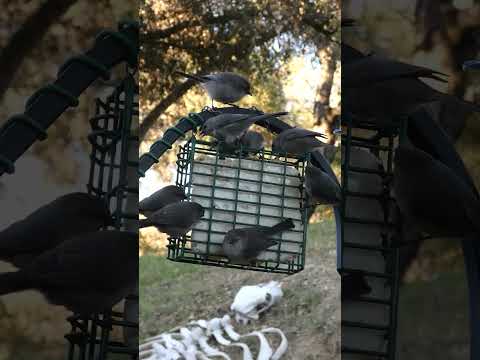
1. Foraging Flock — Coast Live Oak
2. Close-Range Calls — Vocalization Study
3. Contact Call Simulation — “Tsee-Tsee-Tsee”
Habitat, Range & Year-Round Resident Biology
Bushtits are birds of scrub, open woodland, and garden edges — coastal scrub and oak woodland in California, pinyon-juniper and mountain mahogany in the interior West, chaparral, riparian corridors, and shrubby suburbs throughout. The year-round range runs from southwestern British Columbia down the entire Pacific coast, through the hills and mountains of the interior West to parts of Texas, and south through Mexico to the highlands of Guatemala.

A Homebody with a Wandering Flock
Bushtits never migrate. Outside the breeding season, flocks of ten to forty birds wander a local home range — working through oaks, scrub, and backyard shrubs in a rolling wave, then moving on, then circling back days later.
A yard with dense shrubs, a suet cage, and water becomes a regular stop on the flock’s daily circuit. In the interior West they often travel in mixed company with Mountain Chickadees, nuthatches, and kinglets; on the Pacific slope, watch for them alongside Chestnut-backed Chickadees.
Backyard Behavioral Patterns & Social Dynamics
Bushtits pack more energy per gram than anything else at the feeder. Four signature behaviors explain most of what you will observe:
🐦 The Ten-Bird Minimum
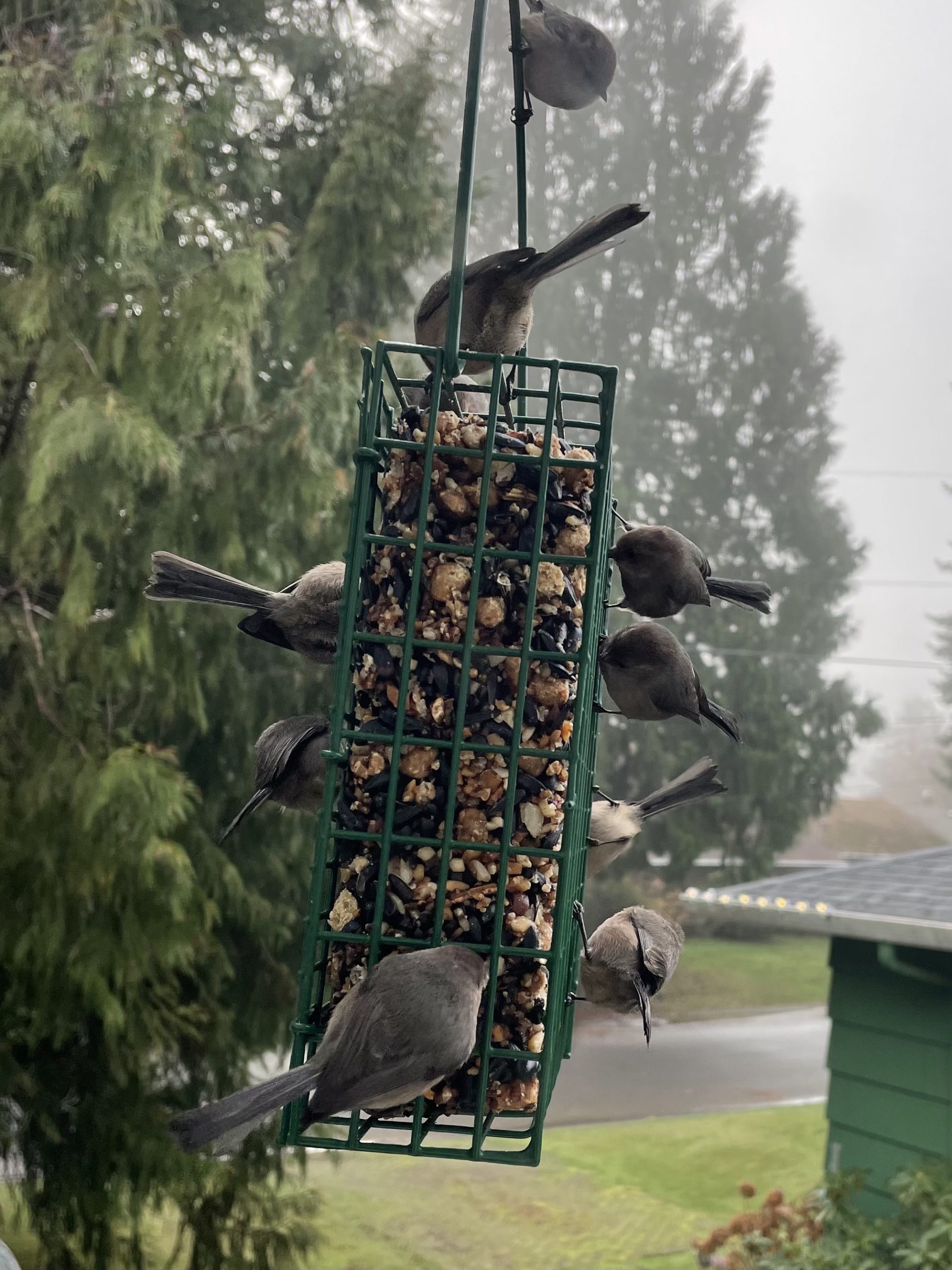
A Bushtit alone is a rarity — the birds travel in chattering flocks of 10–40 that move through the shrubs like a single organism. One scout finds your suet cage, calls, and thirty seconds later the cage is blanketed in gray birds, exactly like the gallery photo.
🧦 The Sock-Nest Weavers
The nest is a hanging pouch up to a foot long, woven from spiderwebs, moss, and lichen and lined with plant down and feathers — so elastic it stretches as the nestlings grow. Both parents build, and extra adult males sometimes help feed the young.
👀 Check the Eyes
Dark eye, male. Pale yellow eye, female. Few backyard birds make sexing this easy — and in the interior Southwest, the black-eared males are unmistakable. A pair of binoculars on the flock at your suet cage turns into a field-mark workshop.
💦 Mister & Bath Fans
Bushtits are drawn to moving water — flocks shower in garden misters and crowd shallow baths, especially in the dry interior West. A mister aimed into shrub foliage can pull a passing flock straight into the yard.
Problem: Why Bushtits Sweep Through — Then Never Come Back
Across the West the usual complaint runs: “a flock hit my feeder once, and I haven’t seen them since.” The reasons are predictable:
First, this is a flock bird on a circuit: the group samples a stop and moves on, so a single visit means your yard is on the route but not yet worth a detour — steady suet is what turns a sample into a habit. Second, the menu matters: a tiny stubby bill cannot crack whole sunflower seeds or handle large chunks, so standard mixes get ignored. Third, exposure kills the deal: an open lawn with one pole feeder offers no shrub corridor, and a flock that must cross open sky in hawk country will forage somewhere with cover. Put crumb-size food near dense shrubs, add moving water, and the flock will fold your yard into its daily round.
Method 1: Set the Table — Suet, Crumbs & Water
Design for a flocking acrobat with a tiny bill:
-
Hang a Suet Cage a Flock Can Swarm
A simple wire suet cage is the single best Bushtit feeder — cling-friendly on every face, so ten birds can feed at once. Stock it with a nut or insect blend. Our lab-tested roundup of the Best Suet Feeders & Cakes compares proven models.
-
Crumble Everything Fine
Think suet crumbles, finely chopped unsalted peanuts, and hulled sunflower chips — bite sizes a 5-gram bird with a stubby bill can actually swallow. Skip whole large seeds entirely.
-
Keep Feeders a Short Dart from Cover
Hang the cage within a few feet of dense shrubs or a hedge. The flock stages in cover, pours out to feed, and pours back — a feeder stranded in the open gets sampled once and abandoned.
-
Add Moving Water
A mister or dripper aimed into shrub foliage, or a shallow bath at ground level, is a flock magnet — above all in the arid West. In freezing snaps, a heated bird bath keeps the station open when natural water locks up.
Method 2: Keep Them Year-Round — Shrubs & Nest Materials
Turn a passing flock into permanent neighbors:
-
Plant a Shrub Corridor
Bushtits commute through connected cover — hedges, native scrub, and bushy plantings. Link your feeders to the wilder corners of the neighborhood with shrubs, and the flock’s daily route will run straight through your yard.
-
Leave the Webs, Lichen & Slender Twigs
The sock nest is built from spiderwebs, moss, and lichen, hung from thin forked twigs. Ease off the deep spring clean-up in the shrubs from late winter on — you are looking at raw building material and scaffolding.
-
Skip the Pesticides
Nestlings are raised almost entirely on tiny insects and spiders gleaned from foliage. A sprayed yard is an empty pantry; an unsprayed shrub layer is a stocked one.
-
Feed Through Every Season
Because flocks never migrate, summer reliability matters as much as winter. Keep suet stocked year-round — the flock that nests nearby in spring is the same one that will huddle through your coldest nights.
Tool Solution: Recommended Hardware for Bushtits
Equipment matched to a tiny, flocking, crumb-eating acrobat:
Hanging Suet Cage
The classic wire cage every face of which a flock can cling to — the one feeder design a dozen Bushtits can mob at the same time.
- • Cake: Nut or insect blend
- • Access: Clingable on all sides
- • Mount: Hook near shrub cover
Mesh Peanut / Chip Feeder
Finely chopped unsalted peanuts, suet crumbles, and hulled sunflower chips in a mesh or small-port feeder — sized for a 5-gram bird with a stubby bill.
- • Nuts: Chopped fine, unsalted
- • Chips: Hulled sunflower hearts
- • Avoid: Whole large seeds
Shallow Bath + Mister
A ground-level shallow bath with a dripper or mister aimed into nearby foliage — the fastest way to pull a passing flock into the yard in dry country.
- • Depth: 1–2 in, gently sloped
- • Extra: Dripper or mister
- • Winter: Heated in cold snaps
Frequently Asked Questions
- Species Profile: The Bushtit (Psaltriparus minimus) is a 3.9–4.3 inch, 5–6 gram songbird in plain gray-brown with a long tail and a tiny stubby black bill — the only New World member of the long-tailed tit family (Aegithalidae).
- Western Resident: Non-migratory from southwestern British Columbia down the Pacific coast, through the interior West to Texas, and south through Mexico to Guatemala.
- Sexes by Eye Color: Males are dark-eyed, females pale yellow-eyed; interior Southwest and Mexican “black-eared” males (melanotis) wear a bold black ear patch.
- Feeder Formula: A suet cage the flock can swarm, suet crumbles, and finely chopped peanuts near shrub cover — plus a mister or shallow bath, the top draw in dry country.
- The Sock Nest: A hanging pouch up to a foot long woven of spiderwebs, moss, and lichen; both parents build it, and helper males sometimes assist at the nest.
- Flock Life: Travels in parties of 10–40, keeps up constant high, thin “tsee-tsee” contact calls instead of a song, and huddles shoulder-to-shoulder on cold nights.
Bird Watching Log
Species: Bushtit (Psaltriparus minimus)
| Bushtit (Eye Color / Flock Size: ____________________________) | |