
Inca Dove


Inca Dove (Columbina inca): Complete Identification, Feeder Guide & Call Library
Quick Answer: How to Attract & Identify Inca Doves
The Inca Dove (Columbina inca) is the tiny scaly dove of Southwest towns — from southern California and Arizona across Texas and down through Mexico — a dove so small it looks half the size of a Mourning Dove, covered in a fish-scale feather pattern, with a long white-edged tail and rufous wing patches that flash in flight. Its soft two-note “no-hope” coo runs in the background all morning, and on cold days the flock famously huddles — even stacking into living pyramids — to share warmth. Attract them with fine millet and tiny cracked grain scattered on bare open ground or a low tray, a shallow water dish, and a sunny dust bath patch — they share the quiet corner with the Dark-eyed Junco.
Species Physical Profile & Morphometrics
The Inca Dove belongs to the pigeon and dove family (Columbidae) — a Columbina ground-dove, built small and long-tailed for life on the ground in hot, open country. Despite the name, it has nothing to do with the Inca Empire; it is a bird of Mexican and Southwestern towns that just barely spills into the United States — and keeps pushing north.
The identification formula: tiny dove + scaly plumage + long white-edged tail + rufous wing flash. The two birds it is compared with most: the Mourning Dove, which is twice its bulk with smooth plumage and a pointed tail; and the Common Ground Dove of the southern tier, which is even smaller and short-tailed, with scaling only on the head and breast. No other backyard dove is scaled from crown to tail tip.
Essential Morphometric Field Marks:
- Body Length & Mass: 6.5 to 9.1 inches (16.5–23 cm) — much of it tail — and just 1.0 to 1.7 ounces (28–48 grams); barely a third the weight of a Mourning Dove.
- Wingspan: 11.0 to 12.6 inches (28–32 cm); flight is quick and low, and the wings burst into rich rufous-chestnut the instant the bird takes off.
- Bill Structure & Color: A small, thin dark bill — built for picking up tiny seeds, useless on big kernels; serve fine grain for this bird.
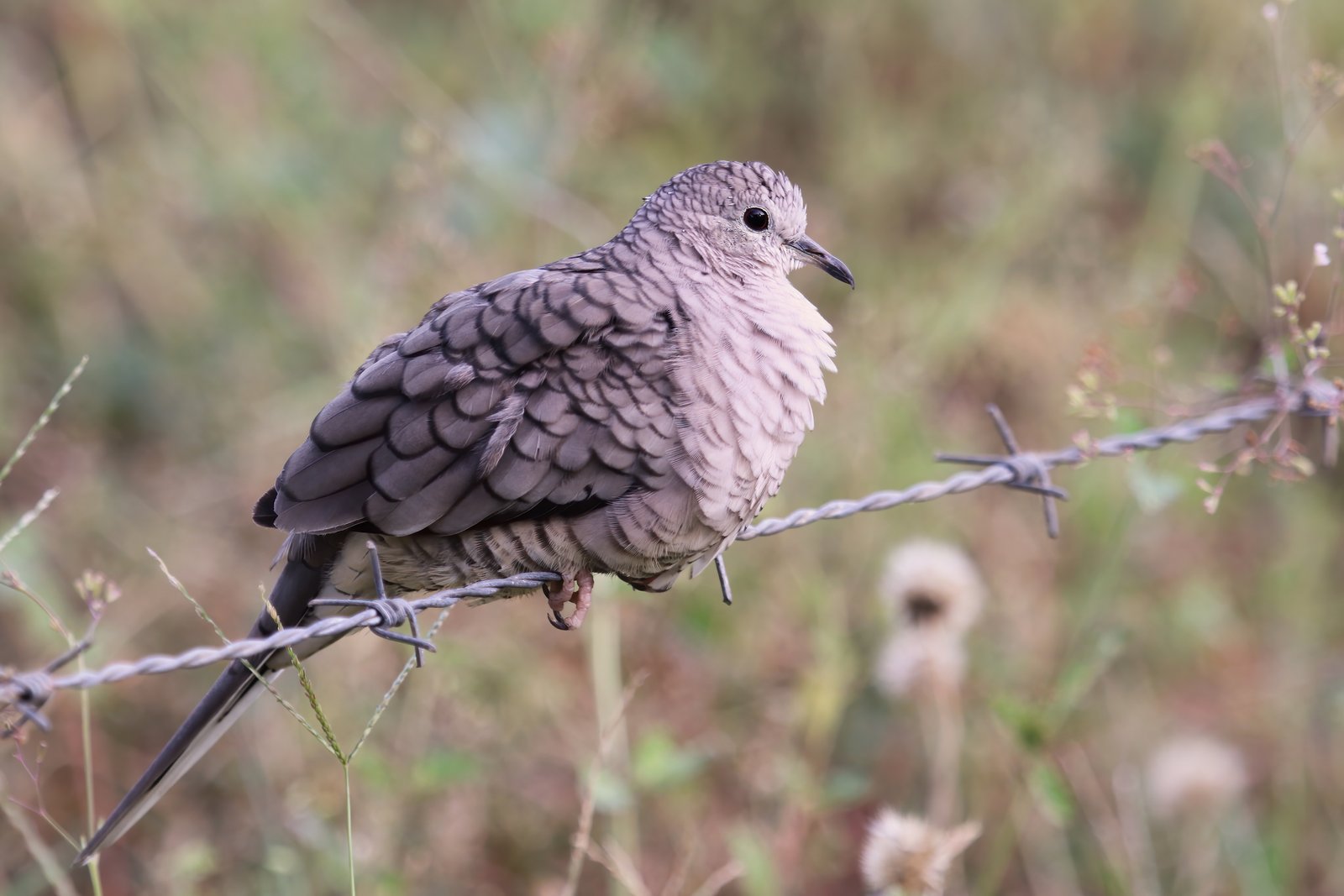
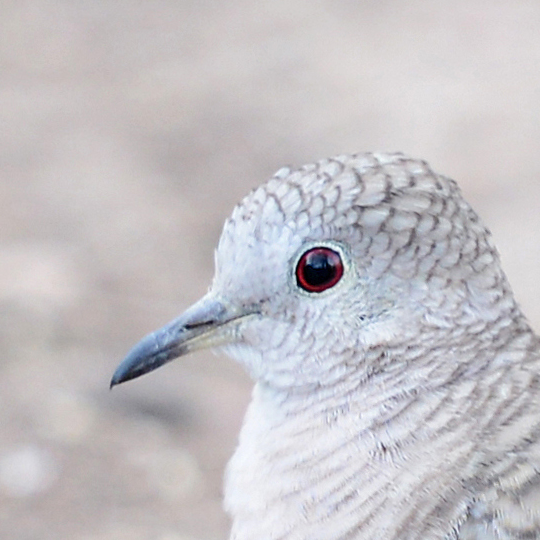
- Color Pattern: Soft tan-gray overall, every body feather edged in dark brown to create the famous scaly look. The eyes are red, the legs pink, and the long tail is framed with white outer feathers that show in flight.
- Male, Female & Juvenile: The sexes look alike — same scales, same size. Juveniles are duller and smoother, with softer scaling and a shorter-looking tail until their first adult molt.
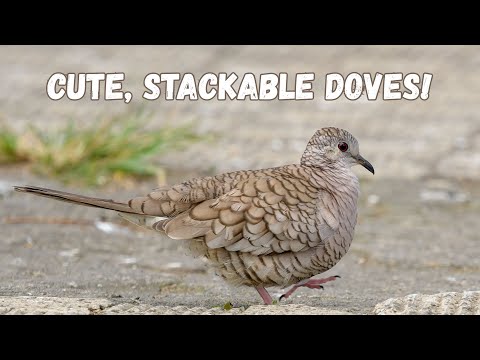
The walking fish-scale: crisp dark-edged feathers from crown to belly, red eyes, and a long white-framed tail. In flight the wings flash warm chestnut — the mark that settles any doubt. Adults coo their two-note phrase from wires and rooflines through much of the year.
Same tiny shape, softer paint — a young Inca Dove is browner and smoother, the scaling muted, the rufous wing patch smaller. Check the tiny size, long tail, and bare-ground feeding style, and it still reads as an Inca.
Inca Dove Vocalization Guide (3 Field Recordings)
The Inca Dove’s voice is a soft, two-note coo — endlessly repeated, often written “no-hope, no-hope” — quiet enough to become background music in a Southwest neighborhood. All three recordings below are real field audio, shared under commercial-use licenses via iNaturalist — no simulations. For a deeper library, browse xeno-canto: Inca Dove.
1. The Christmas Eve Cooer
2. The Colorado River Voice
3. The Heartland Voice
Habitat, Range & the Town Specialist
The Inca Dove is a bird of people: town plazas, ranch yards, city parks, farmsteads, and suburban neighborhoods — anywhere in the warm Southwest with open bare ground to feed on, shrubs to roost in, and water nearby. It is rare in wild desert away from settlement; the town is its habitat.

One Color, One Story: Home Year-Round
The map is a single green band — southern California and Arizona through New Mexico and Texas, then down through Mexico to Costa Rica — because Inca Doves simply do not migrate. They live where they live, all year, and they are strictly limited by cold: hard freezes, not seasons, draw the northern boundary.
The trend line, though, is northward. Following towns, feeders, and warming winters, Inca Doves have pushed well beyond their historic range in recent decades — a slow, steady expansion measured one backyard at a time.
Backyard Behavioral Patterns & Social Dynamics
The Inca Dove is a gentle, sociable ground bird — the quiet regular that slips under the feeder while the bigger doves argue on the tray. Four behaviors explain most of what you will observe:
🔺 The Pyramid Rooster
The signature act: on cold mornings Inca Doves huddle shoulder to shoulder — and when that is not enough, they climb onto each other’s backs, stacking two or even three layers deep into a living pyramid. The pile slashes heat loss and lets a cold-sensitive tropical dove survive desert winter nights.
☀️ The Sun Worshipper
Watch a frosty morning and you will see the whole flock fluffed to twice its size on sunny walls and branches, feathers puffed to trap warm air, sometimes sunbathing with wings slightly spread. Warmth management is the Inca Dove’s full-time winter job.
🏜️ The Bare-Ground Forager
Inca Doves feed on open, bare dirt — walking slow circles, picking up seeds almost too small to see. Lawns mowed short, dusty paths, and the spill zone under feeders are their dining room; a bare dust bath patch gets daily use, with birds wriggling belly-deep into dry soil.
🏘️ The Town Bird
Unlike most doves, the Inca is a commensal of humans: plazas, patios, ranch yards, and feeders are its habitat, and wild backcountry holds few of them. A yard with fine seed, water, and a thorny shrub is a complete estate — and the pair may nest several times a year in that same shrub.
Problem: “Tiny Inca Doves Get Bullied Off My Feeder by Bigger Birds. How Do I Feed Them?”
The three most common Inca Dove worries all have proven answers:
First, the bullying: at a single busy platform, big Mourning Doves, grackles, and pigeons win every time — so don’t feed Incas at the platform at all. Scatter fine millet on open ground in a separate quiet corner near shrub cover, and the Incas will own it; bigger birds prefer the loaded tray. Second, the wrong seed: whole corn and big kernels are wasted on a one-ounce dove with a pin of a bill — white proso millet and finely cracked grain are the Inca Dove menu, and cheap. Third, the cold snaps: a hard freeze is genuinely dangerous for this tropical dove — keep seed and unfrozen water reliable through cold spells, leave sunny wind-sheltered corners undisturbed, and let huddled birds be; a yard that carries them through February keeps them for years. Solve these three and the smallest dove in America becomes your most loyal regular.
Method 1: Set the Table — Fine Seeds on Open Ground
Design for a tiny, ground-feeding, fine-billed dove:
-
Scatter Fine Millet & Tiny Cracked Grain
White proso millet, red millet, and finely cracked corn — seed small enough for a bill built for grass seeds. Scatter a measured handful on open ground each morning rather than maintaining a pile, and refresh daily.
-
Use a Low Tray — or Just the Bare Earth
A low ground tray keeps fine seed clean and visible, but honestly the Inca Dove is happy with swept bare dirt: a cleared patch under the feeder pole becomes its private dining room. Keep it away from the big-bird platform so there is no competition.
-
Create a Quiet Corner Near Cover
Feed them within a quick dash of dense shrubs — Incas feed exposed and need instant escape from hawks and cats. A scatter zone two or three feet from a thorny bush beats an open lawn every time.
-
Offer Water & a Dust Bath Patch
A shallow water dish at ground level serves daily drinkers, and a dry, dusty patch of bare soil serves the other daily ritual: dust bathing, belly-deep, feathers working through the dirt. Both are free, and both get used.
Method 2: Build the Habitat — Thorny Cover & Sun Patches
Feed the habit, not just the bird:
-
Plant Dense, Thorny Shrubs
Dense, twiggy, thorny shrubs — and dense evergreens — are Inca Dove infrastructure: nighttime roosts safe from cats, shade at noon, and favored nesting sites for the small twig platform and its two white eggs. One good shrub can hold a pair for years of broods.
-
Leave Sunny, Wind-Sheltered Corners
A cold-sensitive dove chooses its yard by microclimate: south-facing walls, sheltered fences, and sun-trap corners where the flock can fluff and warm up after a cold night. Leave these spots open and undisturbed — they are as valuable as the seed.
-
Let Grasses & Weeds Go to Seed
Lawn grasses, amaranth, and garden weeds left standing drop exactly the tiny seeds Inca Doves evolved to eat. A slightly shaggy edge of yard is a self-refilling feeder sized for their bills.
-
Keep Cats Indoors — Especially at Ground Level
A one-ounce dove feeding on bare ground is the most vulnerable bird in the yard. Keeping pet cats indoors is the single biggest safety upgrade you can give Inca Doves — and every other ground-feeding bird that shares their patch.
Tool Solution: Recommended Hardware for Inca Doves
Equipment matched to a tiny, ground-feeding, fine-billed dove:
Low Ground Tray
A small, low tray set near shrub cover, filled with white millet and finely cracked grain — the exact scale an Inca Dove is built for, and easy to keep separate from the big-bird stations.
- • Seed: White millet, fine cracked corn
- • Style: Low ground tray
- • Placement: Beside dense cover, away from platforms
Hopper Feeder with Wide Tray
A hopper with a generous tray holds mixed seed for the whole neighborhood flock — keep it stocked with a millet-forward mix so the small doves get their share alongside the cardinals.
- • Seed: Millet-forward mixed seed
- • Style: Wide-tray hopper
- • Bonus: Serves sparrows & finches too
Shallow Ground-Level Bird Bath
A shallow bath at ground level — heated in winter so cold snaps never cut off water — serves the Inca Dove’s daily drinking rounds and every other ground bird in the yard.
- • Depth: 1–2 in, gently sloped
- • Winter: Thermostatic heater
- • Placement: Near the quiet feeding corner
Frequently Asked Questions
- Species Profile: The Inca Dove (Columbina inca) is a tiny 6.5–9.1 inch, 1.0–1.7 ounce dove (Columbidae) scaled head to tail, band code INDO — a year-round resident of Southwest towns from California to Texas and south to Costa Rica.
- ID in One Look: Small, slim, and fish-scaled all over, with red eyes, a long white-edged tail, and rufous wing patches that flash the instant it flies.
- The Sound: A soft two-note coo — “no-hope, no-hope” — running in the background all morning; three real field recordings above.
- The Famous Behavior: Pyramid roosting — on cold mornings the flock huddles and even stacks two or three layers deep to share warmth; watch sunny walls and branches after a cold night.
- Feeder Formula: White millet and fine cracked grain scattered on bare ground or a low tray in a quiet corner near cover — never big kernels — plus a shallow water dish and a dust bath patch.
- Cold Is the Enemy: Non-migratory but freeze-limited; reliable seed, unfrozen water, and sunny wind-sheltered corners carry them through winter — and keep them in your yard for years.
Bird Watching Log
Species: Inca Dove (Columbina inca)
| Inca Dove (Scaly Plumage Seen: Yes / No — Feeder Visits: ___ — Double Coo Heard: Yes / No — Huddle Seen: Yes / No) | |