
Green-tailed Towhee


Green-tailed Towhee (Pipilo chlorurus): Complete Identification, Habitat Guide & Sound Library
Quick Answer: How to Attract & Identify the Green-tailed Towhee
The Green-tailed Towhee (Pipilo chlorurus) is the smallest and shyest western towhee — gray-breasted with an olive-green back and tail, a rufous crown, and a crisp white throat. It breeds in brushy mountain slopes across the West and winters in the desert Southwest. The voice is a cat-like mew and a sweet, hurried song. Western yards attract them with scattered millet beside dense brush and low water. They share the thickets with the Spotted Towhee and the mountain sparrow clan.
Species Physical Profile & Morphometrics
The Green-tailed Towhee belongs to the New World sparrow family (Passerellidae) and is the smallest towhee — a bird of brushy mountain slopes from Washington to Montana south through California, Nevada, Utah, and Colorado, wintering in the Southwest and Mexico.
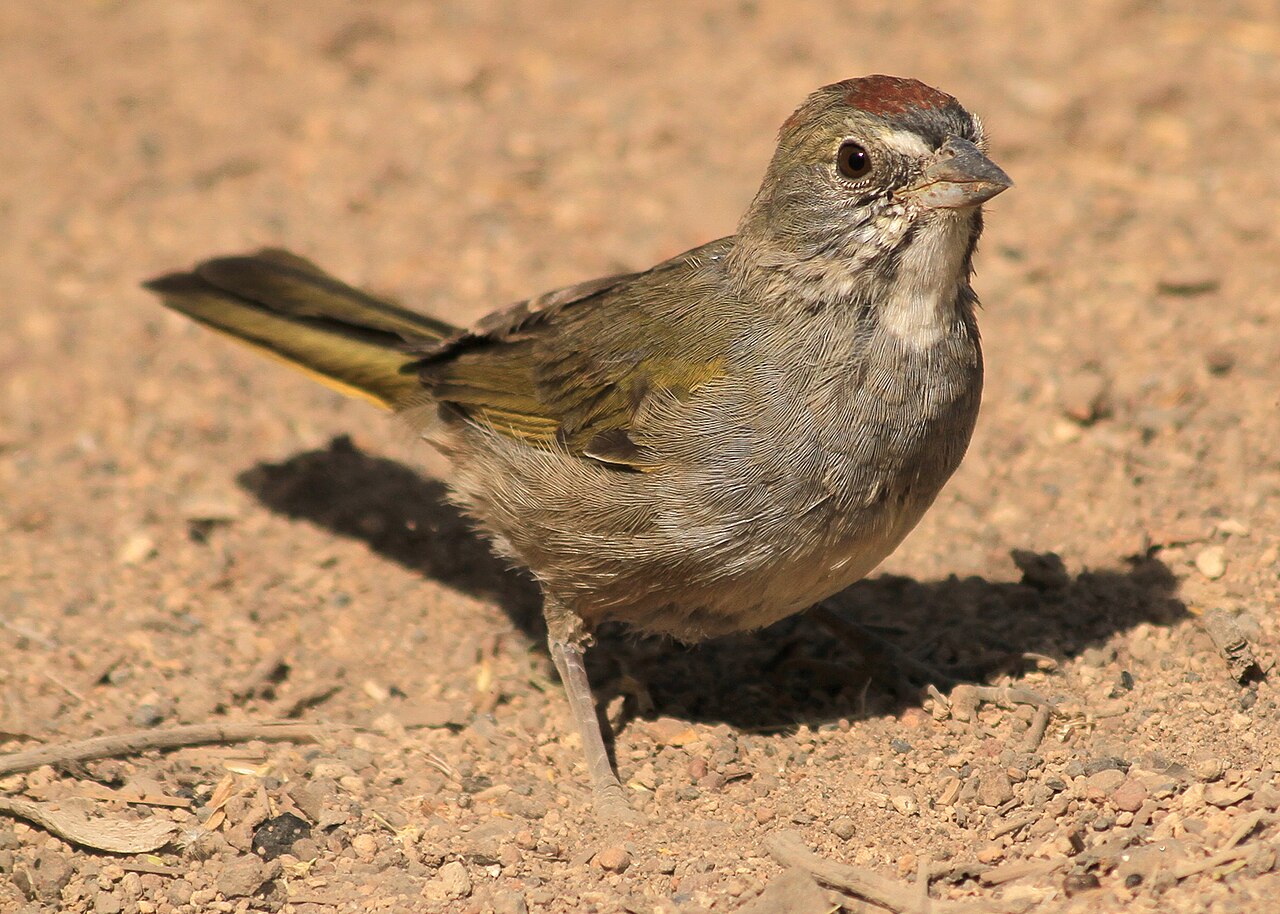
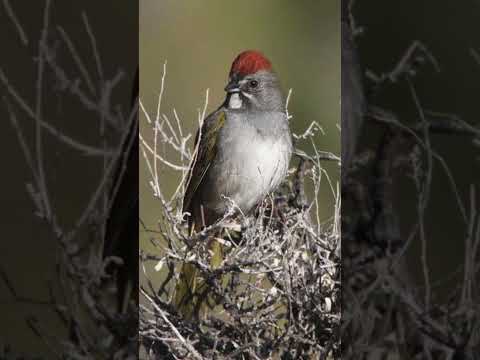
The identification formula: rufous crown + white throat + olive-green back and tail. No other western ground sparrow combines the three. A Spotted Towhee is black-headed and white-spotted; a Green-tailed is gray-breasted and green-backed — and much fonder of staying hidden.
Essential Morphometric Field Marks:
- Body Length & Mass: 6.3 to 7.1 inches (16–18 cm) and 0.7 to 1.2 ounces (20–35 grams) — noticeably smaller than other towhees, slim and quick.
- Wingspan: 9.4 to 10.6 inches (24–27 cm); flight is low and darting — thicket to thicket, never across open ground.
- Bill Structure & Color: A small, dark, conical bill — finer than a Spotted Towhee’s, suited to small seeds and summer insects.
- Color Pattern: Gray head and breast, olive-green back, wings, and tail, rufous crown, white throat patch, and pale belly — subtle, clean, and lovely at close range.
- Male vs. Female: The sexes look alike — both wear the rufous crown; only behavior (the male sings) separates them in the breeding season.
The crowned singer: rufous cap catching the light as he sings his sweet, hurried song from a sagebrush top — brief glory, then back into the brush.
Identically plumaged — rufous crown and all — she nests low in dense mountain brush, slipping to the ground to scratch for seeds beneath the thicket’s edge.
Green-tailed Towhee Vocalization Guide (0 Field Recordings)
The Green-tailed Towhee’s voice is a sweet, hurried song of slurred notes and trills plus a cat-like mew call. All recordings below are real field audio via Wikimedia Commons — no simulations. For a deeper library, browse xeno-canto: Green-tailed Towhee.
1. The Hurried Song
2. The Mew
3. Brush-Line Song
Habitat, Range & the Brushy Slope
The Green-tailed Towhee breeds in brushy mountain habitat: sagebrush slopes, snowberry and serviceberry thickets, aspen edges, and recovering burns across the West. In winter it drops to desert scrub and brushy lowlands of the Southwest — twice a year, migration funnels it through foothill yards.

The Thicket’s Rufous Crown
Breeding range spans the western mountains and Great Basin from Washington and Montana to California and Colorado. Winter takes the population to Arizona, New Mexico, Texas, and Mexico — with spring and fall passage through foothill yards between.
For backyard birders: May and September bring migrants to brushy yards at middle elevations; winter yards in the desert Southwest can host them all season with scattered millet and dense cover.
Backyard Behavioral Patterns & Social Dynamics
The Green-tailed Towhee is a thicket-bound, sweet-voiced skulker. Four behaviors explain most of what you will observe:
🌿 The Skulker
It feeds and travels inside dense brush, emerging to sing or dash across gaps — most sightings are a rufous crown disappearing into leaves.
🍂 The Litter Scratcher
Like all towhees it double-scratches in leaf litter — the rustle under the thicket edge at dawn gives it away.
🎵 The Brief Soloist
The male sings a sweet hurried song from a low exposed perch — a few phrases at dawn, then silence; June mornings are the window.
🐱 The Ventriloquial Mew
The cat-like mew is hard to locate — birders learn to check the brushy slope whenever a distant kitten seems to cry from the sage.
Problem: “I Hear the Sweet Song at Dawn but Never See the Bird. What Should I Do?”
The three most common Green-tailed Towhee puzzles all have proven answers:
First, the phantom singer: the male sings from a low perch at the thicket edge, then drops in — mark the singing perch at dawn, glass it from a seat thirty feet off, and wait; he returns to the same perch. Second, the feeder refusal: it will not visit feeders in the open — scatter millet at the brush line and tuck water beside cover; move the table to the bird, never the reverse. Third, the seasonal mystery: it is present in mountain country May–August and desert lowlands October–March — a yard between the two zones gets passage visits only; log the windows and watch the brush edge when the calendar turns.
Method 1: Set the Table — Millet at the Thicket Edge
Design for a cover-bound ground feeder:
-
Scatter at the Brush Line
White millet scattered where brush meets open ground — a towhee’s feeding strip, never the open lawn.
-
Tuck Water Beside Cover
A shallow dish at the thicket edge — migrants drink and bathe where a dash to cover takes one second.
-
Leave Litter Under Brush
Leaf litter under shrubs is the natural table — the scratching sounds will lead you to the bird.
-
Feed in Migration Windows
May and September at mid-elevation, October–March in the desert Southwest — stock the brush line when the calendar says so.
Method 2: Build the Habitat — Dense Low Brush
Plant the thicket, and the rufous crown moves in:
-
Plant Native Thickets
Snowberry, serviceberry, sagebrush, and wild rose — dense, waist-high tangles are towhee real estate.
-
Keep Edges Feathered
Soft, brushy transitions between lawn and wild ground — hard mowed edges are walls to a skulking bird.
-
Leave Brush Piles
A brush pile at the thicket margin is instant cover — feeding platform and panic room in one.
-
Give Dawn Its Quiet
Still, quiet mornings are when the bird shows — keep the yard calm at dawn in May and June.
Tool Solution: Recommended Hardware for Green-tailed Towhee
Equipment matched to a brush-edge towhee:
Brush-Line Millet Scatter
White millet scattered daily along the thicket edge — the reliable way to pull a skulker into the open inch by inch.
- • Food: White millet
- • Placement: Brush line
- • Timing: Dawn
Shallow Water at Cover
A shallow dish tucked against the brush — the migrant’s first stop and the resident’s daily habit.
- • Depth: One inch
- • Placement: At cover edge
- • Care: Daily refresh
Native Thicket Plantings
Snowberry, serviceberry, and wild rose — the living cover that turns a passage yard into a territory.
- • Plants: Snowberry, serviceberry
- • Structure: Dense, waist-high
- • Bonus: Warblers & wrens too
Frequently Asked Questions
- Species Profile: The Green-tailed Towhee (Pipilo chlorurus) is a 6.3–7.1 inch, 0.7–1.2 ounce sparrow (Passerellidae), band code GTTO — the small rufous-crowned skulker of western brush.
- ID in One Look: Rufous crown, white throat, gray breast, olive-green back and tail.
- The Sound: A sweet hurried song and a ventriloquial cat-like mew; real field recordings above.
- Range & Habit: Breeds in western mountain brush, winters in desert scrub; never strays far from dense cover.
- Feeder Formula: Millet at the brush line, water at cover’s edge, litter under shrubs, native thickets.
- The Cover Rule: No thicket, no towhee — plant the brush and the rufous crown will find it.
Bird Watching Log
Species: Green-tailed Towhee (Pipilo chlorurus)
| Green-tailed Towhee (Rufous Crown Seen: Yes / No — Song Heard: Yes / No — Mew Heard: Yes / No — At Brush Seed: Yes / No — Date & Time: ___) | |