
Common Grackle
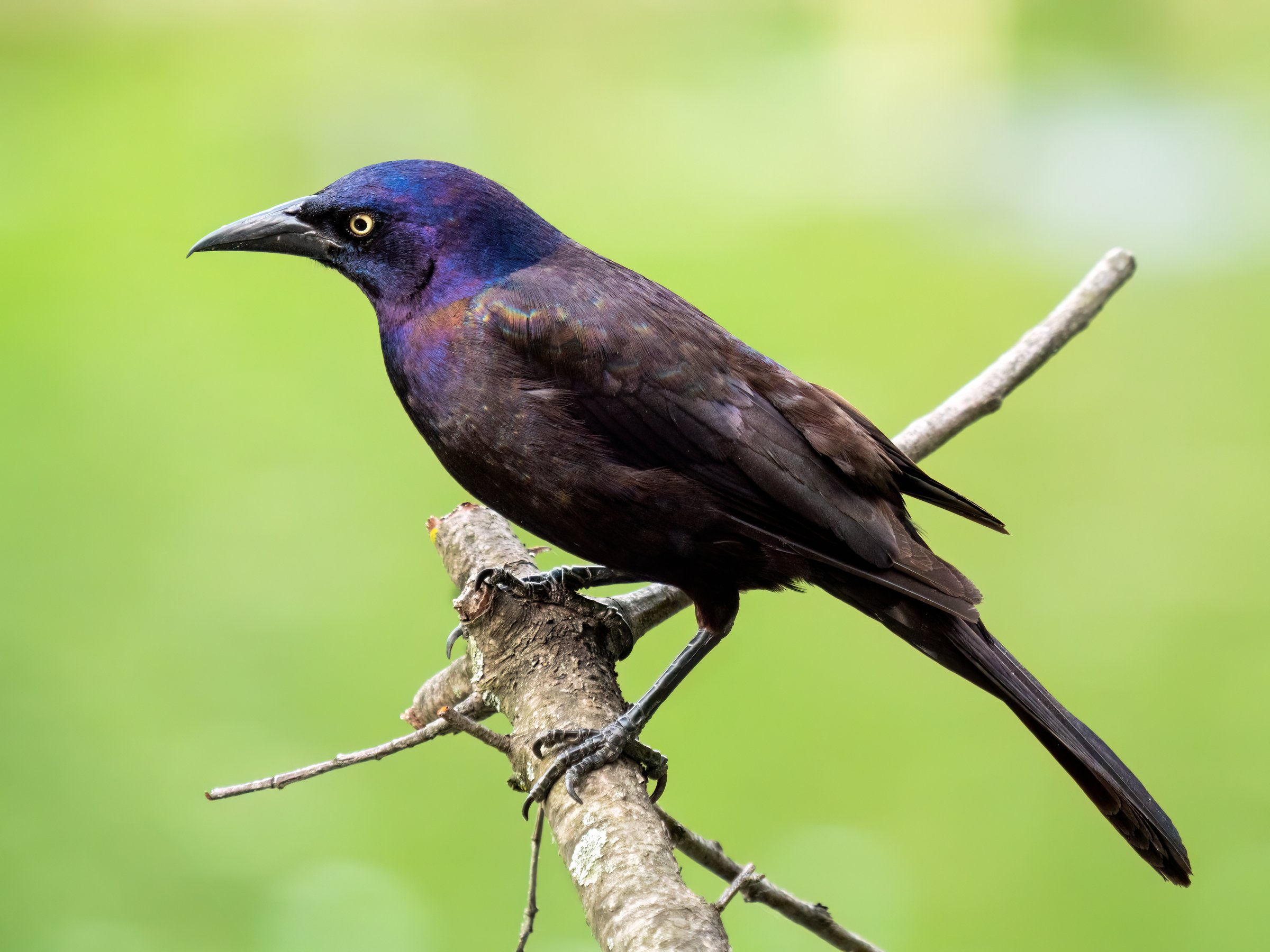
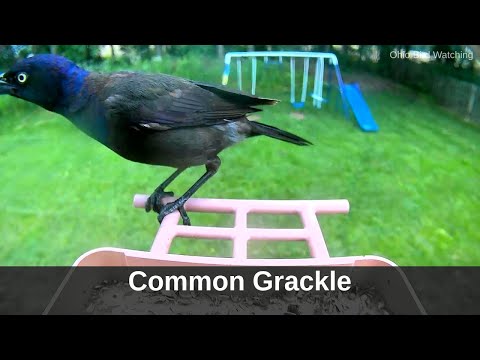


Common Grackle (Quiscalus quiscula): Complete Identification, Feeder Guide & Song Library
Quick Answer: How to Identify & Manage Common Grackles
The Common Grackle (Quiscalus quiscula) is the big, long-tailed blackbird with the iridescent blue-purple hood and pale golden eye, common east of the Rockies in lawns, parks, marshes, and backyards. Its song is a creaky, rusty-hinge squeak, and its tail folds into a shallow keel-shaped V in flight. Grackles are year-round birds across much of the East and partial migrants in the North, traveling in huge mixed flocks. At feeders they take cracked corn, sunflower, suet, and peanuts — sometimes in overwhelming numbers — so stock trays generously for the flock or protect small-bird seed with cage and weight-sensitive feeders, and expect the Red-winged Blackbird and the Brown-headed Cowbird in the same crowd.
Species Physical Profile & Morphometrics
The Common Grackle belongs to the New World blackbird family (Icteridae) and is the largest backyard blackbird over most of the East. Along the Atlantic and Gulf coasts it meets the bigger Boat-tailed and Great-tailed Grackles — both with rounder tails and (in Boat-tailed) dark eyes — while inland the combination of size, keel tail, and pale eye is diagnostic.
The identification formula: big lanky blackbird + long keel-shaped tail + pale golden eye + iridescent blue hood. The Red-winged Blackbird male is smaller with scarlet shoulders and a dark eye; the Brown-headed Cowbird is compact with a short tail and conical bill; the European Starling is shorter-tailed, speckled, and stub-billed by comparison.
Essential Morphometric Field Marks:
- Body Length & Mass: 11.0 to 13.4 inches (28–34 cm) and 2.6 to 5.0 ounces (74–142 grams) — crow-sized impression, robin-sized weight, with much of the length in the tail.
- Wingspan: 14.2 to 18.1 inches (36–46 cm); flight is level and rowing, the long tail folded into its signature shallow V.
- Bill Structure & Color: A heavy, straight, dagger-like black bill — longer and stouter than any other eastern blackbird’s, made for probing lawns and cracking corn.
- Color Pattern: The male wears an iridescent blue-to-purple hood and breast over a bronzy-brown body and wings, with a pale golden-yellow eye and a long black keel tail. The female is duller and browner, with less gloss, a shorter tail, and the same pale eye.
- Male vs. Female: Both sexes share the keel tail and pale eye; the male is larger and far glossier, the female smaller and muted brown-bronze. Juveniles are plain dark brown with a dark eye that pales as they grow.
The oil-slick prince: head and breast shimmering blue, purple, and green in sunlight, bronze body behind, golden eye watching everything. He sings his rusty-hinge squeak with bill thrown open and feathers puffed, and strides across the lawn like he owns the deed.
The quiet bronze — smaller, browner, and less glossy than her mate, with a shorter keel tail. She builds the bulky cup nest in a tree or shrub, often near water and often in loose colonies, and hauls most of the insects to the chicks.
Common Grackle Vocalization Guide (3 Field Recordings)
The Common Grackle’s signature is a creaking, rusty-hinge song — short, raspy, and unforgettable — backed by loud chack calls and the rolling chorus of a roosting flock. All three recordings below are real field audio, shared under commercial-use licenses via Wikimedia Commons — no simulations. For a deeper library, browse xeno-canto: Common Grackle.
1. The Rusty Hinge
2. The Chack Calls
3. The Roost Chorus
Habitat, Range & the Suburban Life
The Common Grackle is a bird of open ground with scattered trees: suburban lawns, parks, farm fields, marsh edges, and city streets. It nests in trees and shrubs — often near water and often in loose colonies — and forages wherever lawns, mudflats, or feeders offer a meal. Few native birds have taken to the American suburb more completely.

East of the Rockies, All Year Long
The range blankets North America east of the Rockies — breeding from northern Canada to the Gulf Coast, and resident year-round across the Southeast and lower Midwest. Northern breeders migrate, pouring south in fall to join mixed winter flocks with blackbirds, cowbirds, and starlings that can darken a field.
For backyard birders the rhythm is flock-driven: spring migrants creak into bare trees as early as February and March, nesting birds work lawns and feeders through summer, and fall gathers the big roving crowds that sweep through farm country and suburban stations alike.
Backyard Behavioral Patterns & Social Dynamics
The Common Grackle is big-brained, bold, and endlessly opportunistic. Four behaviors explain most of what you will observe:
💧 The Dunking Trick
Grackles famously dunk hard food in water to soften it — stale bread, dry dog kibble, and hard seed all take a dip in the birdbath before swallowing. They also raid shallow water for tadpoles and minnows, and rub ants over their feathers in the puzzling ritual called anting.
🌾 The Flock Life
Outside the breeding season grackles are crowd birds — mixed flocks with blackbirds, cowbirds, and starlings that number in the thousands, roosting together in noisy treetop gatherings. When fifty grackles land on your lawn at once, that is migration math, not an invasion.
🥜 The Opportunist’s Bill
That dagger bill handles everything: insects from the lawn, seeds and suet from the feeder, corn from the field, and the occasional egg or nestling from an unguarded nest. At the station they swallow what they can and carry off the rest, returning until the tray is bare.
🌳 The Colonial Nester
Come spring, pairs gather in loose nesting colonies — bulky cup nests tucked into conifers, maples, or shrubs, often near water and sometimes a dozen nests to a stand of trees. The male sings his rusty creak over the colony while the female builds and broods.
Problem: “A Gang of Grackles Took Over My Feeders and the Small Birds Got Nothing. What Should I Do?”
The three most common Common Grackle worries all have proven answers:
First, the monopolized feeder: grackles are heavy and persistent, so make the good stuff hard to grab — weight-sensitive tube feeders that close under a grackle’s weight, short perches, and wire cages sized for songbirds keep sunflower flowing to chickadees and finches while the big birds work the open tray. Second, the corn magnet: cracked corn and cheap mixed seed are grackle fuel — switch the small-bird feeders to safflower or nyjer, which grackles take far less eagerly, and skip ground scattering while flocks are passing through. Third, the spring crowd: a lawn covered in fifty birds feels like an occupation, but it is mostly a late-winter phenomenon — flocks thin out as pairs scatter to nest, so patience plus smart feeder design usually ends the takeover by May. Manage, don’t battle: the iridescent crowd is native wildlife doing what it has done for millennia.
Method 1: Set the Table — Smart Feeders & Seed Choice
Design for balance: feed the flock, protect the small birds:
-
Give the Big Birds Their Own Tray
A platform feeder stocked with cracked corn and sunflower, set apart from the main station, absorbs the grackle crowd — they strongly prefer the easy, open buffet over clinging to a tube feeder. Think of it as the decoy that saves everything else.
-
Arm the Small-Bird Feeders
Weight-sensitive ports, short perches, and wire cages turn tube feeders into songbird-only territory — a grackle either cannot perch or cannot keep the port open. This one change usually solves the “nothing left for the chickadees” problem outright.
-
Switch Seed, Not Bird
Grackles love corn and milo but are lukewarm on safflower and nyjer — stock those in the protected feeders and most of the crowd never bothers. Cardinals, chickadees, and finches eat both happily.
-
Time the Ground Feeding
Scattered seed pulls the whole flock in — during peak migration, sweep up spillage at dusk and pause ground feeding until the crowds pass. Once pairs settle into nesting territories, normal scatter feeding rarely draws more than a few local birds.
Method 2: Build the Habitat — Water, Trees & Lawn
Feed the season, not just the week:
-
Run a Birdbath Year-Round
Grackles use water for drinking, bathing, and their famous food-dunking trick — a shallow, easy-clean bath becomes a daily stop. Expect to rinse out soggy bread and kibble; a quick scrub every few days keeps it healthy for every bird.
-
Keep Mature Trees & a Wet Corner
Mature conifers and shade trees near water are classic grackle nest sites, often in loose colonies. A yard with tall trees and a damp, planted corner offers the full package — roosting, nesting, and foraging within sight of the porch.
-
Let the Lawn Feed Them
An untreated lawn is a grackle cafeteria — beetle grubs, earthworms, and caterpillars probed out with that dagger bill. Skip the insecticides and watch them patrol the grass like slow, glossy janitors all summer.
-
Enjoy the Roost Season
Fall and winter roosts are spectacles, not problems: thousands of birds swirling into dusk treetops, squeaking and chacking before they settle. If a roost forms near you, watch from a comfortable distance — and park the car elsewhere for a few evenings.
Tool Solution: Recommended Hardware for Common Grackles
Equipment matched to a big, bold, flock-feeding omnivore:
Platform / Tray Feeder
A roomy open tray stocked with cracked corn and sunflower — placed apart from the small-bird feeders — gives the grackle crowd an easy target and protects everything else by diversion.
- • Food: Corn, sunflower, peanuts
- • Style: Open tray, drained
- • Placement: Away from small feeders
Weight-Sensitive Tube Feeder
A tube feeder whose ports close under heavy birds — or one wrapped in a songbird-sized wire cage — keeps safflower and sunflower flowing to chickadees and finches no matter how many grackles visit.
- • Food: Safflower, sunflower
- • Style: Weight-sensitive or caged
- • Bonus: Excludes starlings too
Heated Birdbath
A shallow heated bath keeps open water through freezing weather — drinking, bathing, and the famous dunking trick — and draws winter flocks when every puddle is ice.
- • Depth: 1–2 in, gently sloped
- • Feature: Thermostat-controlled
- • Note: Rinse dunked food often
Frequently Asked Questions
- Species Profile: The Common Grackle (Quiscalus quiscula) is an 11.0–13.4 inch, 2.6–5.0 ounce songbird (Icteridae), band code COGR — the big iridescent blackbird of the East.
- ID in One Look: Lanky black bird with a long keel-shaped tail, pale golden eye, and (on the male) a blue-purple iridescent hood over a bronzy body; the female is smaller, browner, and less glossy.
- The Sound: A creaky rusty-hinge song (readle-eak), loud chack calls, and the rolling squeak-chorus of roosting flocks; three real field recordings above.
- Range & Habit: East of the Rockies, resident in the South and migratory in the North; nests colonially in trees near water, forages lawns, fields, shorelines, and feeders.
- Feeder Formula: An open tray with corn and sunflower as the big-bird station, plus weight-sensitive or caged tube feeders with safflower for the small birds — and a birdbath for the famous dunking trick.
- The Season: Biggest backyard crowds arrive with late-winter and spring migration; colonies nest through summer, and fall roosts gather thousands into dusk treetops.

Bird Watching Log
Species: Common Grackle (Quiscalus quiscula)
| Common Grackle (Iridescent Hood: Yes / No — Pale Eye: Yes / No — Rusty-Hinge Song: Yes / No — Food Dunked in Water: Yes / No) | |