
Red-bellied Woodpecker


Red-bellied Woodpecker (Melanerpes carolinus): Complete Identification, Feeder Guide & Call Library
Quick Answer: How to Attract & Identify Red-bellied Woodpeckers
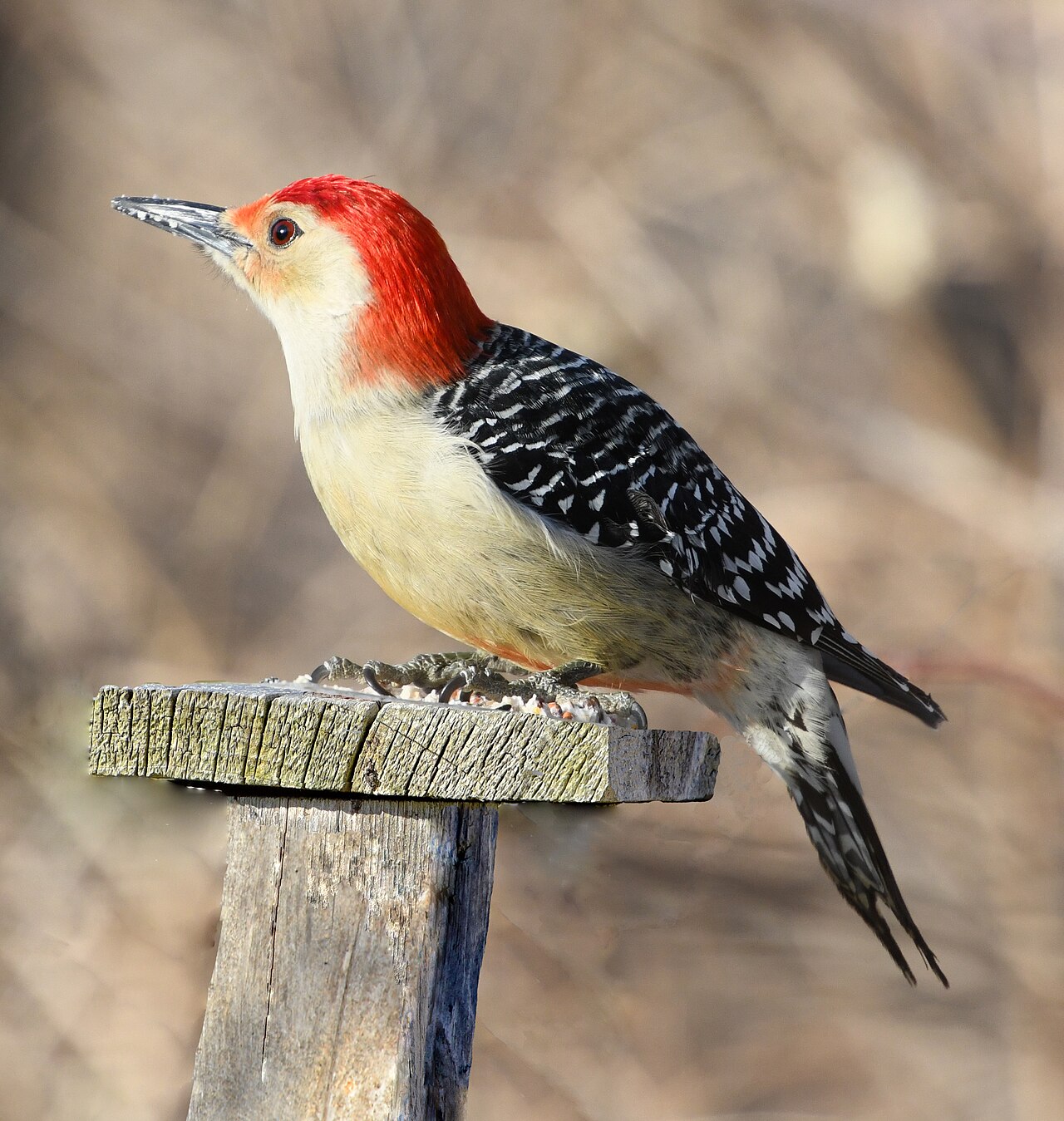
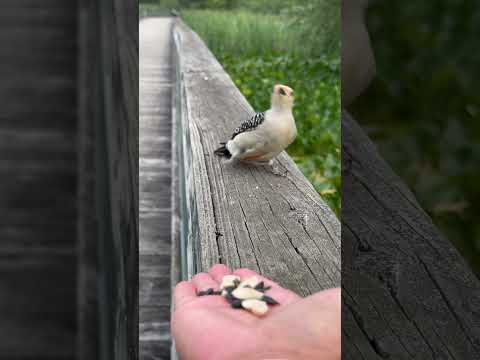
The Red-bellied Woodpecker (Melanerpes carolinus) is the zebra-backed woodpecker of eastern and midwestern backyards — pale gray face and underparts, black-and-white barred back and wings, and a bright red cap: a full crown-to-nape sweep on the male, nape-only on the female. (The faint reddish wash on the lower belly that gives the species its name is almost never visible in the field.) A year-round resident of deciduous woods and tree-lined neighborhoods, it shares suet stations with the Downy Woodpecker and the Hairy Woodpecker. To attract it: hang a suet cage near mature trees, offer whole peanuts and black oil sunflower, and set out apple slices or orange halves on a platform. Listen for the rolling “churr” — often heard long before the bird is seen.
Species Physical Profile & Morphometrics
The Red-bellied Woodpecker belongs to the woodpecker family (Picidae) and carries the standard woodpecker toolkit: zygodactyl feet (two toes forward, two back), a stiff tail braced against bark, and a straight chisel bill for excavating. It sits between the Downy and Hairy in bulk — but its zebra-barred back makes it unmistakable in the eastern yard.
The identification formula: zebra-barred back + pale gray face and underparts + red cap (full crown-to-nape on the male, nape-only on the female), working the trunks of oaks and other deciduous trees.
Essential Morphometric Field Marks:
- Body Length & Mass: about 9.4 inches (24 cm) and 2.0 to 3.2 ounces (56–91 grams) — a mid-sized woodpecker, clearly larger than a Downy and slimmer than a flicker.
- Wingspan: about 13.0 to 16.5 inches (33–42 cm), with the bounding, undulating flight shared by all woodpeckers.
- Bill Structure & Color: A sturdy, straight chisel bill, gray-black, roughly two-thirds the depth of the head — built for chiseling bark and hammering open acorns.
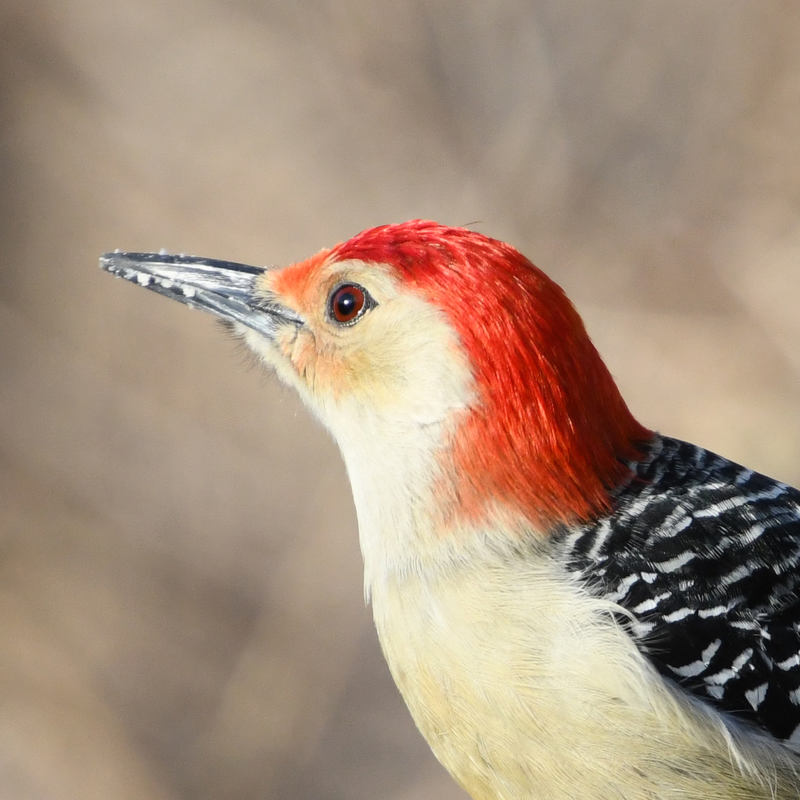
- Color Pattern: Black-and-white zebra barring across the back and wings, a pale gray-buff face and underparts, and white rump patches that flash in flight. The male’s red runs from the bill base over the crown to the nape; the female wears red only on the nape (with a small touch above the bill). The namesake red wash on the lower belly is faint and usually hidden.
- Juveniles: Duller than adults, with a brownish cast and little or no red on the head until the first molt.
Red from bill to nape: one solid scarlet sweep covers the crown and the back of the neck. In late winter he advertises with a brief, even drum on resonant dead wood — about nineteen beats per second — and he usually selects and starts the pair’s new nest cavity.
Gray crown, red nape: her red is limited to the nape, with a small red touch above the bill — the quickest sexing clue at the feeder. She shares incubation and feeding duties, and drums as readily as her mate.
Red-bellied Woodpecker Vocalization Guide (2 Field Recordings + 1 Simulation)
The Red-bellied’s everyday voice is a rolling, slightly descending “churr” or “quurr” — one of the most familiar bird sounds in the eastern backyard — plus a sharper “kwir” contact note. Its spring advertisement is the drum: a brief, even roll hammered on resonant dead wood. The first two cards below are real field recordings shared under Creative Commons licenses; the third is a clearly labeled acoustic simulation of the drumming rhythm. For more wild audio, browse xeno-canto: Red-bellied Woodpecker.
1. Real Recording — The Rolling “Churr”
2. Real Recording — Calls Along the River Bottom
3. Drumming Simulation — The Brief Roll
Habitat, Range & the Eastern Hardwood Neighborhood
The Red-bellied Woodpecker is a bird of eastern deciduous forest and old neighborhoods: oak-hickory woodlots, river-bottom woods, shaded parks, and any street or backyard with mature broadleaf trees. Despite the scientific name carolinus, it is common far beyond the Carolinas — and still spreading.

An Easterner Pushing Northwest
The species lives year-round across the eastern United States — roughly from the Atlantic seaboard west to the Great Plains edge, and from the Gulf Coast up through the Midwest into southern New England and the lower Great Lakes. It does not truly migrate.
Over recent decades red-bellies have been steadily expanding northward and westward into Minnesota, Wisconsin, and southern Ontario — winter feeders are widely credited with helping the push. If one shows up where the books say it “shouldn’t,” believe your eyes.
Backyard Behavioral Patterns & Social Dynamics
The Red-bellied Woodpecker is an assertive but businesslike feeder guest — it announces itself with a “churr,” takes what it came for, and often leaves with extra. Four behaviors explain most backyard encounters:
🌰 The Bark Cacher
Red-bellies are champion hoarders: they wedge acorns, beechnuts, and peanuts into bark crevices — sometimes hammering them in place — and return days later. Watch a bird leave your feeder with a whole peanut; it is heading for its pantry, not its stomach.
🥁 The Brief Drummer
Both sexes drum a short, even roll — about nineteen beats a second — on the most resonant dead limb, sign, or gutter available. The advertisement peaks in late winter and fades once the pair settles to excavate a fresh nest cavity.
🗣️ The Rolling Caller
The “churr” carries far and is given year-round — from territory disputes to simple contact notes between mates. Learn it once and you will start finding red-bellies by ear all over the neighborhood.
🍎 The Orchard Guest
Fruit is a real part of the diet: wild berries and dogwood fruit in season, and at the yard, apple slices, orange halves, and pears set out on a platform draw steady, repeat visits — an easy win most seed-only stations miss.
Problem: “The Book Calls It Red-bellied, but I See No Red Belly — and Is It Chasing Off My Smaller Birds?”
The three most common Red-bellied Woodpecker puzzles all have reassuring answers:
First, the missing red belly: the namesake blush on the lower belly is faint and hidden against the perch — the bird was named from museum skins. Judge it by the zebra back and red cap instead, and save the name “Red-headed” for the different, crimson-headed species. Second, the zebra-back mix-up: beginners sometimes report a “checkerboard woodpecker” they cannot find in the guide — that is this bird, and the male-versus-female crown pattern (full red versus nape-only) settles the rest. Third, the feeder politics: a red-belly is bigger than a chickadee and knows it — it may briefly claim the suet cage, but it eats modestly, caches much of what it takes, and moves on; offering a second suet station a few yards away keeps the peace for everyone.
Method 1: Set the Table — Suet, Whole Peanuts & Fruit
Design for a mid-sized, trunk-clinging omnivore:
-
Hang a Sturdy Suet Feeder
A large wire cage — or a tail-prop suet feeder — suits the red-belly’s clinging style: the extended base lets it brace its stiff tail exactly as it would on a trunk. Plain, peanut, or insect-blend cakes all work.
-
Offer Whole & Shelled Peanuts
Whole in-shell peanuts in a wreath or mesh feeder, or shelled peanuts on a platform, are prime red-belly fare — expect cache-and-carry trips as nuts get wedged into nearby bark, a behavior worth watching.
-
Set Out Fruit Slices
Apple slices or orange halves on a platform feeder or a simple spike tap straight into this omnivore’s fruit habit — especially welcome in winter and early spring when wild fruit is gone.
-
Add Black Oil Sunflower Near Trunks
Black oil sunflower in a hopper or on a platform near mature trees rounds out the menu; red-bellies approach along trunks and limbs, so placement near big bark beats open lawn every time.
Method 2: Build the Habitat — Mature Trees, Snags & Water
Feed the habitat, and the red-bellies follow:
-
Value Big Deciduous Trees
Mature oaks, hickories, maples, and beeches are the core of a red-belly territory — foraging bark, acorn crops, drumming posts, and nest sites in one. Every large tree you keep raises the odds a pair adopts your block.
-
Leave Snags Where Safe
A dead limb or standing snag away from the roof is pantry, drum, roost, and potential nest cavity — the pair chisels a fresh hole each spring, and old cavities get reused by owls, bluebirds, and flying squirrels.
-
Plant Fruit-Bearing Natives
Dogwood, serviceberry, and elderberry extend the menu beyond the feeder — red-bellies take wild fruit readily, and a yard that fruits through the seasons keeps the pair close.
-
Keep Water Open Year-Round
A shallow birdbath near trunk cover is visited daily; in freezing weather a heated bird bath keeps the station — and the resident pair — anchored to your yard.
Tool Solution: Recommended Hardware for Red-bellied Woodpeckers
Equipment matched to a trunk-adapted suet, peanut, and fruit eater:
Tail-Prop Suet Feeder
A suet cage with an extended wooden base that props the tail — the design that lets a red-belly feed exactly as it works a trunk, comfortable for minutes instead of seconds. Downies and nuthatches share it happily.
- • Food: Plain, peanut, or insect-blend suet cakes
- • Style: Cage with tail-prop base
- • Placement: Trunk or pole near mature trees
Whole-Peanut Feeder
A wreath or mesh tube holding whole in-shell peanuts — expect the red-belly to extract a nut, fly to a bark crevice, and wedge it in for later. Shelled peanuts on a platform work for quick feeding too.
- • Food: Whole in-shell or shelled peanuts
- • Build: Mesh or wreath, weather-resistant
- • Placement: Near trunks, 5+ ft up
Shallow Bird Bath
A shallow basin with gently sloped sides set near trunk cover — red-bellies drink and bathe daily, and a heater keeps water open on freezing nights when every liquid source is locked in ice.
- • Depth: 1–2 in, gently sloped
- • Winter: Add a heater or de-icer
- • Placement: Beside trees, visible from the feeder
Frequently Asked Questions
- Species Profile: The Red-bellied Woodpecker (Melanerpes carolinus) is a 9.4-inch, 56–91 gram woodpecker (Picidae) — mid-sized, with a zebra-barred back, zygodactyl feet, and a braced tail.
- ID in One Look: Zebra-barred back and wings, pale gray face and underparts, and a red cap — full crown-to-nape on the male, nape-only on the female; the namesake belly blush is rarely visible.
- A Year-Round Easterner: Resident across the eastern United States and still expanding northwest into the upper Midwest, with no true migration.
- The Sound: A rolling “churr” given year-round, a sharp “kwir” contact note, and a brief, even drum of about nineteen beats per second on resonant dead wood.
- Feeder Formula: A suet cage near mature trunks, whole peanuts for the cache-and-carry show, black oil sunflower, and apple or orange slices on a platform.
- The Hoarder Next Door: A champion cacher that wedges acorns and peanuts into bark crevices — the bird leaving your feeder with a whole peanut is stocking its pantry.
Bird Watching Log
Species: Red-bellied Woodpecker (Melanerpes carolinus)
| Red-bellied Woodpecker (Red Crown: Full / Nape Only — Drumming Heard: Yes / No — Food Carried Off: Yes / No) | |