
Barred Owl


Barred Owl (Strix varia): Complete Identification, Backyard Guide & Call Library
Quick Answer: How to Attract & Identify the Barred Owl
The Barred Owl (Strix varia) is the big brown owl of eastern and northwestern woodlands — and increasingly of wooded suburbs — famous for its unmistakable nine-note question: who-cooks-for-you, who-cooks-for-you-all. Round-headed and dark-eyed, with horizontal barring on the chest and vertical streaks below, it hunts mice, voles, and chipmunks on silent wings and often calls in broad daylight. Wooded yards with mature trees and a big nest box mounted high can host a pair for years — they are non-migratory and faithful to their territory. It shares the nighttime shift with the Eastern Screech-Owl and the daytime woods with the Red-shouldered Hawk.
Species Physical Profile & Morphometrics
The Barred Owl belongs to the true owl family (Strigidae) — a medium-large, round-headed forest owl without ear tufts. Originally a bird of eastern old-growth, it has expanded across Canada into the Pacific Northwest over the past century and now occupies almost any treed landscape, including mature suburbs and city parks.
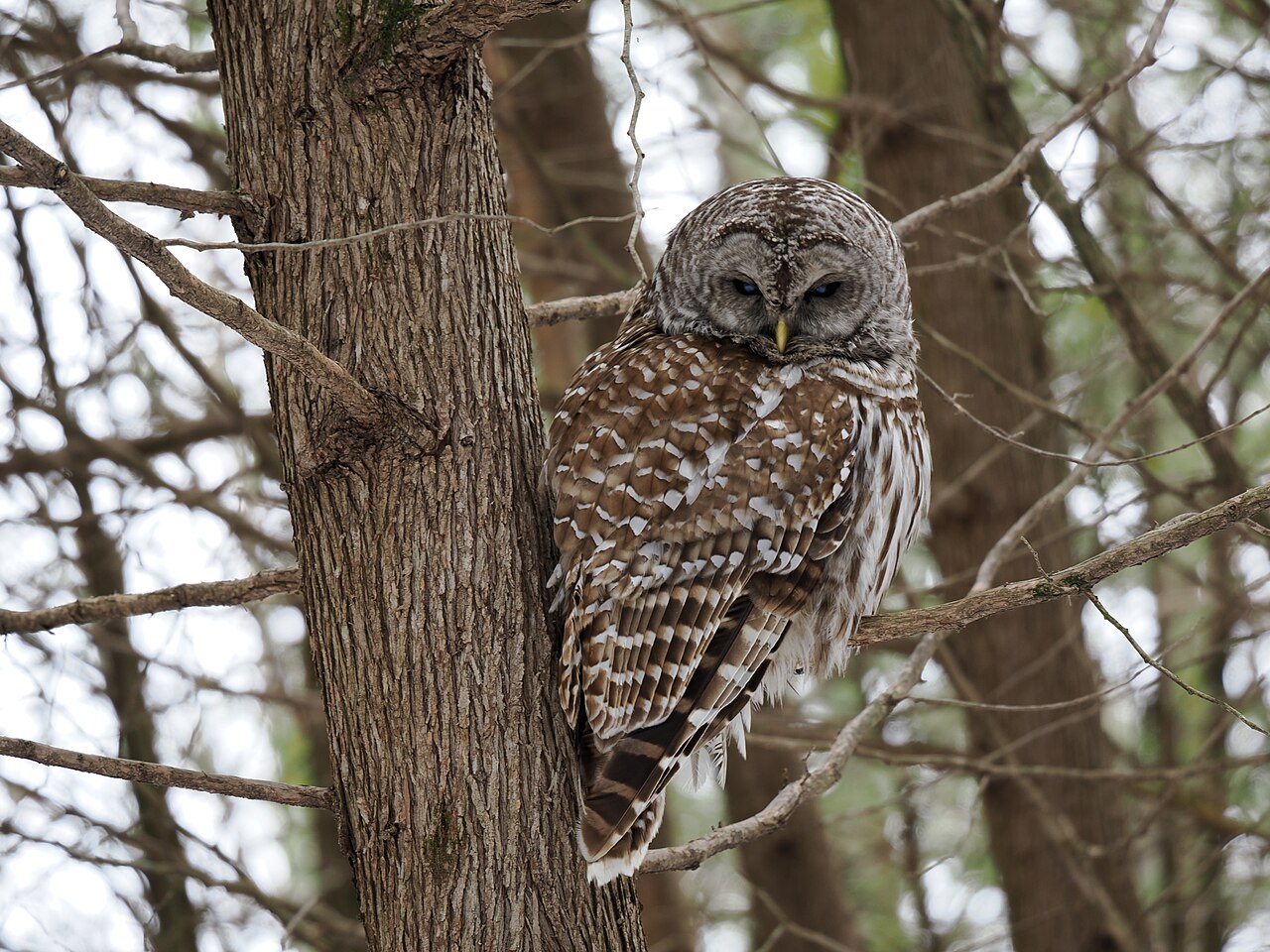
The identification formula: large stocky owl + round bare head (no ear tufts) + dark brown eyes + horizontal barring on the upper chest turning to vertical streaks below. The Great Horned Owl is bigger with ear tufts and yellow eyes; the screech-owls are half its size. Voice is decisive: nothing else in the woods asks who-cooks-for-you.
Essential Morphometric Field Marks:
- Body Length & Mass: 16.9 to 19.7 inches (43–50 cm) and 16.6 to 37.0 ounces (470–1050 grams) — females markedly larger than males, the common owl pattern.
- Wingspan: 38.8 to 43.7 inches (99–111 cm); flight is utterly silent, the leading-edge feather fringes breaking up turbulence — a mouse never hears the end coming.
- Bill Structure & Color: A yellowish, strongly hooked bill set in the facial disc — hidden by feathers until the bird tears prey, which it swallows whole or in large pieces.
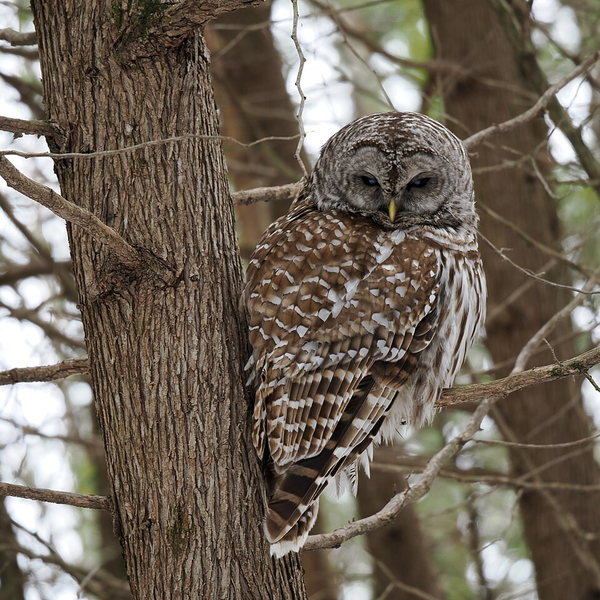
- Color Pattern: Warm brown overall, barred horizontally across the upper chest and streaked vertically down the belly — barred above, streaked below, the field mark that names it. Eyes large and dark brown; facial discs pale concentric rings.
- Male vs. Female: Identical plumage; the female is up to a third larger and her voice is pitched a little higher. In duets — a pair’s manic cackling chorus — the higher voice is hers, the deeper his.
The deeper half of the duet: same barred plumage, smaller build, and the lower-pitched voice in the pair’s who-cooks-for-you exchanges and wild midnight cackling — he feeds the nesting female and, later, tears prey for the brancher young.
Larger and higher-voiced — she incubates in a tree cavity or old hawk nest, fiercely defensive; nesting Barred Owls have famously swooped at intruding humans and dogs. By early summer she leads the loud, begging owlets through the canopy.
Barred Owl Vocalization Guide (3 Field Recordings)
The Barred Owl owns the most famous owl call in North America: a rhythmic nine-note who-cooks-for-you, who-cooks-for-you-all, plus duet cackles, monkey-like hoots, and hair-raising descending screams. It calls day and night, all year. All recordings below are real field audio via Wikimedia Commons — no simulations. For a deeper library, browse xeno-canto: Barred Owl.
1. Who Cooks for You
2. The Duet Cackle
3. The Descending Scream
Habitat, Range & the Mature Woods
The Barred Owl lives in mature forest with big trees: bottomland hardwoods, riverside woods, mixed forest, and — increasingly — older suburbs with large oaks and maples. It needs tree cavities for nesting and a shady understory that holds rodents. A wooded neighborhood with big trees and a stream corridor is prime Barred Owl territory.

From Eastern Forest to Pacific Northwest
The range covers most of North America east of the Great Plains and, after a century of westward expansion, the Pacific Northwest from British Columbia to northern California. Everywhere it is resident — a pair holds the same woods for a decade or more.
For backyard birders: any yard adjoining mature trees in the East or Northwest is potential Barred Owl habitat. They tolerate people well, hunt suburban rodent populations, and call from backyard snags at dusk. Listen on still evenings — the who-cooks-for-you is often the first owl a family ever identifies.
Backyard Behavioral Patterns & Social Dynamics
The Barred Owl is the most conversational bird in the night woods — vocal, curious, and surprisingly tolerant of people. Four behaviors explain most of what you will observe:
🦉 The Nine-Note Question
The who-cooks-for-you call is just the start: Barred Owls have one of the richest vocabularies of any North American owl — duets, cackles, monkey calls, and screams — and they use it day and night, all year. A whistled imitation often gets an answer, sometimes a visit.
🌑 The Daylight Owl
Unlike most owls, Barred Owls often hunt and call in daylight, especially on overcast days and in the long dusks of summer when feeding young. A daytime hoot from the woodlot is worth following with binoculars.
🐭 The Perch-and-Pounce
Hunting is patient work: sit low and still, listen with the facial discs, then drop in silence onto mice, voles, chipmunks, and the occasional frog, crayfish, or small bird. Suburban rodent populations make wooded yards excellent hunting grounds.
🏠 The Cavity Traditionalist
Barred Owls nest in big tree cavities or old hawk nests, returning to the same site for years, and they adopt large owl nest boxes mounted high on a trunk. A pair that boxes up in your woods may stay a decade.
Problem: “I Hear Who-Cooks-for-You Every Night but Have Never Seen the Owl. What Should I Do?”
The three most common Barred Owl encounters all have proven answers:
First, the invisible singer: owls sit tight against bark by day and hunt in the dark — listen at dusk for the hoot, then scan mid-level perches with binoculars, not a flashlight beam; crows and jays mobbing a branch in daytime often betray the roosting owl. Second, the backyard hazard question: a Barred Owl may take an occasional small bird at a feeder at dawn, but its diet is overwhelmingly rodents — it is free pest control, not a feeder problem; if you must protect songbirds, bring feeders in by dusk. Third, the roadkill risk: owls hunting roadside mice are hit by cars — never toss food scraps from vehicles (it concentrates rodents and owls on road edges), and drive gently on wooded roads at night. A yard that hears who-cooks-for-you is already hosting a resident; patience and dusk listening sessions will produce the sighting.
Method 1: Set the Table — Rodents, Water & a Dark Corner
Design for a nocturnal rodent specialist:
-
Let the Rodents Stay Wild
The owl’s table is your yard’s mouse, vole, and chipmunk population — no action needed beyond not waging total war on it. Never use rodenticide: poisoned mice kill the owls that eat them.
-
Offer a Birdbath for Bathing
Owls don’t drink much but they bathe — a ground-level or low bath in a shaded corner gets dusk visits in summer. A dripper’s sound draws them in.
-
Keep a Dark, Quiet Corner
Artificial light disrupts hunting and roosting — switch off or shade yard lights near the woods edge, and give the owl a shadowed corridor between trees.
-
Leave Dead Limbs (Safely)
Broken-top snags and big horizontal limbs are owl furniture — hunting perches and day roosts. Leave any that don’t threaten the roof.
Method 2: Build the Habitat — Cavities & Mature Trees
Feed the territory, and the owl stays for years:
-
Mount a Large Owl Box
A Barred Owl nest box (roughly 24 in deep, 8 in entrance) mounted 15–30 feet up on a mature trunk in quiet woods often gets occupied within a season or two — install in fall for spring use.
-
Protect Mature Trees
Every big old tree with a cavity is potential owl housing — think twice before removing veteran oaks and maples; cavities take a century to make and a minute to fell.
-
Keep the Understory Messy
Brush piles, leaf litter, and unmowed edges shelter the rodents the owl hunts — a manicured yard is an empty pantry; a slightly wild one is a stocked larder.
-
Watch Respectfully at Dusk
Sit quietly near the woods edge at dusk in late winter — listen for the hoot, watch for the silhouette gliding between trees, and skip the playback wars; the resident pair will perform on its own schedule.
Tool Solution: Recommended Hardware for Barred Owl
Equipment matched to a nocturnal woodland hunter:
Large Owl Nest Box
A deep box with an 8-inch entrance mounted high on a mature trunk in quiet woods — the single most effective way to host a nesting pair.
- • Box: ~24 in deep, 8 in entry
- • Mount: 15–30 ft, shady trunk
- • Timing: Install by late fall
Shaded Ground-Level Bath
A low, shaded birdbath with a dripper — bathing owls at dusk are one of summer’s best backyard sightings.
- • Depth: 1–2 in, gently sloped
- • Feature: Dripper sound
- • Placement: Shaded woods edge
Rodenticide-Free Yard
No second-generation anticoagulants, ever — poisoned rodents are the leading documented killer of suburban owls and hawks.
- • Policy: Zero rodenticide
- • Alternative: Snap traps indoors
- • Benefit: Owls do the work free
Frequently Asked Questions
- Species Profile: The Barred Owl (Strix varia) is a 16.9–19.7 inch, 16.6–37 ounce forest owl (Strigidae), band code BDOW — the most vocal owl of eastern and northwestern woods.
- ID in One Look: Round tuftless head, dark liquid eyes, chest barred horizontally and belly streaked vertically — confirmed by the nine-note who-cooks-for-you.
- The Sound: The famous who-cooks-for-you-all plus duet cackles and a descending scream, called day and night, year-round; real field recordings above.
- Range & Habit: Eastern North America plus the Pacific Northwest after a century of expansion; strictly resident, faithful to one territory for years.
- Yard Formula: Big trees, a large nest box mounted high, a shaded ground bath, dark corners, and zero rodenticide — the owl supplies the rodent control.
- The Conversationalist: Barred Owls answer whistled imitations and often call in daylight — the friendliest introduction to owl watching in America.
Bird Watching Log
Species: Barred Owl (Strix varia)
| Barred Owl (Hoots Heard: Yes / No — Duet Heard: Yes / No — Owl Seen: Roosting / Hunting / Flying — Time of Day: ___) | |