
Pileated Woodpecker



Pileated Woodpecker (Dryocopus pileatus): Complete Identification, Feeder Guide & Call Library
Quick Answer: How to Attract & Identify Pileated Woodpeckers
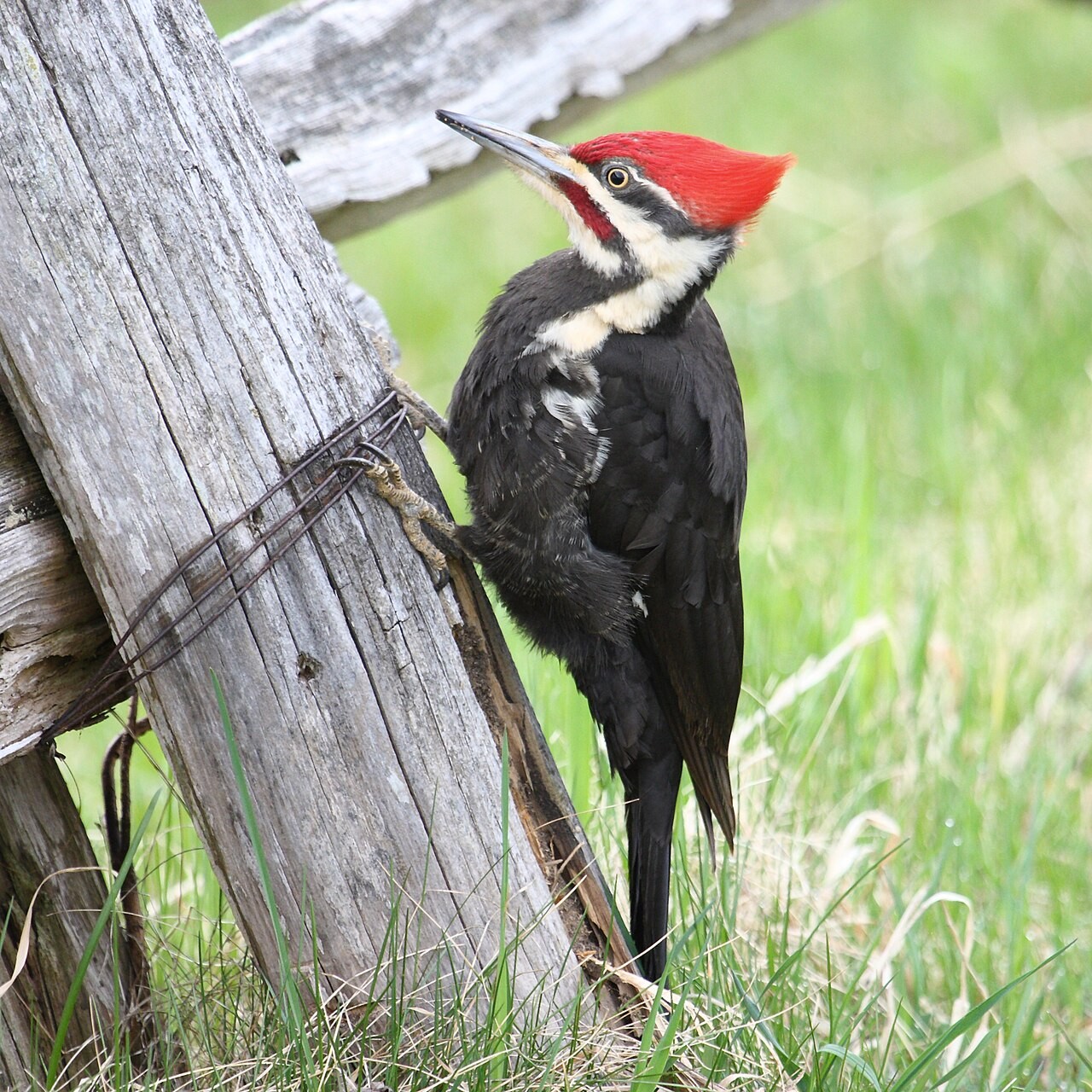
The Pileated Woodpecker (Dryocopus pileatus) is the crow-sized black woodpecker with the flaming red crest — at 16 to 19 inches, the largest living woodpecker in North America. Look for the bold white neck stripe and white underwing flashes in flight; the male carries red from forehead to crest plus a red mustache, while the female’s forehead and mustache are black. Its signature is the large rectangular hole chiseled into ant-infested wood, and its voice is a wild, laughing “kuk-kuk-kuk-kuk” that rolls through the woods. To attract a pair: hang a large log-style or tail-prop suet feeder, keep standing dead trees where safe, and tolerate the carpenter ants that make up much of its diet. It is a year-round resident that often winters beside the Northern Flicker and Red-bellied Woodpecker at suet.
Species Physical Profile & Morphometrics
The Pileated Woodpecker is the heavyweight of the woodpecker family (Picidae) in North America — since the presumed loss of the Ivory-billed Woodpecker, no living species on the continent comes close to its size. Everything about it is built for carpentry: a heavy chisel-tipped bill, a long neck for leverage, stiff tail feathers to brace against bark, and zygodactyl feet — two toes forward, two back — for gripping vertical trunks.
The identification formula: crow-sized black body + sweeping red crest + white neck stripe + white wing linings in flight. Then read the face: red mustache means male, black mustache means female.
Essential Morphometric Field Marks:
- Body Length & Mass: about 15.7 to 19.3 inches (40–51 cm) and 8.8 to 12.3 ounces (250–350 grams) — genuinely crow-sized, and roughly triple the bulk of a Hairy Woodpecker.
- Wingspan: about 26.0 to 29.5 inches (66–75 cm); the flight is a slow, deep, rowing undulation, with white underwing linings flashing against the black body.
- Bill Structure & Color: A massive, straight, chisel-tipped bill, gray-black to pale horn — engineered to blast rectangular pits through bark into carpenter ant galleries.
- Color Pattern: Mostly jet black, with a bold white stripe from the bill down the side of the neck onto the breast, a white chin, and white wing linings visible in flight. The pointed red crest sweeps back from the head.
- Male vs. Female: The male’s crest runs red from forehead to nape and he wears a red mustache stripe; the female has a black forehead and black mustache, with red only on the rear crown.
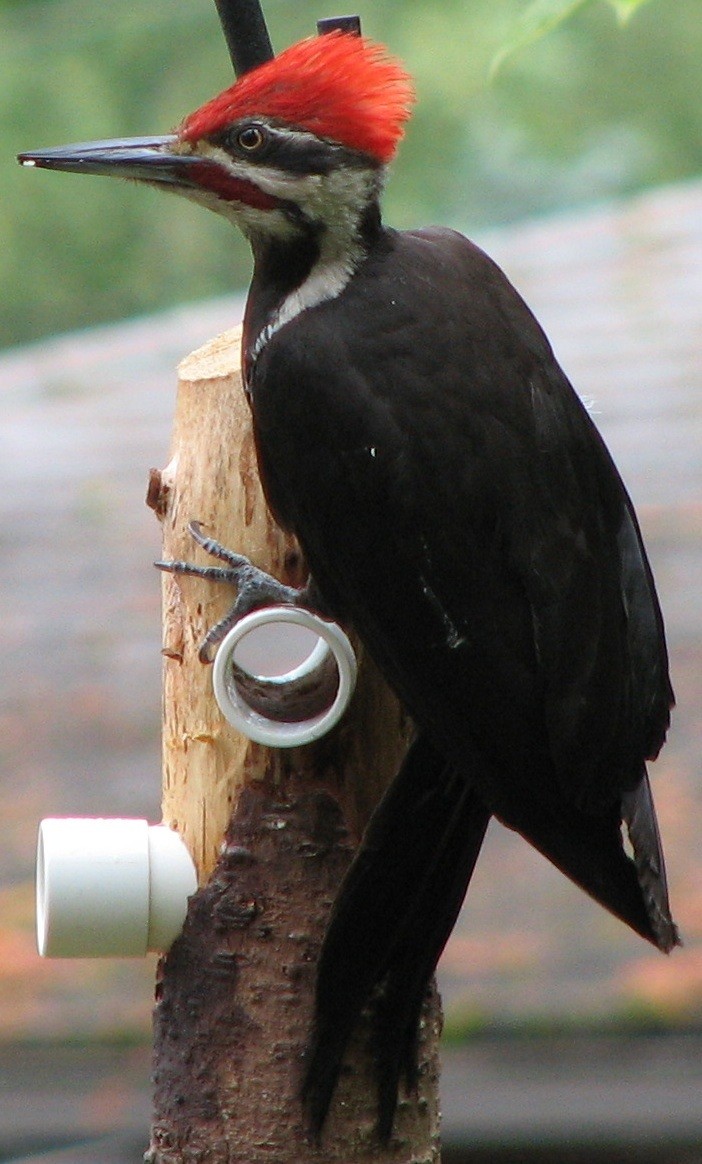
Red all the way forward: the crest starts red at the forehead, and a crimson mustache stripe runs along the jaw. Combined with the white neck stripe on black, the effect is unmistakable — the bird most people picture when they think “giant woodpecker.”
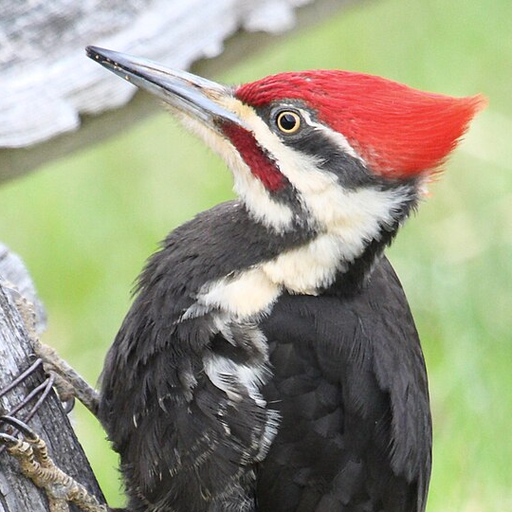
Red only on the back half: her forehead and crown front are dusky black, and the mustache stripe is black too. She is every bit as large and does her full share of the excavating — pairs trade shifts at the nest cavity through the season.
Pileated Woodpecker Vocalization Guide (2 Field Recordings + 1 Simulation)
This is one of the loudest voices in American woods: a wild, laughing “kuk-kuk-kuk-kuk-kuk” that rises and then falls, often delivered on the wing, plus a quieter conversational “wuk” between mates. The drumming is a powerful, deep roll on resonant dead wood that accelerates slightly at the end. The first two cards below are real field recordings shared under Creative Commons licenses; the third is a clearly labeled acoustic simulation of the laughing call. For more wild audio, browse xeno-canto: Pileated Woodpecker.
1. Real Recording — The Laughing “Kuk-kuk-kuk”
2. Real Recording — True Drumming
3. Call Simulation — The Laugh, Slowed to Learn
Habitat, Range & the Big-Tree Neighborhood
The Pileated Woodpecker is a bird of mature deciduous and mixed forest with large standing dead trees — but it has adapted remarkably well to second-growth woodland, wooded suburbs, and big-lot neighborhoods wherever veteran trees and snags remain.

Coast to Coast Wherever Big Trees Stand
Pileated Woodpeckers live year-round from southern Canada through the entire eastern United States, across the Great Lakes, and down the Pacific Northwest coast into northern California. They do not migrate — a mated pair holds the same wooded territory in every season of the year.
If your yard backs onto mature woods with a few dead trunks left standing, you are already inside their world. Learn the laugh first; the bird itself usually follows.
Backyard Behavioral Patterns & Social Dynamics
Everything a Pileated Woodpecker does is supersized. Four behaviors explain most backyard encounters:
🐜 The Carpenter Ant Miner
Carpenter ants can make up more than half the diet. The bird chisels its famous rectangular holes — sometimes several feet long — straight into infested wood, then licks out ants and larvae with a long, barbed, sticky tongue. A foraging pileated is free pest control with a built-in inspection report: where it digs, ants already live.
💪 The One-Tree Demolition Crew
Watch one work and you will flinch: chips the size of playing cards fly with every blow, and a favored dead trunk can be peeled apart over a single winter. This is normal forestry — the bird is dismantling wood that decay and insects already softened.
🥜 The Surprise Suet Regular
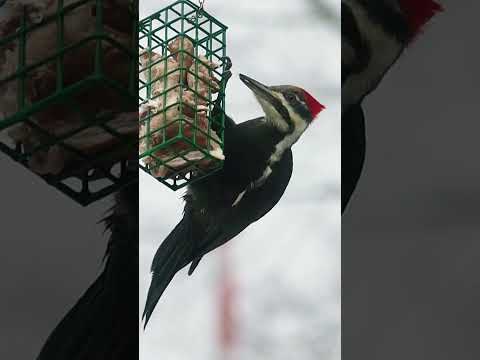
Though a forest bird at heart, the pileated visits backyard suet feeders surprisingly often — especially large log-style or tail-prop stations where its stiff tail can brace. Cold snaps bring the most reliable visits, and a regular pair often arrives together or in quick relay.
🏠 The Landlord of the Woods
A pair excavates a fresh nest cavity each spring, 10 to 80 feet up in a dead trunk. Abandoned pileated holes — and even their big foraging pits — go on to shelter owls, wood ducks, bats, flying squirrels, and songbirds. Keeping one dead tree feeds half the neighborhood.
Problem: “Someone Chiseled a Huge Rectangular Hole in My Tree — Who Did It, and Is the Tree Doomed?”
The three most common Pileated Woodpecker puzzles all have reassuring answers:
First, the rectangular hole: only this species chisels long, squared-off pits — it is mining carpenter ants or beetle larvae that were already inside the wood. On a living yard tree the wounds are usually shallow and cosmetic; on a dead or dying trunk, the bird is dismantling wood that decay had already claimed. If a heavily worked trunk overhangs a roof, have an arborist — not a exterminator — take a look. Second, the jungle-soundtrack laugh at dawn: that wild “kuk-kuk-kuk” is territorial advertisement, strongest in late winter; it settles down once nesting begins. Third, the drumming on the house: like the Northern Flicker, pileateds occasionally drum on gutters or siding for volume. It is noise, not nest destruction — covering the favored spot for a few weeks usually redirects them to a resonant stump.
Method 1: Set the Table — Big Suet & Tail-Prop Stations
Design for a bird the size of a crow with a tail that needs bracing:
-
Hang a Log-Style or Tail-Prop Suet Feeder
Suet is the single most reliable pileated draw — but the feeder must fit the bird. A suet log with drilled plugs or an oversized tail-prop cage lets a 17-inch bird brace its stiff tail and feed for minutes at a stretch. Small cages get emptied by smaller birds first.
-
Mount It on or Beside a Trunk
Pileateds feed most confidently on or near vertical bark — strap the station to a mature trunk or hang it within a short hop of one, ten feet up or higher, in quiet cover away from doors.
-
Offer Peanuts and Sunflower as Backup
Shelled peanuts, peanut halves, and black oil sunflower on a sturdy platform are taken readily once a pair learns the yard — the same spread that holds the Red-bellied Woodpecker.
-
Let the Ants Be
Skip broadcast insecticides around wooded edges — the carpenter ant colony in an old stump is the pileated’s own pantry, and the bird will thin it for you free of charge.
Method 2: Build the Habitat — Big Trees, Snags & Dead Wood
Feed the habitat, and the woodpeckers follow:
-
Leave Standing Dead Trees Where Safe
A snag is the single most valuable structure in pileated country — nest site, drum, and pantry in one. Where a full dead tree is unsafe, ask an arborist to leave a 12-to-20-foot topped trunk instead of removing it outright.
-
Keep Mature Trees and Let Them Age
Pileateds favor the oldest, largest stems in the stand — mature oaks, maples, beeches, and pines. A yard shaded by veterans, with a wooded edge or corridor to larger forest, is already prime territory.
-
Leave Fallen Logs and Brush
Downed logs harbor the beetle larvae and ants the bird mines all winter. A tidy lawn beside a messy woodlot edge is the ideal compromise.
-
Add Winter Water
A heated bird bath near cover keeps a resident pair anchored to your yard through the weeks when every natural source is locked in ice.
Tool Solution: Recommended Hardware for Pileated Woodpeckers
Equipment matched to North America’s biggest backyard woodpecker:
Suet Log Feeder
A hardwood log drilled with plug holes and packed with suet — the design a pileated is built to use: it clings vertically, braces its tail, and chisels exactly as it would on a dead trunk. Hang or strap it to a mature tree.
- • Food: Suet plugs or pressed cakes, insect blend preferred
- • Style: Vertical log, tail-friendly
- • Placement: Trunk-mounted, 8–15 ft up, quiet cover
Tail-Prop Suet Cage
An oversized double-cake cage with an extended tail-prop base — the wire-cage equivalent of the log, and the easiest way to keep suet out all winter for the whole woodpecker guild from downy to pileated.
- • Food: Plain, peanut, or insect-blend suet cakes
- • Build: Double capacity, tail-prop base
- • Placement: Near trunk or large limb
Heated Bird Bath
A sturdy pedestal or ground bath with a thermostatic heater — resident pairs drink daily, and open water in a hard freeze is often the detail that turns a flyover territory into a daily visit.
- • Depth: 1–2 in, gently sloped
- • Winter: Thermostatic heater or de-icer
- • Placement: Open ground beside wooded cover
Frequently Asked Questions
- Species Profile: The Pileated Woodpecker (Dryocopus pileatus) is a 15.7–19.3 inch, 250–350 gram woodpecker (Picidae) — the largest living woodpecker in North America, black with a red crest and white neck stripe.
- ID in One Look: Crow-sized and black, white stripe down the neck, white wing linings in flight; males carry red forehead-to-crest plus a red mustache, females show black forehead and mustache.
- A Year-Round Resident: Lives wherever mature trees stand from southern Canada through the East and the Pacific Northwest — no migration, one territory per pair, every season.
- The Sound: A wild laughing “kuk-kuk-kuk-kuk” that rises and falls, plus a deep, accelerating drum roll on resonant dead wood.
- Feeder Formula: A trunk-mounted suet log or tail-prop suet cage, peanuts and sunflower as backup — and carpenter ants left in peace.
- The Hole Maker: The rectangular excavation is its signature — a report on the ants already inside the wood, and future shelter for owls, ducks, and songbirds.
Bird Watching Log
Species: Pileated Woodpecker (Dryocopus pileatus)
| Pileated Woodpecker (Sex: Male / Female — At Suet: Yes / No — Drumming Heard: Yes / No — Rectangular Holes Seen: Yes / No) | |