
Northern Flicker vs Pileated Woodpecker


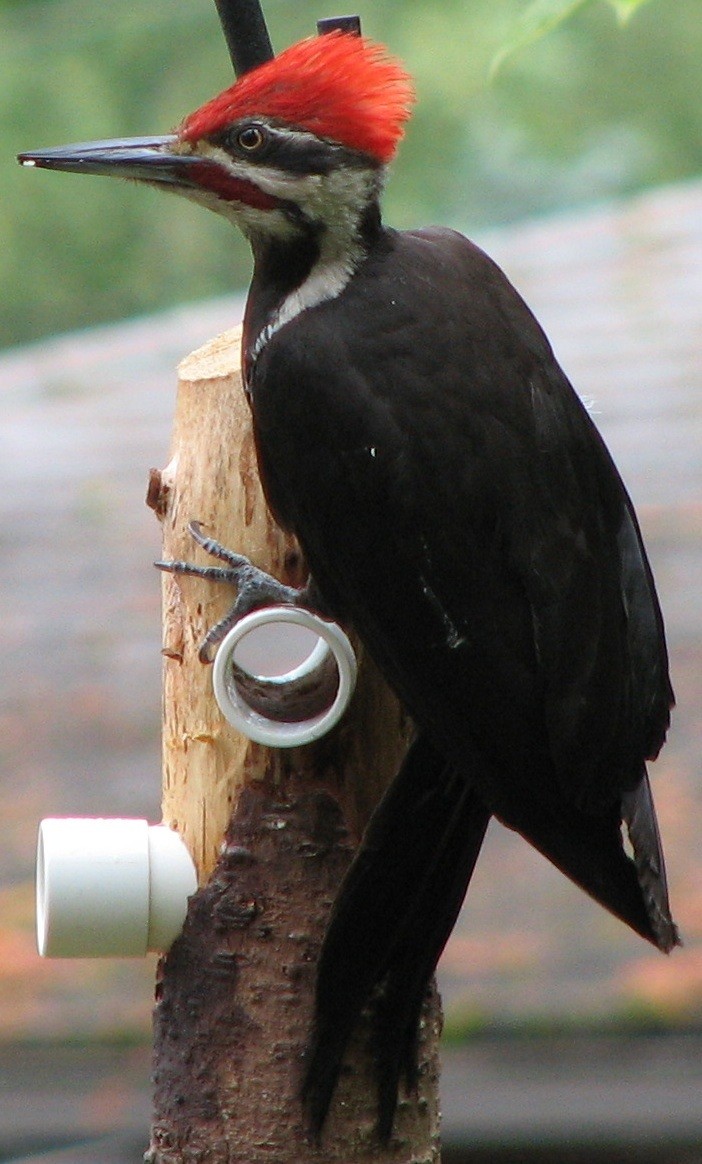

Northern Flicker vs Pileated Woodpecker (Colaptes auratus vs Dryocopus pileatus): The Complete Backyard Identification Guide
Quick Answer: The Fastest Way to Tell Them Apart
The two biggest woodpeckers you are likely to see. Three rules:
- Color: brown and spotted = flicker; black with white neck stripes = Pileated.
- Crest: tall red crest = Pileated; no crest = flicker.
- Feeding: on the lawn = flicker; chiseling a dead tree = Pileated.
At-a-Glance Comparison Table
The brown ground woodpecker and the black giant, side by side. KEY rows separate fastest.
| Feature | Northern Flicker | Pileated Woodpecker |
|---|---|---|
| Scientific Name | Colaptes auratus | Dryocopus pileatus |
| Length KEY | 11–12.2 in (28–31 cm) | 16.5 in (42 cm) |
| Wingspan | 16.5–20.1 in (42–51 cm) | 26–29 in (66–74 cm) |
| Weight | 3.9–5.6 oz (110–160 g) | 8.8–14.1 oz (250–400 g) |
| Overall Shape | A large, long-tailed woodpecker that feeds on the ground — brown, barred and spotted | Crow-sized woodpecker with a flaming red crest |
| Male Plumage KEY | Brown barred back, spotted breast with black bib crescent; yellow wing linings and black mustache in the East (“yellow-shafted”), red linings and red mustache in the West (“red-shafted”) | Black body with a bold white neck stripe, white underwing flashes, red crest and red mustache stripe |
| Female Plumage | Identical pattern without the mustache stripe | Like the male but with a black forehead and black mustache stripe |
| Bill Shape | Long, slightly decurved, gray — an ant probe | Massive, chisel-tipped, gray |
| Tail | Stiff and pointed; white rump flashes in bounding flight | Long, black, stiff |
| Core Range | All of North America in open woodland, parks and yards | Mature forests of the East, the Pacific Northwest and boreal Canada; wooded suburbs with big trees |
| Migration | Northern birds migrate; southern and western birds are largely resident | Non-migratory resident |
| Feeder Presence | Suet and peanuts; more often seen digging ants on the lawn | Visits large suet feeders and log feeders in wooded yards; needs stout support |
| Favorite Foods | Ants above all, plus beetles, berries and suet | Carpenter ants and beetle larvae from rectangular excavations; fruit and nuts in fall |
| Song | No song; a loud, rapid “wik-wik-wik” series | No true song — a loud, ringing call instead |
| Flight Call KEY | A loud “klee-yer” and the “wik-a” series | A loud, ringing “kuk-kuk-kuk-kuk” that rises and falls |
| Population Trend | Declining gradually but still common and widespread | Stable to increasing as eastern forests mature |
Male Field Marks, Side by Side
Northern Flicker — Male
- Brown barred back, black bib, spotted breast.
- White rump flash and golden or red wing linings in flight.
- Feeds on the ground, lapping up ants with a two-inch tongue.
Pileated Woodpecker — Male
- Crow-sized — the largest woodpecker in most of North America.
- Red crest plus red mustache stripe (male).
- White underwing flashes in deep, crow-like flight.
Female & Juvenile Marks, Side by Side
Northern Flicker — Female
- No mustache — otherwise identical.
- Drums on gutters and chimney flashing in spring.
- Nests in tree cavities; starlings compete hard for the holes.
Pileated Woodpecker — Female
- Red crest but black forehead and mustache.
- Carves rectangular holes hunting carpenter ants.
- Pairs hold large year-round territories in mature woods.
Part-by-Part Anatomy Breakdown
Every part offers a check:
| Body Part | Northern Flicker | Pileated Woodpecker |
|---|---|---|
| Body | Brown, barred above, spotted below | Black with white neck stripes |
| Head | Gray-tan, no crest | Flaming red crest |
| Size | 12 in — large | 17 in — crow-sized, the largest US woodpecker |
| Wing Flash | Golden (East) or red (West) linings | White underwings flash in flight |
| Rump | White rump patch | Black back, no rump patch |
| Feeding | Ground — digs for ants | Chisels rectangle holes in dead wood |
| Call | Loud “klee-yer”, “wik-wik-wik” | Loud, rolling “kuk-kuk-kuk-kuk” |
Song & Call Comparison
Northern Flicker
Calls: a loud klee-yer and a rapid wik-wik-wik series.
Drum: a long, even roll — often on metal at dawn.
Pileated Woodpecker
Voice: a loud, ringing kuk-kuk-kuk-kuk, like a flicker but bigger and wilder.
Drumming: powerful, slow-rolling booms that carry a mile.
Range & Seasonal Presence
The Northern Flicker lives in open woodland, parks and yards across the whole continent.
The Pileated Woodpecker needs mature forest — but increasingly visits wooded suburbs with big trees across the East, Northwest and Canada.
Feeder Behavior & Favorite Foods
- Northern Flicker: suet and peanuts; more often on the lawn digging ants.
- Pileated Woodpecker: a long suet log or tail-prop feeder in wooded yards.
- Both drum on resonant surfaces — including gutters and siding at dawn.
- Dead wood: leaving a snag standing feeds Pileateds for years.
Temperament & Flock Behavior
Northern Flickers are adaptable all-arounders — lawns, trees, wires and feeders.
Pileated Woodpeckers are powerful forest birds — shy of people but unforgettable when one rocks the backyard.
6-Step Backyard ID Checklist
- Color. Brown = flicker; black = Pileated.
- Crest. Red crest = Pileated; none = flicker.
- Size. Crow-sized = Pileated; smaller = flicker.
- Feeding. Lawn = flicker; dead tree = Pileated.
- Wing flash. Gold/red = flicker; white = Pileated.
- Call. Klee-yer = flicker; kuk-kuk-kuk = Pileated.
Frequently Asked Questions
- Color: Brown = flicker; black = Pileated.
- Crest: Red crest = Pileated.
- Size: Crow-sized = Pileated.
- Feeding: Lawn = flicker; dead wood = Pileated.
- Wings: Gold/red = flicker; white = Pileated.
- Holes: Rectangles = Pileated.