
Pileated Woodpecker vs Red-headed Woodpecker


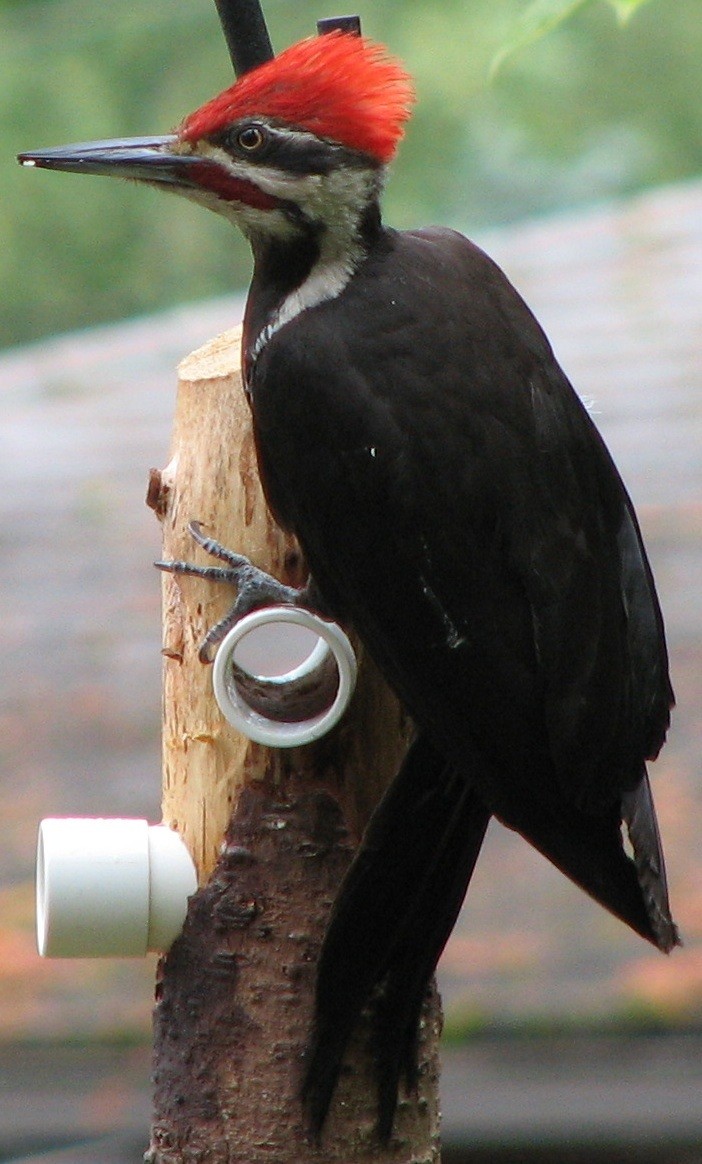


Pileated Woodpecker vs Red-headed Woodpecker (Dryocopus pileatus vs Melanerpes erythrocephalus): The Complete Backyard Identification Guide
Quick Answer: The Fastest Way to Tell Them Apart
The big crested one and the red-headed one. Three rules:
- Size: crow-sized = Pileated; robin-sized = Red-headed.
- Body: black with white neck stripes = Pileated; white belly and wing patches = Red-headed.
- Red: on the crest only = Pileated; covering the whole head = Red-headed.
At-a-Glance Comparison Table
The two red-crowned giants of the woods, side by side. KEY rows separate fastest.
| Feature | Pileated Woodpecker | Red-headed Woodpecker |
|---|---|---|
| Scientific Name | Dryocopus pileatus | Melanerpes erythrocephalus |
| Length KEY | 16.5 in (42 cm) | 9.3 in (24 cm) |
| Wingspan | 26–29 in (66–74 cm) | 16.5 in (42 cm) |
| Weight | 8.8–14.1 oz (250–400 g) | 2.0–3.4 oz (56–97 g) |
| Overall Shape | Crow-sized woodpecker with a flaming red crest | Medium woodpecker with a fully crimson head and bold “checkerboard” body |
| Male Plumage KEY | Black body with a bold white neck stripe, white underwing flashes, red crest and red mustache stripe | Entire head crimson-red; black back and tail; huge white wing patches; clean white underparts (sexes alike) |
| Female Plumage | Like the male but with a black forehead and black mustache stripe | Identical to the male |
| Bill Shape | Massive, chisel-tipped, gray | Stout, blue-gray |
| Tail | Long, black, stiff | Black, stiff |
| Core Range | Mature forests of the East, the Pacific Northwest and boreal Canada; wooded suburbs with big trees | East of the Rockies in open woods, orchards, parks and along roadsides with dead trees |
| Migration | Non-migratory resident | Partial migrant; northern birds withdraw in winter, following acorn crops |
| Feeder Presence | Visits large suet feeders and log feeders in wooded yards; needs stout support | Visits suet, nuts and cracked corn in open country yards; hoards acorns and beechnuts in bark crevices |
| Favorite Foods | Carpenter ants and beetle larvae from rectangular excavations; fruit and nuts in fall | Insects caught in flight, acorns, beechnuts, fruit and berries |
| Song | No true song — a loud, ringing call instead | No true song — harsh calls instead |
| Flight Call | A loud, ringing “kuk-kuk-kuk-kuk” that rises and falls | A harsh, rising “queeah” |
| Population Trend KEY | Stable to increasing as eastern forests mature | Declining — on conservation watch lists; dead trees are essential |
Male Field Marks, Side by Side
Pileated Woodpecker — Male
- Crow-sized — the largest woodpecker in most of North America.
- Red crest plus red mustache stripe (male).
- White underwing flashes in deep, crow-like flight.
Red-headed Woodpecker — Male
- Fully crimson-red head — unmistakable adult.
- Checkerboard body: black with huge white wing patches.
- Flycatches insects and hoards acorns like a tiny lumberjack.
Female & Juvenile Marks, Side by Side
Pileated Woodpecker — Female
- Red crest but black forehead and mustache.
- Carves rectangular holes hunting carpenter ants.
- Pairs hold large year-round territories in mature woods.
Red-headed Woodpecker — Female
- Identical to the male.
- Juveniles are brown-headed and streaky — a different look entirely.
- A year-round pair means standing dead trees nearby.
Part-by-Part Anatomy Breakdown
Every part offers a check:
| Body Part | Pileated Woodpecker | Red-headed Woodpecker |
|---|---|---|
| Size | 17 in — crow-sized | 9.25 in — robin-sized |
| Body | Black with bold white neck stripes | Black back, white belly, huge white wing patches |
| Red Placement | Flaming crest; male adds a red mustache | Entire head crimson, both sexes |
| Flight | White underwings flash, crow-like rowing | Big white wing patches — “flying checkerboard” |
| Habitat | Mature forest, wooded suburbs | Open savanna, burns, beaver swamps with snags |
| Feeding | Chisels rectangular holes for carpenter ants | Flycatches and caches acorns in crevices |
| Call | Loud rolling “kuk-kuk-kuk” | Harsh “queer” and “tchur” |
Song & Call Comparison
Pileated Woodpecker
Voice: a loud, ringing kuk-kuk-kuk-kuk, like a flicker but bigger and wilder.
Drumming: powerful, slow-rolling booms that carry a mile.
Red-headed Woodpecker
Voice: a harsh, rising queeah, plus dry rattles.
Drumming: slow, deliberate rolls on dead snags and poles.
Range & Seasonal Presence
The Pileated Woodpecker lives in mature forest across the East, Northwest and Canada, increasingly in wooded suburbs.
The Red-headed Woodpecker needs open woods with standing dead trees — savanna and burns of the Midwest and Southeast — and has declined with every cleared snag.
Feeder Behavior & Favorite Foods
- Pileated: long suet logs and tail-prop feeders in wooded yards.
- Red-headed: suet, peanuts and sunflower — and it caches what it cannot eat.
- Snags: standing dead wood supports both species’ food supply.
- Winter: both visit feeders most in cold months when insects are scarce.
Temperament & Flock Behavior
Pileated Woodpeckers are powerful and wary — a pair holds a big territory and both parents drum.
Red-headed Woodpeckers are feisty hoarders, defending cached acorns from jays, starlings and squirrels.
6-Step Backyard ID Checklist
- Size. Crow-sized = Pileated; robin-sized = Red-headed.
- Belly. Black = Pileated; white = Red-headed.
- Red. Crest = Pileated; whole head = Red-headed.
- Wings. Underwing flash = Pileated; white patches = Red-headed.
- Habitat. Deep woods = Pileated; open snags = Red-headed.
- Call. Kuk-kuk-kuk = Pileated; queer = Red-headed.
Frequently Asked Questions
- Size: Crow-sized = Pileated; robin-sized = Red-headed.
- Red: Crest = Pileated; whole head = Red-headed.
- Belly: Black = Pileated; white = Red-headed.
- Habitat: Forest = Pileated; open snags = Red-headed.
- Trend: Pileated recovering; Red-headed declining.
- Caching: Acorn hoarder = Red-headed.