
Red-headed Woodpecker


Red-headed Woodpecker (Melanerpes erythrocephalus): Complete Identification, Feeder Guide & Call Library
Quick Answer: How to Attract & Identify Red-headed Woodpeckers
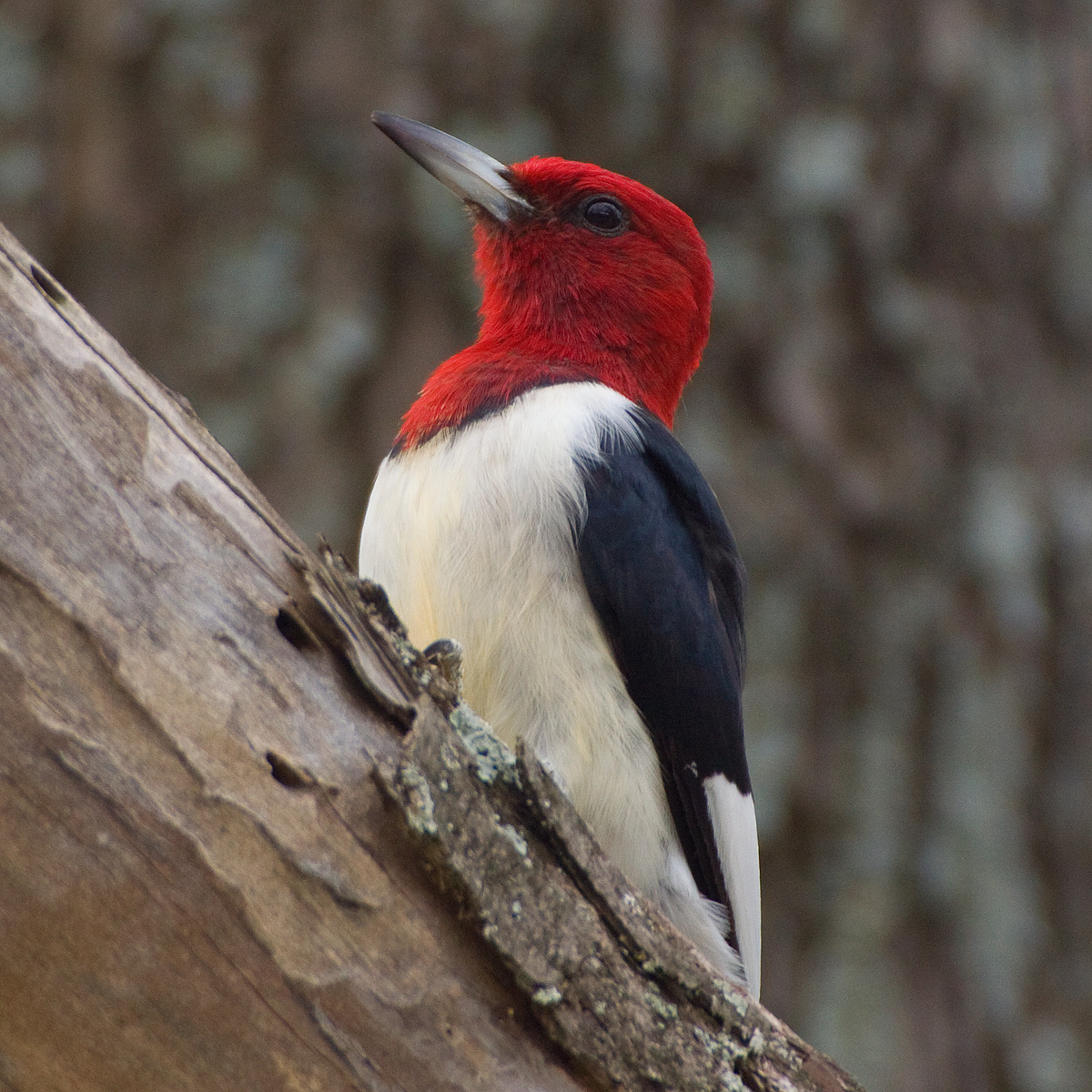
The Red-headed Woodpecker (Melanerpes erythrocephalus) is the boldest-patterned bird in the eastern backyard: a fully crimson head and neck, snow-white underparts, and a black back with huge white wing patches — the “flying checkerboard.” Males and females look identical; juveniles wear a brown, mottled head with no red until their first molt. A bird of open woods, oak savannas, and snag-rich edges east of the Rockies, it winters at feeders especially when the acorn crop fails. To attract it: hang a suet cage, offer whole corn and peanuts on a platform, plant or keep oaks, and leave standing dead wood where safe. Listen for the harsh, high-pitched “quirr!” — like its cousin the Red-bellied Woodpecker, but sharper.
Species Physical Profile & Morphometrics
The Red-headed Woodpecker belongs to the woodpecker family (Picidae) and shares its genus with the Red-bellied: zygodactyl feet, a braced tail, and a straight chisel bill. But where its cousin patterns itself in zebra bars, the Red-headed blocks its plumage into three bold zones — crimson, black, and white — visible across a field, not just at the feeder.
The identification formula: solid crimson hood + black back with big white wing patches + white underparts, in open country with scattered trees and snags. If the head is only partly red and the back is barred, you have a Red-bellied.
Essential Morphometric Field Marks:
- Body Length & Mass: about 7.5 to 9.1 inches (19–23 cm) and 2.0 to 3.2 ounces (56–91 grams) — nearly the same build as the Red-bellied Woodpecker.
- Wingspan: about 16.5 inches (42 cm); in flight the broad white wing patches and white rump flash like a semaphore — the “flying checkerboard.”
- Bill Structure & Color: A sturdy, straight chisel bill, blue-gray with a darker tip — used as much for snatching flying insects and hammering acorns into crevices as for excavating wood.
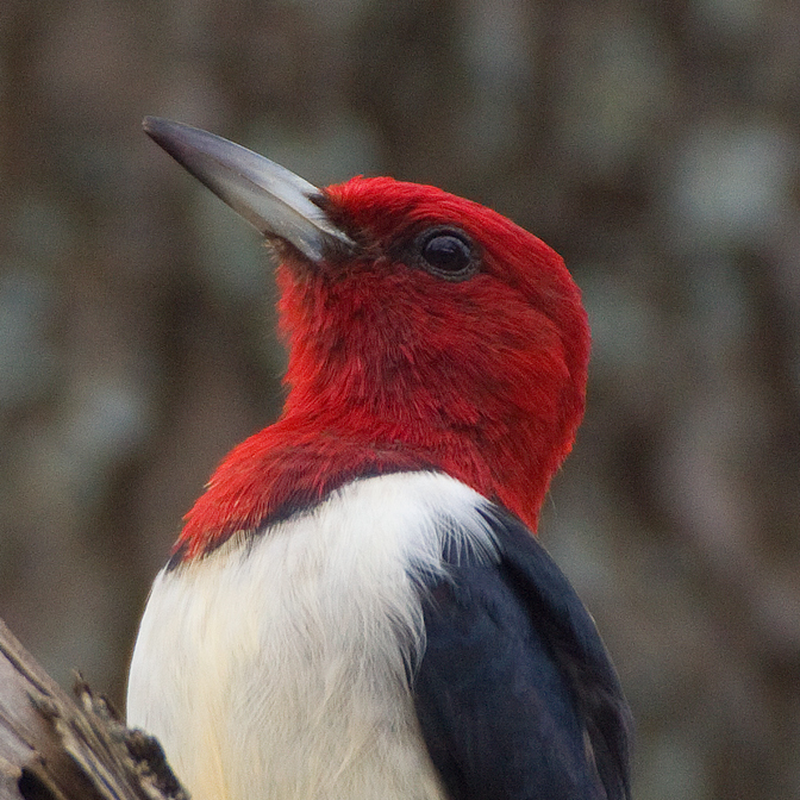
- Color Pattern: The entire head, neck, and throat are deep crimson in adults of both sexes — one of the few North American woodpeckers where male and female are indistinguishable by plumage. Back and wings glossy black with large white secondary patches; underparts and rump clean white; tail black.
- Juveniles: The classic trap — a brown, mottled head with brown-gray barring on the back and dusky streaking below, molting to the crimson hood through the first fall and winter.
Crimson from bill to shoulders: no sexing needed — male and female wear the same brilliant hood. In late winter both advertise with a short, rather weak drum on dead limbs, poles, or signs, and the male does most of the nest excavation.
Brown where the red will be: young birds pass their first months in a sooty brown hood with mottled black-and-white wings. By their first spring the crimson has arrived — a transformation that fools many backyard watchers into reporting a “mystery bird.”
Red-headed Woodpecker Vocalization Guide (2 Field Recordings + 1 Simulation)
The Red-headed’s everyday voice is a loud, harsh “quirr!” or “churr” — like the Red-bellied’s roll but distinctly higher-pitched and sharper. Its drum is a brief, comparatively weak roll on dead wood. The first two cards below are real field recordings shared under Creative Commons licenses; the third is a clearly labeled acoustic simulation of the drumming rhythm. For more wild audio, browse xeno-canto: Red-headed Woodpecker.
1. Real Recording — Calls & Drumming
2. Real Recording — A Pair Trading Calls
3. Drumming Simulation — The Weak, Short Roll
Habitat, Range & the Open Oak Savanna
The Red-headed Woodpecker is a bird of open, sunlit woods: oak savannas, orchards, groves, farmland shelterbelts, roadsides, beaver-flooded timber, and burned forest — anywhere scattered big trees stand over open ground, with dead snags for nesting and caching.

An Eastern-and-Midwestern Mast Follower
The species breeds across eastern and central North America, east of the Rockies — from southern Canada through the Midwest and East to the Gulf. It is a partial migrant: southern birds stay put, while many northern birds withdraw in winter.
Winter presence tracks the acorn and beechnut crop: in big mast years red-headeds overwinter far north on cached stores; in poor years they leave. Sadly, long-term numbers have declined steeply with snag removal — every standing dead tree you can safely keep is a gift to this species.
Backyard Behavioral Patterns & Social Dynamics
The Red-headed Woodpecker is the boldest personality at the feeding station — conspicuous, territorial, and endlessly inventive about food. Four behaviors explain most backyard encounters:
🌰 The Cache Coverer
Red-headeds don’t just jam acorns and corn into bark crevices — they famously cover the stash with pieces of bark or wood, one of the only North American woodpeckers that hides its pantry, and they defend it fiercely against jays and squirrels.
🪰 The Flycatching Woodpecker
Unique among eastern woodpeckers: a red-head will sally out from a perch and snatch insects out of the air, flycatcher-style, then return to the same snag. In summer, watch the dead treetop, not the trunk.
⚔️ The Feeder Boss
This species does not share gracefully: a resident red-head may chase jays, starlings, and even larger birds off the suet and platform. It is bold, conspicuous, and utterly confident — a personality worth the space it demands.
🌽 The Ground Forager
Unlike trunk-bound woodpeckers, red-headeds drop to the ground for fallen acorns, corn, and insects — flying low and undulating between perches. A platform feeder or scattered corn under open sky suits them perfectly.
Problem: “I Thought Red-bellied Was the Red-headed One — and Now a Brown-Headed Bird Is at My Feeder. What Is Going On?”
The three most common Red-headed Woodpecker puzzles all have reassuring answers:
First, the name tangle: the bird with red only on the crown and nape is the Red-bellied Woodpecker; the bird with the entire head dipped in crimson is this one. If the whole head is red, it’s Red-headed — there is no overlap once you know the rule. Second, the brown-headed impostor: a sooty brown-headed bird with black-and-white wings at your feeder in late summer is almost certainly a juvenile Red-headed molting toward its adult hood — not a different species. Third, the disappearing act: red-headeds at a northern feeder can vanish for a whole winter and return the next — they track the acorn crop, not the calendar. Keep the suet stocked and the oaks standing; they will find you again.
Method 1: Set the Table — Suet, Corn & Peanuts
Design for a bold, platform-loving omnivore:
-
Hang a Sturdy Suet Feeder
Suet is the most reliable red-head draw, especially in winter — a large cage or tail-prop feeder hung near open perches lets them swing in from a snag exactly as they sally for insects. Plain, peanut, or insect-blend cakes all work.
-
Offer Corn on a Platform
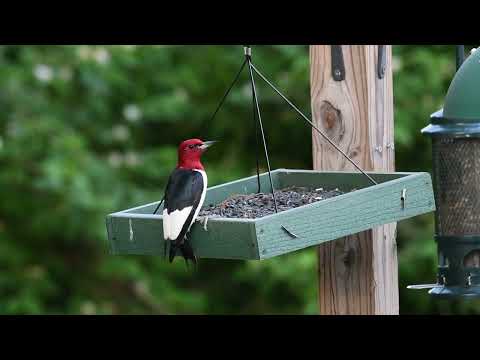
Whole-kernel or cracked corn on an open platform feeder taps straight into this species’ ground-foraging, grain-loving habit — expect birds to carry kernels off to bark crevices for caching.
-
Add Peanuts & Sunflower
Whole in-shell peanuts and black oil sunflower round out the menu — high-energy, cacheable, and taken enthusiastically. A second station a few yards away gives smaller birds room while the red-head holds court.
-
Set Out Fruit in Season
Apple slices, grapes, cherries, and orange halves on the platform are taken readily — red-headeds are among the most fruit-eager woodpeckers, a habit old orchardists knew well.
Method 2: Build the Habitat — Snags, Oaks & Water
Feed the habitat, and the red-headeds follow:
-
Keep Standing Dead Wood
A standing snag or dead limb away from the roofline is nest site, flycatching perch, caching pantry, and drumming post in one — and the single habitat feature this declining species needs most.
-
Plant & Protect Oaks
Oaks (and beeches where they grow) are a red-head’s winter bank account — acorns gathered and cached in fall carry the birds through. A yard near mature oaks is a yard red-headeds will find.
-
Favor Open Structure
Red-headeds want scattered trees over open ground, not dense thicket — keep sight lines open under the canopy, and a snag or pole in the clear becomes prime flycatching real estate.
-
Keep Water Open Year-Round
A shallow birdbath in the open near a perch is visited daily; in freezing weather a heated bird bath keeps overwintering birds — and their caches — anchored to your yard.
Tool Solution: Recommended Hardware for Red-headed Woodpeckers
Equipment matched to a bold, platform-and-suet omnivore:
Tail-Prop Suet Feeder
A suet cage with an extended wooden base that props the tail — comfortable for a bird this size, and the single most dependable way to hold a red-head through winter. Downies and red-bellies share it happily.
- • Food: Plain, peanut, or insect-blend suet cakes
- • Style: Cage with tail-prop base
- • Placement: Near open perches and snags
Open Platform Feeder
A roomy platform for whole corn, peanuts, and sunflower — the setup that matches this species’ ground-foraging style and invites the cache-and-carry behavior that makes red-headeds so watchable.
- • Food: Whole corn, peanuts, sunflower
- • Build: Drained tray, weather-resistant
- • Placement: Open spot near a snag or pole
Shallow Bird Bath
A shallow basin with gently sloped sides set in the open near a perch — red-headeds drink and bathe daily, and a heater keeps water open through the freezing nights when caches matter most.
- • Depth: 1–2 in, gently sloped
- • Winter: Add a heater or de-icer
- • Placement: Open ground beside a snag
Frequently Asked Questions
- Species Profile: The Red-headed Woodpecker (Melanerpes erythrocephalus) is a 7.5–9.1 inch, 56–91 gram woodpecker (Picidae) — fully crimson-hooded, black-and-white bodied, with huge white wing patches.
- ID in One Look: Solid red hood on both sexes, white belly, black back with flashing white wing patches — the “flying checkerboard.” Juveniles wear a brown, mottled head until their first molt.
- A Mast-Driven Partial Migrant: Resident in the south, withdrawing from the north in poor acorn years; winter feeder numbers swing with the oak crop.
- The Sound: A harsh, high-pitched “quirr!” — sharper than the Red-bellied’s roll — plus a comparatively weak, short drum on dead wood.
- Feeder Formula: A suet cage near open perches, plus a platform with whole corn, peanuts, and sunflower — and fruit in season.
- The Pantry Keeper: One of the only woodpeckers that covers its cached acorns with bark — and fiercely defends the stash from jays and squirrels.
Bird Watching Log
Species: Red-headed Woodpecker (Melanerpes erythrocephalus)
| Red-headed Woodpecker (Head: Full Red / Brown Juvenile — Drumming Heard: Yes / No — Food Carried Off: Yes / No) | |