
Northern Flicker


Northern Flicker (Colaptes auratus): Complete Identification, Feeder Guide & Call Library
Quick Answer: How to Attract & Identify Northern Flickers
The Northern Flicker (Colaptes auratus) is the big, brown, polka-dotted woodpecker you find hopping on the lawn instead of climbing a tree — the only North American woodpecker that regularly feeds on the ground, probing for the ants that make up nearly half its diet. Look for the black crescent bib, spotted belly, and flashing white rump in flight; eastern birds glow golden under the wings (yellow-shafted), western birds salmon-red (red-shafted), and males wear a mustache stripe. To attract it: hang a suet cage, offer sunflower and cracked corn on a low platform, skip the lawn insecticide, and leave a snag standing where safe. Listen for the rolling laugh “wicka-wicka-wicka” and a piercing “kleer!”. It winters beside the Red-bellied Woodpecker at suet across much of the country.
Species Physical Profile & Morphometrics
The Northern Flicker belongs to the woodpecker family (Picidae) but breaks the family mold: where other woodpeckers hitch up trunks, the flicker hops across open ground, its brown-barred plumage camouflaging it among grass and soil. The bill is slightly downcurved — built for probing anthills, not chiseling timber.
The identification formula: brown barred back + black crescent bib + spotted belly + white rump in flight, on the ground. Then read the underwing color — gold in the East, salmon in the West.
Essential Morphometric Field Marks:
- Body Length & Mass: about 11.0 to 12.2 inches (28–31 cm) and 3.9 to 5.6 ounces (110–160 grams) — robin-sized and then some, the second-largest woodpecker at most feeders.
- Wingspan: about 16.5 to 20.1 inches (42–51 cm); the flight is deeply undulating, with the white rump flashing on every bound.
- Bill Structure & Color: A slender, slightly downcurved bill, gray-black — and behind it, a barbed, sticky tongue that extends a full two inches past the bill tip to lick up ants.
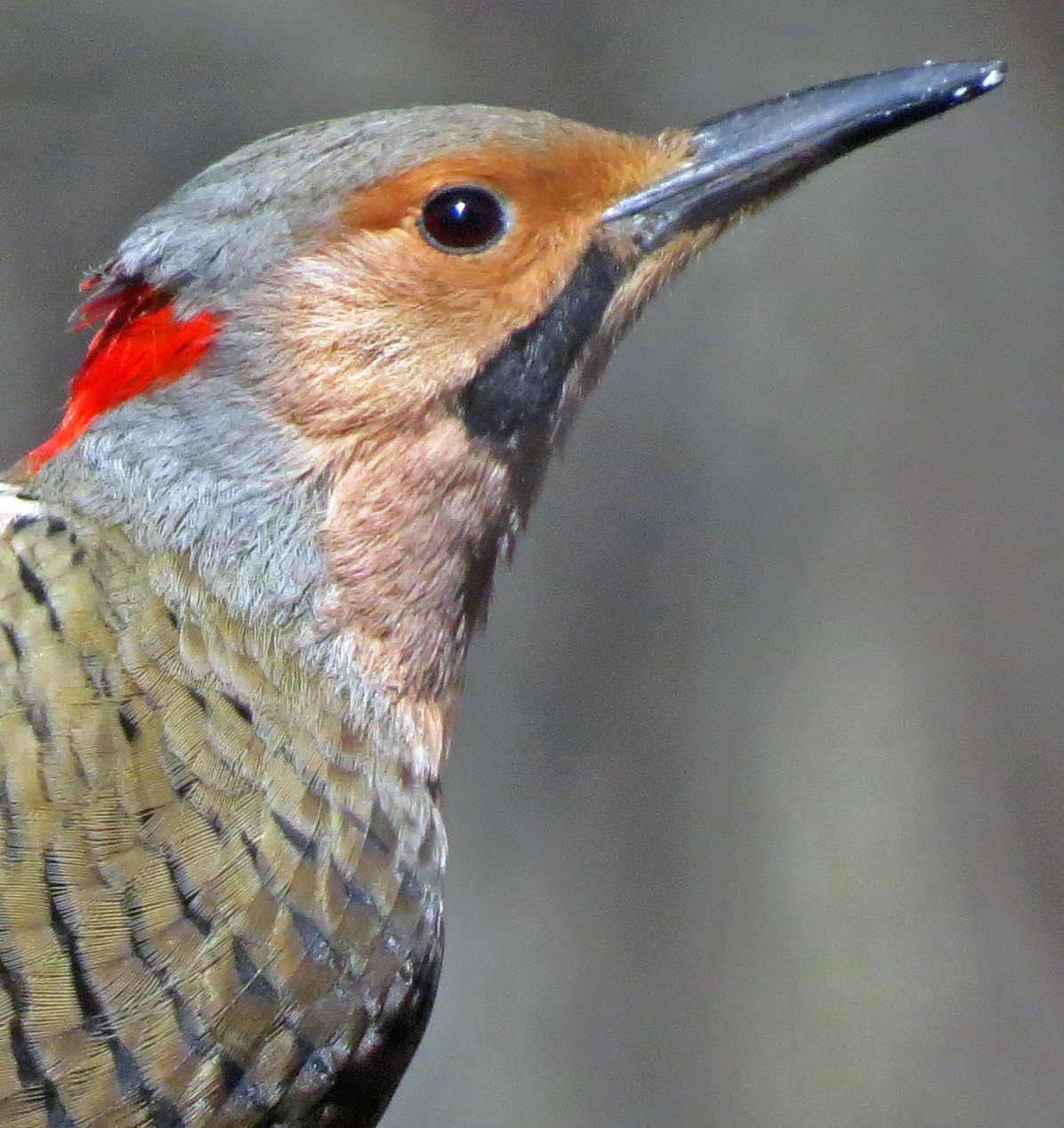
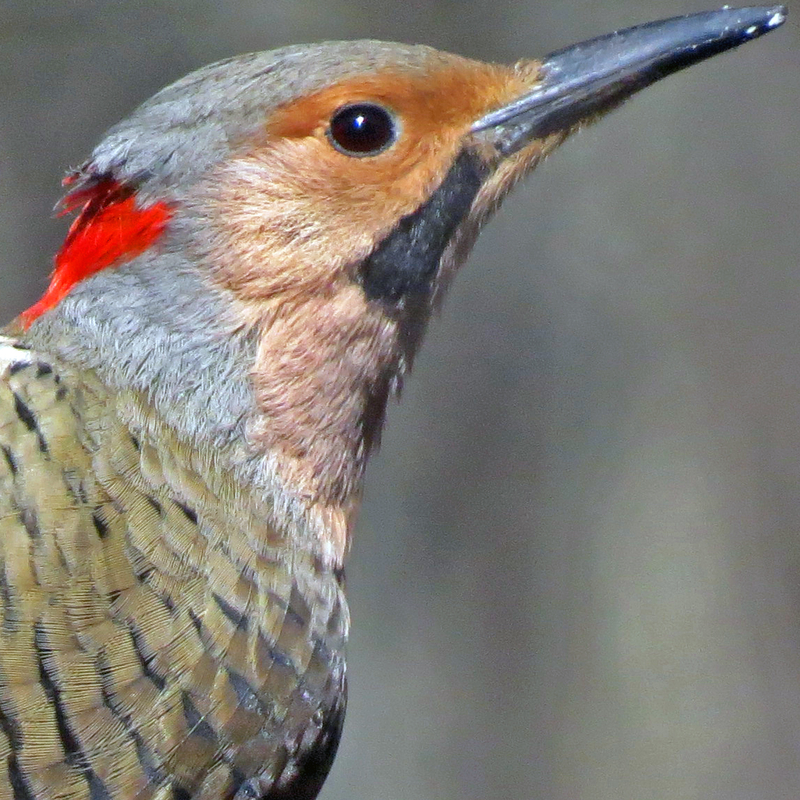
- Color Pattern: Brown back barred with black, a bold black crescent bib, a white belly covered in black spots, and a white rump. Underwings and undertail flash golden yellow (yellow-shafted, East) or salmon red (red-shafted, West). Yellow-shafted birds add a red crescent on the nape.
- Male vs. Female: The male wears a mustache stripe — black in the yellow-shafted form, red in the red-shafted; the female’s face is clean.
Gold under the wings, red on the nape: tan face with a gray crown, a scarlet crescent at the nape, and golden wing linings that flare in flight. The male’s mustache is jet black. This is the form most eastern and midwestern yards know.
Salmon under the wings, no nape crescent: gray face with a brown crown, and the male’s mustache is red. In the Great Plains the two forms meet and interbreed freely, mixing every combination — a field guide puzzle worth celebrating, not solving.
Northern Flicker Vocalization Guide (2 Field Recordings + 1 Simulation)
The flicker’s voice matches its size: a loud, rolling “wicka-wicka-wicka” — a sustained laugh given from a high perch — and a piercing single “kleer!” contact note. Spring brings drumming, famously on gutters, vents, and metal signs. The first two cards below are real field recordings shared under Creative Commons licenses; the third is a clearly labeled acoustic simulation of the single-note call. For more wild audio, browse xeno-canto: Northern Flicker.
1. Real Recording — The Rolling “Wicka” Rattle
2. Real Recording — True Drumming
3. Call Simulation — The Piercing “Kleer!”
Habitat, Range & the Lawn-and-Tree Neighborhood
The Northern Flicker lives where trees meet open ground: woodland edges, parks, orchards, riverside groves, and the classic American suburb — because a lawn, to a flicker, is an ant buffet with lookout posts.

From Alaska to Central America
Few woodpeckers cover so much ground: flickers breed from Alaska and across Canada through the entire continental United States to Mexico and Central America. Northern breeders are migratory, streaming south in fall; across most of the Lower 48 the species is present all year.
The Alabama state bird — the “yellowhammer” — is this very species. Whether your yard sits in yellow-shafted or red-shafted country, a flicker on the lawn in February is doing exactly what its kind has always done: mining the turf for ants.
Backyard Behavioral Patterns & Social Dynamics
The Northern Flicker does everything a little differently from other woodpeckers — starting with where it stands. Four behaviors explain most backyard encounters:
🐜 The Ant Specialist
Ants can make up nearly half a flicker’s diet — it squats by an anthill, hammers the soil like other woodpeckers drill wood, and licks up ants and larvae with a tongue that darts two inches beyond the bill. A flicker working your lawn is free pest control.
🌱 The Lawn Hoppers
Where other woodpeckers cling, flickers hop across open ground, probing turf for insects and fallen seed. The upright, horizontal-backed stance on the grass is unique among North American woodpeckers — once seen, never confused.
📢 The Metal Drummer
In spring, flickers famously drum on gutters, vent caps, and metal signs — the louder the better for advertising a territory. It is noise, not damage; the behavior fades once nesting begins.
🫐 The Winter Berry Eater
When ants go underground, flickers switch to dogwood, sumac, wild cherry, bayberry — even poison ivy berries — plus sunflower and corn at feeders. A yard with native berry shrubs holds flickers long after the lawn freezes.
Problem: “There’s a Big Spotted Bird Pecking My Lawn — Is It Hurting the Grass? And Why Is It Drumming on My Gutter?”
The three most common Northern Flicker puzzles all have reassuring answers:
First, the lawn pecking: that bird is hunting ants, not damaging turf — flickers eat thousands of ants and their larvae, and the small probe holes they leave aerate the soil. Second, the 6 a.m. gutter concert: spring drumming on metal is territorial advertisement, not nest destruction; it peaks for a few weeks and stops once the pair settles to excavate a cavity in dead wood. If it truly wears you down, temporarily covering the favored metal surface usually redirects them. Third, the color confusion: a bird flashing salmon-red under the wings in the East (or gold in the West) is likely an intergrade from the Plains contact zone — both forms are one species, and the mixed birds are a legitimate treat.
Method 1: Set the Table — Suet, Platform Seed & Ants
Design for a big ground-feeder that is happy to visit upward:
-
Hang a Large Suet Feeder
Suet is the most reliable flicker draw at feeder height — use a large cage or tail-prop design that lets a 12-inch bird cling comfortably. Insect-blend cakes nod to its natural diet.
-
Run a Low Platform Feeder
A platform feeder — especially a low one — with black oil sunflower, cracked corn, and peanuts matches the flicker’s ground-feeding style better than any tube feeder.
-
Let the Ants Be
Skip broadcast lawn insecticides — the anthill at the lawn’s edge is the flicker’s own feeder, and the bird will thin it for you free of charge.
-
Offer Water at Ground Level
A ground-level or shallow pedestal bath suits a bird that already works the lawn — flickers drink and bathe readily when the water is where they live.
Method 2: Build the Habitat — Open Lawn, Snags & Berries
Feed the habitat, and the flickers follow:
-
Keep the Edge Habitat
Flickers want trees beside open ground — the lawn-and-shade-tree yard is already their blueprint. Keep sight lines open between turf and canopy.
-
Leave a Snag or Mount a Box
A standing dead tree is prime cavity real estate; where none is safe to keep, a large woodpecker nest box filled with wood shavings, mounted 8–20 feet up, is accepted readily — flickers are among the most willing box nesters.
-
Plant Native Berry Shrubs
Dogwood, sumac, elderberry, and serviceberry carry flickers through the months when ants sleep — fall color for you, winter groceries for them.
-
Keep Water Open Year-Round
In freezing weather a heated bird bath keeps overwintering flickers anchored to your yard when every natural source is locked in ice.
Tool Solution: Recommended Hardware for Northern Flickers
Equipment matched to a large, ground-adapted suet eater:
Tail-Prop Suet Feeder
An oversized suet cage with a tail-prop base — the only style a 12-inch flicker can use comfortably for minutes at a stretch, and the surest way to bring this ground bird up where you can watch it.
- • Food: Plain, peanut, or insect-blend suet cakes
- • Style: Large cage with tail-prop base
- • Placement: Pole or trunk near open lawn
Low Platform Feeder
A sturdy, drained platform set low — even a ground tray — stocked with sunflower, cracked corn, and peanut pieces: the feeder layout a lawn-foraging flicker actually recognizes as a feeding spot.
- • Food: Black oil sunflower, cracked corn, peanuts
- • Build: Drained tray, squirrel-aware placement
- • Placement: Open lawn near cover
Shallow Bird Bath
A shallow basin at or near ground level with gently sloped sides — flickers drink and bathe daily, and a heater keeps water open on freezing nights when ants are deep underground.
- • Depth: 1–2 in, gently sloped
- • Winter: Add a heater or de-icer
- • Placement: Open ground beside cover
Frequently Asked Questions
- Species Profile: The Northern Flicker (Colaptes auratus) is an 11–12.2 inch, 110–160 gram woodpecker (Picidae) — brown-barred, polka-dotted, with a black bib and a flashing white rump.
- ID in One Look: The woodpecker on the lawn: black crescent bib, spotted belly, white rump in flight, and golden (East) or salmon (West) underwings; males wear a mustache stripe.
- A Partial Migrant: Breeds from Alaska and Canada through all of the Lower 48; northern birds move south, so many yards gain a flicker for the winter.
- The Sound: A rolling “wicka-wicka-wicka” laugh, a piercing “kleer!” contact note, and spring drumming — famously on gutters and metal signs.
- Feeder Formula: A large tail-prop suet feeder plus a low platform with sunflower, cracked corn, and peanuts — and a lawn left friendly to ants.
- The Ant Eater: Ants can be nearly half the diet, taken with a two-inch sticky tongue — a flicker working your turf is free, feathered pest control.
Bird Watching Log
Species: Northern Flicker (Colaptes auratus)
| Northern Flicker (Form: Yellow-shafted / Red-shafted — On the Ground: Yes / No — Drumming Heard: Yes / No) | |