
American Crow vs Pileated Woodpecker


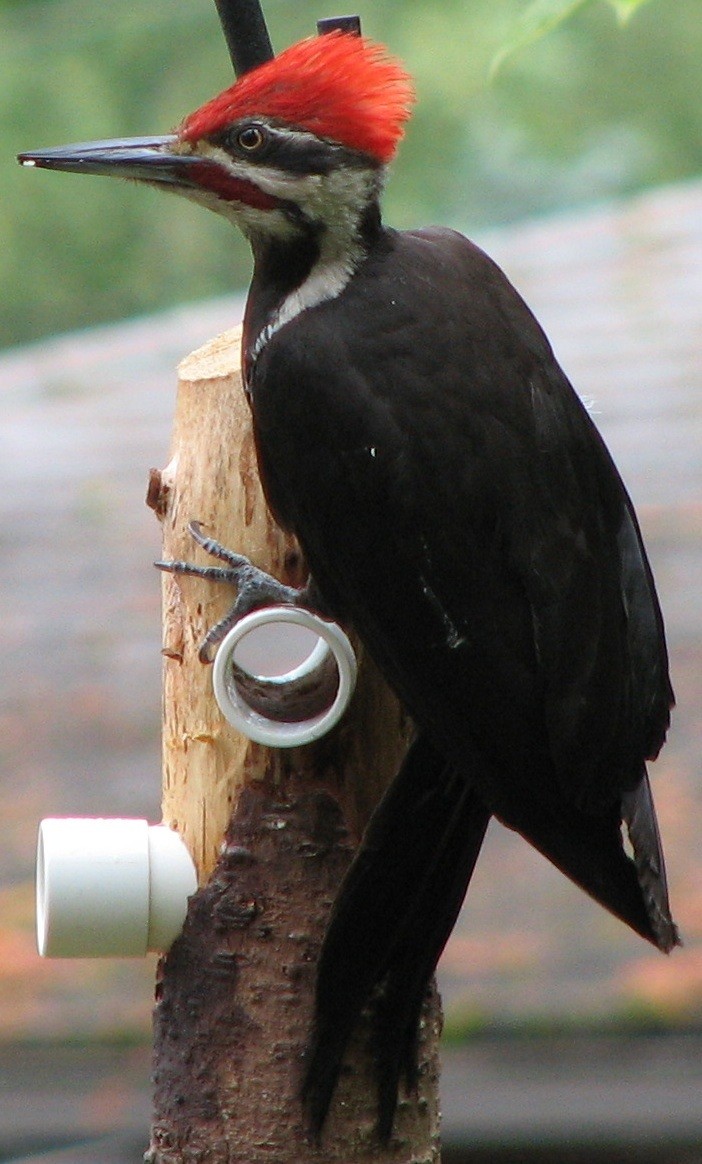

American Crow vs Pileated Woodpecker (Corvus brachyrhynchos vs Dryocopus pileatus): The Complete Backyard Identification Guide
Quick Answer: The Fastest Way to Tell Them Apart
The most common big-black-bird mistake in eastern woods. Three rules:
- Wing flashes: white patches flashing on the underwing with each stroke = Pileated Woodpecker; wings uniformly dark = American Crow.
- Flight path: deep, roller-coaster undulations between trees = Pileated; steady, level, rowing flight = crow.
- Head and neck: a flaming red crest and bold white neck stripes = Pileated; a plain black head = crow.
At-a-Glance Comparison Table
The two big black birds, side by side. KEY rows separate fastest.
| Feature | American Crow | Pileated Woodpecker |
|---|---|---|
| Scientific Name | Corvus brachyrhynchos | Dryocopus pileatus |
| Length KEY | 17.5 in (45 cm) | 16.5 in (42 cm) |
| Wingspan | 36–39 in (91–100 cm) | 26–29 in (66–74 cm) |
| Weight | 11–21 oz (320–600 g) | 8.8–14.1 oz (250–400 g) |
| Overall Shape KEY | Large all-black songbird with a fan-shaped tail | Crow-sized woodpecker with a flaming red crest |
| Male Plumage KEY | Entirely black with a slight gloss; stout black bill (sexes alike) | Black body with a bold white neck stripe, white underwing flashes, red crest and red mustache stripe |
| Female Plumage | Identical to the male, averaging slightly smaller | Like the male but with a black forehead and black mustache stripe |
| Bill Shape | Stout, straight, all-black bill | Massive, chisel-tipped, gray |
| Tail | Squared to slightly rounded fan tail | Long, black, stiff |
| Core Range | Nearly the entire US and southern Canada; cities, farms, woods and shores | Mature forests of the East, the Pacific Northwest and boreal Canada; wooded suburbs with big trees |
| Migration | Mostly resident; northern birds shift south in winter roosts | Non-migratory resident |
| Feeder Presence | Takes cracked corn, peanuts, eggs and table scraps from platforms | Visits large suet feeders and log feeders in wooded yards; needs stout support |
| Favorite Foods | Omnivore: grain, insects, carrion, eggs, fruit, refuse | Carpenter ants and beetle larvae from rectangular excavations; fruit and nuts in fall |
| Song KEY | The familiar loud “caw-caw-caw” | No true song — a loud, ringing call instead |
| Flight Call | Varied caws; also rattles and knocks | A loud, ringing “kuk-kuk-kuk-kuk” that rises and falls |
| Population Trend | Common and adaptable; numbers fluctuate with West Nile virus cycles | Stable to increasing as eastern forests mature |
Male Field Marks, Side by Side
American Crow — Male
- All black with a squared fan tail.
- Steady rowing wingbeats in flight.
- Familiar loud “caw-caw”.
Pileated Woodpecker — Male
- Crow-sized — the largest woodpecker in most of North America.
- Red crest plus red mustache stripe (male).
- White underwing flashes in deep, crow-like flight.
Female & Juvenile Marks, Side by Side
American Crow — Female
- Identical to the male.
- Family groups cooperatively raise young.
- Gathers in huge winter roosts.
Pileated Woodpecker — Female
- Red crest but black forehead and mustache.
- Carves rectangular holes hunting carpenter ants.
- Pairs hold large year-round territories in mature woods.
Part-by-Part Anatomy Breakdown
In silhouette they overlap; in detail they could not differ more:
| Body Part | American Crow | Pileated Woodpecker |
|---|---|---|
| Crest | None — rounded black crown | Flaming red crest sweeping back from the bill |
| Neck | All black | Bold white stripe running down each side |
| Underwing | Uniformly dark | Large white patches that flash in flight |
| Face | Plain black | Black-and-white striped; red mustache on the male |
| Flight | Steady, level rowing | Deep bounding undulations |
| Bill | Stout black cone | Massive gray chisel |
| Perched Posture | Horizontal on a branch | Vertical, braced against a trunk |
Song & Call Comparison
American Crow
Voice: the familiar loud caw-caw-caw, plus rattles and imitations.
Behavior: mobbing calls assemble the neighborhood against owls and hawks.
Pileated Woodpecker
Voice: a loud, ringing kuk-kuk-kuk-kuk, like a flicker but bigger and wilder.
Drumming: powerful, slow-rolling booms that carry a mile.
Range & Seasonal Presence
The American Crow lives nearly everywhere — cities, farms, woodlots and shores across the US and southern Canada.
The Pileated Woodpecker lives in mature forest — the East, the Pacific Northwest and boreal Canada — and increasingly in wooded suburbs with big old trees. Where suburbs grow into forest, the two share the same map, which is exactly when the confusion happens.
Feeder Behavior & Favorite Foods
- American Crow: ground platforms with corn, peanuts and scraps.
- Pileated Woodpecker: a prize feeder bird in wooded yards — it needs a big, stout suet feeder or suet log it can brace against; small cages simply will not hold it.
- Best foods: crows take corn and peanuts; Pileateds take suet and suet plugs, and in fall they strip wild fruit.
- Habitat clue: rectangular holes chiseled deep into dead trees = Pileated territory, feeder or not.
Temperament & Flock Behavior
American Crows are social, scheduled and vocal — you always know when they arrive.
Pileated Woodpeckers are shy and forest-deep — pairs hold big territories, announce themselves with ringing calls, and flush away from roads and people in long undulating flight.
6-Step Backyard ID Checklist
- Underwing. White flashes = Pileated; all dark = crow.
- Crest. Red crest = Pileated; none = crow.
- Flight path. Bounding waves = Pileated; level rowing = crow.
- Voice. Ringing “kuk-kuk-kuk” = Pileated; “caw-caw” = crow.
- Posture. Clinging vertically to a trunk = Pileated; perched horizontally = crow.
- Habitat. Deep mature woods = likely Pileated; open country and town = likely crow.
Frequently Asked Questions
- Underwing: White flashes = Pileated; all dark = crow.
- Crest: Flaming red crest = Pileated; none = crow.
- Flight: Bounding waves = Pileated; steady rowing = crow.
- Voice: Ringing “kuk-kuk-kuk” = Pileated; “caw” = crow.
- Posture: Vertical trunk-clinging = Pileated; horizontal perch = crow.
- Sign: Rectangular holes in snags = Pileated territory.