
Fox Sparrow


Fox Sparrow (Passerella iliaca): Complete Identification, Feeder Guide & Call Library
Quick Answer: How to Attract & Identify Fox Sparrows
The Fox Sparrow (Passerella iliaca) is one of the largest and handsomest North American sparrows — a big, plump, rust-red ground bird whose dense arrowhead breast streaks converge into a central spot, with a rusty tail and a strong conical bill. Its signature move is the double-scratch: jumping forward and kicking both feet backward at once so the leaves fly like a miniature chicken’s. It breeds across Canada, Alaska, and the western mountains, then winters over most of the United States — a cold-season guest at yards from late October into April. To attract it: scatter sunflower seeds, white millet, and cracked corn on the ground or a low platform beside dense shrubs, keep a bed of leaf litter for it to kick through, and skip the hanging tubes — this bird feeds with its feet in the leaves. Listen for the rich, melodious whistled song and a loud, sharp “tschip” call.
Species Physical Profile & Morphometrics
The Fox Sparrow belongs to the New World sparrow family (Passerellidae) and stands apart from the little brown flock by sheer size and color — it is the heaviest of the familiar backyard sparrows, dressed in fox-red or chocolate brown depending on where it was born.
The identification formula: big plump body + dense rusty breast streaks + central spot + rust-red tail + double-scratch feeding, almost always on the ground in or beside cover.
Essential Morphometric Field Marks:
- Body Length & Mass: 5.9 to 7.5 inches (15–19 cm) and 0.9 to 1.6 ounces (26–44 grams) — clearly larger and plumper than a Song Sparrow, closer in heft to a small thrush.
- Wingspan: About 10.5 to 11.4 inches (27–29 cm), with low, direct flights diving back into shrub cover.
- Bill Structure & Color: A strong conical seed bill, yellowish below and darker above — massive in the Thick-billed group of the California mountains, built to crush large seeds.
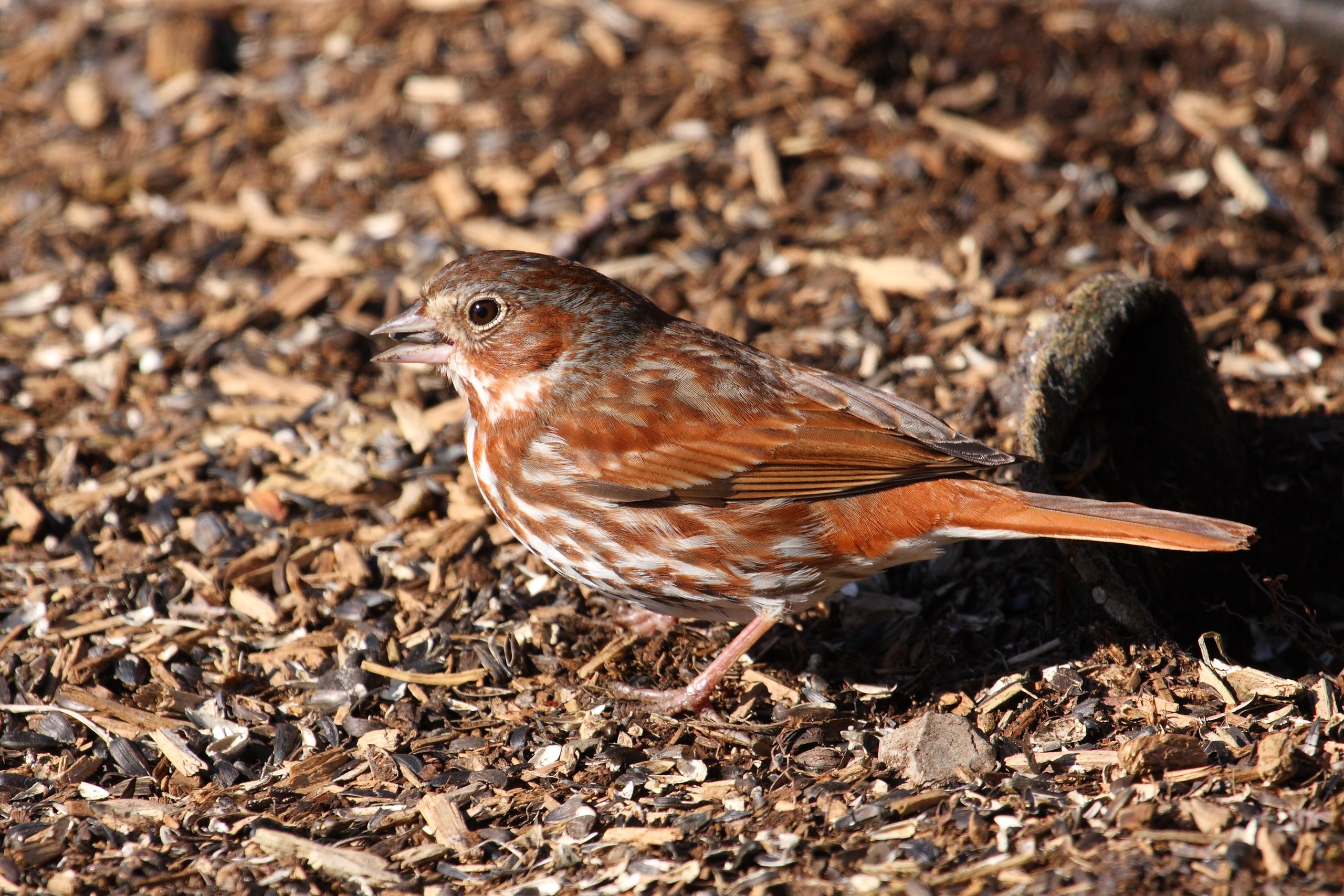
- Color Pattern: Dense, arrowhead-shaped reddish-brown streaks on a whitish breast converging into a central spot; a rusty-red tail and rump; grayish face tones mixed with rust on the head. Western groups replace the rust with gray (Slate-colored), dark chocolate (Sooty), or a gray head with a giant bill (Thick-billed).
Bright rusty red: red-brown streaks on a whitish breast, a rust-red tail, and rusty tones on the head and wings. This is the fox-colored bird that winters in eastern and southern yards — the one that gives the species its name.
Slate-colored birds of the Rockies wear a plain gray head and back against brown wings; Sooty birds of the Pacific Northwest coast are deep, dark chocolate all over; Thick-billed birds of the California high mountains pair a gray head with an outsized bill. Males and females look alike in every group.
Fox Sparrow Vocalization Guide (2 Field Recordings + 1 Simulation)
The song is a contender for the finest of any American sparrow: a short, loud, melodious outburst of clear, sliding whistles, rich and slightly husky. Migrants sing on mild late-winter days long before they head north. The everyday voice is a loud, hard “tschip” or “smack” — far sharper than other sparrows’ chips — plus a thin high “tseet” from the leaf litter. The first two cards below are real field recordings shared under Creative Commons licenses; the third is a clearly labeled acoustic simulation of the song skeleton. For more wild audio, browse xeno-canto: Fox Sparrow.
1. Real Recording — The Rich Whistled Song
2. Real Recording — The Foraging “Tseet”
3. Song Simulation — Whistles That Rise and Fall
Habitat, Range & the Four Color Groups
Fox Sparrows breed in northern and mountain thickets — brushy forest edges, willow and alder tangles, and regenerating clearings across Canada, Alaska, and the western ranges. In winter they shift to woodland undergrowth, overgrown field edges, and brushy backyards across most of the United States, especially the East, South, and Pacific lowlands.

One Species, Four Regional Coats
The map shows where each of the four color groups breeds: Red across the boreal forest of Canada and Alaska, Slate-colored in the Rockies and Great Basin, Sooty along the Pacific Northwest coast, and Thick-billed in the high mountains of California and Nevada.
In winter the groups fan out: Red birds flood the eastern and southern states, Sooty birds winter down the Pacific lowlands, and the mountain groups drop into the Southwest — so the Fox Sparrow at your feeder tells you which continent-spanning population adopted your yard.
Backyard Behavioral Patterns & Social Dynamics
The Fox Sparrow is a shy but forceful ground bird whose manners are unmistakable once seen. Four behaviors explain most of what you will observe:
🐔 The Barnyard Scratcher
Its signature move: a forward hop with both feet kicked backward at once, scraping leaves aside in a spray — like a scratch-fed chicken in miniature. You will often hear the rustling in the leaf bed before you spot the bird.
🎵 The Late-Winter Soloist
On mild days from late winter into April, a wintering male may deliver his rich, whistled song from a shrub-top perch — one of the finest sparrow songs on the continent, heard in the South only before he leaves.
🛡 The Cover Hugger
Fox Sparrows feed within a dash of safety. At the first alarm they dive into the nearest dense shrub or brush pile and wait it out — a feeding station without nearby cover will be ignored no matter how good the seed.
👑 The Pecking-Order Boss
Its size is no bluff: at a scattered-seed patch a Fox Sparrow shoulders aside smaller sparrows and holds its ground against birds nearly twice its weight — then goes quietly back to double-scratching.
Problem: “A Big Rusty Bird Is Kicking Up My Leaves Like a Chicken — What Is It, and Why Won’t It Come to My Feeders?”
The three most common Fox Sparrow puzzles all have reassuring answers:
First, the identity mystery: a plump, rust-red, heavily streaked bird doing the two-footed leaf-kick is a Fox Sparrow — no other common backyard bird combines that size, rusty color, and double-scratch. Second, the feeder boycott: this is a ground-feeding thicket bird that distrusts swaying tubes and exposed trays — the same sunflower seeds and millet scattered on the ground beside (or under) dense shrubs will be found within a day. Third, the disappearing act: it is a migrant and winter guest — it arrives quietly in late fall, may vanish for weeks while ranging locally, and leaves for the boreal forest in spring. That schedule is the species being itself, not a failure of your setup.
Method 1: Set the Table — Seed on the Ground
Design for a big, cover-loving ground scratcher:
-
Scatter Sunflower Seeds and Cracked Corn at the Shrub Line
Black oil sunflower seeds, white millet, and cracked corn scattered on the ground at the edge of dense shrubs are the Fox Sparrow staple — its strong bill crushes even large striped sunflower seeds with ease. Toss a handful where lawn meets cover each morning.
-
Add a Low Platform Near Cover
A stable platform feeder set low beside thick shrubs gives tidier serving — Fox Sparrows will feed from it confidently while ignoring a hanging tube entirely. The feeder style comparison guide covers platform options.
-
Seed the Leaf Litter Directly
The most natural presentation of all: scatter seed right into the leaf bed under a shrub and let the bird double-scratch for it. The rustling leaves will tell you it is working.
-
Keep Ground Stations Fresh
Ground seed spoils fast in wet winter weather. Scatter only a day or two’s worth at a time, rotate the spot if it stays soggy, and rake the patch weekly through the season.
Method 2: Build the Habitat — Leaf Litter & Brush Cover
Feed the habitat, and the bird follows:
-
Leave the Leaves Under Shrubs
A deliberate bed of leaf litter beneath a shrub border is the single best Fox Sparrow feature a yard can offer — it is both pantry and feeding technique in one. Skip the fall rake-out in at least one corner.
-
Build a Brush Pile
A loose pile of branches and prunings in a quiet corner gives this cover-loving bird the instant refuge it requires — pile it beside the feeding spot so the dash to safety is a single hop.
-
Plant Dense, Tangled Shrubs
Thicket-forming shrubs, hedges, and bramble patches recreate the willow-and-alder tangles of its breeding grounds. The denser and more tangled, the better — neatness is not the goal here.
-
Offer Water Near Cover
A shallow bath set within a quick dash of shrubs serves wintering birds daily; a heated bird bath keeps it open through the freezing weeks when they need it most.
Tool Solution: Recommended Hardware for Fox Sparrows
Equipment matched to a large, ground-feeding, cover-loving winter guest:
Low Platform / Ground Tray
A stable tray set low at the shrub-line edge, filled with sunflower seeds, millet, and cracked corn — the serving style this thicket-loving ground feeder actually trusts.
- • Seed: Sunflower, millet, cracked corn
- • Style: Low platform or ground tray
- • Placement: Lawn edge beside dense shrubs
Shallow Bird Bath (Heated in Winter)
A shallow bath with gently sloped sides set near brushy cover — a daily stop for wintering Fox Sparrows, and a lifeline during hard freezes.
- • Depth: 1–2 in, gently sloped
- • Winter: Thermostatic heater
- • Placement: Quick dash from shrubs
Seed Tray Under Hanging Feeders
A wide tray mounted beneath your existing tube feeders — turns finch and chickadee spillage into an official Fox Sparrow feeding station without extra refilling.
- • Seed: Catches spillage
- • Cleanup: Keeps lawn clean
- • Bonus: Serves juncos and towhees
Frequently Asked Questions
- Species Profile: The Fox Sparrow (Passerella iliaca) is a big 5.9–7.5 inch, 26–44 gram New World sparrow (Passerellidae) — one of the largest and most colorful sparrows on the continent.
- ID in One Look: Dense rusty arrowhead breast streaks converging into a central spot, rust-red tail, strong bill — feeding on the ground with the famous two-footed double-scratch.
- A Winter Guest: Breeds in Canada, Alaska, and western mountains; winters across most of the U.S. — watch for it from late October into April.
- The Sound: A rich, melodious burst of sliding whistles, plus a loud sharp “tschip” call and thin “tseet” from the leaf litter.
- Feeder Formula: Sunflower seeds, white millet, and cracked corn scattered on the ground or a low platform beside dense shrubs — plus a leaf-litter bed to kick through and a brush pile to dive into.
- Four Coats: Red, Slate-colored, Sooty, and Thick-billed color groups span the continent — all one species with one double-scratch.

Bird Watching Log
Species: Fox Sparrow (Passerella iliaca)
| Fox Sparrow (Double-Scratch Seen: Yes / No — Singing: Yes / No — Group Size: ____________________________) | |