
Blue Jay



Blue Jay (Cyanocitta cristata): Complete Identification, Feeder Guide & Call Library
Quick Answer: How to Attract & Identify Blue Jays
The Blue Jay (Cyanocitta cristata) is the crested blue corvid of eastern North America — bright blue above, white below, with a black “necklace” and a pointed crest that rises when the bird is excited. A member of the crow family, it is intelligent, loud, and famously caches thousands of acorns each fall, planting oak forests as it goes. To attract it: offer whole peanuts in the shell and black oil sunflower on a large, sturdy platform feeder, and keep a bird bath filled. Listen for the harsh “jay! jay!” alarm, the musical “queedle-queedle”, and a Red-shouldered Hawk scream that isn’t a hawk at all. It shares eastern yards with the Tufted Titmouse and the White-breasted Nuthatch.
Species Physical Profile & Morphometrics
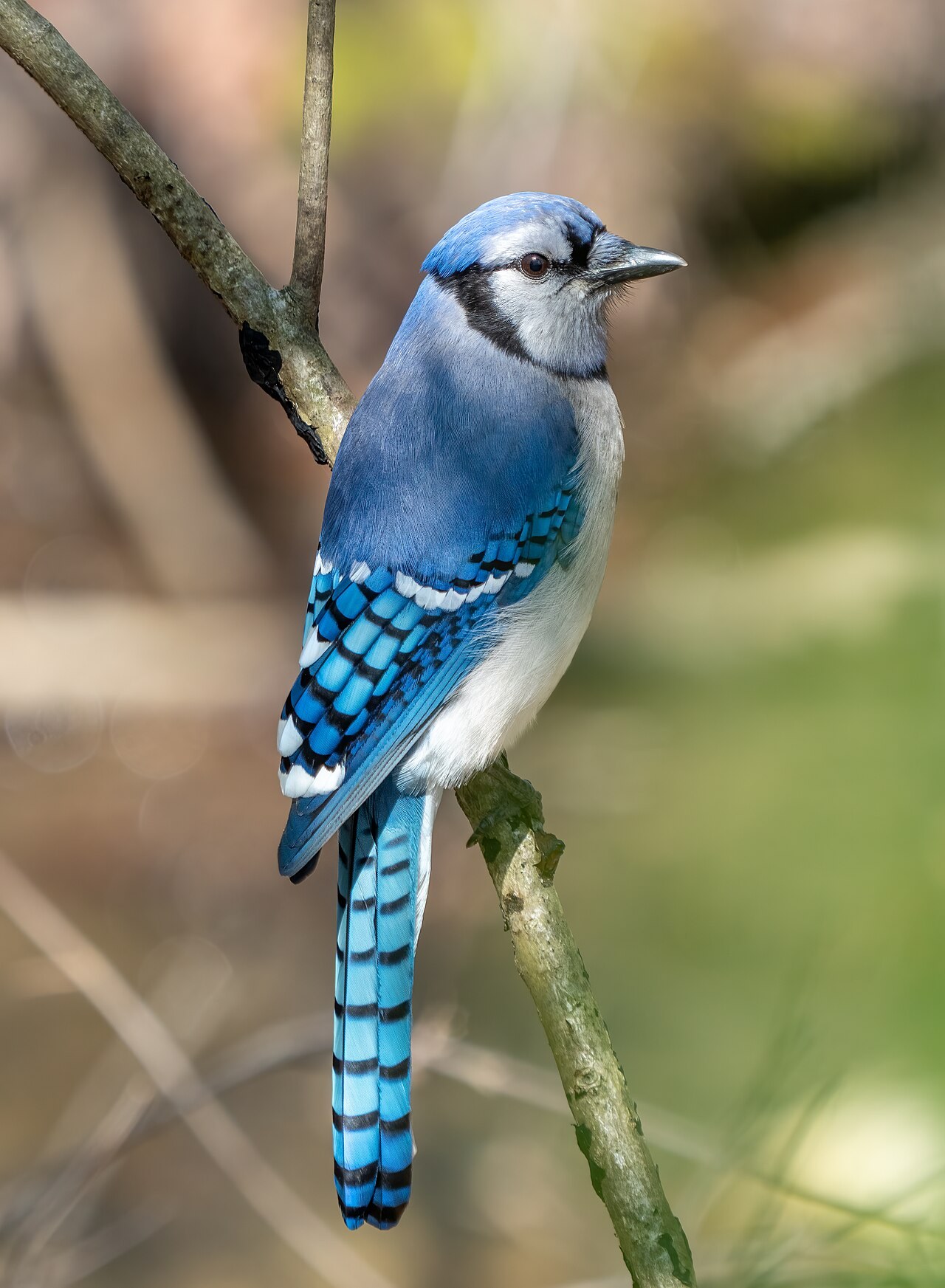
The Blue Jay is a large songbird of the crow and jay family (Corvidae) — kin to crows, ravens, and magpies, and like them, conspicuously intelligent. Its toolkit is an all-purpose corvid build: a strong black bill that cracks acorns, an expandable throat pouch for carrying nuts, and a movable crest that works as a mood indicator.
The identification formula: blue upperparts + white face and underparts + black necklace + pointed crest. And the famous blue is an illusion — the feathers contain no blue pigment; the color comes from light refracting through the feather’s internal structure.
Essential Morphometric Field Marks:
- Body Length & Mass: about 9.8 to 11.8 inches (25–30 cm) and 2.5 to 3.5 ounces (70–100 grams) — robin-class, the largest regular at most eastern feeders.
- Wingspan: about 13.4 to 16.9 inches (34–43 cm); the broad, rounded wings flash bold white patches in the slow, rowing flight.
- Bill Structure & Color: A stout, straight black bill — a nutcracker, probe, and hammer in one, strong enough to split an acorn shell.
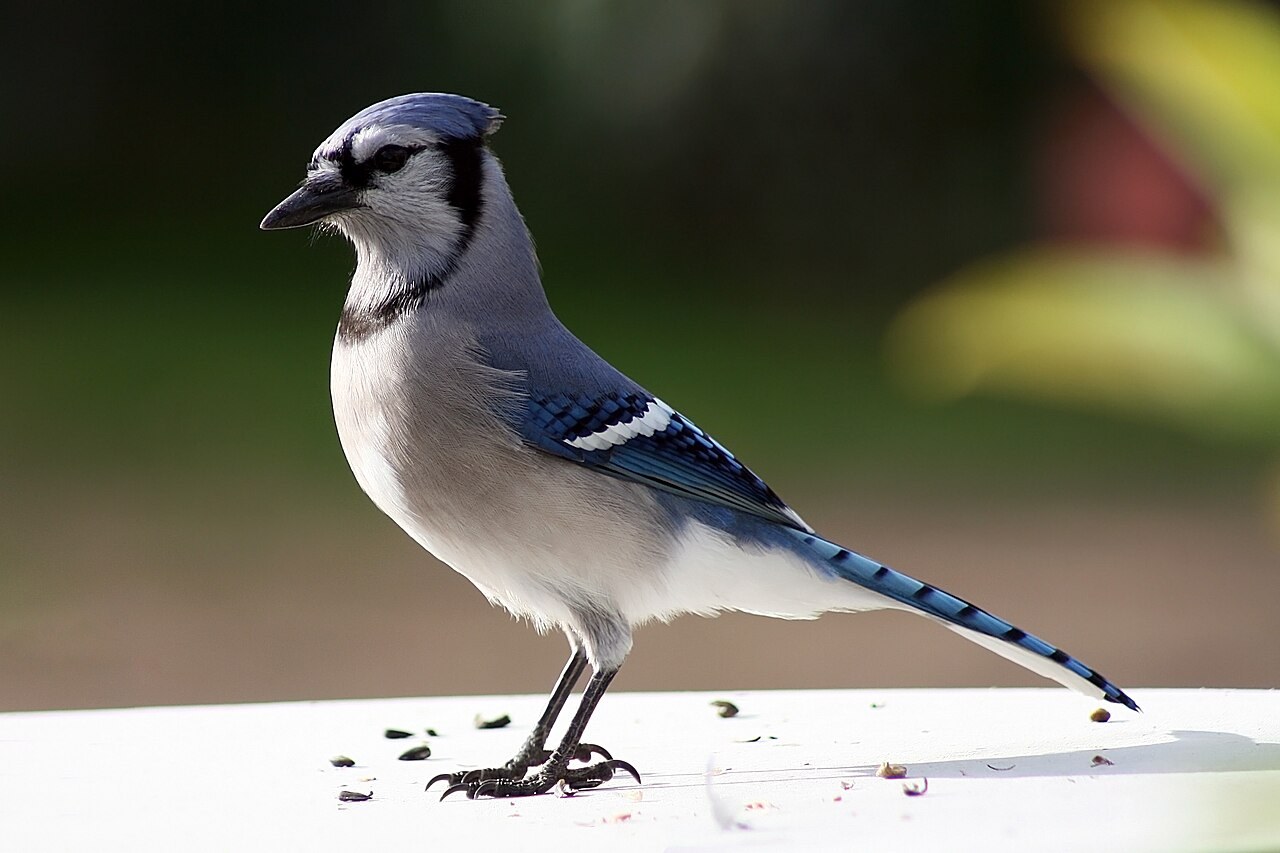
- Color Pattern: Blue crest, back, wings, and tail; white face, throat, and belly; a bold black necklace wraps up the nape and through the eye; wings and tail barred blue-black-white with white wing bars and tail corners.
- Male vs. Female: The sexes look identical — same crest, same necklace; males average slightly larger. Watch for the rattle call and nest-building behavior to tell the female in spring.
Same uniform, bigger frame: identical blue-and-white plumage and necklace as the female, averaging a touch larger. Males court with crests raised and exaggerated bobbing, and escort mates with soft, musical calls rarely heard at feeders.
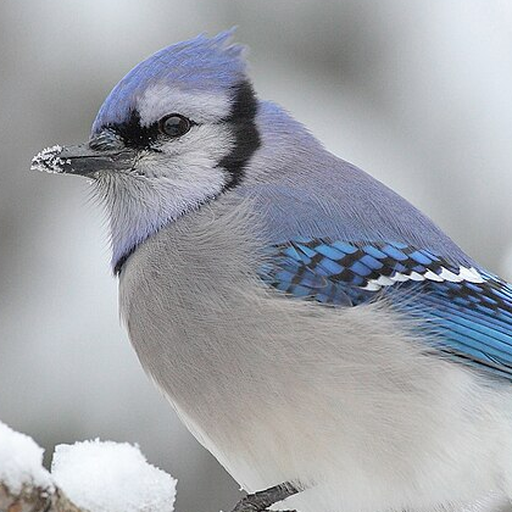
Same uniform, signature sound: identical plumage, but the female gives most of the mechanical “rattle” calls — a dry, rapid clatter often heard around the nest site — and does the nest-building while her mate brings food.
Blue Jay Vocalization Guide (4 Field Recordings)
Blue Jays have one of the widest vocabularies of any backyard bird: the harsh “jay! jay!” scream, a musical “queedle-queedle”, a mechanical rattle, and famously accurate hawk mimicry. All four recordings below are real field audio hosted on Wikimedia Commons, recorded by Jonathon Jongsma (mirrored from xeno-canto) — no simulations. For a deeper library, browse xeno-canto: Blue Jay.
1. The “Jay! Jay!” Alarm Scream
2. The Musical “Queedle” Call
3. The Rattle Call
4. The Flock Chorus
Habitat, Range & the Eastern Woodland
The Blue Jay belongs to the oak and beech woodlands of eastern North America — forest edges, parks, leafy suburbs, and any yard with mature trees. Wherever oaks drop acorns, jays are close behind.

East of the Rockies, Coast to Plains
The range covers everything east of the Rockies: from southern Canada (Newfoundland to Alberta) through the entire eastern and central United States to the Gulf Coast and Florida. Most birds are year-round residents, but some migrate — loose daytime flocks stream along the Great Lakes and Atlantic coast each fall, and which individuals go remains one of bird migration’s unsolved puzzles.
Suburbs suit them perfectly: mature oaks, platform feeders, and bird baths make an eastern yard ideal Blue Jay territory in all twelve months.
Backyard Behavioral Patterns & Social Dynamics
The Blue Jay is the sharp, loud foreman of the backyard. Four behaviors explain most encounters:
🌰 The Acorn Banker
Each fall a single jay can cache 3,000–5,000 acorns, carrying several at once in its throat pouch and burying them over a wide area. The forgotten ones germinate — jays are credited with spreading oak forests northward after the ice age.
🦅 The Hawk Mimic
Blue Jays imitate Red-shouldered and Red-tailed Hawk screams so accurately that seasoned birders are fooled. The payoff may be a cleared feeder, a warning to flockmates, or a test for real hawks — probably all three.
🚨 The Neighborhood Watch
Jays are the backyard’s alarm system: they mob owls, hawks, and cats with screaming dives, and every songbird in the yard benefits from the early warning. A sudden eruption of “jay! jay!” means look up — something is out there.
👑 The Feeder Foreman
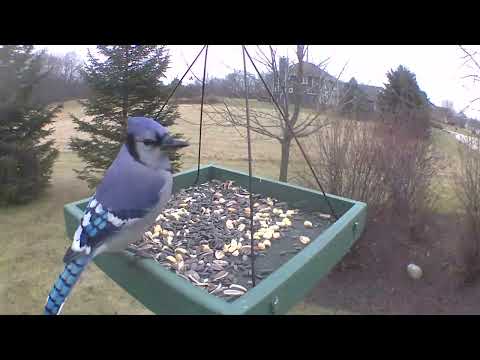
At feeders the jay is bold and dominant, scattering smaller birds with a sweep of its wings — then stuffing its pouch with sunflower seeds and flying off to cache them. It favors large, stable platforms it can land on confidently.
Problem: “Blue Jays Chase Off My Smaller Birds and Empty the Feeder. Can I Fix That?”
The three most common Blue Jay complaints all have workable answers:
First, the feeder bullying: don’t fight it — partition it. Give jays their own large platform with whole peanuts and sunflower a few yards from the small-bird station; hang tube and finch feeders with short perches that jays can’t comfortably use, and everyone eats. Second, “a hawk screamed, but it was a jay”: that’s mimicry, and it’s normal — the jay may be clearing the feeder or reporting a real predator. Enjoy the trick; it costs nothing. Third, the vanishing seed bill: much of what a jay grabs is cached, not eaten — buried across the neighborhood for lean days. If peanuts are disappearing wholesale, ration them: put out a dozen in the morning rather than filling a feeder to the top.
Method 1: Set the Table — Peanuts & Platforms
Design for a big, bold nut specialist:
-
Lead with Whole Peanuts in the Shell
Nothing attracts a Blue Jay faster — in-shell peanuts on a platform or in a wire wreath feeder get hammered open on the spot or carried off to cache. Expect repeat daily visits within days.
-
Use a Large, Sturdy Platform
A jay is too big for most tube perches. A large tray or fly-through platform gives it a confident landing pad — mount it solidly; a swaying feeder loses the bird.
-
Add Sunflower and Cracked Corn
Black oil sunflower is the everyday staple, and cracked corn on the ground or a low tray rounds out the menu — jays swallow seeds whole and cache the surplus.
-
Offer Suet in Winter
A suet cage sized for a bigger bird (or a tail-prop design) carries jays through the cold months, alongside the Downy Woodpeckers that share it.
Method 2: Build the Habitat — Oaks, Cover & Water
Feed the habitat, and the jays follow:
-
Plant (or Keep) an Oak
Oaks are the ultimate Blue Jay tree — acorns fuel the caching instinct that defines the species. Beech, hickory, and hazel work too. One mature oak can hold a jay family for decades.
-
Keep Dense Cover for Nesting
Pairs nest in the crotch of a tree or thick shrub, 8–30 feet up, and go secretive in April. Evergreens and dense hedges near the feeder give them the safe approach routes they prefer.
-
Provide a Bird Bath They Trust
Jays are enthusiastic bathers — a shallow basin near cover gets loud, splashy use, and a heated bath in winter draws the whole neighborhood flock.
-
Tolerate the Caches
Peanuts in the flower bed and acorns in the lawn are the species’ signature. Leave them be — worst case you pull a few sprouts; best case you grow an oak.
Tool Solution: Recommended Hardware for Blue Jays
Equipment matched to a large, strong, clever corvid:
Large Platform / Tray Feeder
A big, rigid tray or fly-through platform — the only common feeder style a Blue Jay can land on with full confidence, and the natural stage for peanuts, sunflower, and corn.
- • Food: Whole peanuts, sunflower, cracked corn
- • Style: Large rigid tray, drain holes
- • Placement: Firm mount, near tree cover
In-Shell Peanut Feeder
A wire wreath or mesh peanut feeder that holds whole in-shell peanuts — jays cling, hammer, and carry off nuts to cache, giving you front-row seats to the species’ most entertaining behavior.
- • Food: Whole peanuts in the shell
- • Style: Wire wreath or mesh cylinder
- • Placement: A few yards from small-bird feeders
Heated Bird Bath
A shallow basin with a thermostatic heater — jays bathe enthusiastically all year, and open water in a hard freeze makes your yard the flock’s daily headquarters.
- • Depth: 1–2 in, gently sloped
- • Winter: Thermostatic heater or de-icer
- • Placement: Open sightlines beside cover
Frequently Asked Questions
- Species Profile: The Blue Jay (Cyanocitta cristata) is a 9.8–11.8 inch, 70–100 gram corvid (Corvidae) of eastern North America — blue crest, black necklace, barred blue-and-white wings and tail.
- ID in One Look: Crest + necklace + blue is diagnostic; sexes look identical, and the blue is structural, not pigment.
- A Partial Migrant: Most jays stay year-round; some migrate by day in fall flocks — and nobody can predict which birds go.
- The Sound: A harsh “jay! jay!” alarm, a musical “queedle,” a female-biased rattle call — and flawless hawk mimicry.
- Feeder Formula: Whole peanuts in the shell and black oil sunflower on a large rigid platform, plus a bird bath — and a separate small-bird station to keep the peace.
- The Forest Planter: Each jay caches thousands of acorns a year; forgotten caches grow into oaks.
Bird Watching Log
Species: Blue Jay (Cyanocitta cristata)
| Blue Jay (Crest Raised: Yes / No — At Peanuts: Yes / No — Caching Seen: Yes / No — Alarm Calling: Yes / No) | |