
Steller’s Jay


Steller’s Jay (Cyanocitta stelleri): Complete Identification, Feeder Guide & Call Library
Quick Answer: How to Attract & Identify Steller’s Jays
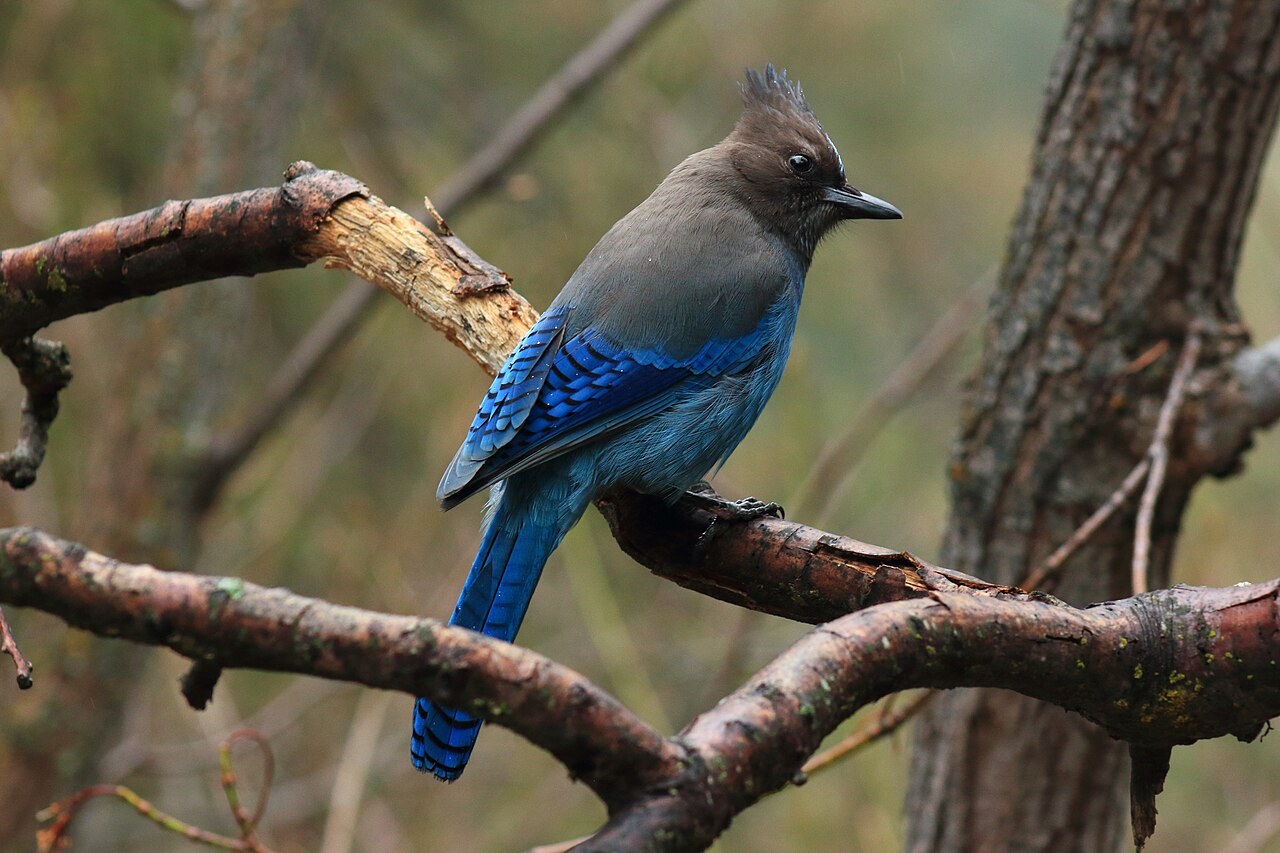
The Steller’s Jay (Cyanocitta stelleri) is the black-crested blue jay of western mountain forests — a charcoal head and tall triangular crest shading into a deep midnight-blue body, with no white face or necklace. It is the West’s answer to the Blue Jay: equally intelligent, equally loud, and an equally committed nut cacher, burying pine seeds and acorns by the thousand each fall. To attract it: put out whole peanuts in the shell and suet on a sturdy platform, especially in winter when mountain birds drift downslope. Listen for the harsh “shaack-shaack-shaack” and a Red-tailed Hawk scream coming suspiciously from inside a pine. It shares mountain yards with the Mountain Chickadee and the Hairy Woodpecker.
Species Physical Profile & Morphometrics
The Steller’s Jay is a large member of the crow and jay family (Corvidae), named for naturalist Georg Wilhelm Steller, who recorded it in Alaska in 1741 — one of the first western birds known to science. Its toolkit is classic corvid: a strong black bill for hammering nuts, an expandable throat pouch for hauling them, and a tall triangular crest that telegraphs mood.
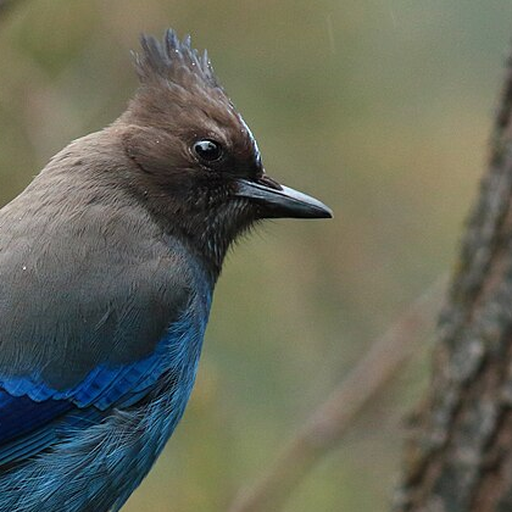
The identification formula: black crested head + midnight-blue body + barred dark-blue wings and tail + no white face. Interior birds add fine white forehead streaks.
Essential Morphometric Field Marks:
- Body Length & Mass: about 11.8 to 13.4 inches (30–34 cm) and 3.5 to 4.9 ounces (100–140 grams) — bigger and longer-crested than a Blue Jay, the largest jay of western forests.
- Wingspan: about 17.3 inches (44 cm); flight is deep and rowing, with the long blue tail trailing behind.
- Bill Structure & Color: A stout, straight black bill with a small hook at the tip — built for splitting pine seeds, acorns, and picnic sandwiches alike.
- Color Pattern: Head, crest, and upper breast charcoal-black, shading through the shoulders into deep blue on the belly, wings, and tail; wings and tail finely barred with darker blue-black. Interior birds show white streaks on forehead and chin; coastal birds are all-dark.
- Male vs. Female: The sexes look identical — same crest, same two-tone plumage; males average slightly larger. Pairs are quiet and secretive around the nest, bold everywhere else.
Same uniform, slightly larger: identical black-and-blue plumage as the female. In courtship he feeds her choice morsels and postures with the crest high and wings drooped; both sexes share the harsh alarm calling.
Same uniform, chief architect: identical plumage, averaging a touch smaller. She builds the bulky mud-and-twig nest high in a conifer and incubates, while the male delivers food — listen for the pair’s soft, private “sputtering” subsong in spring.
Steller’s Jay Vocalization Guide (4 Field Recordings)
The Steller’s Jay’s voice is the soundtrack of the western mountain forest: a harsh, rapid “shaack-shaack-shaack”, a low clicking “klook” between companions, guttural rattles, and famously convincing hawk mimicry. All four recordings below are real field audio hosted on Wikimedia Commons, recorded by Jonathon Jongsma (mirrored from xeno-canto) — no simulations. For a deeper library, browse xeno-canto: Steller’s Jay.
1. The Pair’s Calling
2. The Up-Slurred Call
3. The Flock Medley
4. The Creek-Side Forager
Habitat, Range & the Western Conifer Belt
The Steller’s Jay belongs to the evergreen forests of the mountainous West — pine, fir, and spruce country from Alaska to Central America, plus the campgrounds, cabins, and feeders embedded in it. If your yard has tall conifers, you are in its territory.

Alaska to Nicaragua, Always Near Conifers
The range runs from southern Alaska down the Pacific coast and through the Cascades, Sierra Nevada, and Rockies, continuing along Mexico’s highlands all the way to Nicaragua. The species barely migrates in the classic sense — instead it moves by altitude, drifting downslope into foothill towns and valley yards when snow buries the high-country food supply, then returning to the conifers to breed.
Backyards score best when they sit within or beside conifer forest: mountain cabins, rural foothill lots, and wooded suburbs of western cities. Platform feeders with peanuts turn a passing winter flock into daily regulars.
Backyard Behavioral Patterns & Social Dynamics
The Steller’s Jay is the bold, loud quartermaster of the mountain forest. Four behaviors explain most backyard encounters:
🌲 The Nut Cacher
Each fall a Steller’s Jay caches thousands of pine seeds, acorns, and hazelnuts, carrying several at a time in its throat and mouth and hiding them across its territory. The forgotten ones germinate — the species is a genuine tree planter of the western forest.
🏕️ The Camp Robber
Few western birds are bolder around people: Steller’s Jays patrol campgrounds, picnic tables, and cabin decks, snatching unattended food within seconds of your turning away. That boldness transfers straight to backyard feeders — they learn your refill schedule in days.
🦅 The Hawk Mimic
Like its eastern cousin, the Steller’s Jay imitates Red-tailed and Red-shouldered Hawk screams well enough to fool birders — and to send every small bird at the feeder diving for cover. A “hawk” that circles back to your peanut tray was probably a jay.
🚨 The Forest Alarm
A sudden eruption of “shaack-shaack-shaack” means a predator: jays mob owls, hawks, and cats with screaming dives, and every bird and squirrel in earshot benefits. Learn the alarm and you will start finding the owls they find.
Problem: “Steller’s Jays Raid the Campsite and Hog the Feeder. Can I Fix That?”
The three most common Steller’s Jay complaints all have workable answers:
First, the campsite raiding: that boldness is learned, and you control the lesson. Keep food in closed containers and coolers, never leave plates unattended, and never hand-feed — a hand-fed jay becomes a picnic-table thief for life, and some parks fine wildlife feeding. Second, the feeder hogging: don’t fight it, partition it. Give the jays their own large platform with whole peanuts several yards from the small-bird station, hang tube and finch feeders with short perches jays can’t use comfortably, and both crowds eat. Third, the winter flock that empties everything: when snow pushes high-country birds downslope, much of what they grab is cached, not eaten. Ration the peanuts — a dozen in the morning rather than a topped-up feeder — and spread pressure with a suet cage on the opposite side of the yard.
Method 1: Set the Table — Whole Peanuts, Suet & Big Nuts
Design for a big, bold mountain nut specialist:
-
Lead with Whole Peanuts in the Shell
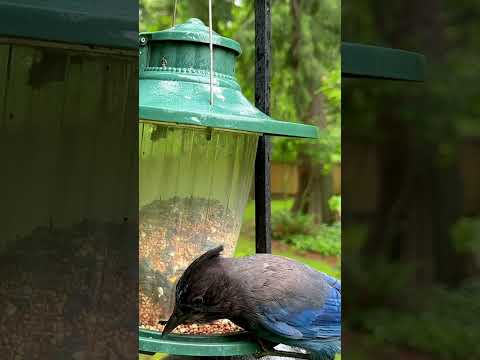
Nothing attracts a Steller’s Jay faster — in-shell peanuts on a platform or in a wire wreath feeder get hammered open on the spot or flown off to cache. Expect repeat daily visits within days, and expect the bird to announce them loudly.
-
Hang Suet for the Cold Months
A suet cage on a sturdy mount carries jays through winter, when high-elevation birds are working the lowlands hardest. Pepper suet keeps squirrels honest without bothering the birds.
-
Add Sunflower and Big Nuts
Black oil sunflower is the everyday staple; walnuts, hazelnuts, or almonds in the shell on the platform are premium draws that trigger the caching instinct — you will get to watch the hiding behavior up close.
-
Use a Large, Firmly Mounted Platform
A jay is too big and too suspicious for swinging feeders. A large tray or fly-through platform, mounted solid and sited within a quick dash of conifer cover, is the landing pad this species trusts.
Method 2: Build the Habitat — Conifers, Water & Quiet Corners
Feed the habitat, and the jays follow:
-
Keep (or Plant) Native Conifers
Pines, firs, and spruces are the species’ homeland — they supply seed crops, nest sites, and the safe approach routes jays use to reach a feeder. Even two or three mature conifers anchor a yard in Steller’s Jay territory.
-
Add an Oak or Berry Layer Where Range Allows
In pine-oak country, oaks add the acorn crop that fuels fall caching; serviceberry, elderberry, and madrone add the fruit jays take in season. Diversity here is what keeps birds after the feeder runs low.
-
Provide Water They Trust
A shallow basin near cover gets loud, splashy use — jays are enthusiastic bathers — and a heated bath makes your yard the winter flock’s headquarters when creeks lock up.
-
Leave a Quiet Corner in Spring
Pairs nest high in a conifer and go secretive and silent around the nest — a total personality change from the camp-robber act. Keep disturbance low near dense evergreens from April through June and you may host a family.
Tool Solution: Recommended Hardware for Steller’s Jays
Equipment matched to a large, strong, clever mountain corvid:
Large Platform / Tray Feeder
A big, rigid tray or fly-through platform — the only common feeder style a Steller’s Jay lands on with full confidence, and the natural stage for peanuts, sunflower, and in-shell nuts.
- • Food: Whole peanuts, sunflower, walnuts, hazelnuts
- • Style: Large rigid tray, drain holes
- • Placement: Firm mount, a short dash from conifer cover
Wire Peanut Wreath / Suet Cage
A wire wreath holding whole in-shell peanuts — or a solidly mounted suet cage — turns feeding into a show: the jay clings, hammers, and flies off with nuts to cache, and winter birds lean on the suet hard.
- • Food: Whole peanuts in the shell; suet blocks
- • Style: Wire wreath or heavy-duty suet cage
- • Placement: A few yards from small-bird feeders
Heated Bird Bath
A shallow basin with a thermostatic heater — mountain jays bathe enthusiastically all year, and open water during a hard freeze makes your yard the flock’s daily headquarters.
- • Depth: 1–2 in, gently sloped
- • Winter: Thermostatic heater or de-icer
- • Placement: Open sightlines beside dense cover
Frequently Asked Questions
- Species Profile: The Steller’s Jay (Cyanocitta stelleri) is an 11.8–13.4 inch, 100–140 gram corvid (Corvidae) of western mountain conifer forests — charcoal-black crested head shading into a midnight-blue body, band code STJA.
- ID in One Look: Black crested head + dark blue body + no white face is diagnostic — the only crested jay in the West; interior birds add fine white forehead streaks.
- An Altitude Migrant, Not a Distance Migrant: Year-round resident that drifts downslope into foothill yards in winter — feeder visits peak in the cold months.
- The Sound: A harsh, rapid “shaack-shaack-shaack” alarm, a low clicking “klook,” guttural rattles — and convincing hawk mimicry.
- Feeder Formula: Whole peanuts in the shell, sunflower, big in-shell nuts, and suet on a large rigid platform near conifers — plus a separate small-bird station to keep the peace.
- The Forest Planter & Camp Robber: Each jay caches thousands of pine seeds and acorns a year — and learns a campground’s food habits in days. Secure the picnic; enjoy the show.
Bird Watching Log
Species: Steller’s Jay (Cyanocitta stelleri)
| Steller’s Jay (Crest Raised: Yes / No — At Peanuts: Yes / No — Caching Seen: Yes / No — Shaack Heard: Yes / No) | |