
Florida Scrub-Jay


Florida Scrub-Jay (Aphelocoma coerulescens): Complete Identification, Conservation Guide & Call Notes
Quick Answer: Identify It Freely, Feed It Never
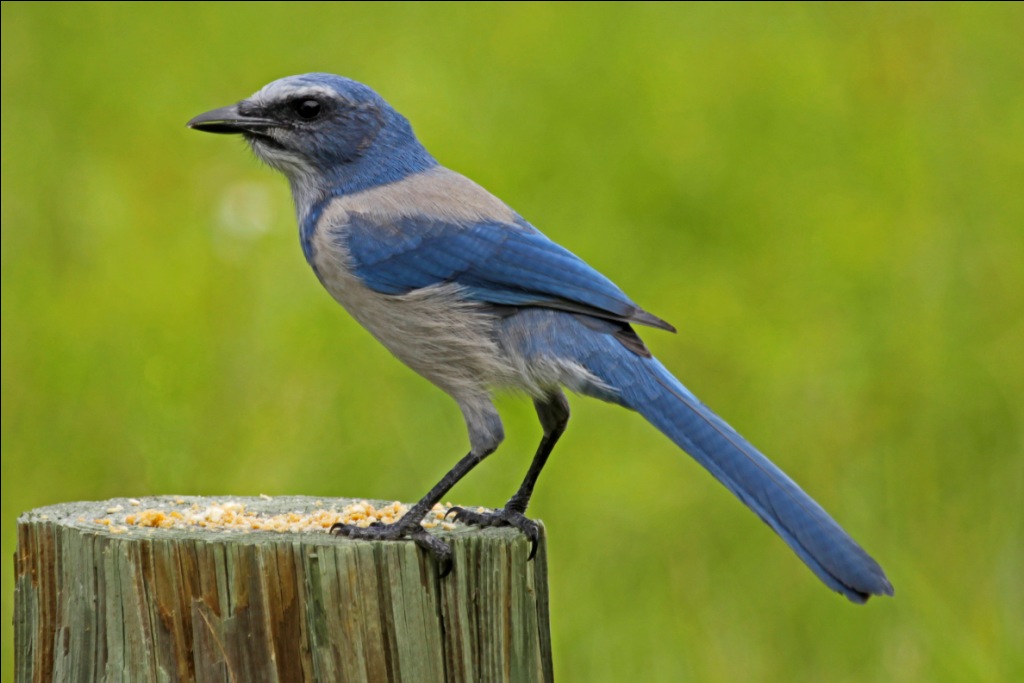
The Florida Scrub-Jay (Aphelocoma coerulescens) is the only bird species found nowhere on Earth but Florida — a crestless azure-blue jay with a whitish forehead, pale gray underparts, and a gray-brown back, living only in the peninsula’s oak scrub. It is federally listed as Threatened, and feeding it is illegal without a U.S. Fish & Wildlife Service permit. The honest formula: watch with binoculars, offer a shallow bird bath with a dripper, plant native scrub oaks if you border scrub, and keep cats indoors. Listen for the raspy, rising “shreep” call. It shares the scrub with the Eastern Towhee and the Blue Jay.
Species Physical Profile & Morphometrics
The Florida Scrub-Jay is a large songbird of the crow and jay family (Corvidae) — roughly robin-sized in the body but stretched by a long, graduated blue tail. Think of a Blue Jay that has lost its crest and its black necklace, and traded crisp patterning for a soft, sun-faded, dusty palette. That dusty look is the scrub-jay signature.
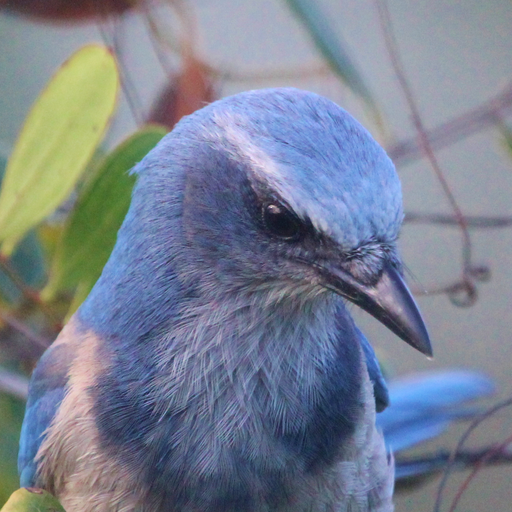
The identification formula: azure-blue head, wings, and tail + whitish forehead + plain pale gray underparts + gray-brown back + NO crest. And the range is the clincher — no other crestless blue jay occurs in peninsular Florida.
Essential Morphometric Field Marks:
- Body Length & Mass: about 9.1 to 11 inches (23–28 cm) and 2.3 to 3.1 ounces (66–88 grams) — slightly smaller and leaner than a Blue Jay, with a proportionally long tail.
- Wingspan: about 13 to 14.2 inches (33–36 cm); flight is a low, undulating flap-and-glide between shrubs, usually below treetop height.
- Bill Structure & Color: A straight, pointed black bill — slimmer than a Blue Jay’s, built for hammering acorns open on the sand and snatching insects from leaf litter.
- Color Pattern: Azure-blue head, wings, and tail; a whitish forehead; plain pale gray-white throat and belly with only a soft bluish wash on the upper breast; a dull gray-brown saddle across the back. Wings unbarred — no white spots, no black barring.
- Male vs. Female: The sexes look identical in plumage. In the breeding season, listen instead — only the female gives the strange hollow “hiccup” call.
Same uniform, sentinel and provider: plumage identical to the female, averaging a touch larger. He posts up on the tallest shrub oak as the family lookout and delivers food to his incubating mate — soft gurgling notes pass between the pair at close range.
Same uniform, the voice gives her away: identical plumage, but in late winter and spring she alone gives the hollow “hiccup” call around the nest site. She builds the twig cup low in a dense shrub oak, lined with palmetto fibers, and does the incubating.
Florida Scrub-Jay Vocalization Guide (2 Synthesized Mnemonics)
The Florida Scrub-Jay sounds much like its Western cousins: a loud, raspy, rising “shreep” is the everyday call, and alarmed birds fire a rapid, scolding “chek-chek-chek” series from an exposed sentinel perch. One sound is unique in the jay world: in the breeding season, the female gives a strange hollow “hiccup” call that males never produce. An honest note on audio: the Wikimedia Commons archive holds no freely licensed field recording of this species — so instead of mislabeled audio, the two buttons below play clearly labeled synthesized approximations to help you memorize the patterns. For real field recordings, browse xeno-canto: Florida Scrub-Jay.
1. The Raspy “Shreep” Call
2. The Female’s “Hiccup” Call
Habitat, Range & One Bird, One State
The Florida Scrub-Jay has the tightest address of any North American bird: it lives only in peninsular Florida, and only in xeric oak scrub and scrubby flatwoods — the ancient sand ridges down the spine of the state, old coastal dunes, and sandy river deposits: low shrub oaks, scattered sand pine, and critically, open patches of bare white sand where acorns are cached and insects are easy to spot.

A Broken Necklace of Sand Ridges
The range is a scattered chain of scrub patches: Ocala National Forest in the interior, Merritt Island and the Canaveral coast in the east, the Lake Wales Ridge down the peninsula’s spine, and fragments around Sarasota and Charlotte counties. Roughly 90% of the population has vanished over the past century as ridges became citrus groves and subdivisions, and isolated patches keep winking out.
The habitat is built by fire: scrub must burn periodically to stay low and open, and decades of fire suppression let it grow too tall and dense for jays. Prescribed burning is now the species’ most important recovery tool — about three-quarters of remaining scrub sits on protected conservation land.
Behavioral Patterns & Family Social Life
The Florida Scrub-Jay is the most intensively studied wild bird in North America — Archbold Biological Station has followed banded families for over fifty years. Four behaviors explain most encounters:
👨👩👧👦 The Family Business
Scrub-jays are cooperative breeders: the mated pair holds a permanent territory, and grown offspring stay home for one to two years as helpers — defending the territory, feeding nestlings, and mobbing predators. A group of three to eight birds moves through the scrub together like a small committee on patrol.
🌰 The Sand Bank
Each fall the family buries thousands of acorns, one per spot, in the bare sand — and digs them back up through winter. The acorns they forget sprout into the next generation of scrub oaks: the birds are literally planting their own pantry.
🧢 The Famous Tameness
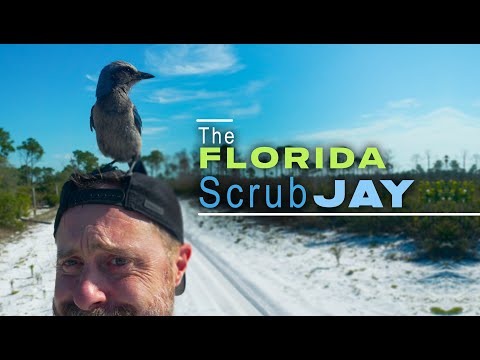
Wild scrub-jays will perch on a birder’s hat, camera, or open palm — the most confiding wild bird most Americans will ever meet. That trust is also the species’ weakness: habituated jays beg at roadsides, which is exactly why feeding them is now illegal.
🚨 The Sentinel System
While the family forages on open ground, one bird posts up on the tallest shrub as sentinel, scanning for hawks and snakes. At the first sharp “shreep,” everyone freezes or dives for cover — find the sentinel, and you’ve found the family.
Problem: “It’s Tame, It’s Rare, and It Wants a Peanut. Why Can’t I Feed It?”
With almost any other bird, a handful of peanuts is a kindness. With the Florida Scrub-Jay it is a federal offense without a U.S. Fish & Wildlife Service permit — and the reasons are biologically specific, not bureaucratic. Fewer than 5,000 of these birds remain.
First, the breeding mismatch: winter feeding makes jays nest earlier, so their nestlings hatch before the spring caterpillar peak they depend on — chicks starve with full stomachs of the wrong food. Second, the roadside trap: habituated jays learn that people mean food, people gather along roads, and vehicle strikes already kill breeding adults faster than young birds can replace them. Third, the law: the species is protected by the Endangered Species Act (Threatened since 1987), the Migratory Bird Treaty Act, and Florida’s own endangered species rule — harassing or feeding a listed species can constitute illegal “take.” If a scrub-jay approaches you, step back and enjoy it through binoculars — and if you live beside scrub, feed nothing outdoors at all.
Method 1: Watch, Don’t Feed — Ethical Scrub-Jay Etiquette
The close encounter is free and legal — if the bird chooses it:
-
Find the Sentinel First
Scan the tallest shrub oak or snag along a scrub trail for the upright blue silhouette of the sentinel. Where the sentinel is, the family is — usually working the open sand below, flipping leaf litter for insects.
-
Let Them Set the Distance
Stand still and quiet, and curious family members will often approach to within a few yards on their own. Never follow, crowd, or call them in — and never step off-trail toward a nest in spring.
-
Keep Food Zipped Away
On scrub trails, keep snacks sealed and out of sight. If a jay lands on you, offer nothing — savor the closest wild-bird encounter Florida has to offer, and let the bird decide when it is over.
-
Report What You See
Log every sighting in eBird — note band colors if visible — and if you live in Florida, consider Audubon’s Jay Watch, the citizen-science counts that state biologists actually use to track this species’ survival.
Method 2: Help From Your Own Yard (If You Border Scrub)
No feeders — habitat and safety do the helping:
-
Plant Native Scrub Oaks
Along a scrub edge, plant sand live oak, myrtle oak, and Chapman’s oak. You are growing next decade’s acorn crop — food delivered exactly the way the species evolved to receive it.
-
Offer Water, Not Food
A shallow bird bath with a dripper is legal, safe, and genuinely valuable in Florida’s dry season. Keep it clean, keep it one to two inches deep, and place it near cover but well away from roads.
-
Keep Cats Indoors
Ground-foraging, family-living birds are catastrophically vulnerable to free-roaming cats. An indoor cat is the cheapest conservation action any scrub-adjacent homeowner can take.
-
Support Fire and Land Management
Prescribed burning is the scrub’s life-support. Support your county’s burn programs and land acquisition — and if you own scrub, ask an FWC landowner-assistance biologist about managing it for jays.
Tool Solution: The Right Gear for Scrub-Jay Country
Equipment matched to a bird you watch but never feed:
8×42 Binoculars
Optics replace feeders here. A bright 8×42 pair lets you read leg-band colors, watch acorn caching, and enjoy the sentinel system from the respectful, legal distance the birds’ survival depends on.
- • Spec: 8×42, close focus under 8 ft
- • Why: Reads band codes at family distance
- • Build: Waterproof — Florida humidity
Bird Bath with Solar Dripper
Moving water advertises itself to every bird in the scrub and breaks no law — in the dry season, a dripping shallow basin may be the most-visited water hole on the ridge, jays included.
- • Depth: 1–2 in, gently sloped
- • Extras: Solar dripper for sound & sparkle
- • Placement: Near shrub cover, far from roads
Native Scrub Oak Planting
Sand live oak, myrtle oak, and Chapman’s oak saplings turn a scrub-edge yard into future territory — each mature shrub feeds a family for decades, acorns cached in the sand your grandkids will watch.
- • Species: Sand live, myrtle, Chapman’s oak
- • Source: Florida native plant nurseries
- • Care: No irrigation once rooted
Frequently Asked Questions
- Species Profile: The Florida Scrub-Jay (Aphelocoma coerulescens) is a 9.1–11 inch, 66–88 gram corvid (Corvidae) — azure-blue head, wings, and tail, whitish forehead, pale gray underparts, gray-brown back, no crest, band code FLSJ.
- ID in One Look: A crestless blue jay with a whitish forehead in Florida’s oak scrub is diagnostic — the Blue Jay’s crest and black necklace rule it out instantly.
- Florida’s Only Endemic Bird: Found nowhere else on Earth; federally Threatened, with numbers down roughly 90% over the past century as scrub ridges were lost to groves and development.
- The Sound: A loud, raspy, rising “shreep” plus a scolding “chek-chek-chek” — and in nesting season, the female’s one-of-a-kind hollow “hiccup” call.
- Feeding Is Illegal: No peanuts, no feeders — a federal permit is required. Feeding shifts nesting ahead of the caterpillar peak and draws habituated birds to fatal roadside encounters.
- The Family Business: Cooperative breeders — grown offspring stay home as nest helpers, and the whole family buries thousands of acorns in bare sand each fall.
Bird Watching Log
Species: Florida Scrub-Jay (Aphelocoma coerulescens)
| Florida Scrub-Jay (Family Group Size: ___ — Helpers Seen: Yes / No — Shreep Heard: Yes / No — Caching Seen: Yes / No) | |