
Phainopepla


Phainopepla (Phainopepla nitens): Complete Identification, Habitat Guide & Sound Library
Quick Answer: How to Attract & Identify the Phainopepla
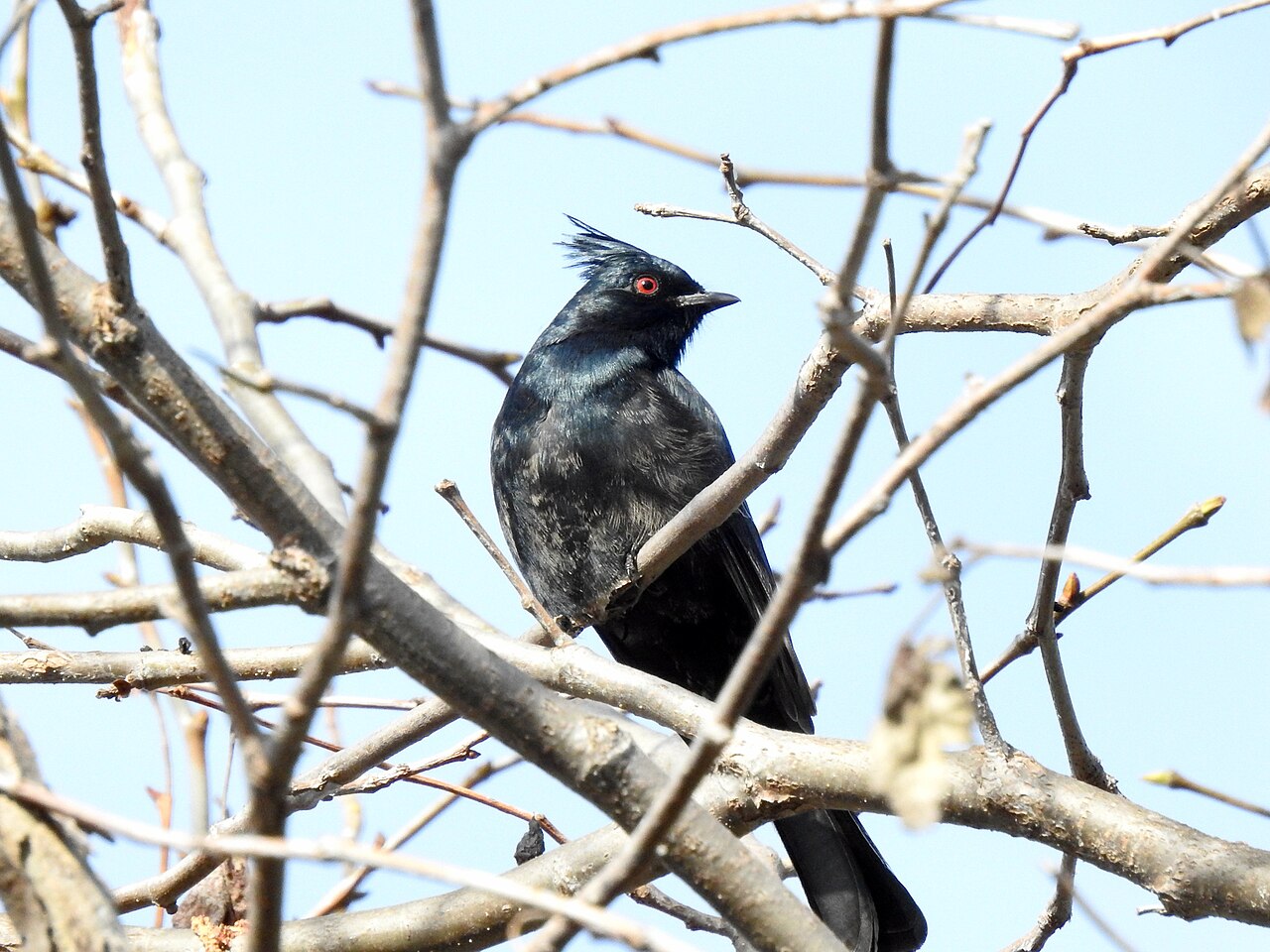
The Phainopepla (Phainopepla nitens) is the crested silky-flycatcher of the southwestern deserts — the male glossy blue-black with a crest, red eye, and white wing patches that flash in flight; the female soft gray in the same pattern. It lives on desert mistletoe berries — digesting the pulp and planting the seeds — and calls a soft wurp. Desert yards attract them with mistletoe-bearing mesquite and palo verde. They share the desert with the Verdin and the Cactus Wren.
Species Physical Profile & Morphometrics
The Phainopepla belongs to the silky-flycatcher family (Ptiliogonatidae) — a small tropical family whose only U.S. member breeds in the southwestern deserts and California.
The identification formula: crested slim body + male glossy black, female gray + red eye + white wing patches in flight. Cardinals are stout-billed and red; blackbirds lack the crest. Nothing in the desert wears this combination.
Essential Morphometric Field Marks:
- Body Length & Mass: 6.7 to 7.9 inches (17–20 cm) and 0.6 to 1 ounce (18–28 grams) — slim and long-tailed, elegant in every line.
- Wingspan: 11 inches (28 cm); flight is smooth and swooping, white wing patches blazing at every beat.
- Bill Structure & Color: A short, slim black bill — sized for mistletoe berries swallowed whole.
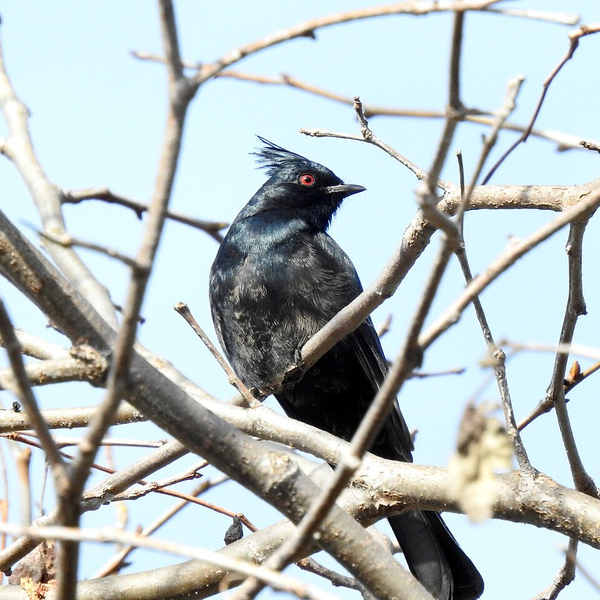
- Color Pattern: Male — glossy blue-black with white wing patches; female — soft gray with paler wing edging; both crested with ruby-red eyes.
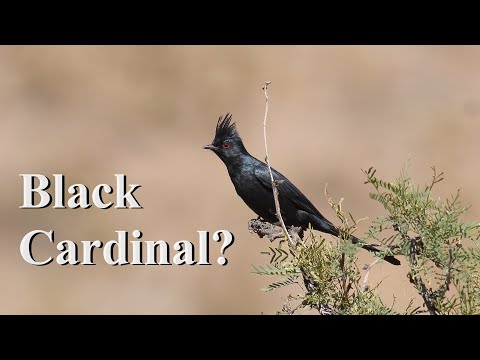
- Male vs. Female: Strongly dimorphic — he is the black cardinal of the desert; she is his gray echo, crest and all.
The shining sentinel: perched at the top of a mistletoe-laden mesquite, crest up, white patches flashing as he sallies for a flying insect.
Gray and crested — she weaves the tiny nest cup in the mistletoe clump and feeds nestlings a puree of berries.
Phainopepla Vocalization Guide (0 Field Recordings)
The Phainopepla’s voice is a soft, low wurp call and a thin, warbled song. All recordings below are real field audio via Wikimedia Commons — no simulations. For a deeper library, browse xeno-canto: Phainopepla.
1. The Wurp
2. The Thin Warble
3. The Flight Note
Habitat, Range & the Mistletoe Bond
The Phainopepla lives where desert mistletoe grows: mesquite bosques, palo verde washes, and desert riparian corridors across the Southwest — the bird and the parasitic plant are evolution’s partners.

The Mistletoe’s Own Bird
Breeding range covers the Sonoran and Mojave deserts and California’s interior; many birds make a unique two-step migration — breeding in the desert in spring, then moving to coastal and oak country to raise a second brood in summer.
For backyard birders: desert yards with mistletoe-bearing mesquite or palo verde can host a resident pair — the bird is a faithful daily visitor to any tree its plant colonizes.
Backyard Behavioral Patterns & Social Dynamics
The Phainopepla is a mistletoe specialist with a double breeding season. Four behaviors explain most of what you will observe:
🌿 The Mistletoe Bond
It lives on mistletoe berries — digesting the pulp and depositing the sticky seeds on new branches, planting its own pantry.
🪽 The Wing Flash
The white wing patches blaze in flight — a semaphore hidden at rest, visible across the wash when the bird moves.
🗓️ The Two-Step Breeding
Many birds breed in the desert in spring, then again in coastal oak country in summer — a rare double nesting season.
🎯 The Sally Break
Between berries it flycatches from the treetop — insects on the wing supplement the fruit diet.
Problem: “How Do I Attract a Phainopepla? What Should I Do?”
The three most common Phainopepla puzzles all have proven answers:
First, the identity check: a slim black crested bird in a desert tree is not a cardinal or a blackbird — the crest, red eye, and white wing flash belong to the Phainopepla. Second, the mistletoe dilemma: homeowners often strip mistletoe as a parasite — leave clumps on wild mesquite and palo verde, and manage only prized ornamentals; the bird follows the plant. Third, the summer disappearance: birds that vanish after spring have moved to coastal or oak country for a second brood — the two-step breeding season, not a loss.
Method 1: Set the Table — Host Trees & Their Mistletoe
Design for a mistletoe specialist:
-
Keep Desert Mistletoe
Leave clumps on mesquite and palo verde — the berry crop that anchors a Phainopepla territory.
-
Plant Native Legume Trees
Mesquite, palo verde, ironwood — the host trees desert mistletoe colonizes.
-
Keep a Treetop Perch
High bare crowns near the wash — the sentinel post for singing and sallying.
-
Skip the Insecticide
Flying insects supplement the berries — sprayed washes lose their silky-flycatchers.
Method 2: Build the Habitat — Drink & the Double Season
Keep the wash green and the calendar full, and the crest stays year-round:
-
Provide Shallow Water
A shallow dish or dripper near cover — used daily in the desert heat.
-
Expect the Two-Step
Spring desert breeding, summer move-out — do not be surprised by the seasonal shift.
-
Plant Berry Natives
Elderberry and wolfberry backup — fruit diversity for the weeks between mistletoe crops.
-
Watch the Wing Flash
The white patches find the bird — scan the wash for the semaphore, not the black body.
Tool Solution: Recommended Hardware for Phainopepla
Equipment matched to a mistletoe-dependent desert bird:
Mistletoe-Bearing Mesquite
Native mesquite and palo verde with desert mistletoe — the pantry and territory anchor of the Phainopepla.
- • Trees: Mesquite, palo verde
- • Feature: Mistletoe clumps
- • Bonus: Verdins & woodpeckers
Shallow Dish or Dripper
Shallow moving water near wash cover — the daily stop in the dry months.
- • Depth: 1 inch
- • Placement: Beside trees
- • Bonus: Warblers & finches
Native Berry Shrubs
Elderberry and wolfberry — bridging fruit when the mistletoe crop thins.
- • Plants: Berry natives
- • Season: Spring–summer
- • Bonus: Thrashers & towhees
Frequently Asked Questions
- Species Profile: The Phainopepla (Phainopepla nitens) is a 6.7–7.9 inch, 0.6–1 ounce silky-flycatcher (Ptiliogonatidae), band code PHAI — the black cardinal of the desert.
- ID in One Look: Crested, black male or gray female, red eye, white wing flash.
- The Sound: Soft wurp calls and a thin spring warble; real field recordings above.
- Range & Habit: Southwestern deserts; tied to mistletoe; many breed twice in two habitats.
- Feeder Formula: Mistletoe-bearing trees and water — no feeder applies.
- The Partnership: The bird plants the mistletoe that feeds it — leave the clumps on wild trees.
Bird Watching Log
Species: Phainopepla (Phainopepla nitens)
| Phainopepla (Crest Seen: Yes / No — Wing Flash Seen: Yes / No — Wurp Heard: Yes / No — Mistletoe Present: Yes / No — Date & Time: ___) | |