
Red-tailed Hawk


Red-tailed Hawk (Buteo jamaicensis): Complete Identification, Backyard Guide & Call Library
Quick Answer: How to Attract & Identify the Red-tailed Hawk
The Red-tailed Hawk (Buteo jamaicensis) is North America’s most familiar large raptor — the broad-winged hawk soaring over highways and sitting on every other pole, flashing a brick-red tail and a dark belly band. Its raspy kee-eee-arr scream is Hollywood’s stock sound effect for any raptor (even bald eagles). An adaptable rodent hunter, it nests in tall trees and hunts yards, fields, and fence lines. You don’t feed a Red-tail — you welcome its free rodent control and protect backyard poultry with covered runs. Its day shift alternates with the night shift of the Great Horned Owl, and its smaller feeder-hunting cousin is the Cooper’s Hawk.
Species Physical Profile & Morphometrics
The Red-tailed Hawk belongs to the hawk family (Accipitridae) and is the most widespread and abundant buteo in North America — the big soaring hawk of every road trip. It thrives from Alaska to Central America, in desert, forest edge, farmland, and suburb alike, and its adaptability to human landscapes makes it the default hawk over most American yards.
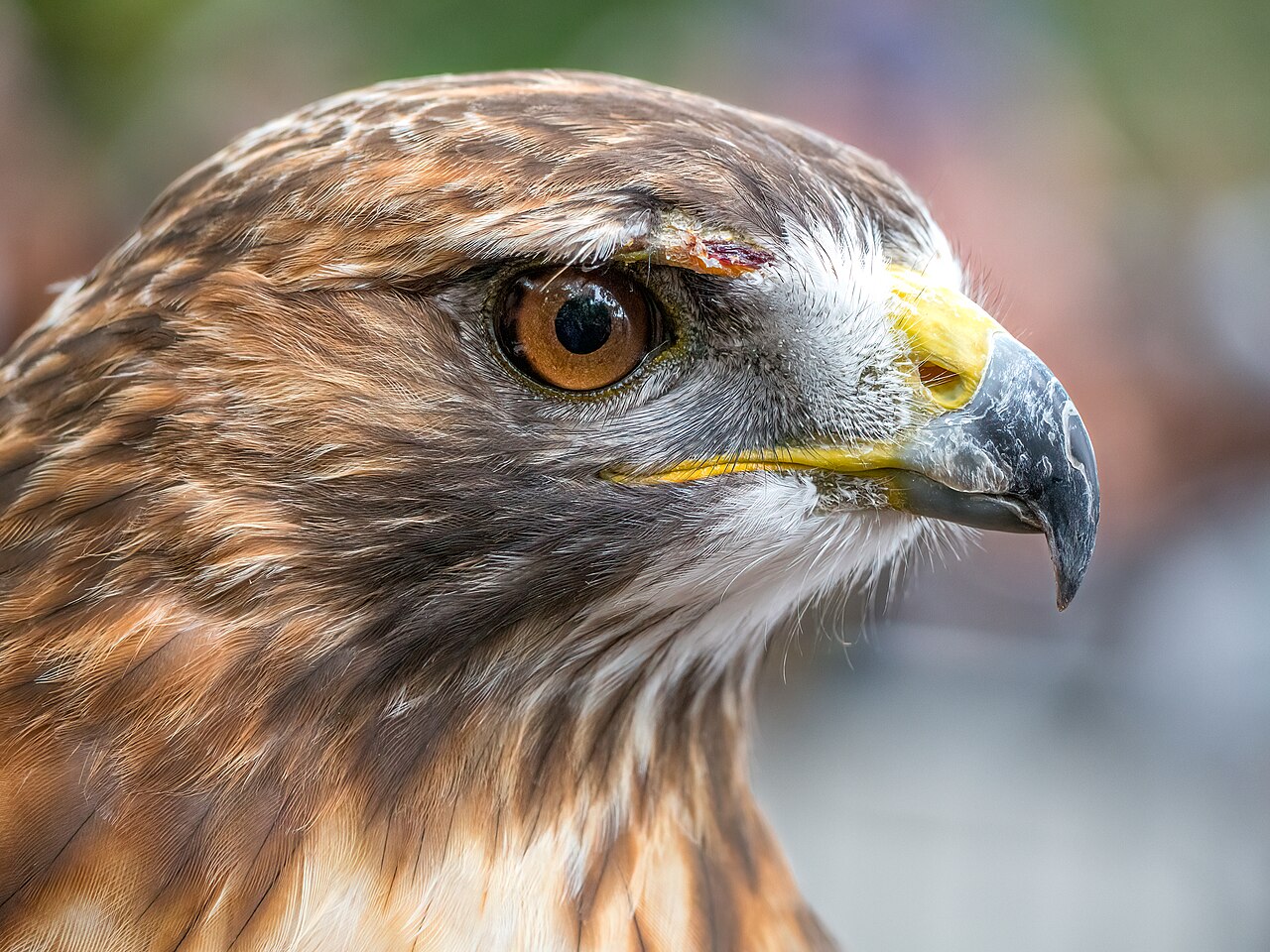
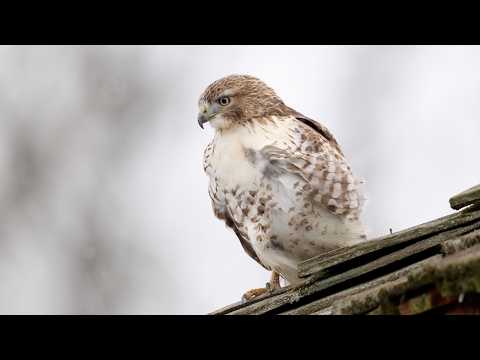
The identification formula: big, broad-winged buteo + brick-red upper tail (adults) + dark belly band across a pale chest. Western birds come in a chocolate dark morph that keeps the red tail; juveniles lack the red entirely, showing a brown tail with narrow bands and the same belly band. The soaring silhouette — broad rounded wings, short wide tail — separates buteos from the long-tailed accipiters like Cooper’s Hawk.
Essential Morphometric Field Marks:
- Body Length & Mass: 17.7 to 25.6 inches (45–65 cm) and 24.3 to 51.5 ounces (690–1460 grams) — females up to a quarter larger than males, the standard raptor rule.
- Wingspan: 44.9 to 52.4 inches (114–133 cm); soaring flight on broad, rounded wings held in a slight dihedral, circling thermals for minutes without a wingbeat.
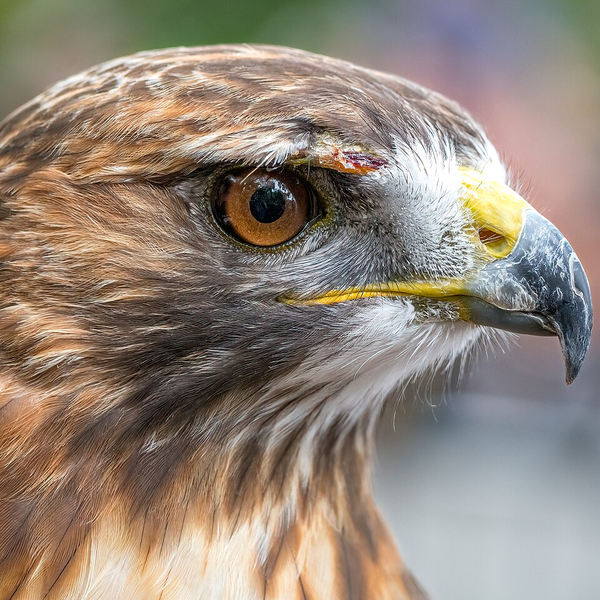
- Bill Structure & Color: A strongly hooked dark bill with a yellow cere — small for the bird’s size; the real weapons are the talons, which strike and crush in one motion.
- Color Pattern: Adults: rich brown above, pale below with a dark belly band, and a brick-red tail above with a pale tip; western dark morphs are chocolate-brown overall but keep the red tail. Juveniles: brown-banded tail, same belly band.
- Male vs. Female: Identical plumage; the female is distinctly larger — in a perched pair she looms over him. Both scream, both hunt; she incubates while he delivers prey to the nest rim.
The smaller, slimmer provider: same red tail and belly band, three-quarters her size. Through the April nesting he hunts alone and delivers mice and squirrels to the nest; in migration he is the sleeker shape in the kettle.
The bigger half — up to 25% heavier, and the one who incubates the two or three eggs in the big stick nest high in a crotch tree, mantling the chicks through storms while the male supplies the table.
Red-tailed Hawk Vocalization Guide (3 Field Recordings)
The Red-tailed Hawk’s voice is the most recycled sound in cinema: a raspy, descending kee-eee-arr, two to three seconds of slurred scream that Hollywood dubs under bald eagles, desert vistas, and every screen raptor. Real Red-tails scream on the wing and from perches, especially around the nest. All recordings below are real field audio via Wikimedia Commons — no simulations. For a deeper library, browse xeno-canto: Red-tailed Hawk.
1. The Movie Scream
2. The Territory Patrol
3. The Hungry Young
Habitat, Range & the Roadside Empire
The Red-tailed Hawk thrives in open country with elevated perches: farmland, prairie, desert edge, roadsides, pastures, and suburban greenbelts — anywhere voles and mice run beneath a pole, snag, or tree. It nests in the tallest available tree crown, often visible from the hunting grounds. Human landscaping — mowed verges, fence lines, highway medians — has been very good to this hawk.

The Hawk of Every Highway
The range spans virtually all of North America — Alaska and Canada in summer, the entire Lower 48 year-round or nearly so, Mexico and Central America in winter. Northern breeders migrate; birds of the South and West largely stay put, joined each winter by northern cousins.
For backyard birders: if you have open ground nearby, you have Red-tails. Learn the local pair’s favorite poles and snag; watch for the white chest flash of a perched bird against dark trees; and in fall, look up for kettles — circling flocks of dozens riding thermals south.
Backyard Behavioral Patterns & Social Dynamics
The Red-tailed Hawk is the generalist that conquered a continent — a patient sit-and-wait hunter and a master of the thermal. Four behaviors explain most of what you will observe:
🦅 The Pole Sitter
The default hunt: sit on a pole, snag, or tree edge for twenty minutes, then drop onto a vole. Red-tails burn almost nothing hunting this way — which is why every rural fence line in America has its regular.
🌀 The Thermal Master
On warm afternoons Red-tails spiral up thermals for hours, barely flapping — and in fall they ride thermals south in kettles of dozens. The screaming pairs circling high over your yard in March are mapping their territory for the year.
🐭 The Rodent Accountant
A pair of Red-tails takes hundreds of rodents a year — voles, mice, rats, ground squirrels, rabbits — plus snakes, and occasionally birds. Suburban and farm Red-tails are among the most effective free pest control on the continent.
💞 The Sky-Bond Pair
Pairs mate for life and advertise it: circling together, screaming, legs dangling, sometimes locking talons in a tumbling display. The big stick nest is reused and enlarged for years — a nest tree can anchor a territory for a generation.
Problem: “A Red-tailed Hawk Is Sitting Over My Yard — Are My Pets and Chickens at Risk?”
The three most common Red-tailed Hawk worries all have proven answers:
First, the pet question: a Red-tail can take prey up to rabbit size — adult cats are safe; tiny kittens, toy puppies, and free-range bantams should be supervised, though most yard Red-tails ignore anything that isn’t mouse-shaped. Second, the chicken question: a hawk over the coop is real risk — covered runs and netting solve it completely; shooting is illegal (federal Migratory Bird Treaty Act) and unnecessary when a roof does the job. Third, the feeder question: a Red-tail may occasionally grab a dove at dawn, but its diet is overwhelmingly rodents — your finches are safer with it around, because it also hunts the rats that draw snakes. If a hawk is sitting over your yard, the honest reading is: your neighborhood has rodents, and the cheapest exterminator in America just moved in.
Method 1: Set the Table — Rodents, Perches & Open Sky
Design for a sit-and-wait rodent specialist:
-
Protect, Don’t Poison, the Rodent Chain
The hawk’s menu is your vole, mouse, and rat population — let the hawk harvest it. Never use anticoagulant rodenticide: poisoned rodents kill the hawks and owls that eat them.
-
Keep High Perches Over Open Ground
A snag, tall fence post, or lone tree overlooking meadow or lawn is a hunting station — properties with prominent perches get regular hawk hours; pole-less yards get flyovers.
-
Leave Grass Edges Unmowed
Rough grass strips harbor the voles that make a hunting territory worth holding — a slightly shaggy field edge feeds the food chain that feeds the hawk.
-
Provide an Open Water Source
Hawks drink and bathe: a wide, ground-level bath in an open, watchable spot occasionally hosts the most impressive bath customer in backyard birding.
Method 2: Share the Sky — Coexisting With a Top Predator
Keep the hawk, protect the vulnerable:
-
Roof the Chicken Run
For poultry keepers the answer is architectural: a fully covered run with hardware cloth, not a battle with a federally protected bird. Free-ranging ends the day a hawk learns the flock — roof it first.
-
Supervise the Smallest Pets
Toy puppies and kittens outdoors need company at dawn and dusk — the two hunting peaks. Adult cats and dogs over about 15 pounds are beyond hawk capacity.
-
Move Feeders From Ambush Cover
Feeder birds are occasional prey — place feeders either within 3 feet of windows or beyond 30 feet, with quick escape cover nearby, so a diving hawk has no approach lane.
-
Watch the Winter Roadsides
The season’s gift: drive rural roads on winter afternoons and count the pole-sitters — a red-tail every mile is common, dark morphs appear in the West, and every one is hunting free of charge.
Tool Solution: Recommended Hardware for Red-tailed Hawk
Equipment matched to hosting a top predator:
8×42 Binoculars
A bright 8×42 glass turns a distant pole-sitter into a portrait and a circling kettle into a migration spectacle — the essential hawk-watching tool.
- • Spec: 8×42 roof prism
- • Use: Poles, snags, thermals
- • Season: Year-round; winter best
Covered Run & No Rodenticide
Hardware-cloth roofing for poultry and a strict no-poison policy — the two measures that make a hawk-friendly yard fully safe.
- • Poultry: Fully roofed run
- • Rodents: No anticoagulants
- • Result: Hawk as ally, not threat
Perch & Snag Preservation
One tall snag or lone tree over open ground — the hunting throne that keeps a red-tail pair working your block for years.
- • Keep: Tall perches over grass
- • Leave: Big stick nests in trees
- • Bonus: Owls may use them too
Frequently Asked Questions
- Species Profile: The Red-tailed Hawk (Buteo jamaicensis) is a 17.7–25.6 inch, 24.3–51.5 ounce buteo (Accipitridae), band code RTHA — the most familiar large raptor in North America.
- ID in One Look: Brick-red upper tail (adults), dark belly band, broad rounded wings in a shallow V — plus western chocolate dark morphs that keep the red tail.
- The Sound: The raspy, descending kee-eee-arr — Hollywood’s stock scream for every screen raptor; real field recordings above.
- Range & Habit: Nearly all of North America; resident across most of the U.S., with northern birds wintering south in kettle-forming migration.
- Yard Formula: Rodents unpoisoned, perches preserved, grass edges rough, poultry runs roofed — and the hawk pays its rent in pest control.
- The Roadside Ritual: Winter afternoons on rural roads, a red-tail on every other pole — the easiest great hawk watching in the country.
Bird Watching Log
Species: Red-tailed Hawk (Buteo jamaicensis)
| Red-tailed Hawk (Red Tail Seen: Yes / No — Morph: Light / Dark — Behavior: Perched / Soaring / Hunting — Belly Band: Yes / No — Location: ___) | |