
Ruby-crowned Kinglet


Ruby-crowned Kinglet (Regulus calendula): Complete Identification, Habitat Guide & Sound Library
Quick Answer: How to Attract & Identify the Ruby-crowned Kinglet
The Ruby-crowned Kinglet (Corthylio calendula) is the tiny winter guest with the oversized voice — a four-inch olive bird with a bold white eye ring, constantly flicking wings, and a male’s hidden ruby crown flashed only in excitement. Its song is famously loud for its size — a rich jumbled caroling in three parts. Breeding in northern spruce forest, it winters across the southern states, where suet, peanut butter smears, and dense shrubs attract it. It forages alongside the Golden-crowned Kinglet and the Yellow-rumped Warbler.
Species Physical Profile & Morphometrics
The Ruby-crowned Kinglet belongs to the kinglet family (Regulidae) — recently moved to its own genus as Corthylio. It breeds across the northern spruce belt and western mountains and winters through the southern U.S. and Mexico, a familiar winter yard bird of the South and West.
The identification formula: tiny + plain face with bold white eye ring + constant wing-flicking. The Golden-crowned Kinglet has a striped face and a permanently visible golden crown; the Ruby-crowned’s red crown stays hidden unless the male flares it. The nervous wing-flick is the Ruby-crowned’s signature habit.
Essential Morphometric Field Marks:
- Body Length & Mass: 3.5 to 4.3 inches (9–11 cm) and 0.2 to 0.3 ounces (5–10 grams) — kinglet-small, slightly plumper than its golden-crowned cousin.
- Wingspan: 6.3 to 7.1 inches (16–18 cm); flight is a flicking dart, and the wings never fully rest — the nervous flick-flick is constant while foraging.
- Bill Structure & Color: A thin, black, needle bill — insect tweezers, used with hummingbird energy among leaves and twigs.
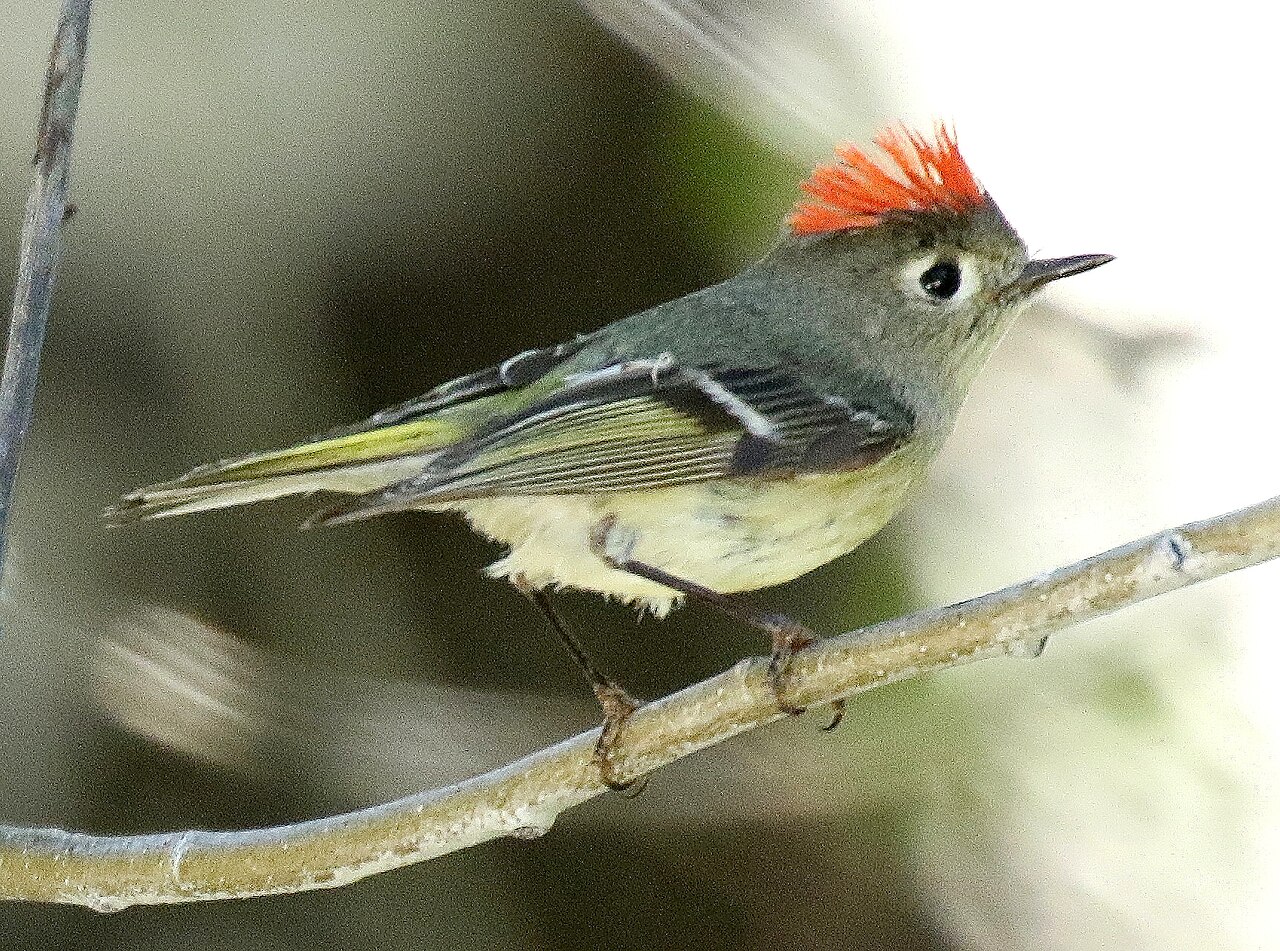
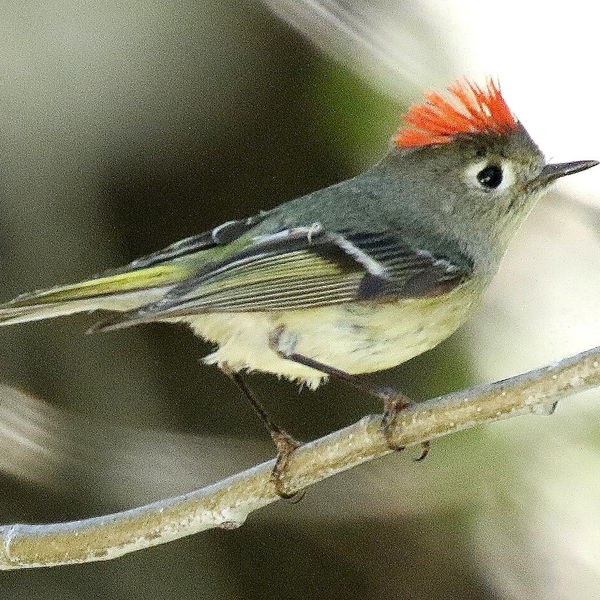
- Color Pattern: Olive-green above, pale yellowish below, two wing bars, bold broken white eye ring on a plain face; the male hides a ruby-red crown patch flashed only when agitated or singing.
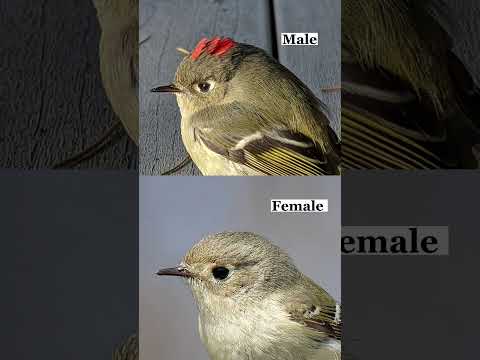
- Male vs. Female: Only the male carries the ruby crown — and he hides it; most sightings show two identical plain-faced birds, one of which occasionally erupts in red.
The hidden jewel: plain olive and eye-ringed until the moment he sings or squares off — then the ruby crown flares like a struck match.
The crownless partner — same eye ring, same fidgets — she builds a deep hanging cup in a spruce tip and incubates up to a dozen eggs, a record clutch for so small a bird.
Ruby-crowned Kinglet Vocalization Guide (3 Field Recordings)
The Ruby-crowned Kinglet’s song is famously far too loud for its body — a three-part caroling: tee-tee-tee, tur-tur-tur, tew-TEW-tew. All recordings below are real field audio via Wikimedia Commons — no simulations. For a deeper library, browse xeno-canto: Ruby-crowned Kinglet.
1. The Three-Part Song
2. The Jit Call
3. The Excited Flash
Habitat, Range & the Winter Shrub Edge
The Ruby-crowned Kinglet breeds in spruce-fir forest across Canada, Alaska, and the western mountains. In winter it spreads through shrubby yards, parks, and woodland edges across the southern states — anywhere dense low cover meets open foraging space.

The South’s Winter Songster
Breeding range covers the northern forest belt and western mountains; winter range blankets the southern half of the U.S. and Mexico, from coast to coast. The bird singing in your Georgia yard in March may nest in an Alaskan spruce in June.
For backyard birders: October through April, southern and western yards with shrub edges can host a kinglet daily — suet crumbs, peanut butter smears, and unfrozen water are the winter formula.
Backyard Behavioral Patterns & Social Dynamics
The Ruby-crowned Kinglet is a wing-flicking, oversized-voiced winter acrobat. Four behaviors explain most of what you will observe:
⚡ The Wing Flicker
It flicks its wings every second or two while foraging — the nervous signature that separates it from every other tiny olive bird at a glance.
📣 The Giant Voice
The song is astonishingly loud for the body — one of the greatest volume-to-size ratios in North American birds; hear a big song from a tiny shrub, think kinglet.
🔴 The Crown Flash
The male’s ruby patch flares only in excitement — aggression or courtship — then vanishes; most observers never see it, which makes the sighting a small triumph.
🍇 The Flexible Winter Diet
In winter it adds berries and suet to the insect diet — wax myrtle, poison ivy berries, and feeder crumbs carry it through cold snaps.
Problem: “I’ve Watched Kinglets All Winter and Never Seen a Ruby Crown. What Should I Do?”
The three most common Ruby-crowned Kinglet puzzles all have proven answers:
First, the hidden ruby: only males have it, and they keep it folded flat — watch singing or squabbling males in March and April; the crown flares during song and confrontation, sometimes right at the suet smear. Second, the look-alike: the plain face separates it from the striped Golden-crowned — bold eye ring plus constant wing-flicking equals Ruby-crowned, every time. Third, the sudden departure: winter kinglets leave for the northern spruce belt in April — the yard goes quiet overnight; mark the last date each spring and the first each October, and you will learn your bird’s personal calendar.
Method 1: Set the Table — Bark Smears & Shrub Edges
Design for a winter insect-eater:
-
Smear Peanut Butter on Bark
Plain peanut butter worked into bark crevices — the proven kinglet draw, placed where shrub cover is one dart away.
-
Crumble Suet on a Tray
Fine suet crumbs on a low tray — particle size matters for a seven-gram bill.
-
Plant Wax Myrtle & Native Berries
Berry shrubs — wax myrtle, holly, elderberry — the natural winter fallback when insects vanish.
-
Keep Water Unfrozen
A heated or daily-refreshed bath — winter kinglets drink and bathe daily near cover.
Method 2: Build the Habitat — Shrub Layers & Shelter
Layer the cover, and the winter guest stays all season:
-
Build Shrub Layers
Dense shrubs at several heights — kinglets forage low to mid-level; layered cover keeps them feeding in view.
-
Keep an Evergreen Refuge
A conifer or dense holly for storm shelter — the winter roost that keeps the bird attached to your yard.
-
Leave Stems Standing
Un-cut perennial stems and leaf litter shelter overwintering insects — the kinglet’s natural pantry.
-
Learn the Departure Calendar
Log first and last dates each year — your yard’s kinglet schedule is remarkably consistent once measured.
Tool Solution: Recommended Hardware for Ruby-crowned Kinglet
Equipment matched to a tiny winter songster:
Bark Smear & Suet Crumbs
Peanut butter in bark crevices plus crumbled suet — the winter staples a kinglet checks on every circuit.
- • Food: Peanut butter, suet crumbs
- • Placement: Trunk near shrubs
- • Season: October–April
Heated Bird Bath
Unfrozen water within a dart of cover — the resource that holds a kinglet through the hard weeks.
- • Feature: Heated
- • Placement: Beside shrubs
- • Season: Winter
Native Berry Shrubs
Wax myrtle, holly, and elderberry — the berries that carry kinglets (and warblers) through insectless weeks.
- • Plants: Wax myrtle, holly
- • Season: Fall–winter fruit
- • Bonus: Warblers & waxwings too
Frequently Asked Questions
- Species Profile: The Ruby-crowned Kinglet (Corthylio calendula) is a 3.5–4.3 inch, 0.2–0.3 ounce kinglet (Regulidae), band code RCKI — the winter guest with the oversized song.
- ID in One Look: Tiny, plain-faced with bold eye ring, constant wing-flicking; ruby crown flashed only in excitement.
- The Sound: A three-part caroling far too loud for the body; real field recordings above.
- Range & Habit: Breeds in northern spruce; winters across the South in shrubby yards; forages low with nervous energy.
- Feeder Formula: Peanut butter bark smears, suet crumbs, berry shrubs, unfrozen water, layered cover.
- The Hidden Jewel: The ruby crown is earned, not given — watch the singing male and wait for the flash.
Bird Watching Log
Species: Ruby-crowned Kinglet (Regulus calendula)
| Ruby-crowned Kinglet (Eye Ring Seen: Yes / No — Wing Flicking: Yes / No — Ruby Crown: Yes / No — Song Heard: Yes / No — At Suet: Yes / No — Date & Time: ___) | |