
Scott’s Oriole


Scott’s Oriole (Icterus parisorum): Complete Identification, Habitat Guide & Sound Library
Quick Answer: How to Attract & Identify the Scott’s Oriole
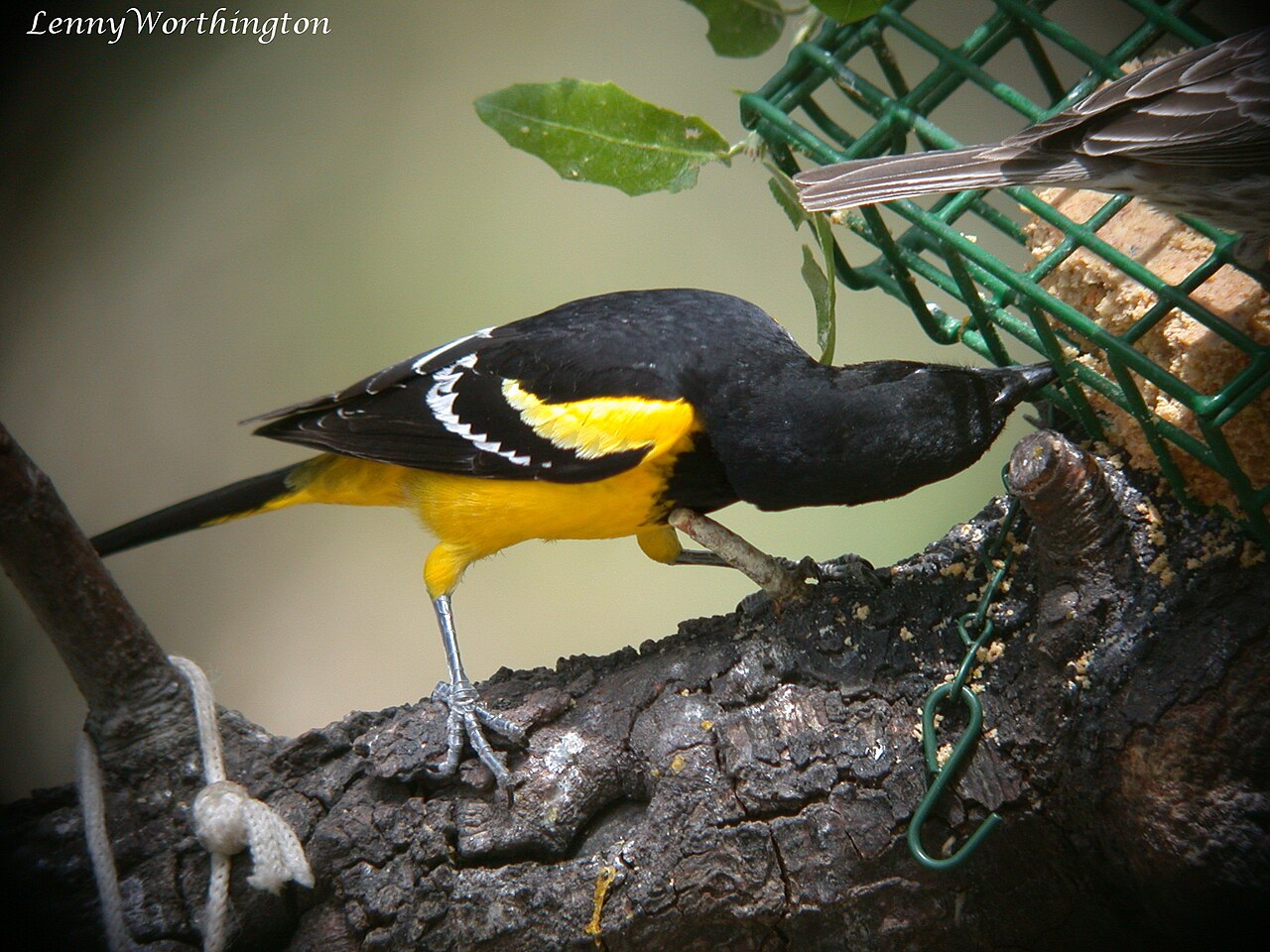
The Scott’s Oriole (Icterus parisorum) is the oriole of southwestern yucca country — the male lemon-yellow with a black head, bib, and back and white wing bars; the female olive-yellow and gray-headed. It feeds on insects, nectar, and fruit — agave blooms are a spring staple — and visits yards for oranges, grape jelly, and hummingbird nectar. The song is a rich, whistled series like a western meadowlark in miniature. Desert yards attract them with orange halves, jelly dishes, and native yucca. They share the slopes with the Gila Woodpecker and the Broad-tailed Hummingbird.
Species Physical Profile & Morphometrics
The Scott’s Oriole belongs to the blackbird family (Icteridae) and breeds in southwestern mountain country — yucca grassland, pinyon-juniper, and agave slopes — from California to Texas, wintering in Mexico.
The identification formula: lemon-yellow body + black head and back + white wing bars. The Hooded Oriole is orange with a black face patch only; the Bullock’s is orange-faced with a big white wing patch. Scott’s is the yellow one with the full black hood-and-back jacket.
Essential Morphometric Field Marks:
- Body Length & Mass: 8.3 to 9.4 inches (21–24 cm) and 1.1 to 1.4 ounces (32–41 grams) — a slim, elegant oriole.
- Wingspan: 12.6 inches (32 cm); flight is bounding between yucca stalks and treetops.
- Bill Structure & Color: A slim, slightly decurved black bill — the nectar-and-insect tool of the oriole line.
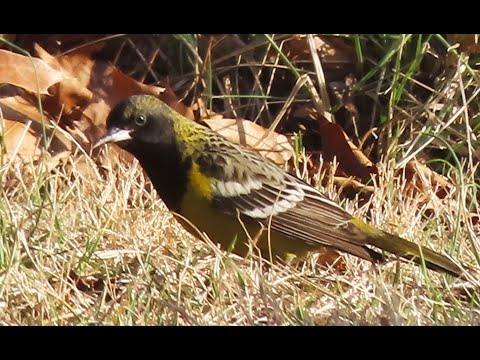
- Color Pattern: Male — lemon-yellow below and on the rump, black head, bib, back, wings, and tail, white wing bars; female — olive-yellow with gray head and back.
- Male vs. Female: Strongly dimorphic — he is the yellow-and-coal showpiece; she is olive subtlety, weaving the hanging nest in a yucca.
The lemon lantern: glowing yellow against the black jacket, whistling his meadowlark-like phrases from a yucca stalk.
Olive and gray — she sews the hanging nest to yucca fibers or a juniper fork and works the agave blooms for nectar.
Scott’s Oriole Vocalization Guide (1 Field Recording)
The Scott’s Oriole’s song is a rich, whistled series of phrases — like a Western Meadowlark’s flute scaled down. All recordings below are real field audio via Wikimedia Commons — no simulations. For a deeper library, browse xeno-canto: Scott’s Oriole.
1. The Whistled Series
2. The Chack Call
3. The Dawn Phrases
Habitat, Range & the Yucca Slopes
The Scott’s Oriole lives in open southwestern mountain country: yucca grassland, agave slopes, pinyon-juniper woodland, and oak foothills — often nesting in the yucca plants themselves.

The Oriole of the Agave Bloom
Breeding range spans the Southwest from California to Texas, centered on upland desert slopes; winter takes the population to Mexico, with a few lingering at southwestern feeders.
For backyard birders: desert and foothill yards with orange halves, grape jelly, and nectar feeders attract Scott’s Orioles reliably in spring — one of the easiest orioles to host in the Southwest.
Backyard Behavioral Patterns & Social Dynamics
The Scott’s Oriole is a yucca-country nectar and insect feeder with a sweet tooth. Four behaviors explain most of what you will observe:
🌼 The Agave Feeder
It works agave and yucca blooms for nectar and insects — a hummingbird’s menu on oriole scale.
🍊 The Jelly Guest
It visits orange halves and grape jelly dishes — among the most reliable feeder orioles in the Southwest.
🪹 The Yucca Nest
The hanging nest is sewn to yucca fibers or a juniper fork — camouflaged in the plant that anchors the territory.
🎶 The Mini Meadowlark
The song is a whistled series recalling a meadowlark — a flute voice on the dry slopes.
Problem: “How Do I Attract Scott’s Orioles? What Should I Do?”
The three most common Scott’s Oriole puzzles all have proven answers:
First, the oriole lineup: in the Southwest compare color and hood — Scott’s is lemon-yellow with a full black head-and-back; Hooded is orange with a black face patch; Bullock’s is orange-faced with a big white wing patch. Second, the jelly dish gone dry: orioles empty dishes fast in spring — refresh grape jelly daily and rinse the dish; mold and fermentation are real hazards. Third, the summer disappearance: birds leave for Mexico in late summer — a July yard going quiet is normal migration, not a problem to fix.
Method 1: Set the Table — Oranges, Jelly & Nectar
Design for a nectar-loving desert oriole:
-
Serve Orange Halves
Fresh orange halves on a spike or dish — the classic oriole invitation, refreshed daily.
-
Offer Grape Jelly
Plain grape jelly in a small dish — a tablespoon at a time, refreshed and rinsed daily.
-
Hang a Nectar Feeder
Oriole or hummingbird nectar, 4:1, no dye — Scott’s Orioles drink it readily.
-
Plant Yucca & Agave
Native bloom stalks feed and house them — the territory anchor of the species.
Method 2: Build the Habitat — Bloom Timing & Spring Arrival
Keep the blooms coming and the station fresh, and the pair returns each spring:
-
Sequence the Bloom
Agave, yucca, and native flowers in succession — nectar from March through July.
-
Skip the Insecticide
Insects are the nestling diet — sprayed slopes raise no orioles.
-
Leave Spent Stalks
Old yucca stalks host insects and fiber — tidy them only after they fall.
-
Watch the Spring Window
April arrival, August departure — the lemon lantern appears with the agave bloom.
Tool Solution: Recommended Hardware for Scott’s Oriole
Equipment matched to a southwestern oriole:
Orange & Jelly Feeder
Orange halves on spikes plus a small jelly dish — the proven Scott’s Oriole station.
- • Feed: Orange + jelly
- • Refresh: Daily
- • Bonus: Hooded orioles too
Oriole Nectar Feeder
4:1 nectar with big ports and perches — the drink station for a bloom-following bird.
- • Ratio: 4:1 water:sugar
- • Rule: No dye
- • Bonus: Hummingbirds share it
Native Yucca & Agave
Bloom stalks for nectar, fibers for nests — the plants that make a slope an oriole territory.
- • Plants: Yucca, agave
- • Feature: Spring bloom
- • Bonus: Woodpeckers & wrens
Frequently Asked Questions
- Species Profile: The Scott’s Oriole (Icterus parisorum) is an 8.3–9.4 inch, 1.1–1.4 ounce icterid (Icteridae), band code SCOR — the lemon lantern of the yucca slopes.
- ID in One Look: Lemon-yellow body, full black hood and back, white wing bars.
- The Sound: Whistled meadowlark-miniature phrases; real field recordings above.
- Range & Habit: Southwestern slopes April–August; winters in Mexico; nests in yucca.
- Feeder Formula: Orange halves, grape jelly, nectar — refreshed daily.
- The Bloom Bond: Agave and yucca flowers feed the bird that nests in their fibers.
Bird Watching Log
Species: Scott’s Oriole (Icterus parisorum)
| Scott’s Oriole (Lemon Body Seen: Yes / No — Black Hood Seen: Yes / No — Whistle Heard: Yes / No — Feeder Visited: Yes / No — Date & Time: ___) | |