
Hooded Oriole


Hooded Oriole (Icterus cucullatus): Complete Identification, Feeder Guide & Song Library
Quick Answer: How to Attract & Identify Hooded Orioles
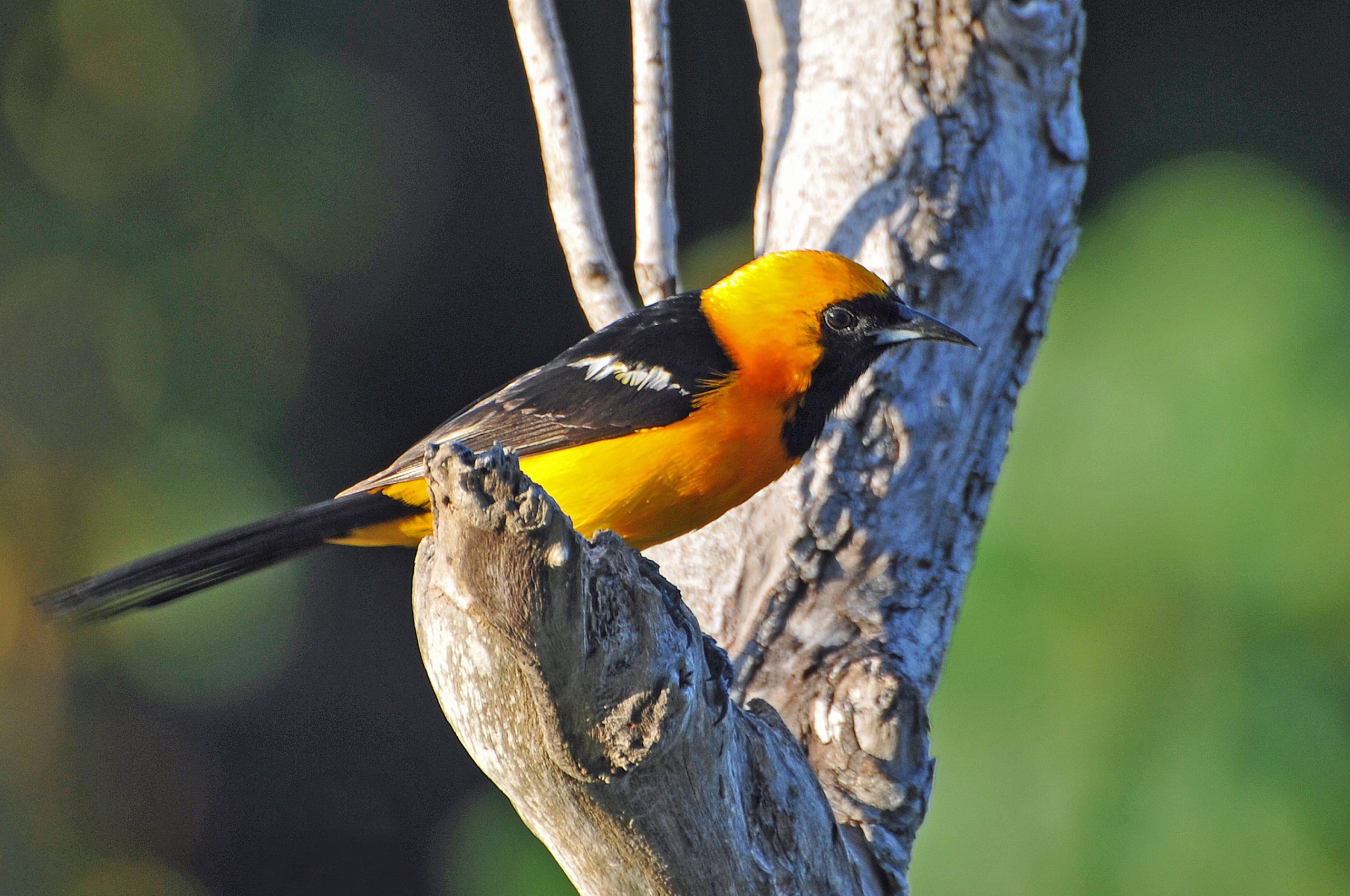
The Hooded Oriole (Icterus cucullatus) is the slim, long-tailed oriole of southwestern palms and shade trees — the male blazes orange (California and Arizona) to yellow (Texas) with a neat black bib running up to a long, slightly curved bill, while the female is grayish-olive above and soft yellow below. They arrive in March and April, weave pouch nests sewn to the undersides of palm fronds, and slip south to Mexico by early fall. Attract them with a nectar feeder (orioles drink from hummingbird feeders), orange halves, and a small dish of grape jelly hung near palms or tall trees — and expect the Anna’s Hummingbird and the Lesser Goldfinch to share the station.
Species Physical Profile & Morphometrics
The Hooded Oriole belongs to the New World blackbird family (Icteridae) — the same American family as blackbirds, grackles, and meadowlarks. It shares the Southwest with the Bullock’s Oriole, and suburban California and Arizona now hold both species in the same palm-lined streets — a pairing that makes the slim, curved-billed Hooded easy to separate once you know the shape.
The identification formula: slim orange bird + black bib rising to the bill + long curved bill + long tail in southwestern palms. A male Bullock’s Oriole shows a black eyeline across an orange face, a stockier build, and a big white wing patch; the much smaller Orchard Oriole wears dark chestnut rather than orange. Females are plainer, but the Hooded female’s slim build and distinctly curved bill give her away.
Essential Morphometric Field Marks:
- Body Length & Mass: 7.1 to 7.9 inches (18–20 cm) and about 0.8 ounces (24 grams) — long-tailed and slender, built for acrobatics among palm fronds.
- Wingspan: 9.1 to 11.0 inches (23–28 cm); flight is light and direct between palms and flowering trees.
- Bill Structure & Color: A long, slender, distinctly downcurved black bill — the nectar-sipping tool that fits flowers and hummingbird-feeder ports alike.
- Color Pattern: The male is brilliant orange (yellow in Texas) with a black bib that runs from the throat up around the bill base, black wings with two white wing bars, and a long black tail. The female is grayish-olive above and soft yellow below, paling toward the belly, with two white wing bars.
- Male vs. Female: The male’s orange body and black bib flash at any distance; the female’s plain yellowish plumage disappears into palm shadows. Young males resemble females at first, darkening at the throat as they mature.
The desert flame: a slim body of blazing orange — sunflower-yellow in Texas birds — set off by a crisp black bib and a long curved bill. He sings his thin, jumbled whistles from the crown of a fan palm and guards the neighborhood nectar feeders like a tiny orange landlord.
The frond seamstress — olive-backed and yellow-bellied, with the same elegant curved bill. She alone builds the nest, sewing a hanging pouch to the underside of a living palm frond with fibers pushed clean through the leaf, then lines it with plant down for the eggs.
Hooded Oriole Vocalization Guide (3 Field Recordings)
The Hooded Oriole’s signature is a thin, slightly squeaky jumble of warbled whistles and chatters — lighter and less flute-like than the bigger orioles — backed by a sharp rising weet call and a dry chatter when alarmed. All three recordings below are real field audio, shared under commercial-use licenses via iNaturalist — no simulations. For a deeper library, browse xeno-canto: Hooded Oriole.
1. The Solano Singer
2. The Desert Edge Voice
3. The Paton Center Visitor
Habitat, Range & the Palm-Tree Life
The Hooded Oriole lives where the Southwest grows palms and tall shade trees: suburban streets lined with fan palms, riverside sycamores and cottonwoods, desert oases, and open oak country. Ornamental palms planted across California and Arizona neighborhoods have carried the species deep into suburbia — today a palm-lined yard is the single best place in America to meet one.

A Southwestern Summer, a Mexican Winter
The breeding range spans the southwestern United States — California’s valleys and coast, Arizona and New Mexico, Nevada’s southern corners, and Texas west of the Hill Country — and reaches far down into Mexico. Most birds winter in Mexico, though growing numbers linger through mild winters at feeders in coastal Southern California and southern Arizona.
For backyard birders the calendar runs early: Hooded Orioles arrive on breeding grounds in March and April, nest through early summer — some pairs raise two broods — and most slip south in late summer and early fall. Nectar feeders can hold strays well into winter along the mild coast.
Backyard Behavioral Patterns & Social Dynamics
The Hooded Oriole is a nectar specialist at heart, and suburbia’s feeders and palms suit it perfectly. Four behaviors explain most of what you will observe:
🍯 The Nectar Raider
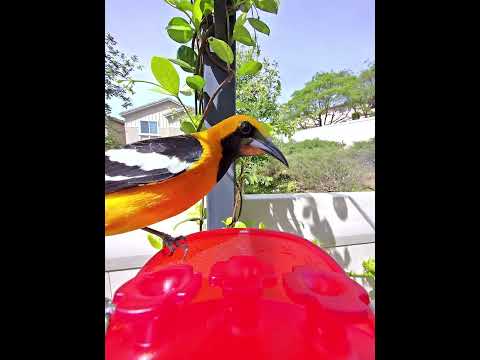
Slim enough to perch where bigger orioles cannot, the Hooded Oriole is the hummingbird feeder’s most glamorous thief — clinging to the ports and drinking sugar water by the minute. An oriole-sized nectar feeder, or a second hummingbird feeder hung across the yard, keeps peace between the orange giant and the tiny hummers.
🌴 The Palm Seamstress
Watch a fan palm in May and you may see the female at work: she sews her pouch nest to the underside of a living frond, stitching fibers through the leaf itself until the cradle hangs secure. Ornamental palms in southwestern yards have made this one of the few birds that nests feet from the patio.
🐛 The Quiet Gleaner
Between nectar runs, Hooded Orioles hunt methodically — beetles, caterpillars, wasps, and spiders picked from foliage, palm skirts, and flower clusters. Nesting pairs switch heavily to insects when the chicks hatch, and a pesticide-free yard keeps that protein within a short flight.
👨👩👧 The Family Finale
Pairs often raise two broods in a season, and late summer brings the payoff at the station: dull yellowish juveniles following their parents to the nectar ports and jelly dish, wings quivering as they beg. It is the best watching of the year — right before they all slip south.
Problem: “A Hooded Oriole Drains My Hummingbird Feeder Every Day — and the Hummers Get Nothing. What Should I Do?”
The three most common Hooded Oriole worries all have proven answers:
First, the drained hummingbird feeder: a thirsty oriole empties a small reservoir fast — hang an oriole-sized nectar feeder (or a second hummingbird feeder) several yards away, and the oriole will usually take the easier perches while the hummingbirds reclaim theirs; use the same four-to-one sugar water in both. Second, the invisible bird: a male that sings all morning from the palms may never show at a station hidden under the eaves — hang nectar, oranges, and jelly in the open, within sight of the palms, where a treetop scout can spot the color. Third, the ant invasion: sweet stations in the desert summer draw ants within hours — fit an ant moat above every nectar feeder and refresh jelly daily in small spoonfuls so it never crusts or sours. Solve these three and the palm-tree ember will treat your yard as its summer headquarters.
Method 1: Set the Table — Nectar, Oranges & Jelly
Design for a slim nectar specialist with a sweet tooth:
-
Hang Nectar Where Orioles Can Perch
The Hooded Oriole’s number-one lure is sugar water — four parts water to one part white sugar, no dye. An oriole nectar feeder has bigger ports and sturdier perches, but this slim species happily uses standard hummingbird feeders too; hang a second one across the yard to keep peace with the hummers.
-
Put Out Orange Halves
A fresh orange cut in half, cut-side-up on a spike or feeder prong serves as food and beacon at once — the color reads as “nectar here” to a bird in the palms. Replace halves every couple of days, sooner in desert heat, before they dry or mold.
-
Offer Grape Jelly in Small Spoonfuls
A spoonful of grape jelly in a shallow dish rounds out the sweet menu and holds birds between nectar refills. Keep portions small so it stays fresh in the heat, and never use sugar-free or artificially sweetened jelly.
-
Start in March and Guard Against Ants
Southwestern orioles arrive early: have the station running by early March in the low desert, April elsewhere, so spring birds find it on their first pass. Fit an ant moat above every sweet feeder — in the desert summer, unguarded sugar belongs to the ants by noon.
Method 2: Build the Habitat — Palms, Flowers & Water
Feed the season, not just the week:
-
Keep the Palms — Fronds and Skirts
Tall fan palms are Hooded Oriole real estate: living fronds hold the sewn pouch nest, and untrimmed dead-leaf skirts shelter insects the birds glean all summer. If you trim, wait until fall when nesting is done — a tidy May palm can cost a nest.
-
Plant Nectar-Rich Natives
Flowering natives — agave, ocotillo, desert willow, honeysuckle, salvia — keep natural nectar flowing between feeder refills and draw the insects orioles feed their chicks. A yard that blooms from March to August holds orioles all season.
-
Offer Water in a Dry Land
A clean, shallow birdbath is a genuine magnet in the arid Southwest — drinking, bathing, and bringing the juveniles for a first splash in late summer. A dripper or fountain makes the water audible from the palm crowns.
-
Skip the Pesticides
Nestlings run on caterpillars, beetles, and spiders, not sugar. A pesticide-free yard — palm skirts included — keeps the protein pantry stocked within a short flight of the nest, and the adults will repay you by cleaning up your shade trees.
Tool Solution: Recommended Hardware for Hooded Orioles
Equipment matched to a slim, nectar-loving palm specialist:
Oriole Nectar Feeder
An oriole-sized nectar feeder with large ports, sturdy perches, and a built-in ant moat — filled with four-to-one sugar water and hung in the open within sight of the palms.
- • Mix: 4 parts water : 1 sugar
- • Style: Oriole ports + moat
- • Placement: Open, near palms
Jelly & Orange Feeder
A feeder with spikes for orange halves and small cups for grape jelly — bright orange as a visual beacon — gives orioles a second station and eases pressure on the hummingbird feeders.
- • Food: Orange halves, grape jelly
- • Style: Spikes + jelly cups
- • Bonus: Eases hummer-feeder raids
Shallow Birdbath with Bubbler
A shallow bath with a bubbler or dripper — audible from the palm crowns — draws orioles down for drinking and bathing through the desert summer and holds juveniles in late season.
- • Depth: 1–2 in, gently sloped
- • Feature: Bubbler or dripper
- • Placement: Open sightlines
Frequently Asked Questions
- Species Profile: The Hooded Oriole (Icterus cucullatus) is a 7.1–7.9 inch, 0.8 ounce songbird (Icteridae), band code HOOR — the slim, long-tailed oriole of southwestern palms.
- ID in One Look: The male is brilliant orange (yellow in Texas) with a black bib rising to a long curved bill; the female is grayish-olive above and yellow below; a Bullock’s male shows a black eyeline, black crown, and a big white wing patch.
- The Sound: A thin, squeaky jumble of warbled whistles and chatters, plus a sharp rising weet call; three real field recordings above.
- Range & Habit: Breeds across the southwestern United States, winters mostly in Mexico — arrives March to April, departs late summer into fall; sews its pouch nest to the underside of living palm fronds.
- Feeder Formula: An oriole nectar feeder (4:1 sugar water, ant moat fitted), orange halves on spikes, and a spoonful of grape jelly — set out by early March in the desert, in the open near palms.
- The Season: Peak traffic runs through early summer; watch for yellowish juveniles at the nectar ports in late summer, and keep a birdbath running in dry country to hold the family an extra week.

Bird Watching Log
Species: Hooded Oriole (Icterus cucullatus)
| Hooded Oriole (Black Bib: Yes / No — Squeaky Warbled Song: Yes / No — Nectar / Orange Taken: Yes / No — Palm Nest Seen: Yes / No) | |