
Lesser Goldfinch


Lesser Goldfinch (Spinus psaltria): Complete Identification, Feeder Guide & Call Library
Quick Answer: How to Attract & Identify Lesser Goldfinches
The Lesser Goldfinch (Spinus psaltria) is North America’s smallest true finch — a tiny 3.5–4.3-inch seed specialist of the West, Southwest, and Texas. The male is unmistakable up close: bright yellow below, a solid glossy black cap, and a green or solid black back depending on where you live. The female is olive above and yellow below with yellow undertail coverts — the mark that separates her from a female American Goldfinch. Unlike its bigger cousin, this goldfinch keeps its bold plumage all year — no drab winter molt. Its song is a rapid twittering warble laced with mimicked phrases of other birds, and its everyday call is a plaintive, descending tee-yee. Attract flocks with fresh Nyjer in a mesh or fine-port tube feeder, sunflower chips, a shallow bath, and a garden of seed-bearing sunflowers and coneflowers.
Species Physical Profile & Morphometrics
The Lesser Goldfinch belongs to the true finch family (Fringillidae), genus Spinus — the same group as the American Goldfinch and the Pine Siskin. It is the smallest member of the trio, and the one backyard watchers in the West and Texas most often meet.
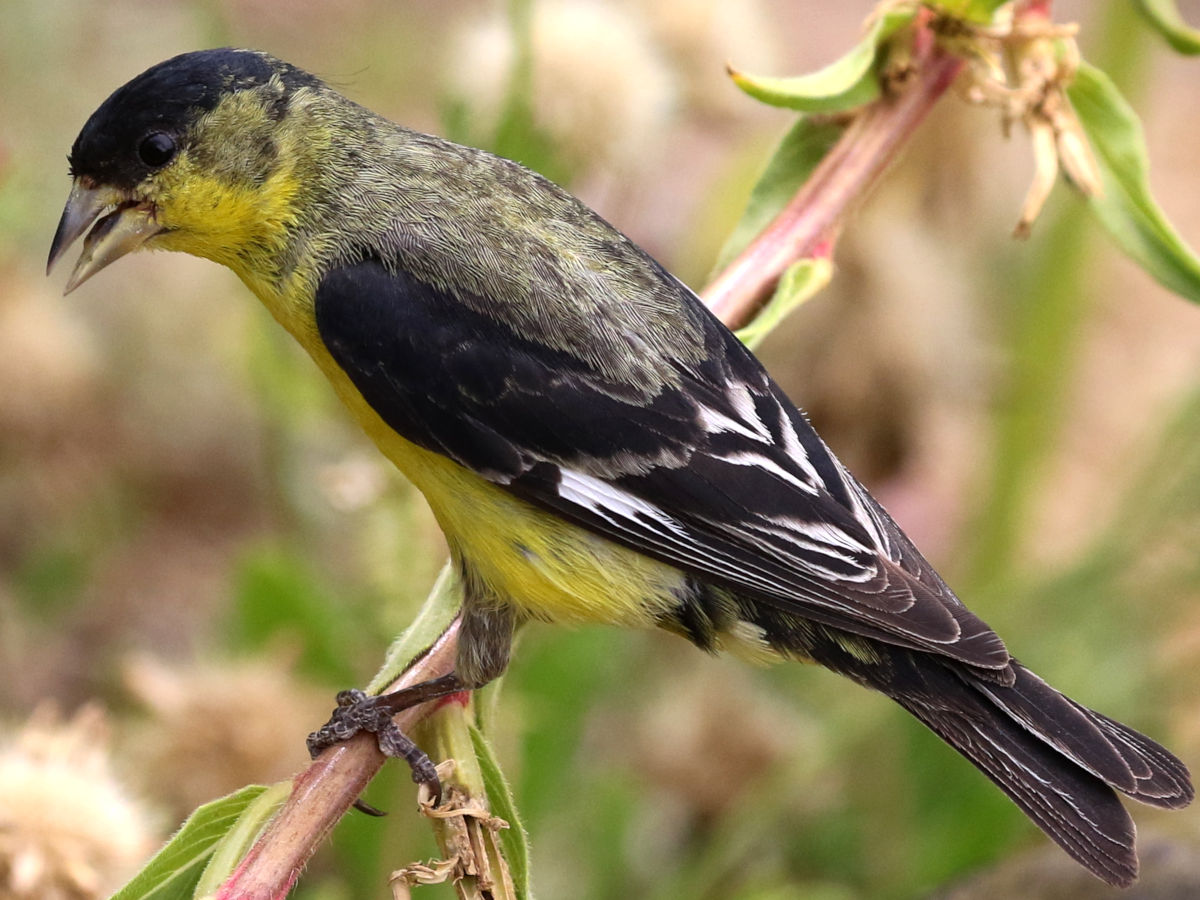
Its signature trait is a two-tone back: males in the western part of the range wear a green back, while males in Texas and eastward wear a fully black back — two looks, one species. Add the solid black cap, bold white wing patches, and a bill built for tiny seeds, and there is no real look-alike at close range.
Essential Morphometric Field Marks:
- Body Length & Mass: Just 3.5 to 4.3 inches (9–11 cm) and 0.3 to 0.4 ounces (8–11.5 grams) — the smallest true finch in North America, noticeably tinier than an American Goldfinch standing beside it.
- Wingspan: About 5.9 to 7.9 inches (15–20 cm), driving the same deeply undulating, bounds-and-dips flight as other goldfinches.
- Bill Structure & Color: A small, sharply conical bill — dark in the male, paler in the female — precision tooling for Nyjer, thistle, and sunflower seeds.
- Color Pattern: Male: solid black cap, bright yellow underparts, green or black back, black wings with bold white patches. Female: olive-green above, yellow below, no cap, with yellow undertail coverts (white in the American Goldfinch). Critically, this species does not molt into a drab winter coat — a January male still wears June colors.
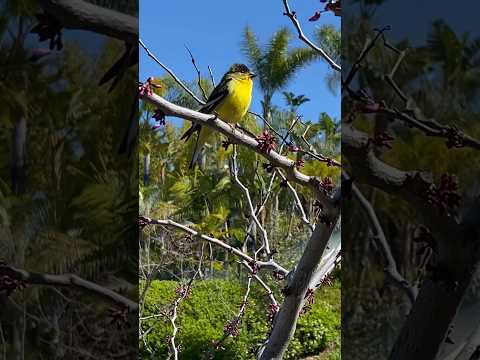
Unmistakable: solid glossy black cap over bright yellow, with a green back in the West or a fully black back in Texas and eastward. The wings flash bold white patches in flight, and the white at the base of the tail shows on every takeoff. He keeps this look all year — no winter disguise.
Olive-green above and soft yellow below, with no black cap — she looks like a permanent “winter” American Goldfinch, which is exactly the confusion to avoid. Check the undertail coverts: yellow here, white on a female American, and note the smaller size and shorter bill.
Lesser Goldfinch Vocalization Guide (1 Field Recording + 2 Simulations)
The song is a rapid, bright jumble of twitters, trills, and warbles — and the Lesser Goldfinch is a genuine mimic, weaving imitations of other local birds into its song. The everyday call is a plaintive, descending tee-yee, softer and sadder-sounding than the American Goldfinch’s bouncy “po-ta-to-chip.” The first card below is a real field recording shared under a Creative Commons license; the second and third are clearly labeled acoustic simulations. For more wild audio, browse xeno-canto: Lesser Goldfinch.
1. Real Recording — Song of a Singing Male
2. Call Simulation — “Tee-yee” Contact Call
3. Song Simulation — Twittering Mimic Warble
Habitat, Range & Seasonal Shifts
Lesser Goldfinches live in open and semi-open country of the West and Southwest: oak savannas, streamside willows and cottonwoods, chaparral edges, desert washes, parks, and suburban backyards — nearly always within reach of water. They breed from the western U.S. south through Mexico and Central America.

A Western Bird That Barely Moves
Lesser Goldfinches are partial, short-distance migrants: most of California, the Southwest, and Texas keeps them year-round, while birds breeding in the interior Northwest and the Rockies slip south into the lowlands and Mexico for winter.
In winter they roam in busy flocks through weedy fields and feeder yards, often mixed with American Goldfinches, Pine Siskins, and House Finches — and they never trade their bright colors for a drab winter coat.
Backyard Behavioral Patterns & Social Dynamics
The Lesser Goldfinch is a sociable, acrobatic miniature with a few signature habits. Four behaviors explain most of what you will observe:
🎭 The Mimic Songster
Males sing a rapid, sweet twittering warble laced with copied phrases from other birds — a Lesser Goldfinch may borrow notes from a dozen neighbors in a single song. Listen for the sudden “different voice” mid-warble.
🖼 Two Backs, One Bird
Western males wear a green back; males in Texas and eastward wear a solid black back. Same species, same song, same habits — if your Texas “different bird” has the black cap and yellow belly, it is still a Lesser Goldfinch.
🤸 The Flower-Head Acrobat
Lesser Goldfinches cling at any angle — even upside down — riding bending sunflower and thistle heads while they shell seeds on the spot. A flock working a sunflower patch barely stops to breathe between seed heads.
🐦 The Bird That Never Fades
Unlike the American Goldfinch, this species keeps its bold plumage year-round — no confusing drab winter molt. The black-capped yellow male at your January feeder is the same bird you watched in June.
Problem: “Is That a Goldfinch? It Looks Too Small — and Too Dark”
The three most common Lesser Goldfinch confusions all have simple fixes:
First, the “winter American Goldfinch” mistake: a female Lesser looks so much like a drab American Goldfinch that many watchers file her under the wrong species — check the tiny size and the yellow (not white) undertail coverts. Second, the “House Finch” dismissal: at a distance, a streaky-looking flock at the Nyjer sock gets written off as House Finches, when half the birds are actually much smaller goldfinches — look for the clean, unstreaked yellow and the conical bill. Third, the “too small to see” problem: at barely four inches, these birds are easily overlooked in dense shrubs — their constant soft tee-yee calls give them away long before you spot them. And if the feeder goes quiet, check the seed: stale Nyjer dries out within weeks and goldfinches flatly refuse it. Learn the size, the undertail color, and the call — and refresh the seed — and these tiny finches stop being invisible.
Method 1: Set the Table — Nyjer & Sunflower, Done Right
Design for a tiny, acrobatic, all-seed flocking finch:
-
Make Fresh Nyjer the Main Course
Nyjer (“thistle”) seed is the Lesser Goldfinch favorite — tiny, oil-rich, and perfectly sized for that sharp little bill. Serve it in a mesh sock or fine-port tube feeder, and buy small bags often: Nyjer goes stale in weeks, and goldfinches refuse old seed. Our lab-tested roundup of the Best Tube Feeders for Small Birds includes dedicated finch models.
-
Add Sunflower Chips — or the Real Flower
Hulled sunflower chips are the close second choice — no shells, no mess. Better still, plant a row of sunflowers and let the birds ride the bending heads: Lesser Goldfinches cling to the flower and shell seeds on the spot, a show no tube feeder can match.
-
Hang It Where a Tiny Flock Feels Safe
These finches cling at any angle, so mesh surfaces let a whole flock feed at once. Hang feeders near a shrub or small tree — close cover for a quick escape, clear sightlines for a nervous flock — and low enough to watch from a chair.
-
Offer Water Year-Round
In the dry West and Texas, water can outdraw seed. Goldfinches drink and bathe daily and love a shallow bath near the feeders. In freezing weather a heated bird bath becomes the busiest spot in the yard.
Method 2: Grow the Feeder — A Living Seed Garden
Let the garden itself do the feeding:
-
Plant Seed-Bearing Natives
Native sunflowers, purple coneflowers, asters, black-eyed Susans, and native thistles are Lesser Goldfinch magnets. This is a bird built to harvest the sunflower family — give it the real thing.
-
Skip the Fall Cut-Down
The single easiest strategy is doing nothing: leave seed heads and weedy corners standing into winter. What looks untidy in October is a stocked pantry in December, with finches riding every stalk.
-
Add Water and Cover Near the Seed
Lesser Goldfinches nest in dense shrubs and small trees near water and feed within easy reach of both. A yard with cover, a bird bath, and standing seed heads offers a pair everything they need.
-
Keep the Station Clean
Dense finch flocks spread disease fast at dirty feeders. Empty, scrub, and fully dry feeders every one to two weeks, and rake up old hulls and droppings beneath the station.
Tool Solution: Recommended Hardware for Lesser Goldfinches
Equipment matched to a tiny, clinging, seed-loving flock bird:
Nyjer Mesh Sock / Finch Tube
A mesh sock or fine-port tube filled with fresh Nyjer — the one setup Lesser Goldfinches will mob in flocks, cling to upside down, and return to daily from winter through spring.
- • Seed: Fresh Nyjer (buy small, often)
- • Style: Mesh or micro-port tube
- • Capacity: Serves a whole flock
Tube Feeder with Sunflower Chips
A standard multi-port tube filled with hulled sunflower chips — the no-mess backup that keeps goldfinches fed when the Nyjer runs low and diversifies your flock.
- • Seed: Hulled sunflower chips
- • Ports: 4–6 perches
- • Mess: Near zero
Shallow Heated Bird Bath
A shallow, gently sloped bath with a thermostatic heater — goldfinches drink and bathe daily, and in the arid West open water can pull in more birds than any feeder.
- • Depth: 1–2 in, gently sloped
- • Winter: Thermostatic heater
- • Placement: Near shrubs, off the lawn
Frequently Asked Questions
- Species Profile: The Lesser Goldfinch (Spinus psaltria) is North America’s smallest true finch — just 3.5–4.3 inches and 8–11.5 grams — a seed specialist of the West, Southwest, and Texas.
- One Coat, All Year: Males wear a solid black cap and bright yellow underside with a green or black back — and unlike the American Goldfinch, they never molt into a drab winter disguise.
- The Mimic: A rapid twittering warble laced with borrowed phrases from other birds, plus a plaintive descending “tee-yee” contact call that gives feeding flocks away.
- Feeder Formula: Fresh Nyjer in a mesh sock or fine-port tube, plus sunflower chips, near cover and water — and replace stale seed without mercy.
- Know the Look-Alikes: Female Lessers wear yellow undertail coverts (white on female Americans); “winter goldfinches” at a Western feeder are often Lessers you have simply been misnaming.
- Garden Bonus: Plant sunflowers and let the seed heads stand — the birds will ride the bending heads and shell seeds on the spot.
Bird Watching Log
Species: Lesser Goldfinch (Spinus psaltria)
| Lesser Goldfinch (Back Green / Black — Flock Size: ____________________________) | |