
Orchard Oriole
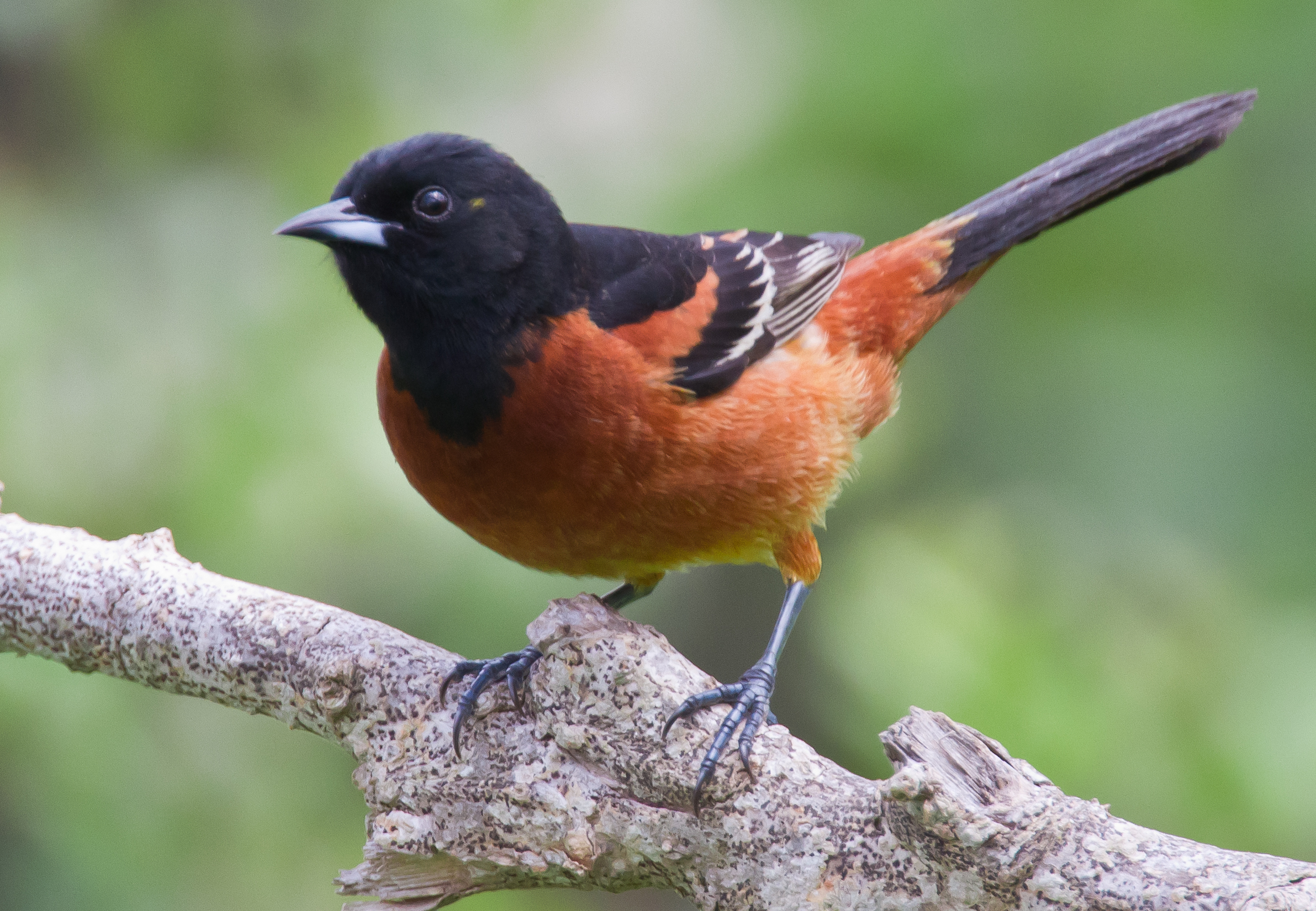



Orchard Oriole (Icterus spurius): Complete Identification, Feeder Guide & Song Library
Quick Answer: How to Attract & Identify Orchard Orioles
The Orchard Oriole (Icterus spurius) is the smallest oriole in North America — a sparrow-sized treetop singer of eastern orchards, riverside groves, and big suburban shade trees. The male wears a black hood over a deep chestnut-rust body (dark rust, never blaze orange); the female is yellow-green with two white wing bars, and first-spring males look like her but carry a crisp black bib. They arrive in late April and May and leave astonishingly early — many head south by late July. Attract them during that short window with orange halves, a small dish of grape jelly, and an oriole nectar feeder set near tall trees — and expect the Gray Catbird and the Ruby-throated Hummingbird to share the sweets.
Species Physical Profile & Morphometrics
The Orchard Oriole belongs to the New World blackbird family (Icteridae) — the same American family as blackbirds, grackles, and meadowlarks. It is the eastern counterpart of the Hooded Oriole in build and habits, and shares its range with the bigger, brighter Baltimore Oriole; the two species often feed in the same shade trees, and the Baltimore’s blaze orange makes the Orchard’s dark chestnut easy to overlook.
The identification formula: sparrow-sized oriole + black hood + deep chestnut-rust body in the treetops of the East and Great Plains. A male Baltimore Oriole is much bigger with a brilliant orange body; the western Bullock’s Oriole shows an orange face behind its black eyeline. Females of all three are yellowish — but the Orchard female is the smallest and the brightest yellow-green of the group.
Essential Morphometric Field Marks:
- Body Length & Mass: 5.9 to 7.1 inches (15–18 cm) and 0.6 to 1.0 ounces (16–28 grams) — the smallest oriole on the continent, barely larger than a House Sparrow.
- Wingspan: 9.8 inches (25 cm); flight is quick and direct between treetops, noticeably nimbler than the bigger orioles.
- Bill Structure & Color: A slender, sharply pointed, slightly downcurved blue-gray bill with a dark ridge — finer than a Baltimore’s, built for gleaning larvae and sipping nectar.
- Color Pattern: The male wears a black hood (head, throat, back) and black wings and tail, set off by deep chestnut-rust underparts, shoulder, and rump, with a single clean white wing bar. The female is yellow-green above and soft yellow below, with grayish wings and two white wing bars.
- Male vs. Female: The male’s black hood and chestnut body are unmistakable at any distance; the female’s yellow-green plumage hides well in summer foliage. First-spring males look like females but show a solid black bib on the throat, and do not wear full chestnut until their second fall.
The dark ember: a black hood flowing into a body of deep, burnished chestnut — richer and darker than any other oriole’s orange. He pours out his hurried, jumbled whistles from the crown of a shade tree and rivals far bigger birds for the jelly dish — size means nothing at a sweet station.
The grass weaver — yellow-green all over with two white wing bars. She alone builds the nest, weaving fresh green grass blades into a hanging pouch that dries to straw color as summer advances, and she gathers most of the caterpillars that feed the brood inside.
Orchard Oriole Vocalization Guide (3 Field Recordings)
The Orchard Oriole’s signature is a hurried, jumbled run of rich whistled notes — faster and less measured than the Baltimore Oriole’s slow flute phrases — backed by a sharp chuck call and a chattering scold. All three recordings below are real field audio, shared under commercial-use licenses via Wikimedia Commons — no simulations. For a deeper library, browse xeno-canto: Orchard Oriole.
1. The Hurried Song
2. The Second Singer
3. The Classic Cut
Habitat, Range & the Orchard Life
True to its name, the Orchard Oriole lives in open country with scattered tall trees: orchards and farm shelterbelts, riverside groves, parks, golf courses, and mature suburban yards. It wants leafy crowns to sing and glean in, a sturdy fork to hang a nest from, and open sky around it all — a yard with two or three big shade trees is already prime Orchard Oriole country.

An Eastern Summer, a Tropics Winter
The breeding range covers the eastern and central United States — from the Gulf Coast north through the Midwest and Mid-Atlantic into parts of New England, and west across the Great Plains into the foothills of the Rockies. Come fall, the birds funnel south to winter from Mexico through Central America, where flowering trees and shade-coffee plantations are favorite haunts.
For backyard birders the calendar is compressed: Orchard Orioles arrive late April through May, and the males are already slipping south by mid to late July — among the earliest fall migrants of any North American songbird. Your window to host one is barely ten weeks.
Backyard Behavioral Patterns & Social Dynamics
The Orchard Oriole is a treetop bird with a sweet tooth and a short visa. Four behaviors explain most of what you will observe:
🍇 The Jelly Regular
Small but bold at the station: Orchard Orioles take grape jelly, orange halves, and nectar eagerly, and a bird that finds your dish in May often returns many times a day through June. Because they are slimmer than Baltimore Orioles, they can even perch at hummingbird feeders to sip sugar water.
🌾 The Green Grass Nest
The female weaves a hanging pouch almost entirely of fresh green grass blades, knotted around supporting twigs in a tree fork; the nest dries to straw color as the season wears on. A yard with a lawn corner left long — or clumps of ornamental grass — gives her building material within sight of the nest tree.
🐛 The Canopy Gleaner
Between jelly runs, Orchard Orioles are methodical insect hunters — caterpillars are the summer staple, picked from leaves high in the canopy and carried to the nest by the beakful. A pesticide-free yard with native trees keeps this pantry stocked all season.
🗓 The Early Departure
No common songbird keeps a shorter summer schedule: males quiet down and head south by mid to late July, weeks before Baltimore Orioles leave the same trees. When your jelly dish suddenly goes quiet in high summer, the season’s Orchard Orioles have already checked out.
Problem: “An Orchard Oriole Sang in My Maples All May — but My Jelly Dish Sat Untouched. What Should I Do?”
The three most common Orchard Oriole worries all have proven answers:
First, the late start: this species arrives late and leaves early, so a station that appears in June may get only days of traffic — set food out by mid-April in the South and early May in the North, before the first scouts pass through. Second, the bully at the bowl: a small oriole gives way to bigger birds, and one hogging Baltimore Oriole, catbird, or starling can keep an Orchard Oriole off a single dish — offer a second, smaller jelly cup on the far side of the yard, near shrubs the little bird can dive into. Third, the silent July: a station that suddenly empties in high summer has not failed — the birds have simply left for Mexico on their early schedule — mark your calendar for next spring, keep the station fresh for stragglers and southbound travelers, and expect your regulars to find you again on their first pass north. Solve these three and the chestnut ember will pencil your yard into its short, sweet season for years.
Method 1: Set the Table — Oranges, Jelly & Nectar
Design for a small, sweet-loving treetop migrant with a short stay:
-
Serve Grape Jelly in Small Dishes
A spoonful of grape jelly in a shallow cup is the single most reliable oriole attractant, and small portions suit a small bird — one spoonful, refreshed daily, beats a bowl that sits and crusts. Offer a second cup across the yard if bigger birds take over the first, and skip sugar-free or artificially sweetened varieties entirely.
-
Put Out Orange Halves
A fresh orange cut in half, cut-side-up on a spike, nail, or feeder prong works as both food and beacon — the color catches an oriole’s eye from the treetops. Replace halves every couple of days before they dry out or mold, sooner in southern heat.
-
Hang a Nectar Feeder They Can Actually Use
An oriole nectar feeder with larger ports and perches — or even a hummingbird feeder, whose perches fit this smallest oriole — serves four-to-one sugar water all season. Give it an ant moat and afternoon shade, and never use red dye.
-
Start Early and Stay Consistent
With barely ten weeks to work with, timing is everything: set the station out before the birds arrive so spring migrants find it on their first scouting pass, and refresh it on a daily rhythm — an empty or crusted dish trains a short-stay visitor to look elsewhere.
Method 2: Build the Habitat — Shade Trees, Grass & Water
Feed the season, not just the week:
-
Keep (or Plant) Tall, Open Shade Trees
Maples, elms, willows, and orchard trees with leafy crowns and sturdy horizontal forks are song perches, insect pantries, and nest sites in one. A yard with two or three mature shade trees already owns the single best Orchard Oriole attractant there is.
-
Leave Grass Clippings and a Long Corner
The female weaves her pouch from fresh green grass blades — an unmowed lawn corner, clumps of ornamental grass, or a tray of long clippings near the nest tree puts building material within easy reach. Watch for her tugging blades free in May and June.
-
Plant Native Fruiting Trees and Shrubs
Mulberry, serviceberry, elderberry, and wild cherry keep fruit on the menu after jelly traffic fades, and native flowering plants supply nectar and the insects that feed the nestlings. Fruiting natives also hold southbound birds an extra day or two in July.
-
Offer Water and Skip the Spray
A clean, shallow birdbath draws orioles down from the canopy for drinking and bathing, and a dripper makes it audible from the treetops. Just as important, a pesticide-free yard keeps the caterpillar supply that a nesting pair depends on — spray the trees and you close the pantry.
Tool Solution: Recommended Hardware for Orchard Orioles
Equipment matched to a small, sweet-loving treetop migrant:
Oriole Jelly & Orange Feeder
A purpose-built oriole feeder with spikes for orange halves and small cups for grape jelly — bright orange for visibility, hung in the open within sight of the shade trees where the birds sing.
- • Food: Grape jelly, orange halves
- • Style: Spikes + small jelly cups
- • Placement: Open, near tall trees
Oriole Nectar Feeder
A hummingbird-style feeder scaled for orioles — larger ports, sturdy perches, and an ant moat — filled with four-to-one sugar water; this smallest oriole will also visit standard hummingbird feeders.
- • Mix: 4 parts water : 1 sugar
- • Style: Oriole ports + moat
- • Bonus: Serves hummingbirds too
Shallow Birdbath with Dripper
A shallow bath with a dripper or bubbler — audible from the treetops — gives orioles a reason to drop to eye level for drinking and bathing through the heat of their short summer stay.
- • Depth: 1–2 in, gently sloped
- • Feature: Dripper or bubbler
- • Placement: Open sightlines
Frequently Asked Questions
- Species Profile: The Orchard Oriole (Icterus spurius) is a 5.9–7.1 inch, 0.6–1.0 ounce songbird (Icteridae), band code OROR — the smallest oriole in North America.
- ID in One Look: The male has a black hood over a deep chestnut-rust body; the female is yellow-green with two wing bars; first-spring males look like females but wear a crisp black bib; a Baltimore male is bigger and blaze orange.
- The Sound: A hurried, jumbled run of rich whistled phrases ending in slurred notes, plus a sharp chuck and a chattering scold; three real field recordings above.
- Range & Habit: Breeds across the eastern and central United States, winters from Mexico through Central America — arrives late April to May, leaves as early as mid-July; weaves a hanging pouch of green grass in a tree fork.
- Feeder Formula: A spoonful of grape jelly, orange halves on spikes, and an oriole nectar feeder (4:1 sugar water) — set out before arrival, in the open near tall trees, refreshed daily.
- The Season: Peak traffic runs May through June at the station; a yard with tall shade trees, a grassy corner for nesting material, and a pesticide-free canopy keeps the pair coming back each spring.

Bird Watching Log
Species: Orchard Oriole (Icterus spurius)
| Orchard Oriole (Chestnut Body: Yes / No — Hurried Whistled Song: Yes / No — Jelly / Orange Taken: Yes / No — Nest Seen: Yes / No) | |