
Eastern Bluebird




Eastern Bluebird (Sialia sialis): Complete Identification, Mealworm Guide & Nest Box Handbook
Quick Answer: How to Attract & Identify Eastern Bluebirds
The Eastern Bluebird (Sialia sialis) is the small thrush of open backyards, meadows, and pasture edges east of the Rockies — the male brilliant sky-blue with a rusty breast, the female in softer gray-blue. To attract a pair: serve live mealworms in a smooth-sided dish at the same times each day, and mount a nest box with a 1.5-inch entrance hole on a post in open mowed grass. It shares open lawns with the Chipping Sparrow and the Northern Cardinal.
Species Physical Profile & Morphometrics
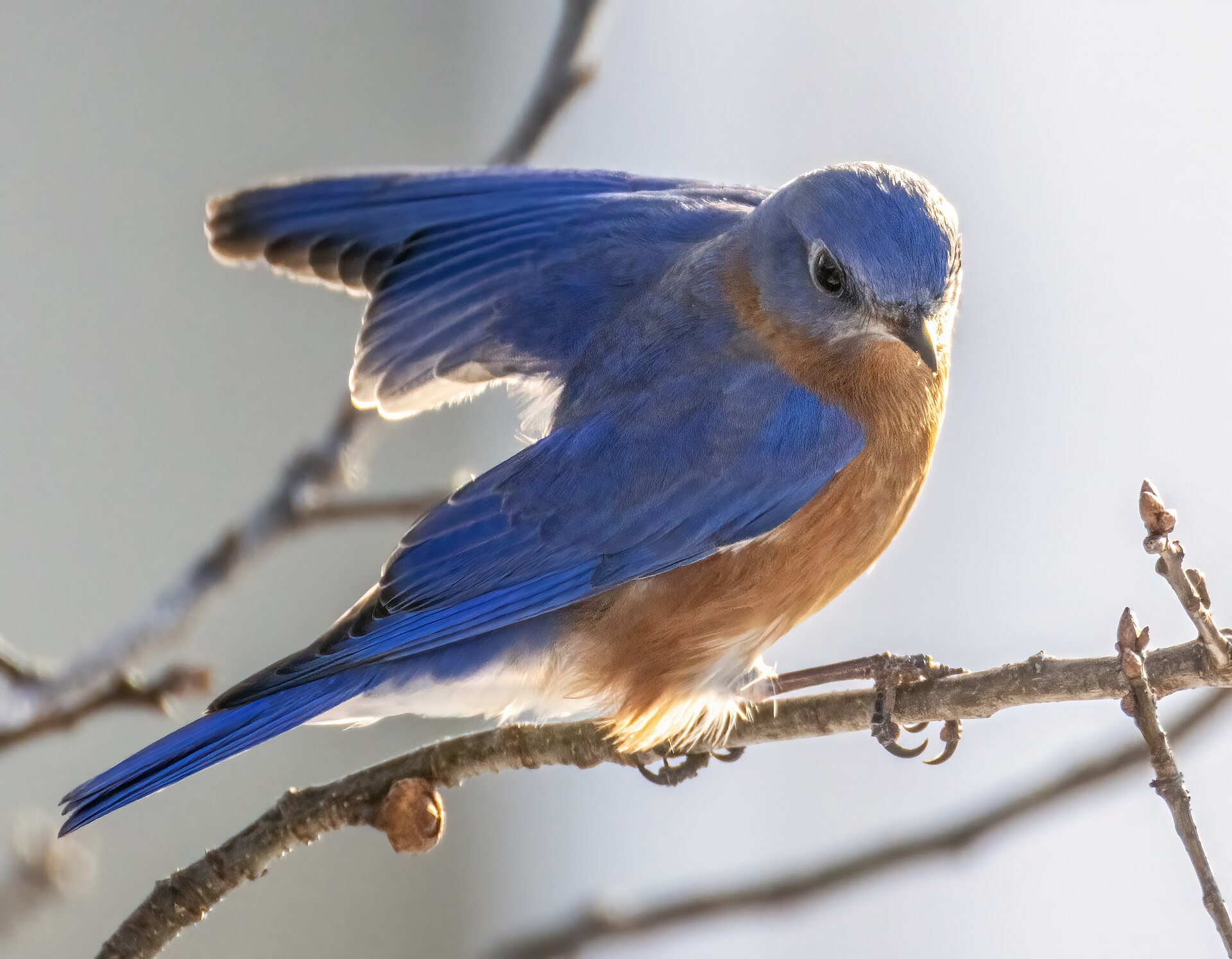
The Eastern Bluebird is a small, plump member of the thrush family (Turdidae) — a round-headed, short-tailed bird that sits upright on low perches. No other eastern bird carries this exact pattern: blue above, rusty orange across the throat and breast, clean white belly.
The identification formula: round body + low perch + blue-and-rust plumage + soft warble. The birds it gets confused with are the Indigo Bunting (all blue including the belly, conical seed bill) and the Blue Jay (three times larger, crested, white below). Western travelers should note the Western and Mountain Bluebirds, whose males lack the rusty throat.
Essential Morphometric Field Marks:
- Body Length & Mass: about 6.3 to 8.3 inches (16–21 cm) and 0.95 to 1.1 ounces (27–32 grams) — two-thirds the size of an American Robin, with the same upright thrush posture.
- Wingspan: about 9.8 to 12.6 inches (25–32 cm); flight is light and fluttering between low perches, with shallow wingbeats.
- Bill Structure & Color: A short, straight, dark bill — an insect-catcher’s tool, thin enough to pluck a caterpillar, nothing like a finch’s seed-cracker.
- Color Pattern: Male: vivid sky-blue head, back, wings, and tail with a rusty-red throat and breast and white belly. Both sexes show the signature rust-and-white underside pattern that separates them from every other blue bird.
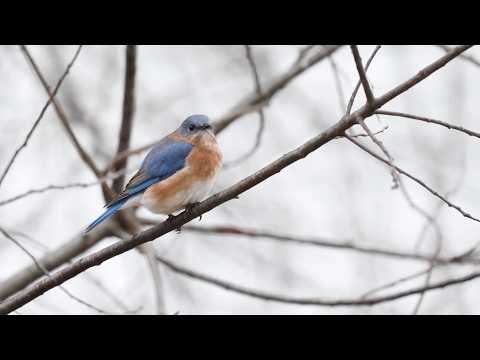
- Male vs. Female: The female is a softened copy — grayish-blue above with bluish wings and tail, a paler orange wash on the breast, and a whitish eye-ring. She is duller but never brown or streaky.
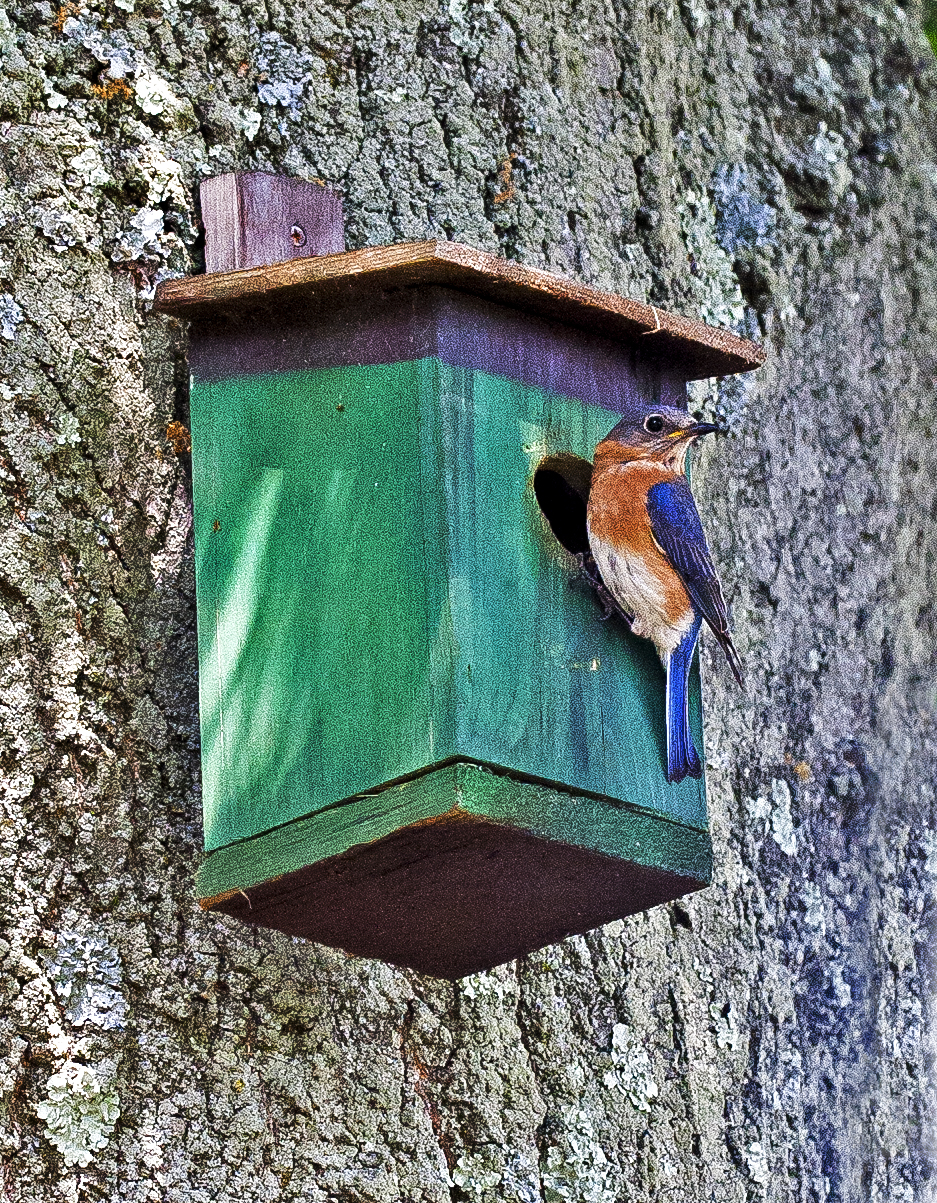
The electric one: brilliant sky-blue head, back, and wings over a deep rusty breast. He scouts nest cavities in late winter, fluttering at the entrance with nesting material in his bill to show off the site — but the final choice is hers.
The quiet architect: softer gray-blue with a gentle orange wash. She alone builds the grass-cup nest and incubates the 3–7 pale blue eggs for about two weeks, while her mate stands guard and brings her food.
Eastern Bluebird Vocalization Guide (4 Field Recordings)
The bluebird’s voice is as gentle as the bird: a soft, musical warble remembered as “cheer, cheerful charmer,” and the liquid “chur-lee” calls mates trade across the meadow. All four recordings below are real field audio hosted on Wikimedia Commons, recorded by Jonathon Jongsma (mirrored from xeno-canto) — no simulations. For a deeper library, browse xeno-canto: Eastern Bluebird.
1. The Nest Box Song
2. The Territory Chase
3. The Hunting Perch Calls
4. The Nestlings Begging
Habitat, Range & the Human Landscape
The Eastern Bluebird owns the open countryside: meadows, pastures, orchards, golf courses, cemeteries, parks, and big mowed yards — anywhere short grass for hunting insects meets scattered trees, fence lines, or wires for perches and cavities for nests. Deep forest and dense city blocks are both useless to it; the suburban edge is perfect.

East of the Rockies, Into the Suburbs
The range covers North America east of the Rockies: southern Canada through the entire eastern United States to the Gulf Coast, and south into the Mexican highlands. Northern birds are partial migrants, heading south in October and November; across the Southeast, bluebirds stay year-round.
Backyards score best with short mowed grass, open sightlines, and a scatter of perches. A yard with a nest box on a post, a mealworm dish, and a berry-producing dogwood or sumac is a complete bluebird territory in miniature.
Backyard Behavioral Patterns & Social Dynamics
The Eastern Bluebird is the gentlest regular in the open yard — a low-perching hunter with a comeback story behind it. Four behaviors explain most backyard encounters:
🦗 The Drop-and-Pounce Hunter
Bluebirds hunt by sight: a bird sits on a wire or fence post over short grass, drops to the ground, grabs a grasshopper or beetle, and returns to the perch. A low clothesline or shepherd’s hook over your lawn becomes a hunting tower within days.
🪺 The Nest Box Comeback
Bluebird numbers crashed in the mid-1900s as habitat vanished and starlings and House Sparrows seized every cavity. Volunteer “bluebird trails” of properly designed boxes brought the species back — one of the great citizen-conservation successes, and the reason a correct box still matters.
👫 The Two-Brood Pair
Pairs form in late winter and may raise two, sometimes three broods between March and August. The male shows off cavities, the female builds and incubates — and young from the first brood sometimes linger to help at the second nest.
❄️ The Winter Berry Flock
In the cold months bluebirds drop the territorial act and gather in loose flocks, roaming hedgerows for dogwood, sumac, juniper, and wild grape. A winter flock descending on your mealworm dish — a dozen soft blue backs in the snow — is one of the finest sights in backyard birding.
Problem: “House Sparrows Took the Box, Starlings Found the Mealworms, and the Bluebirds Gave Up. Can I Fix That?”
The three most common Eastern Bluebird frustrations all have proven answers:
First, House Sparrows in the box: they will kill bluebird nestlings — the fix is vigilance plus placement: mount the box away from buildings and dense shrubs (sparrow habitat), check it weekly, and remove sparrow nests (an unprotected introduced species) promptly. Second, starlings at the door: a starling cannot fit through a 1.5-inch entrance hole — if starlings are entering, your hole is too big or the box front is damaged; a metal hole guard fixes both. Third, the mealworm pirates: robins, mockingbirds, and starlings will strip an open dish — serve mealworms in a smooth-sided, caged, or window-mounted feeder bluebirds can slip into, in measured portions twice a day. Bluebirds are gentle but loyal: solve the competition once, and the same pair returns to the same box for years.
Method 1: Serve Live Mealworms the Right Way
Design for a small, insect-eating thrush that ignores seed:
-
Live Mealworms Are the Magnet
Live mealworms are the single most reliable bluebird attractant ever discovered — a wiggling dish of them is visible from a hunting perch across the yard. Dried mealworms work as a backup, but live ones start the habit.
-
Use a Smooth-Sided Dish
Serve them in a glass, plastic, or glazed dish with smooth vertical sides the worms cannot climb, on a pole or low platform. Caged or window-mounted versions keep out the robins and starlings that would otherwise steal every worm.
-
Small Portions, Set Times
Fifty to a hundred worms, morning and late afternoon — bluebirds learn the schedule within days and will be waiting on the wire. Measured portions keep costs sane and stop the mealworm buffet from feeding the whole neighborhood.
-
Round Out the Menu
In winter, add suet crumbles, soaked raisins, and chopped berries to the same dish. Bluebirds almost never take seed — skip the hopper and spend the budget on worms and suet instead.
Method 2: Hang the Right Box in the Right Spot
With bluebirds, the nest box is the attraction strategy:
-
The 1.5-Inch Rule
The entrance hole must be exactly 1.5 inches in diameter — big enough for a bluebird, too small for a starling. A metal hole guard keeps squirrels and woodpeckers from enlarging it, and a predator baffle on the pole stops climbing snakes and raccoons.
-
Post It in Open Grass
Mount the box on a smooth post 4 to 6 feet high in open, mowed grass, facing a perch — a tree, wire, or fence — 25 to 50 feet away so the female has a staging spot on her first visit. Boxes stuck in deep woods go to wrens and mice, not bluebirds.
-
Face It Away from Storms
Aim the entrance away from the prevailing wind and driving rain (in most of the East, that means facing east or southeast). A box that stays dry inside fledges more young.
-
Keep the Hunt Close
Bluebirds need short grass and open sightlines around the box — their hunting ground. Skip lawn pesticides (you would be removing their food), keep the lawn mowed, and leave a few low perches standing between the box and the feeding dish.
Tool Solution: Recommended Hardware for Eastern Bluebirds
Equipment matched to a gentle, worm-loving, cavity-nesting thrush:
Smooth-Sided Mealworm Dish / Feeder
A glass or glazed dish with vertical sides on a pole or window mount — keeps live mealworms contained and, in caged versions, keeps out the robins and starlings that would steal them all.
- • Food: Live mealworms, suet crumbles, soaked raisins
- • Style: Smooth-sided dish, optional cage dome
- • Routine: 50–100 worms, morning and afternoon
Bluebird Nest Box (1.5-Inch Hole)
A proper bluebird box with an exact 1.5-inch entrance, ventilation, and a front that opens for cleaning — mounted on a baffled post in open grass, it turns a passing pair into resident breeders.
- • Entrance: 1.5 in, metal hole guard
- • Mount: 4–6 ft post with predator baffle
- • Placement: Open mowed grass, perch nearby
Heated Bird Bath
A shallow heated bath keeps open water available through freezes — bluebirds drink and bathe daily even in winter, and ice-free water draws the whole roaming flock to your yard on the coldest mornings.
- • Depth: 1–2 in at the edge
- • Extras: Thermostat-controlled heater
- • Placement: Open ground near berry shrubs
Frequently Asked Questions
- Species Profile: The Eastern Bluebird (Sialia sialis) is a 6.3–8.3 inch, 27–32 gram thrush (Turdidae) of open eastern backyards — sky-blue male, softer gray-blue female, band code EABL.
- ID in One Look: Round body + low perch + blue above, rust breast, white belly; a blue bird with an orange chest is this species and nothing else in the East.
- Partial Migrant: Northern birds head south in fall; southeastern bluebirds stay year-round, and winter flocks roam berry trees in loose, gentle companies.
- The Sound: A soft warble remembered as “cheer, cheerful charmer,” plus liquid “chur-lee” calls — four real field recordings above, including nestlings begging in the box.
- Feeder Formula: Live mealworms in a smooth-sided dish at set times, backed by suet crumbles and soaked raisins in winter — bluebirds do not eat seed.
- The Comeback Bird: A 1.5-inch-hole nest box on a baffled post in open grass is the proven invitation — the same boxes that rescued the species now fill yards with blue.
Bird Watching Log
Species: Eastern Bluebird (Sialia sialis)
| Eastern Bluebird (Pair or Flock: ___ — Mealworms Taken: Yes / No — Nest Box Visited: Yes / No — Singing: Yes / No) | |