
Baltimore Oriole


Baltimore Oriole (Icterus galbula): Complete Identification, Feeder Guide & Song Library
Quick Answer: How to Attract & Identify Baltimore Orioles
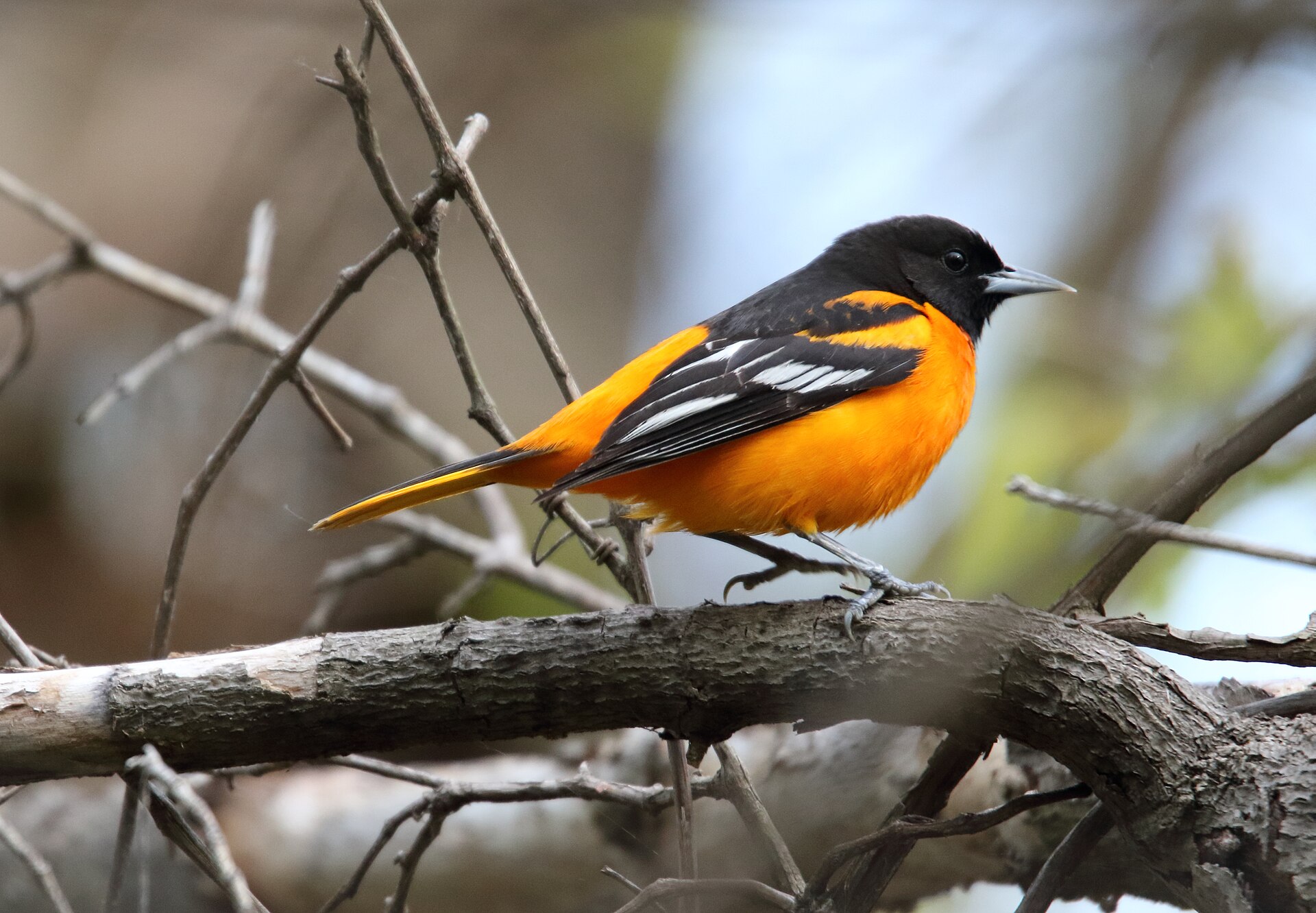
The Baltimore Oriole (Icterus galbula) — Maryland’s state bird, named for the orange-and-black heraldry of the Baltimore family — is the flame-orange treetop songbird of eastern shade trees, famous for the male’s solid black head and blazing orange underparts, a rich flute-like whistled song, and a woven pouch nest slung from a branch tip. The female is yellow-orange below with a gray-brown head and two white wing bars. They are long-distance migrants, pouring into eastern backyards in late April and May and slipping away by August. Attract them with orange halves on spikes, a small dish of grape jelly, and an oriole nectar feeder set out early, placed in the open where a treetop bird can spot them — and expect the Gray Catbird and the Ruby-throated Hummingbird to share the sweets.
Species Physical Profile & Morphometrics
The Baltimore Oriole belongs to the New World blackbird family (Icteridae) — a varied American family that includes blackbirds, grackles, cowbirds, and meadowlarks. Despite the name, it is not related to the orioles of Europe and Asia; early colonists simply reached for the brightest bird they knew. This one earned its title honestly: few sights in an eastern yard match a male oriole against a May sky.
The identification formula: robin-sized bird + flame-orange underparts + solid black head in the treetops of the East. The western lookalike is Bullock’s Oriole, whose male wears an orange face with a black eyeline and throat instead of a full black hood — the two hybridize where their ranges meet on the Great Plains, and were once lumped as the “Northern Oriole.” In the East, the much smaller Orchard Oriole wears deep chestnut rather than blaze orange.
Essential Morphometric Field Marks:
- Body Length & Mass: 6.7 to 7.5 inches (17–19 cm) and 1.1 to 1.4 ounces (30–40 grams) — a sturdy, robin-sized songbird built for the high canopy.
- Wingspan: 9.1 to 11.8 inches (23–30 cm); flight is strong and direct between treetops, with the orange rump and tail corners flashing in the sun.
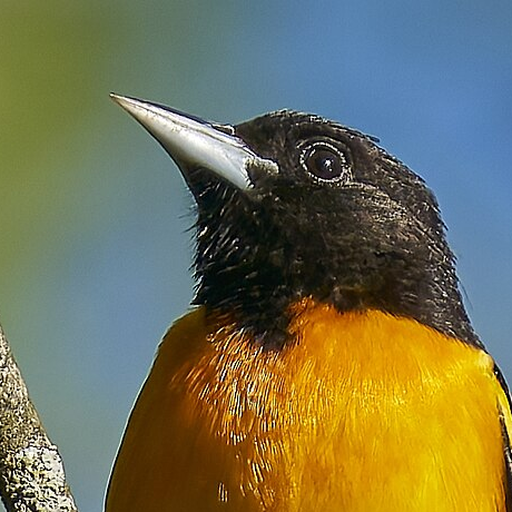
- Bill Structure & Color: A sharply pointed, slightly downcurved silver-gray bill — a versatile tool for piercing caterpillars, puncturing fruit, and probing flowers and jelly dishes alike.
- Color Pattern: The male wears a solid black head, back, and wings against brilliant orange underparts, shoulder, and rump, with a bold white wing bar and orange tail corners. The female is yellow-orange below — brightest on the breast and tail — with a gray-brown head and back and two white wing bars.
- Male vs. Female: The male’s black hood separates him at any distance; the female’s soft gray head and duller orange blend with new leaves. Young males resemble females through their first year and do not wear the full black-and-orange until their second fall.
The flame in the canopy: jet-black hood and back, neon-orange breast, shoulder, and rump, a crisp white wing bar, and orange tail corners that flash as he flies. He sings his rich, whistled phrases from the highest twigs and escorts the female on her nest-material runs — but leaves the weaving to her.
The master weaver — yellow-orange below, gray-brown above, two white wing bars, and no black anywhere. She alone builds the famous hanging pouch nest, knotting hundreds of plant fibers into a cradle at a branch tip, and she answers her mate’s song with shorter whistles of her own.
Baltimore Oriole Vocalization Guide (3 Field Recordings)
The Baltimore Oriole’s signature is a short series of rich, flute-like whistles — smooth, unhurried notes with pauses between — backed by harsh chatter and rattle calls when alarmed. All three recordings below are real field audio, shared under commercial-use licenses via Wikimedia Commons — no simulations. For a deeper library, browse xeno-canto: Baltimore Oriole.
1. The Flute-Like Song
2. Song & Chatter
3. The Treetop Soloist
Habitat, Range & the Treetop Life
The Baltimore Oriole lives in the treetops: open deciduous woodland, riverside groves, orchards, parks, and shady suburban streets — anywhere with tall elms, maples, cottonwoods, or sycamores to sing from and drooping branch tips to hang a nest from. It is one of the few bright tropical-colored birds an eastern backyard can host all summer.

An Eastern Summer, a Tropical Winter
The breeding range blankets the eastern half of North America — from southern Canada through the Midwest and East, roughly east of the Rockies. Come fall, the birds cross the Gulf and the southeastern states for wintering grounds in Central America and northern South America, with some lingering in the Southeast.
For backyard birders the calendar is everything: orioles arrive with the apple blossoms in late April and May, crowd jelly feeders through early summer, and quietly slip south in August and early September. The window is short — be ready before they get here.
Backyard Behavioral Patterns & Social Dynamics
The Baltimore Oriole lives high and moves fast, but a well-placed jelly dish brings it down to eye level. Four behaviors explain most of what you will observe:
🍊 The Sweet Tooth
Orioles are built for sugar: fruit, nectar, and — famously — grape jelly, which they take eagerly from backyard dishes, sometimes visiting dozens of times a day in May. The craving peaks at migration time and again when fledged juveniles arrive at the feeder in late summer, beaks wide and wings quivering.
🕸 The Hanging Pouch Nest
The female weaves one of the marvels of the bird world: a gourd-shaped pouch of knotted plant fibers, slung beneath a drooping branch tip where predators can barely reach. The build takes about a week; she lines it with fine grass and plant down, then raises four or five chicks in the swaying cradle.
🐛 The Caterpillar Patrol
Between jelly runs, orioles are working insect hunters — caterpillars are the staple, including hairy pest species like tent caterpillars and gypsy moth larvae that most songbirds refuse. A nesting pair removes thousands of larvae from your shade trees over the season, an arborist’s best friend.
🌳 The Treetop Singer
Males sing from the highest exposed perches — chimney tops, antennae, the crown of the tallest elm — and defend a breeding territory around the nest tree. Learn the whistled song and you will locate orioles by ear weeks before you ever spot the orange against green leaves.
Problem: “The Orioles Came in May, Then Vanished by August — and the Bees Took Over the Jelly. What Should I Do?”
The three most common Baltimore Oriole worries all have proven answers:
First, the mid-summer disappearance: adults switch to caterpillars when nesting peaks, so jelly traffic naturally dips — keep the station fresh anyway, because late summer brings the year’s best show: fledged juveniles following their parents in to beg. Second, the bees and ants: sweet stations attract insects — offer jelly in small spoonfuls, refresh it every day or two, move the dish a few feet if bees find it, and use an ant moat or a dab of dish soap under the hanger for ants. Third, the no-shows: orioles find food by sight from high perches, and a station hidden under the porch roof goes unnoticed — set oranges and jelly in the open near a tall tree, and put them out before the birds arrive in late April; a feeder that appears mid-June may wait a whole season for its first customer. Solve these three and the flame-orange regulars will pencil your yard into their migration for years.
Method 1: Set the Table — Oranges & Grape Jelly
Design for a sight-feeding, sugar-loving treetop migrant:
-
Put Out Orange Halves on Spikes
A fresh orange cut in half and impaled cut-side-up on a spike, nail, or feeder prong is the classic oriole lure — bright enough to catch a treetop bird’s eye and sweet enough to keep it coming. Replace halves every couple of days before they dry or mold.
-
Serve Grape Jelly in Small Spoonfuls
A spoonful of grape jelly in a shallow dish — or the built-in cup of an oriole feeder — is the single most reliable oriole attractant known. Keep portions small so it stays fresh, and skip sugar-free or artificially sweetened varieties entirely.
-
Place the Station Where Treetops Can See It
Orioles hunt by sight from high perches: set the station in the open, near a tall tree, not tucked under deep cover. A splash of orange on the feeder itself works as a beacon — orioles are drawn to the color.
-
Start Early, Keep It Fresh
Timing beats quantity: set food out in late April, before arrival, so migrating birds find your yard on their first scouting pass. Then refresh jelly every day or two and oranges every few days — stale sweets lose birds faster than no sweets at all.
Method 2: Build the Habitat — Nectar, Fruit Trees & Water
Feed the season, not just the week:
-
Hang an Oriole Nectar Feeder
An orange-accented nectar feeder with larger ports — hummingbird style, built for oriole bills — serves four-to-one sugar water (no dye needed) as a second sweet station. Give it an ant moat and shade from the afternoon sun so the nectar stays fresh.
-
Plant Native Fruiting Trees & Shrubs
Serviceberry, mulberry, wild cherry, and elderberry keep orioles visiting long after the jelly cools, and their blossoms feed the insects orioles hunt. A yard with one fruiting native holds orioles deeper into summer than a yard with a jelly dish alone.
-
Keep Tall Shade Trees & Drooping Branch Tips
Orioles nest where they sing: mature elms, maples, cottonwoods, and sycamores with long, drooping terminal branches are prime pouch-nest real estate. Leave slender branch tips unpruned in spring — you may host next summer’s woven cradle.
-
Offer Water & Skip the Pesticides
A clean birdbath draws orioles for drinks and baths through the season, and a pesticide-free yard keeps the caterpillar pantry stocked — spray the tent caterpillars and you spray the orioles’ grocery store.
Tool Solution: Recommended Hardware for Baltimore Orioles
Equipment matched to a sight-feeding, sugar-loving treetop migrant:
Oriole Jelly & Orange Feeder
A purpose-built oriole feeder with spikes for orange halves and cups for grape jelly — orange-colored for visibility, sized for oriole bills, and hung in the open near a tall tree.
- • Food: Orange halves, grape jelly
- • Style: Spikes + jelly cups
- • Placement: Open, near tall trees
Oriole Nectar Feeder
A hummingbird-style feeder scaled up for orioles — larger ports, perches, and an ant moat — filled with four-to-one sugar water as a season-long sweet supply.
- • Mix: 4 parts water : 1 sugar
- • Style: Oriole ports + moat
- • Bonus: Serves hummingbirds too
Shallow Birdbath with Bubbler
A shallow bath — moving water if possible — gives orioles a reason to linger between sweets: drinking, bathing, and bringing the juveniles for their first splash in late summer.
- • Depth: 1–2 in, gently sloped
- • Feature: Bubbler or dripper
- • Placement: Open sightlines
Frequently Asked Questions
- Species Profile: The Baltimore Oriole (Icterus galbula) is a 6.7–7.5 inch, 1.1–1.4 ounce songbird (Icteridae), band code BAOR — Maryland’s state bird and the flame-orange voice of eastern shade trees.
- ID in One Look: The male is solid black above and blaze orange below with a white wing bar; the female is yellow-orange below with a gray-brown head and two wing bars; young males take two years to earn the black hood.
- The Sound: A short series of rich, flute-like whistled phrases from the high canopy, plus harsh chatter at the feeder; three real field recordings above.
- Range & Habit: Breeds across the eastern half of North America, winters in Central America — arrives late April to May, departs August to early September; lives in the treetops and weaves a hanging pouch nest.
- Feeder Formula: Orange halves on spikes, a spoonful of grape jelly, and an oriole nectar feeder (4:1 sugar water) — set out early, placed in the open, refreshed every day or two.
- The Season: Peak jelly traffic runs May through July; watch for dull-plumaged juveniles begging at the dish in late summer, and keep native fruiting trees for the long haul.
Bird Watching Log
Species: Baltimore Oriole (Icterus galbula)
| Baltimore Oriole (Black Hood: Yes / No — Whistled Song Heard: Yes / No — Jelly / Orange Taken: Yes / No — Nest Seen: Yes / No) | |