
Ruby-throated Hummingbird


Ruby-throated Hummingbird (Archilochus colubris): Complete Identification, Feeder Guide & Nectar Handbook
Quick Answer: How to Attract & Identify Ruby-throated Hummingbirds
The Ruby-throated Hummingbird (Archilochus colubris) is the only hummingbird that breeds east of the Mississippi — an emerald-green spark barely 3 inches long and lighter than a nickel, the male flashing an iridescent ruby-red throat. To attract it: hang a red feeder filled with 4:1 white-sugar water (¼ cup sugar per 1 cup water — never red dye, never honey), clean it weekly, and plant red tubular flowers like bee balm and cardinal flower. It shares eastern yards with the Downy Woodpecker and the Northern Cardinal.
Species Physical Profile & Morphometrics
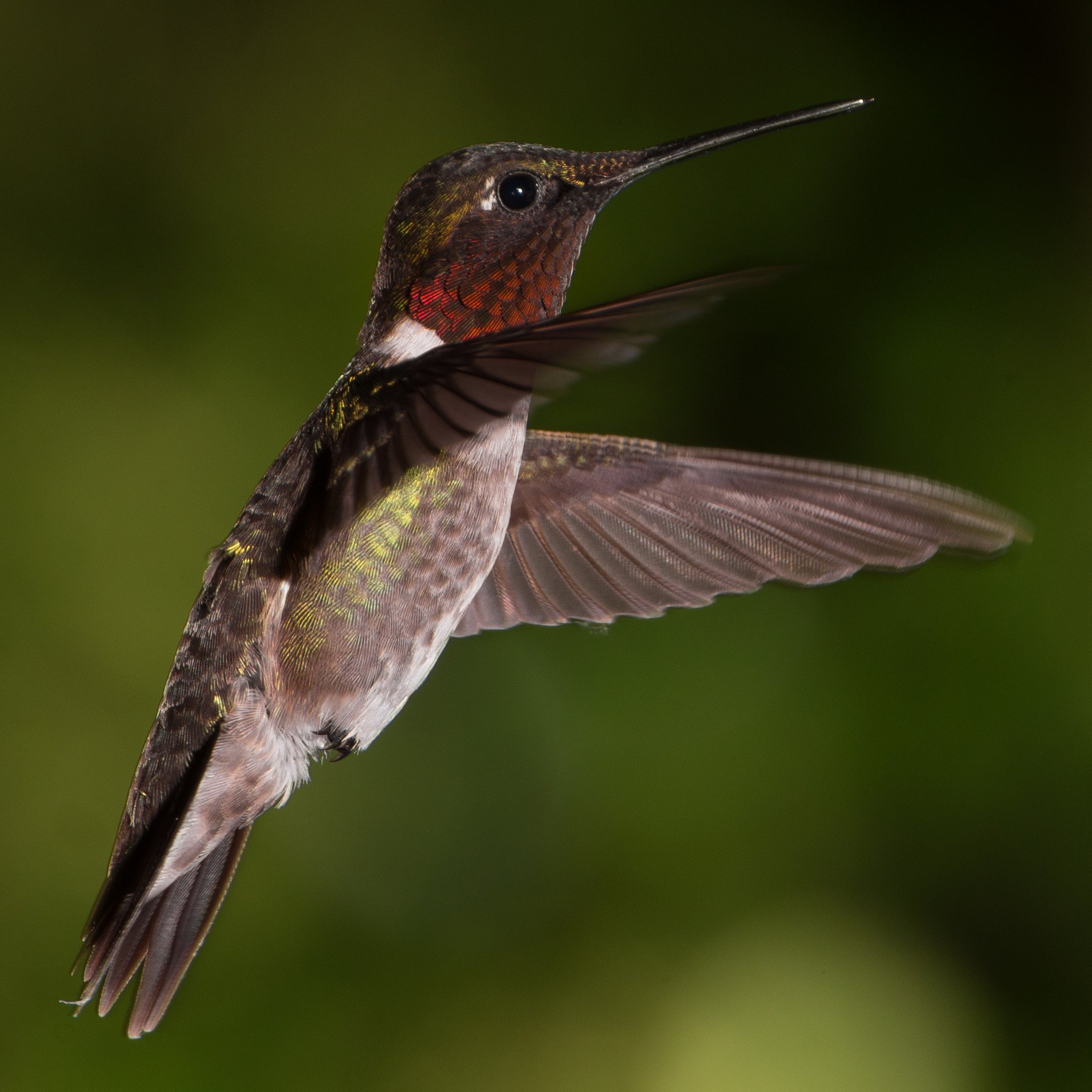
The Ruby-throated Hummingbird is the smallest bird of the eastern backyard — a member of the hummingbird family (Trochilidae) with a metallic green back, pale underparts, and a bill like a straight black needle. Its legs are so short it cannot walk — it can only shuffle sideways along a perch — but its wings do things no other eastern bird can match.
The identification formula: tiny green bullet + needle bill + blurred wings + (on the male) a throat that ignites ruby-red in sunlight. The only look-alikes are other hummingbirds: western travelers should note the Black-chinned (dusky-violet gorget) and the Rufous (orange-sided, a feisty winter stray to the East). Within the eastern summer range, a hummingbird is a Ruby-throat until proven otherwise.
Essential Morphometric Field Marks:
- Body Length & Mass: about 2.8 to 3.5 inches (7–9 cm) and 0.1 to 0.2 ounces (2–6 grams) — lighter than a nickel, and near the top of that range only when fattened for migration.
- Wingspan: about 3.1 to 4.3 inches (8–11 cm); the wings beat roughly 53 times per second in a hover and can fly the bird backward — a trick no other backyard bird can do.
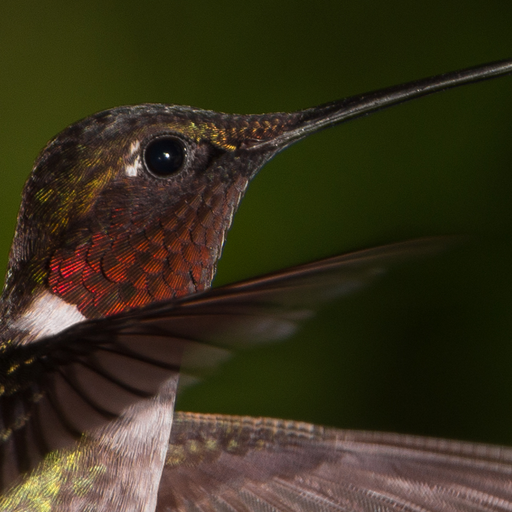
- Bill Structure & Color: A long, needle-straight black bill — a straw for nectar and a tweezer for tiny insects. The tongue flicks in and out about 13 times per second while feeding.
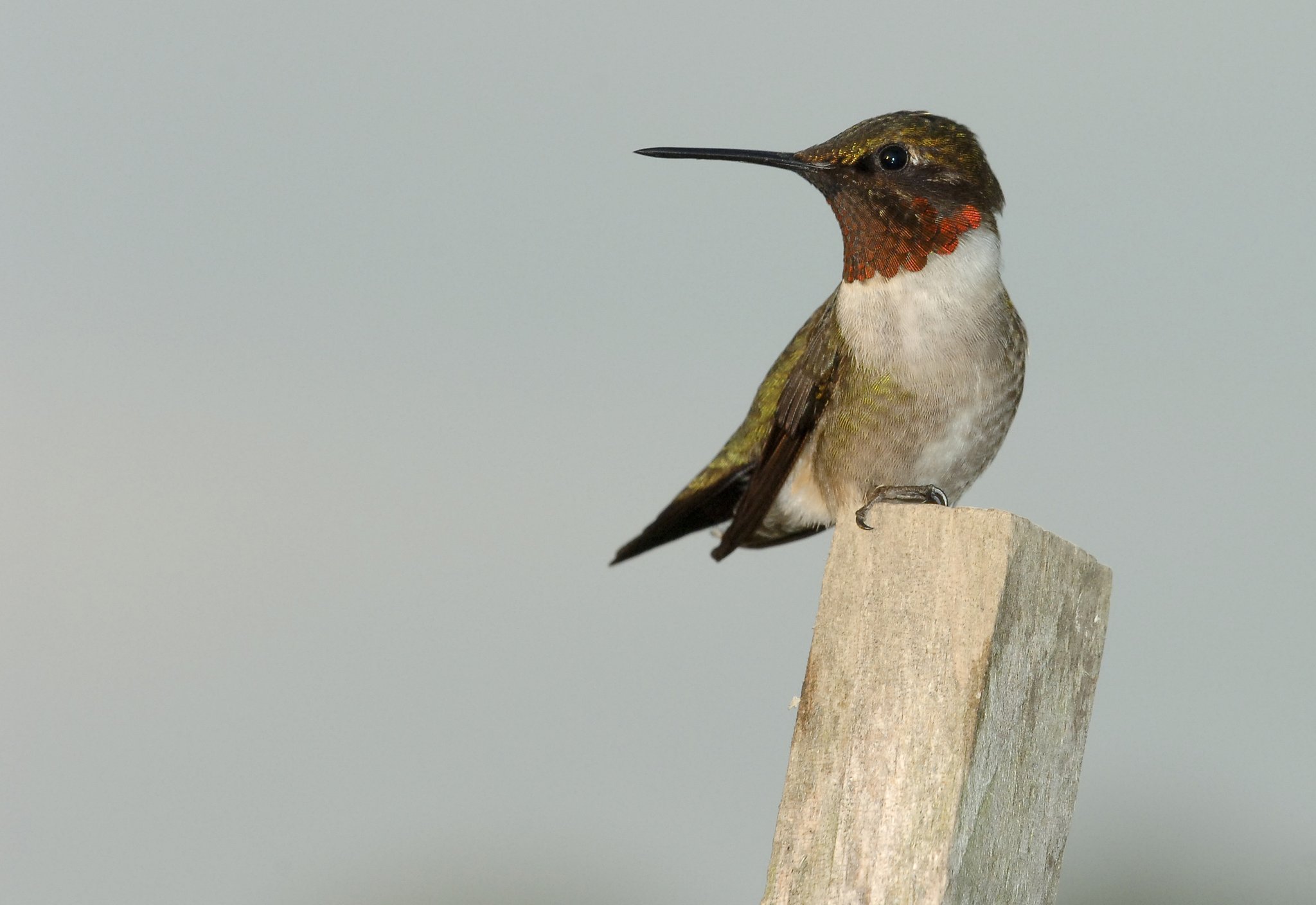
- Color Pattern: Both sexes are metallic emerald-green above and grayish-white below. The male adds the namesake ruby-red gorget — structural feathers that flash scarlet in direct light and can look velvety black in shade.
- Male vs. Female: The female has no ruby at all — a plain white throat and a rounded tail with white tips, where the male’s tail is forked and all-dark. Juvenile males show streaked throats with a few red feathers by late summer.
The jewel with a temper: emerald above with the iridescent ruby gorget and a forked tail. He migrates first, claims a feeder or flower patch within hours of arrival, and spends the summer driving off every rival — his courtship display is a giant U-shaped dive, whistling with his wings.
The solo architect: white-throated and white-tipped, with no ruby flash. She alone builds the walnut-sized nest of plant down and spider silk, lays 2 pea-sized eggs, incubates them 12–16 days, and feeds the chicks until they fledge at 18–23 days — the male contributes nothing but genes.
Ruby-throated Hummingbird Vocalization Guide (3 Field Recordings)
A hummingbird has no true song — its soundtrack is the hum of the wings themselves (about 53 beats a second), plus sharp, squeaky “chee-dit” chip notes and the excited chatter of feeder chases. All three recordings below are real field audio hosted on Wikimedia Commons — no simulations. For a deeper library, browse xeno-canto: Ruby-throated Hummingbird.
1. The Jewelweed Patch Chorus
2. The Long Feeding Session
3. The Single “Chee-Dit”
Habitat, Range & the Human Landscape
The Ruby-throated Hummingbird owns the eastern half of North America: deciduous woodland edges, gardens, orchards, parks, and backyards from the Gulf Coast to southern Canada. It needs two things — flowers (or feeders) and trees to nest and perch in — which makes the flower-rich suburban yard its perfect summer habitat.

East in Summer, the Tropics in Winter
The breeding range blankets everything east of the Great Plains — the largest breeding range of any North American hummingbird. In fall the entire population pours south through the yellow corridor to winter from Mexico to Panama (a few stay in southern Florida). Most individuals cross the Gulf of Mexico nonstop — 500-plus miles over open water — after nearly doubling their weight from about 3 grams to 6 grams of stored fat.
Backyards score best with red tubular flowers in continuous bloom, a clean feeder, and shrubs or small trees for perches. Hummingbirds also bathe on wet leaves and in fine spray — a mister aimed at foliage can draw them on hot afternoons.
Backyard Behavioral Patterns & Social Dynamics
The Ruby-throated Hummingbird is the feistiest gram-for-gram resident of the eastern yard — a flying jewel with a fighter’s heart. Four behaviors explain most backyard encounters:
🚁 The 53-Beat Hover
Hummingbird wings rotate at the shoulder in a figure-eight, beating about 53 times per second — fast enough to hover motionless, fly backward, and even fly upside-down briefly. The tongue works just as hard, licking nectar roughly 13 times a second, and a busy bird may visit 1,000 to 2,000 flowers in a day.
⚔️ The Feeder Bully
A dominant male treats a feeder as private property: he perches nearby, then dive-bombs every intruder — other hummingbirds, bees, even butterflies. These “hummer wars” are pure energy economics: nectar is scarce fuel, and a bird burning 53 wingbeats a second cannot afford to share. The fix is a second feeder out of his sightline.
🕸️ The Spider-Silk Nest
The female builds alone: a walnut-sized cup of plant down (dandelion and thistle fluff) bound with stolen spider silk and camouflaged with lichen, saddled on a downward-sloping branch. The silk lets the nest stretch as the chicks grow — and it is why tidy gardeners should leave a few cobwebs standing.
🌙 The Torpor Trick
A body that tiny cannot afford overnight heating bills, so on cold nights a hummingbird drops into torpor — a controlled mini-hibernation where the heart rate plunges from about 1,200 beats per minute to near 50. A hummingbird hanging motionless and puffed up at dawn is not sick; it is rebooting.
Problem: “One Bully Owns the Feeder, the Nectar Turned Cloudy — and the Hummingbirds Vanished. Can I Fix That?”
The three most common Ruby-throated Hummingbird frustrations all have proven answers:
First, the resident bully: one male guarding one feeder is hummingbird nature — the fix is numbers and sightlines: hang a second (or third) feeder around a corner or across the yard where the guard cannot see it, and subordinate birds feed in peace. Second, cloudy or moldy nectar: sugar water ferments fast, and spoiled nectar can make hummingbirds sick — dump and refill weekly at minimum, every 2–3 days when temperatures pass 85°F, scrubbing the ports with hot water and a bottle brush (a 10% bleach rinse kills black mold in the corners). Third, ants and bees: an ant moat — the little water cup above the feeder — stops ants cold, and bee guards or a saucer-style feeder keeps bees from monopolizing the ports. Solve these three and the hummingbirds handle the rest.
Method 1: Mix & Serve Perfect Nectar
Design for a 3-gram athlete running on pure sugar:
-
The 4:1 Recipe
Mix 1 part plain white sugar to 4 parts water — ¼ cup of sugar per 1 cup of water — stirred until clear (brief boiling helps it dissolve and last longer; cool before filling). This ratio matches the average sweetness of the wildflower nectar hummingbirds evolved on.
-
Never Red Dye, Never Honey
Skip red food coloring entirely — the red parts of the feeder itself are all the advertising needed, and dyes are an unnecessary chemical load on a 3-gram body. Honey is worse: it grows a fungus that is fatal to hummingbirds. White sugar only — no brown sugar, no raw sugar, no artificial sweeteners.
-
Hang It in Dappled Shade
Hang the feeder 5–6 feet up in light shade with an open approach, ideally within sight of flowers or shrubs where the birds can perch between sips. Full-day sun ferments the nectar faster; deep shade hides it from passing migrants.
-
Clean on a Schedule
Empty, scrub, and refill every week — every 2–3 days in hot weather — whether or not the feeder looks empty. A weekly rinse with a 10% bleach solution (rinsed thoroughly) keeps black mold from colonizing the feeding ports.
Method 2: Plant a Season-Long Red Buffet
Feeders win the visit; flowers keep the territory:
-
Red and Orange Tubes
Plant the tubular flowers hummingbirds are built for: bee balm, cardinal flower, trumpet vine, salvias, coral honeysuckle, and jewelweed. Red and orange blooms with deep tubes are the classic magnets — the bee balm photo in the gallery above is this relationship in action.
-
Run a Bloom Relay
Aim for something in bloom from April through October: columbine and native honeysuckle for spring arrivals, bee balm and cardinal flower for the summer peak, jewelweed and late salvias to fuel the September migrants heading for the Gulf.
-
Leave the Cobwebs and the Fluff
A female builds her nest from spider silk and plant down — dandelion clocks, thistle fluff, milkweed silk. An over-tidy yard offers no building supplies; leave a few cobwebs under the eaves and a patch of gone-to-seed flowers, and she may nest within sight of your window.
-
Skip the Pesticides, Add a Mister
Hummingbirds need tiny insects and spiders for protein — nectar alone cannot raise chicks — so a pesticide-free garden feeds them twice. On hot days, a mister or dripper on foliage draws them in to bathe, one of the great close-up shows in backyard birding.
Tool Solution: Recommended Hardware for Ruby-throated Hummingbirds
Equipment matched to a hovering, sugar-burning, fiercely territorial sprite:
Red Hummingbird Feeder (with Ant Moat)
A red feeder with built-in ant moat and bee-proof ports — easy to take apart and scrub, which matters more than any other feature. The red plastic does the attracting; the nectar stays clear.
- • Food: 4:1 white-sugar water, no dye, no honey
- • Style: Easy-clean reservoir, ant moat, bee guards
- • Routine: Scrub and refill weekly — sooner in heat
Second Feeder + Window Feeder
Because one male cannot guard what he cannot see, a spare feeder hung around a corner — or a suction-cup window feeder on another face of the house — lets females and juveniles feed in peace while the bully patrols his post.
- • Placement: Out of sight of the first feeder
- • Style: Window-mount for close viewing
- • Effect: Ends most “hummer war” complaints
Mister or Shallow Bird Bath
Hummingbirds bathe in fine spray and on wet leaves rather than deep pools — a mister aimed at foliage, or a bath with a very shallow edge, gives them the bathing spot they will visit daily in summer heat.
- • Depth: Fine spray or under 1 in of water
- • Extras: Timer or dripper for hot afternoons
- • Placement: Near perching shrubs, in view of flowers
Frequently Asked Questions
- Species Profile: The Ruby-throated Hummingbird (Archilochus colubris) is a 2.8–3.5 inch, 2–6 gram hummingbird (Trochilidae) — emerald above, the male with a ruby gorget, band code RTHU, and the only breeding hummingbird east of the Mississippi.
- ID in One Look: Tiny green bullet + needle bill + blurred wings; a red throat that ignites in sunlight is the male, a white throat with white tail tips is the female.
- The Gulf Crossing: Nearly every bird migrates, most flying 500-plus miles nonstop over the Gulf of Mexico after doubling their weight to about 6 grams — males return first, as early as late February on the Gulf Coast.
- The Sound: No true song — the wing-hum at 53 beats a second, squeaky “chee-dit” chips, and chase chatter; three real field recordings above, including a jewelweed-patch chorus.
- Feeder Formula: 4:1 white-sugar water (¼ cup sugar per 1 cup water), no red dye and no honey, scrubbed and refilled weekly — every 2–3 days in hot weather.
- Garden Formula: Red tubular flowers in a season-long relay (bee balm, cardinal flower, trumpet vine), no pesticides, a mister for bathing — and a second feeder out of sight to foil the resident bully.
Bird Watching Log
Species: Ruby-throated Hummingbird (Archilochus colubris)
| Ruby-throated Hummingbird (Male Gorget Seen: Yes / No — Feeder Visits: ___ — Chases Watched: Yes / No — Flowers Visited: Yes / No) | |