
Anna’s Hummingbird


Anna’s Hummingbird (Calypte anna): Complete Identification, Feeder Guide & Winter Nectar Handbook
Quick Answer: How to Attract & Identify Anna’s Hummingbirds
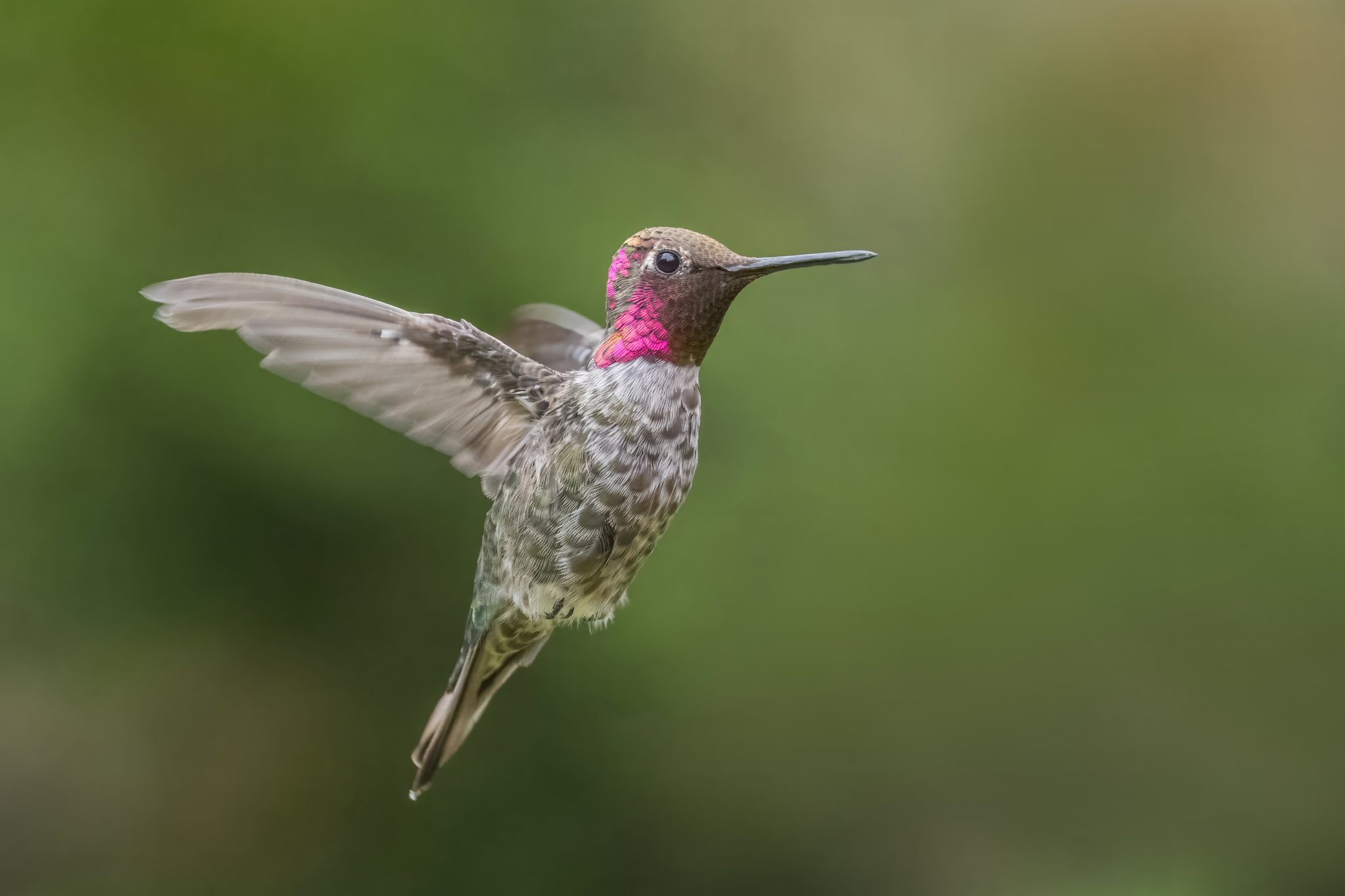
The Anna’s Hummingbird (Calypte anna) is the stocky, big-headed hummingbird of the Pacific Coast — and the only hummingbird that stays all winter from British Columbia to Baja. The male wears a rose-pink helmet (crown plus throat) that blazes in sunlight; the female is green and gray with a small rose patch on her throat. To attract them: keep a red feeder of 4:1 white-sugar water up year-round — and keep it unfrozen in cold snaps — and plant winter bloomers like manzanita and flowering currant. It shares West Coast yards with the Bushtit and the California Scrub-Jay.
Species Physical Profile & Morphometrics
Anna’s Hummingbird is a medium-sized, stocky hummingbird with a relatively big head, a straight black bill, and a short, broad tail that extends past the wingtips at rest. Both sexes are bronze-green above and grayish below; what separates them is how much of the head can catch fire with color.
The identification formula: stocky body + short tail + (on the male) a whole-head rose-pink flash + a scratchy, ongoing song from an exposed perch. The look-alikes along the coast are the Costa’s Hummingbird (male’s purple gorget flares into long side “mustaches,” crown smaller) and the Allen’s and Rufous Hummingbirds (orange-flanked, with a gorget that stops at the throat — never covering the crown). If a hummingbird is at your West Coast feeder in January, it is an Anna’s.
Essential Morphometric Field Marks:
- Body Length & Mass: about 3.9 to 4.3 inches (10–11 cm) and 0.1 to 0.2 ounces (3–6 grams) — noticeably bulkier than the Ruby-throated Hummingbird of the East.
- Wingspan: about 4.7 inches (12 cm); hovering wingbeats run near 50 per second, with the same figure-eight shoulder rotation that lets hummingbirds fly backward.
- Bill Structure & Color: A straight, slender black bill, medium-length for a hummingbird — built for tubular flowers and feeders alike.
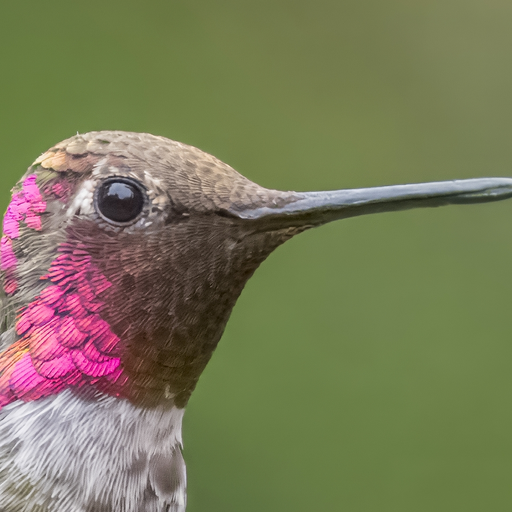
- Color Pattern: The male’s entire crown and gorget are rose-pink iridescent — the only North American hummingbird whose color helmet covers the whole head. The color is structural: tilt the light and it vanishes into gray-brown.
- Male vs. Female: The female is green above, gray below, usually with a small patch of rose feathers at the center of the throat — never a full gorget — and white tips on the outer tail feathers.
The pink-helmeted show-off: rose crown plus gorget, grayish-green belly. He sings a scratchy warble from an exposed perch for minutes at a time, then seals the performance with a 130-foot climb and a 60-mph dive that ends in a loud tail-feather chirp.
The winter architect: quietly green-and-gray with a rose-spotted throat. She alone builds the lichen-covered nest — often starting in December — lays 2 eggs, incubates about two and a half weeks, and raises the chicks solo, sometimes two or three broods a season.
Anna’s Hummingbird Vocalization Guide (3 Field Recordings)
Anna’s is the songbird of the hummingbird world — one of the few North American species with a true, learned song: a long, scratchy, buzzy warble that goes on for minutes. Add the explosive tail-chirp at the bottom of the courtship dive and the sharp “tik” chips, and you have a year-round backyard soundtrack. All three recordings below are real field audio hosted on Wikimedia Commons — no simulations. For a deeper library, browse xeno-canto: Anna’s Hummingbird.
1. The Dive Display
2. The Chaparral Song
3. The Freeze Survivor
Habitat, Range & the Human Landscape
Anna’s Hummingbird owns the Pacific slope: coastal scrub, chaparral, oak woodland, city parks, and above all gardens — anywhere flowers bloom and a feeder hangs. It is more urban-tolerant than any other western hummingbird, thriving from San Diego suburbs to Seattle backyards.

The Coast That Never Loses Its Hummingbirds
The green strip tells the story: year-round along the entire Pacific Coast, with breeding (blue) pushing north to Vancouver Island and inland into Arizona. A century ago this bird bred only in southern California and Baja — feeders and winter-blooming garden plants carried it to British Columbia, one of the great range expansions in North American birding. A few wanderers turn up as far east as the Gulf Coast in winter.
Backyards score best with a clean feeder kept up all year, winter-blooming shrubs, and a mister for bathing. Because the birds never leave, the feeder you hang in November matters more than the one you hang in May.
Backyard Behavioral Patterns & Social Dynamics
Anna’s Hummingbird is the year-round engine of the West Coast yard — a singer, a stunt pilot, and a cold-weather survivor. Four behaviors explain most backyard encounters:
🎤 The Singing Hummingbird
Most hummingbirds only chip and chatter — the male Anna’s sings a true, learned song: a scratchy, buzzy warble that can run for minutes from a bare twig or wire. In coastal neighborhoods it is a genuine dawn-chorus singer, starting in the dark weeks of December.
🤿 The 60-mph Dive
The courtship display is physics made feathers: the male climbs about 130 feet (40 m), then plummets at up to 60 mph — covering some 385 body-lengths per second, the fastest known maneuver of any vertebrate relative to size — and pulls out with an explosive chirp made by air through his tail feathers.
❄️ The Freeze Survivor
On freezing nights an Anna’s drops into torpor — heart rate plunging from over 1,000 beats per minute to a fraction of that — then warms back up at dawn and heads straight for the feeder. It is the trick that lets a tropical family winter in Vancouver.
🏙️ The City Colonist
In the 1930s this bird barely reached San Francisco; today it breeds to British Columbia and winters through most of that range. Ornamental gardens, eucalyptus, and above all year-round sugar-water feeders carried it north — one of the clearest cases of backyard birders redrawing a species’ map.
Problem: “The Feeder Froze Overnight, a Bully Guards It All Day — and in Summer the Nectar Spoils Before I Refill It. Can I Fix That?”
The three most common Anna’s Hummingbird frustrations all have proven answers:
First, the frozen feeder: Anna’s needs dawn calories most on the coldest mornings, so bring the feeder in overnight and hang it back out at first light, or rotate two feeders — one thawing inside, one outside. Wrapping the reservoir with holiday lights or mounting a low-wattage heat lamp nearby also works; never add anything to the nectar itself. Second, the resident bully: a dominant male will guard one feeder all day — the fix is a second feeder around a corner or on another side of the house, out of his sightline. Third, spoiled nectar: sugar water ferments fast — dump, scrub, and refill weekly, and every 2–3 days in hot weather, using hot water and a bottle brush with an occasional 10% bleach rinse for black mold. Solve these three and your yard can hold Anna’s Hummingbirds all twelve months of the year.
Method 1: Mix & Serve Perfect Nectar
Design for a year-round resident that depends on you most in winter:
-
The 4:1 Recipe
Mix 1 part plain white sugar to 4 parts water — ¼ cup of sugar per 1 cup of water — stirred until clear (brief boiling helps it dissolve; cool before filling). This matches the sweetness of the wildflower nectar hummingbirds evolved on.
-
Never Red Dye, Never Honey
Skip red food coloring entirely — the red parts of the feeder itself are all the advertising needed. Honey is dangerous: it grows a fungus that is fatal to hummingbirds. White sugar only — no brown sugar, no raw sugar, no sweeteners of any kind.
-
Hang It Where Winters Stay Mild
Hang the feeder 5–6 feet up in light shade, near shrubs where the birds can perch between sips. In cold climates, a spot sheltered from wind and catching morning sun thaws nectar faster and gives torpid birds an easier first meal.
-
Clean on a Schedule — Even in Winter
Empty, scrub, and refill every week — every 2–3 days in hot weather — and keep the routine through winter, because a year-round bird never stops visiting. A weekly 10% bleach rinse (rinsed thoroughly) keeps black mold out of the feeding ports.
Method 2: Plant a Winter-Blooming Buffet
Feeders win the visit; winter flowers hold the territory:
-
Bloom When Nothing Else Does
The secret to Anna’s is winter bloom: manzanita, flowering currant (Ribes), hummingbird sage, and winter-flowering salvias all open while the rest of the garden sleeps — exactly when a resident hummingbird needs them most.
-
Fill the Rest of the Calendar
Layer in spring-to-fall tubes — penstemon, fuchsia, coral honeysuckle, bee balm, and cape honeysuckle — so something is blooming in every month. Coastal yards that run this relay hold the same birds for years.
-
Leave the Cobwebs and the Fluff
A female builds her December nest from spider silk and plant down — willow fluff, dandelion clocks, seed heads gone soft. Leave a few cobwebs under the eaves and a corner of the garden untrimmed through fall, and she may nest within view of your window.
-
Skip the Pesticides, Add a Mister
Hummingbirds need tiny insects and spiders for protein — nectar alone cannot raise chicks — so a pesticide-free garden feeds them twice. A mister or dripper on foliage gives them the fine spray they prefer for bathing, in every season.
Tool Solution: Recommended Hardware for Anna’s Hummingbirds
Equipment matched to a year-round resident facing winter cold and summer heat:
Red Hummingbird Feeder (with Ant Moat)
A red feeder with a built-in ant moat and bee-proof ports that comes apart easily for scrubbing — the single most-used piece of equipment in a West Coast yard, twelve months a year.
- • Food: 4:1 white-sugar water, no dye, no honey
- • Style: Easy-clean reservoir, ant moat, bee guards
- • Routine: Scrub and refill weekly, year-round
Spare Feeder + Feeder Warmer
A second feeder lets you rotate — one thawing indoors, one serving outside — and a low-wattage warmer or string of holiday lights keeps nectar liquid through hard freezes. The spare also breaks a bully’s monopoly when hung out of his sightline.
- • Winter: Rotate feeders at dawn on freezing days
- • Extras: Feeder warmer or sheltered mount
- • Bonus: Second station ends “hummer wars”
Mister or Shallow Bird Bath
Hummingbirds bathe in fine spray and on wet leaves rather than deep pools — a mister aimed at foliage, or a bath with a very shallow edge, gets daily use even on cool coastal mornings.
- • Depth: Fine spray or under 1 in of water
- • Extras: Timer or dripper for dry spells
- • Placement: Near perching shrubs, in view of flowers
Frequently Asked Questions
- Species Profile: Anna’s Hummingbird (Calypte anna) is a 3.9–4.3 inch, 3–6 gram hummingbird (Trochilidae) of the Pacific Coast — stocky and short-tailed, the male wearing a rose-pink helmet, band code ANHU.
- ID in One Look: Stocky body + short tail + a whole-head pink flash on the male (crown plus gorget); the female is green-and-gray with a rose-spotted throat. A January hummingbird on the West Coast is an Anna’s.
- The Year-Round Resident: The only hummingbird that winters along the entire U.S. Pacific Coast — feeders and winter gardens carried it from southern California to British Columbia in under a century.
- The Sound: A true, learned song — scratchy, buzzy, minutes long — plus “tik” chips and the explosive tail-chirp at the bottom of the 60-mph dive; three real field recordings above.
- Feeder Formula: 4:1 white-sugar water up all year, scrubbed weekly — and kept unfrozen: bring feeders in overnight during freezes or rotate a warm spare at dawn.
- Garden Formula: Winter bloomers (manzanita, flowering currant, hummingbird sage) plus a spring-to-fall bloom relay, no pesticides, spider webs left standing — and a mister for bathing.
Bird Watching Log
Species: Anna’s Hummingbird (Calypte anna)
| Anna’s Hummingbird (Rose Helmet Seen: Yes / No — Feeder Visits: ___ — Dive Display Watched: Yes / No — Song Heard: Yes / No) | |