
Wrentit


Wrentit (Chamaea fasciata): Complete Identification, Habitat Guide & Sound Library
Quick Answer: How to Attract & Identify the Wrentit
The Wrentit (Chamaea fasciata) is the lifelong resident of Pacific chaparral — plain brownish gray with a long cocked tail, a pale eye, and a warm rufous wash on the breast. Its song is a bouncing ping-pong ball — an accelerating series of chips dropping off at the end. It mates for life on a permanent territory and almost never crosses open ground. It eats insects and berries gleaned deep in shrubs. Coastal yards attract them with dense native chaparral plantings. They share the scrub with the Chestnut-backed Chickadee and the Bushtit.
Species Physical Profile & Morphometrics
The Wrentit belongs to its own family — the parrotbill family (Paradoxornithidae) — and is the only member in North America, a sedentary resident of Pacific coastal chaparral from Oregon to Baja.
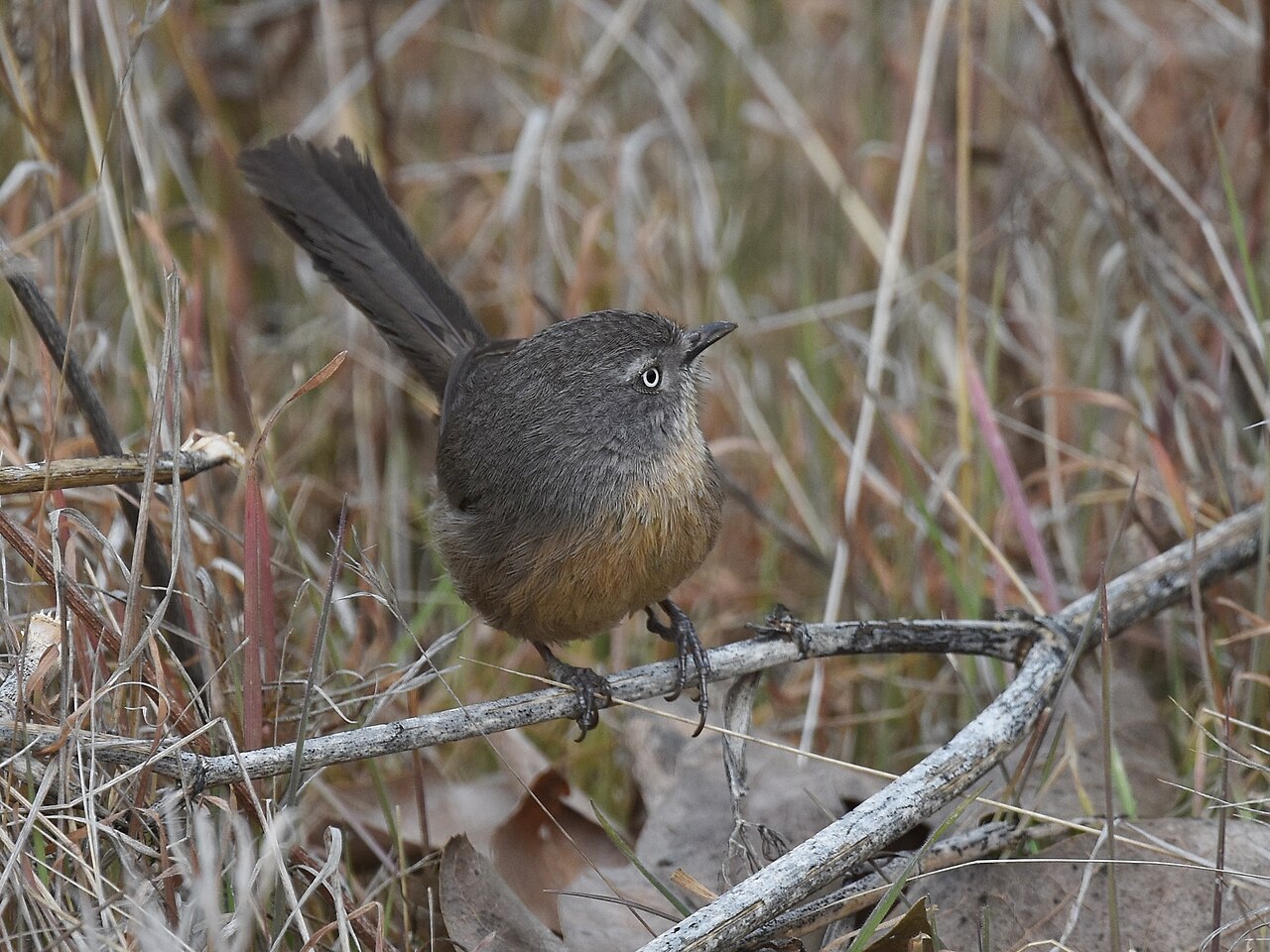
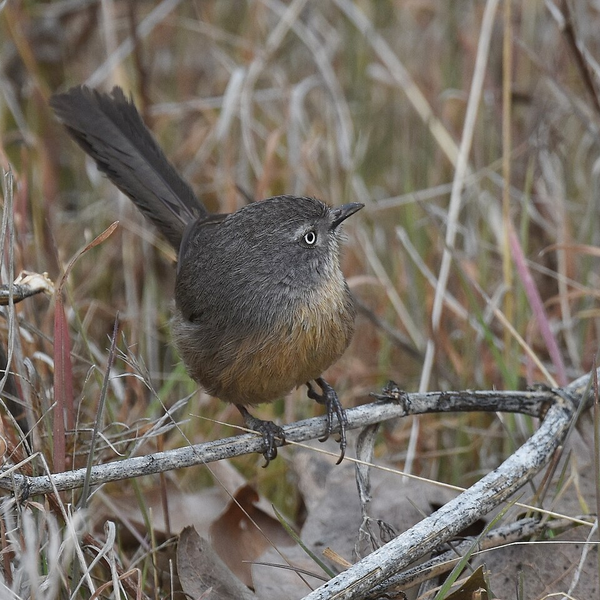
The identification formula: plain brown-gray + long cocked tail + pale eye + chaparral. Bushtits are tinier and travel in flocks; wrens are barred and shorter-tailed; sparrows are streaked. The bouncing-ball song and the pale iris settle any doubt.
Essential Morphometric Field Marks:
- Body Length & Mass: 6.5 inches (16.5 cm) — half of it tail — and 0.4 to 0.6 ounces (12–18 grams).
- Wingspan: Short, rounded wings — built for cover-to-cover dashes, not distance; most Wrentits never fly a mile in their lives.
- Bill Structure & Color: A short, dark, slightly curved bill — parrotbill heritage, sized for insects and small berries.
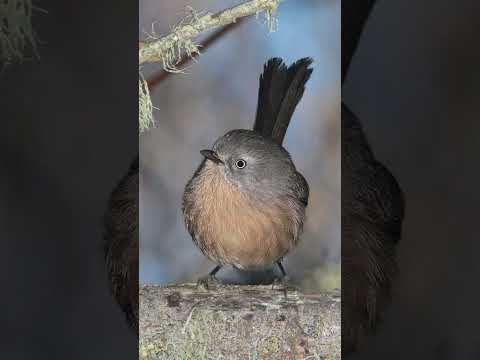
- Color Pattern: Brownish gray above, warm rufous wash below, pale cream iris, and a long tail in constant motion — plain but characterful.
- Male vs. Female: The sexes look alike — both sing, both hold the territory year-round, and pairs stay together for life.
The ping-pong singer: hidden deep in the sage, pouring out an accelerating series of chips that drop off the end of the table.
Identical in plumage — she answers his song from across the territory and weaves the cup nest low in the chaparral.
Wrentit Vocalization Guide (3 Field Recordings)
The Wrentit’s song is a bouncing-ball series — chips accelerating like a ping-pong ball dropping. All recordings below are real field audio via Wikimedia Commons — no simulations. For a deeper library, browse xeno-canto: Wrentit.
1. The Bouncing Ball
2. The Duet
3. The Scolding Churr
Habitat, Range & the Permanent Territory
The Wrentit lives in dense chaparral and coastal sage scrub — coyote brush, ceanothus, sagebrush, and manzanita — from the Columbia River to Baja, almost never leaving the territory where it hatched.

The Homebody of the Hills
Range hugs the Pacific slope from Oregon through California into Baja — resident all year, with individuals often spending their entire lives within a few acres.
For backyard birders: coastal and foothill yards planted with dense native chaparral shrubs can hold a permanent pair — the most loyal tenants in western birding.
Backyard Behavioral Patterns & Social Dynamics
The Wrentit is a sedentary shrub specialist with a marriage record. Four behaviors explain most of what you will observe:
📍 The Lifetime Territory
Pairs hold the same territory for life — banded birds have spent a decade on a few acres of scrub.
🏓 The Ping-Pong Song
The song accelerates and drops like a settling ball — once learned, you will hear it on every coastal hike.
🌿 The Shrub Gleaner
It feeds deep inside shrubs — insects in summer, berries and fruit in winter, rarely showing in the open.
🎤 The Duet Habit
Mates duet across the territory — a lifelong conversation that reinforces the pair bond year-round.
Problem: “How Do I See a Wrentit? What Should I Do?”
The three most common Wrentit puzzles all have proven answers:
First, the invisible singer: Wrentits sing from deep inside shrubs — stand still near the sound, watch the shrub edges, and wait; curiosity brings them to a gap within minutes. Second, the plain-brown doubt: the bird looks unremarkable until the pale eye and long mobile tail register — get close views rather than color clues. Third, the yard that never gets one: Wrentits will not cross lawns or roads — plant connecting corridors of dense native shrubs to wild scrub, and the pair will eventually hop their way in.
Method 1: Set the Table — Dense Native Shrubs
Design for a shrub-bound homebody:
-
Plant Chaparral Natives
Coyote brush, ceanothus, sagebrush, manzanita — the structure a Wrentit territory requires.
-
Build Shrub Corridors
Connect yard plantings to wild scrub — dense hedgerows are the roads a Wrentit travels.
-
Keep the Middle Layer
Shrubs three to eight feet tall — the foraging and nesting zone; lawns and bare beds are dead space.
-
Skip Spring Trimming
No hedge work March through June — nests sit deep in the shrubs at waist height.
Method 2: Build the Habitat — Safety & Year-Round Food
Keep the scrub dense and the predators out, and the pair settles for life:
-
Keep Cats Indoors
Shrub-foragers are cat prey — one indoor cat policy saves your local pair.
-
Leave Berry Shrubs Standing
Toyon, coffeeberry, and elderberry — winter fruit carries the pair through the lean months.
-
Tolerate the Wild Look
Unsheared, layered shrubs — the messy middle layer is the whole habitat.
-
Listen Year-Round
Wrentits sing in every season — the bouncing ball bounces in January too.
Tool Solution: Recommended Hardware for Wrentit
Equipment matched to a chaparral homebody:
Native Chaparral Planting
Coyote brush, ceanothus, and sagebrush in dense layers — the complete Wrentit territory, planted once and permanent.
- • Plants: Native scrub
- • Structure: Dense & layered
- • Bonus: Towhees & thrashers too
Connected Hedgerow
A dense shrub strip linking yard to wild scrub — the road a Wrentit will actually travel.
- • Width: Continuous cover
- • Height: 3–8 feet
- • Bonus: Wrens & sparrows use it
Native Berry Shrubs
Toyon, coffeeberry, elderberry — the winter fruit that carries a sedentary pair through the year.
- • Plants: Berry natives
- • Season: Fall–winter fruit
- • Bonus: Waxwings & robins
Frequently Asked Questions
- Species Profile: The Wrentit (Chamaea fasciata) is a 6.5-inch, 0.4–0.6 ounce songbird (Paradoxornithidae), band code WREN — the voice of the chaparral.
- ID in One Look: Plain brown-gray, pale eye, long cocked tail, deep in the shrubs.
- The Sound: A bouncing ping-pong ball of accelerating chips; real field recordings above.
- Range & Habit: Pacific slope resident, Oregon to Baja; pairs hold territory for life.
- Feeder Formula: Native chaparral and shrub corridors — feeders do not apply.
- The Homebody Record: Many Wrentits live and die within a few acres of their birthplace.
Bird Watching Log
Species: Wrentit (Chamaea fasciata)
| Wrentit (Pale Eye Seen: Yes / No — Bouncing-Ball Song Heard: Yes / No — Duet Heard: Yes / No — Shrub Corridor Present: Yes / No — Date & Time: ___) | |