
Barn Swallow
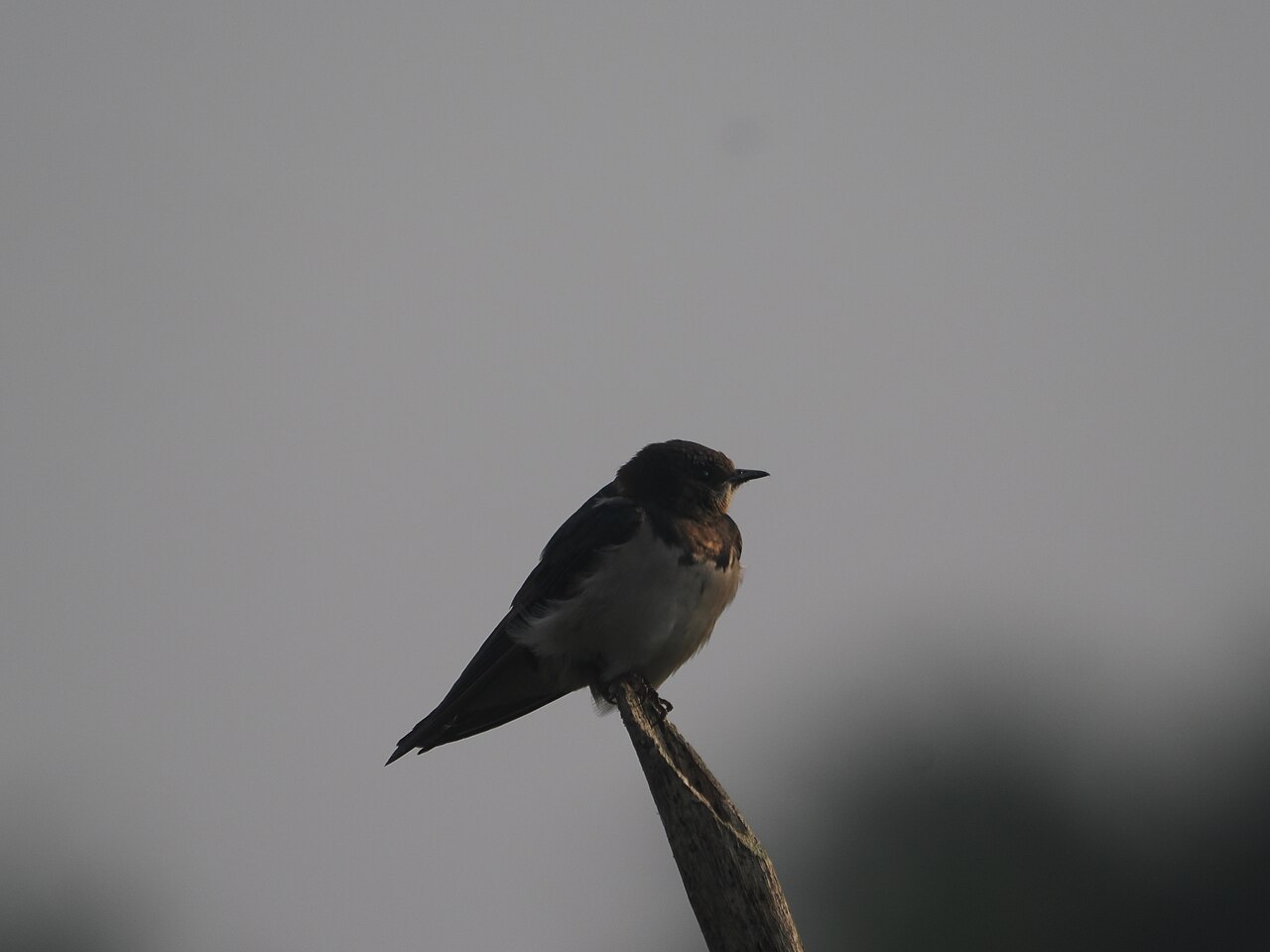
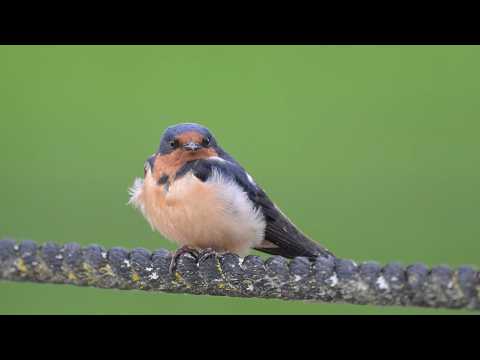


Barn Swallow (Hirundo rustica): Complete Identification, Habitat Guide & Sound Library
Quick Answer: How to Attract & Identify the Barn Swallow
The Barn Swallow (Hirundo rustica) is the fork-tailed swallow of farms and open country worldwide — glossy steel-blue above, cinnamon-buff below, with a rusty throat and a deeply forked tail spotted with white. It feeds entirely on the wing and builds an open mud-cup nest on beams, ledges, and porch ceilings. The voice is a cheerful twittering vit-vit and a rattling song. Yards attract them with open flyways, mud for nest building, sheltered ledges, and insect-rich airspace. They share the sky with the Tree Swallow and the Chimney Swift.
Species Physical Profile & Morphometrics
The Barn Swallow belongs to the swallow family (Hirundinidae) and is the most widespread swallow on Earth — breeding across North America wherever open country, flying insects, mud, and a sheltered ledge come together.
The identification formula: deeply forked tail + glossy blue back + rusty throat. Tree and Violet-green Swallows have squared tails and white underparts; Cliff Swallow wears a pale rump and a squared tail. No other North American swallow carries this deep a fork.
Essential Morphometric Field Marks:
- Body Length & Mass: 5.9 to 7.5 inches (15–19 cm) — much of it tail — and 0.6 to 0.7 ounces (17–20 grams).
- Wingspan: 11.4 to 12.6 inches (29–32 cm); flight is a continuous feeding performance — banks, dips, and glides a few feet over the grass.
- Bill Structure & Color: A tiny black bill opening into an enormous gape — an aerial net for flying insects, rimmed with rictal bristles.
- Color Pattern: Glossy steel-blue back and crown, rusty forehead and throat, cinnamon-buff underparts, and a long forked tail with white windows.
- Male vs. Female: He is glossier with a deeper rusty throat and longer tail streamers; she is slightly duller with a shorter fork — both build and feed.
The long-streamered acrobat: the deepest tail fork and richest rust below, singing his rattling twitter from the wire above the nest.
Slightly shorter-tailed — she shapes most of the mud cup, carries pellets beakful by beakful, and incubates through the warm afternoons.
Barn Swallow Vocalization Guide (3 Field Recordings)
The Barn Swallow’s voice is a cheerful twittering — dry vit-vit calls and a long rattling warble ending in a buzz. All recordings below are real field audio via Wikimedia Commons — no simulations. For a deeper library, browse xeno-canto: Barn Swallow.
1. The Vit-Vit
2. The Rattling Song
3. The Alarm Chatter
Habitat, Range & the Human Partnership
The Barn Swallow lives in open country with structures: farms, suburbs, parks, and wetlands — anywhere with flying insects, a mud source, and a sheltered beam. It almost never nests away from human buildings or bridges anymore.

The Bird That Moved Into Our Buildings
Breeding range covers nearly all of North America from Alaska to Mexico; in fall the entire population funnels south to winter across Central and South America — a round trip of up to 6,000 miles.
For backyard birders: a yard with open lawn, a water source, and a porch or barn overhang can host a nesting pair — and their appetite for mosquitoes and flies is legendary.
Backyard Behavioral Patterns & Social Dynamics
The Barn Swallow is an aerial insect harvester that has tied its nesting life to human architecture. Four behaviors explain most of what you will observe:
🎯 The Wing Feeder
It eats entirely on the wing — flies, beetles, moths, and mosquitoes snatched mid-air, often a few feet above grass or water.
🏺 The Mud Mason
The nest is hundreds of mud pellets carried one beakful at a time and molded into an open cup on a ledge or beam.
🪶 The Six-Thousand-Mile Commute
It winters deep in South America and returns to the same barn each spring — navigating hemispheres to reclaim a beam.
👪 The Colony Tolerance
Unlike most songbirds it nests semi-colonially — several pairs may share one barn, each guarding its own cup.
Problem: “How Do I Live with Barn Swallows? What Should I Do?”
The three most common Barn Swallow puzzles all have proven answers:
First, the droppings problem: do not remove an active nest — instead mount a board or shelf beneath it to catch debris, and relocate the welcome mat, not the birds. Second, the dive-bombing week: parents swoop at cats and people near fledging — it lasts days, not months; give the doorway a wide berth until the young fly. Third, the unwanted site: if a location truly cannot work, block it before nest building starts in spring with netting or a smooth barrier, and offer a better ledge nearby — once eggs are laid, the site is locked by law until the family leaves.
Method 1: Set the Table — Nest Ledges & a Mud Source
Design for a mud-nesting aerialist:
-
Offer a Sheltered Ledge
A beam, shelf, or simple wooden platform under cover — porch ceilings and open barns are classic sites.
-
Provide Mud
A damp clay patch or dripping puddle edge in spring — nest building stops cold without mud pellets.
-
Keep Flyways Open
Uncluttered airspace over lawn or pond — swallows hunt the open lanes, not the shrubbery.
-
Leave an Old Nest
One standing cup invites renovation — the cheapest nest welcome sign you will ever hang.
Method 2: Build the Habitat — Open Sky & Flying Prey
Keep the air full of food and the routes clear, and the pair returns each spring:
-
Skip the Insecticide
Flying insects are 100% of the diet — sprayed yards starve swallows even when the ledge is perfect.
-
Keep a Water Feature
Ponds and drippers concentrate midges — swallow buffet lines form over moving water at dawn.
-
Grow Meadow Margins
Unmowed edges raise beetles and flies — a hayfield margin is a swallow cafeteria.
-
Expect the Return
Same barn, same beam, next spring — site fidelity is strong; host them once and they come back for years.
Tool Solution: Recommended Hardware for Barn Swallow
Equipment matched to a mud-nesting aerial acrobat:
Open Barn or Porch Access
An open door, a beam, and tolerance — the entire infrastructure a Barn Swallow family requires.
- • Site: Sheltered ledge
- • Need: Open flight path
- • Bonus: Free mosquito control
Under-Nest Board
A simple shelf mounted beneath the nest cup — catches droppings and keeps both birds and owners happy.
- • Mount: Below the nest
- • Size: 12-inch shelf
- • When: Before eggs hatch
Pond or Meadow Margin
Moving water and unmowed grass — the flying-insect nursery that feeds a swallow family all summer.
- • Feature: Water + grass
- • Rule: No insecticide
- • Bonus: Martins & swifts too
Frequently Asked Questions
- Species Profile: The Barn Swallow (Hirundo rustica) is a 5.9–7.5 inch, 0.6–0.7 ounce swallow (Hirundinidae), band code BARS — the fork-tailed acrobat of the farm.
- ID in One Look: Deeply forked tail, glossy blue back, rusty throat, cinnamon belly.
- The Sound: Dry vit-vit calls and a rattling twitter song; real field recordings above.
- Range & Habit: Breeds continent-wide on human structures; winters in South America.
- Feeder Formula: Open sky, flying insects, mud, and a sheltered ledge — no seed involved.
- The Old Nest Rule: Leave one cup standing after fledging — next spring’s pair will renovate it.
Bird Watching Log
Species: Barn Swallow (Hirundo rustica)
| Barn Swallow (Forked Tail Seen: Yes / No — Blue Back Seen: Yes / No — Vit-Vit Heard: Yes / No — Mud Nest Active: Yes / No — Date & Time: ___) | |