
Purple Martin
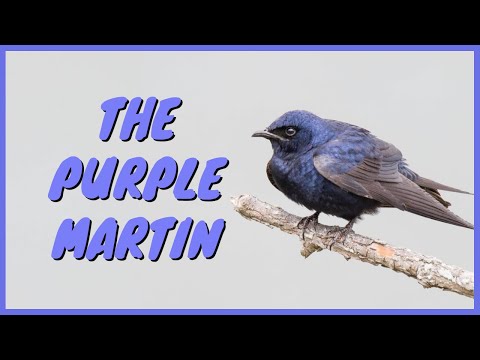


Purple Martin (Progne subis): Complete Identification, Housing Guide & Sound Library
Quick Answer: How to Attract & Identify the Purple Martin
The Purple Martin (Progne subis) is America’s largest swallow — the male glossy blue-black with a purple sheen, the female gray-collared and pale-bellied. East of the Rockies it nests almost entirely in human-provided housing — martin houses and gourds — a partnership centuries old. The song is a rich, gurgling chortle given in flight. It feeds on high-flying insects and winters in the Amazon. Successful landlords offer housing in the open, white paint, and active sparrow and starling control. They share the sky with the Barn Swallow and the Chimney Swift.
Species Physical Profile & Morphometrics
The Purple Martin belongs to the swallow family (Hirundinidae) and is the largest swallow in North America — a colonial cavity nester that, east of the Rockies, depends almost completely on housing people provide.
The identification formula: large swallow size + male all dark glossy blue-purple; female gray collar and dingy belly. Starlings at a martin house are shorter-tailed and speckled; martins are bigger, longer-winged, and glide between flaps.
Essential Morphometric Field Marks:
- Body Length & Mass: 7.5 to 7.9 inches (19–20 cm) and 1.6 to 2.1 ounces (45–60 grams) — twice the bulk of any other swallow on the continent.
- Wingspan: 15.3 to 16.1 inches (39–41 cm); flight alternates powerful flapping with long glides, often high overhead.
- Bill Structure & Color: A small black bill with a broad gape — sized for dragonflies, beetles, and wasps taken at altitude.
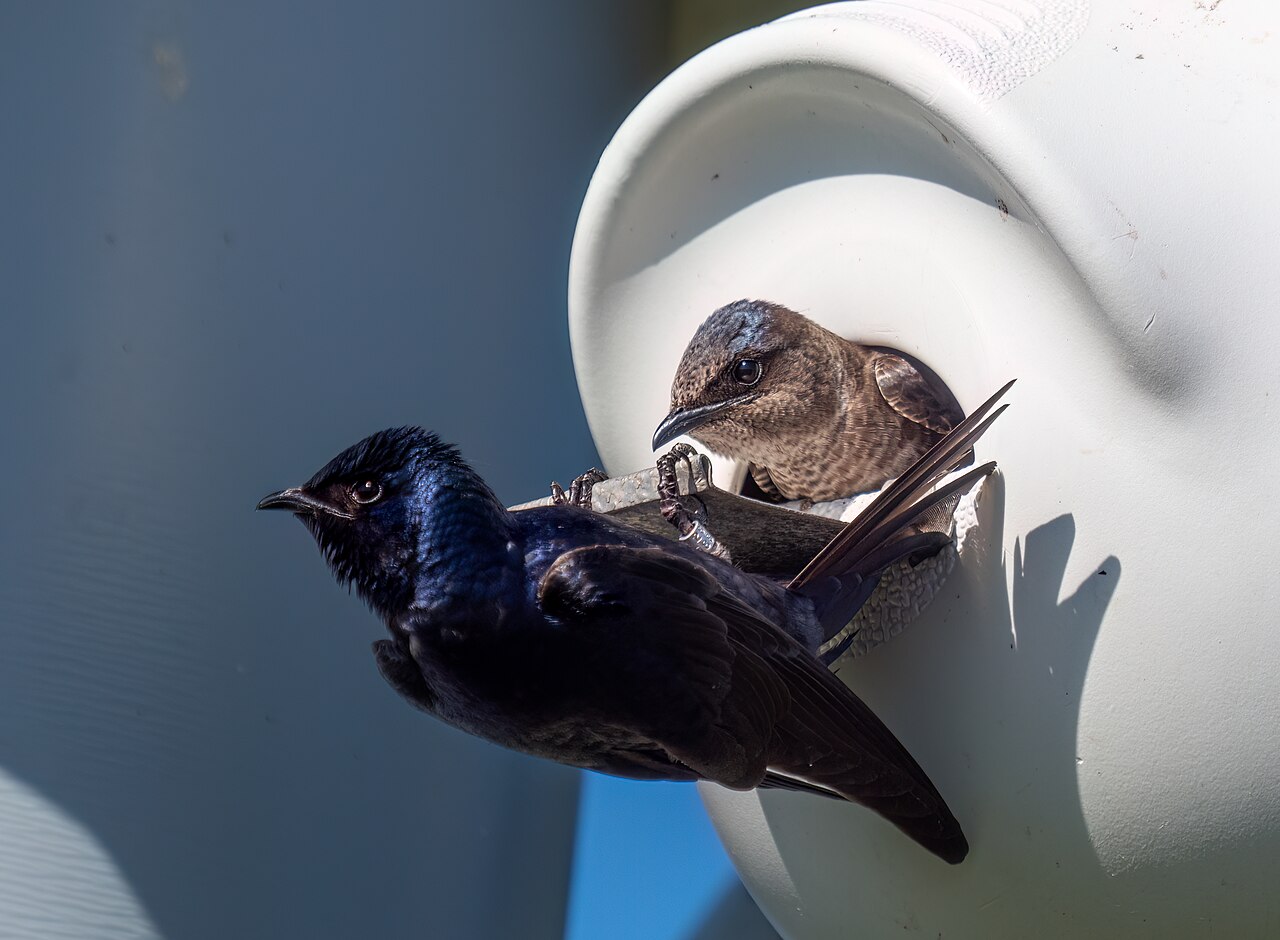
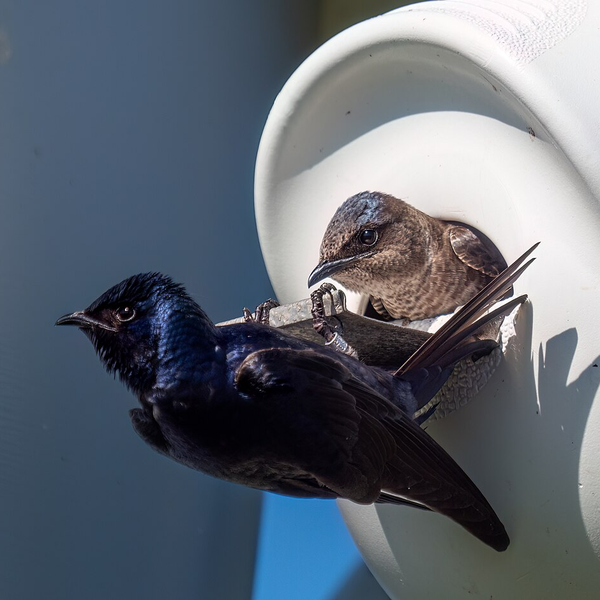
- Color Pattern: Male — uniform glossy blue-black with purple sheen; female — gray collar, dingy white belly, dusky back. Subadult males mix female gray with patches of purple.
- Male vs. Female: Strongly dimorphic — he is all gloss; she is gray-collared and pale below. Both carry nesting material and feed the young.
The glossy landlord’s reward: perched on the house rail at dawn, pouring out gurgling song that carries across the whole property.
Gray-collared and busy — she lines the compartment with green leaves and does the lion’s share of incubation.
Purple Martin Vocalization Guide (3 Field Recordings)
The Purple Martin’s voice is a rich, gurgling chortle — rolling, liquid phrases given in flight and at the house. All recordings below are real field audio via Wikimedia Commons — no simulations. For a deeper library, browse xeno-canto: Purple Martin.
1. The Gurgling Chortle
2. The Dawn Song
3. The Colony Chatter
Habitat, Range & the Landlord Tradition
The Purple Martin lives in open country near water — and, east of the Rockies, almost exclusively where people erect housing. Western birds still use woodpecker cavities in saguaros and snags; eastern birds are the ultimate backyard colonists.

The Bird That Lives in Our Houses
Breeding range covers the eastern half of the continent plus the Pacific coast and desert Southwest; the entire population winters in South America, especially the Amazon basin, returning north as early as January along the Gulf.
For backyard birders: east of the Rockies, a properly sited martin house or gourd rack is the whole habitat — put housing in the open near water and you may host a colony for decades.
Backyard Behavioral Patterns & Social Dynamics
The Purple Martin is a colonial aerialist bound to human housing. Four behaviors explain most of what you will observe:
🏘️ The Colony Life
It nests colonially in multi-room houses and gourd racks — dozens of pairs sharing one structure in noisy harmony.
🎯 The High Feeder
It feeds higher than other swallows — dragonflies, beetles, and wasps taken 150 feet up on long gliding wings.
🌿 The Green Leaf Lining
Nests are lined with fresh green leaves — possibly to regulate parasites; a signature of an active compartment.
🌎 The Amazon Winter
The entire species winters in South America — gathering in roosts of hundreds of thousands before the Amazon commute.
Problem: “Why Won’t Martins Use My House? What Should I Do?”
The three most common Purple Martin puzzles all have proven answers:
First, the wrong location: houses fail when trees or buildings crowd within 40 feet — martins demand open flyways; move the pole to the most open spot you have, ideally within 100 feet of water. Second, the sparrow and starling takeover: both exotics seize housing before martins arrive — keep entrances closed until scouts appear, use crescent starling-resistant holes, and remove exotic nests weekly. Third, the silent house: a colony can take two or three seasons to establish — play dawn-song recordings in spring, keep the housing clean and white, and patience usually wins.
Method 1: Set the Table — Site, Paint & Entrances
Design housing the way a colony chooses:
-
Site in the Open
40+ feet from trees, 10–20 feet up, near water if possible — open flyways are non-negotiable.
-
Paint It White
White housing reflects heat — nestlings survive southern summers only in cool compartments.
-
Use Crescent Entrances
Starling-resistant crescent holes — martins enter; starlings cannot.
-
Time the Opening
Open compartments when scouts arrive — too early invites exotics; too late misses the pioneers.
Method 2: Keep the Colony — Weekly Landlord Habits
An active landlord keeps a colony for decades:
-
Lower Weekly
Telescoping pole checks every 5–7 days — remove House Sparrow nests (legal) and watch nestlings grow.
-
Play the Dawn Song
Martin dawn-song recordings in spring — the proven beacon that draws passing scouts down.
-
Offer Grit & Eggshell
Crushed eggshell or oyster shell on a platform — martins take calcium and grit in the open.
-
Never Give Up Early
New sites often take 2–3 seasons — the first nesting pair usually recruits a colony behind it.
Tool Solution: Recommended Hardware for Purple Martin
Equipment matched to America’s largest swallow:
Martin House or Gourd Rack
A white multi-room house or gourd rack on a telescoping pole, sited in the open — the entire habitat a colony needs.
- • Rooms: 6+ compartments
- • Entrance: Crescent
- • Pole: Telescoping
Dawn Song Recordings
Martin dawn-song playback at first light in spring — the signal that turns flyover scouts into residents.
- • Timing: Pre-dawn
- • Season: Scout arrival
- • Cost: Free recordings
Eggshell & Grit Platform
Crushed eggshell or oyster shell on an open platform — a supplement martins visit on the wing.
- • Offer: Crushed shell
- • Placement: Open platform
- • Bonus: Swallows use it too
Frequently Asked Questions
- Species Profile: The Purple Martin (Progne subis) is a 7.5–7.9 inch, 1.6–2.1 ounce swallow (Hirundinidae), band code PUMA — America’s largest swallow.
- ID in One Look: Male all glossy purple-blue; female gray-collared and pale below; big and long-winged.
- The Sound: Rich gurgling chortles and the famous dawn song; real field recordings above.
- Range & Habit: Breeds continent-wide, winters in the Amazon; eastern birds nest almost entirely in human housing.
- Feeder Formula: Housing in the open, white paint, crescent entrances, and weekly landlord rounds.
- The Landlord Pact: Control starlings and sparrows, and a colony can occupy your yard for decades.
Bird Watching Log
Species: Purple Martin (Progne subis)
| Purple Martin (Colony Active: Yes / No — Glossy Males Count: ___ — Chortle Heard: Yes / No — Sparrow Nests Removed: Yes / No — Date & Time: ___) | |