
Bewick’s Wren


Bewick’s Wren (Thryomanes bewickii): Complete Identification, Feeding & Song Library
Quick Answer: How to Attract & Identify Bewick’s Wrens
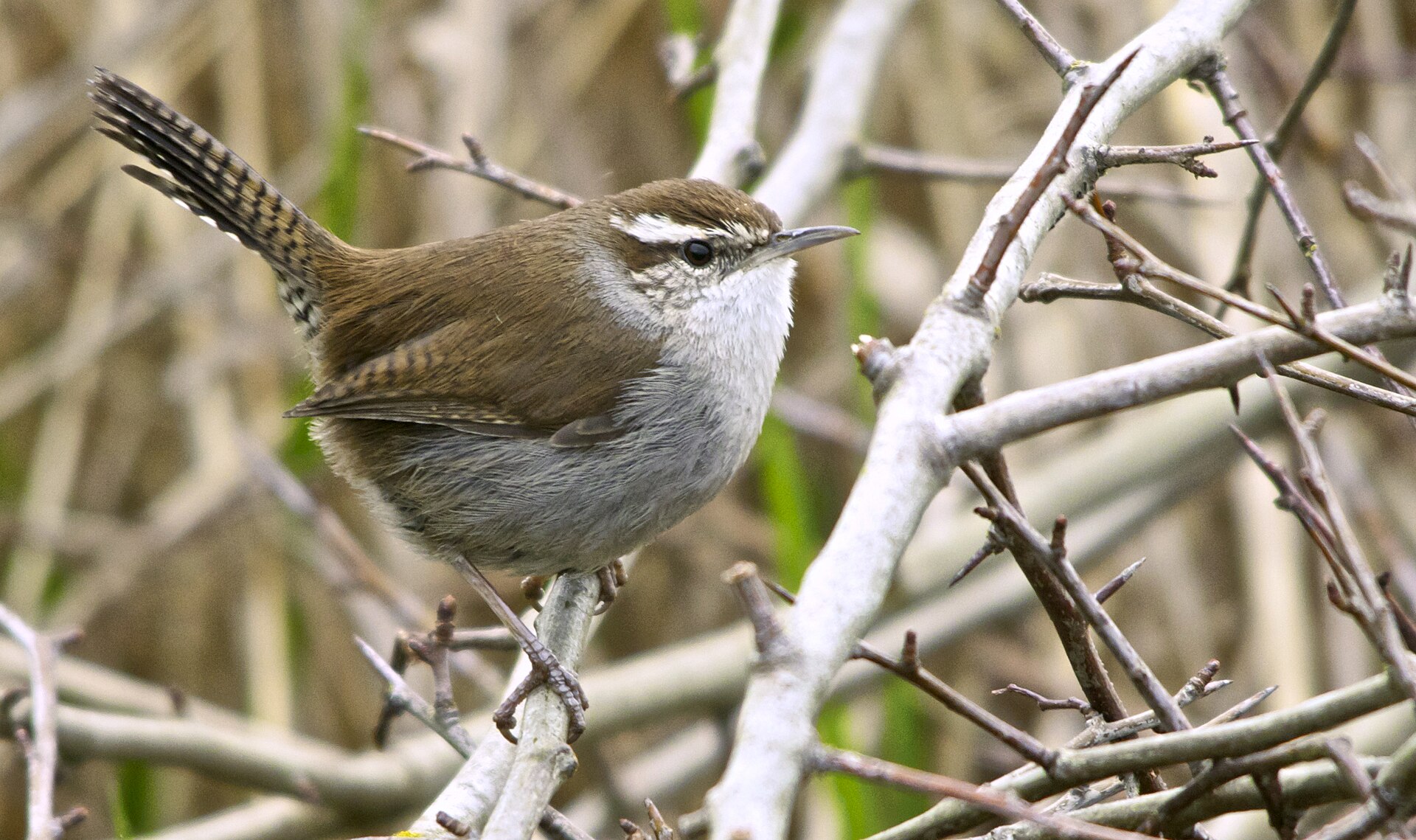
The Bewick’s Wren (Thryomanes bewickii) is the slim brown wren with the bold white eyebrow and the long, white-corners tail — the common backyard wren of western brush, oak woodland, and desert-edge gardens. Look for plain brown upperparts, grayish-white underparts, a striking white eyebrow, and a long tail it constantly flicks. Attract a pair with suet crumbles, mealworms, and sunflower chips on a low tray near a brush pile, plus a small nest box at the yard’s edge. In the East its place is taken by the Carolina Wren and the House Wren.
Species Physical Profile & Morphometrics
The Bewick’s Wren belongs to the wren family (Troglodytidae) and is the characteristic wren of western backyards. Compare the smaller, plainer House Wren (faint eyebrow, short barred tail) and the rustier Carolina Wren (buffy-orange belly, shorter tail, southeastern).
The identification formula: slim + brown over gray-white + bold white eyebrow + long flicking tail with white corners + thin buzzy song. If a wren in a western yard waves a long tail like a tiny mockingbird, you have your answer.
Essential Morphometric Field Marks:
- Body Length & Mass: about 5.1 inches (13 cm) and just 0.3 to 0.4 ounces (8–12 grams) — a slim, long-tailed silhouette rather than the round ball shape of a Carolina Wren.
- Wingspan: about 7.1 inches (18 cm); flight is quick and direct, usually low between shrubs, with the long tail trailing behind.
- Bill Structure & Color: A slim, pointed, slightly downcurved bill, dark above and pale below — longer and finer than a House Wren’s, built for picking spiders from bark crevices.
- Color Pattern: Plain brown above, grayish-white below, with a bold white eyebrow, a dark eye line, and a long brown tail barred with black and tipped with white spots at the corners. Sexes look alike; western coastal birds are darker, desert birds paler and grayer.
- Juveniles & Seasons: Juveniles are duller with a weaker eyebrow and shorter tail; adults look the same in every season, matching their resident lifestyle.
The dialect singer: males learn their songs from neighboring males, so each territory sounds a little different — one bird may know a dozen or more song variations. He sings from fence posts and snag tops through the breeding season and helps defend the pair’s permanent territory.
The nest builder — identical in plumage, she chooses among the cavities the pair’s territory offers and builds the cup of twigs, grass, and feathers herself, laying five to seven speckled eggs. Pairs commonly stay together on the same ground year-round.
Bewick’s Wren Vocalization Guide (3 Field Recordings)
The Bewick’s Wren’s song is a high, thin, buzzy warble of varied phrases — thinner and less explosive than a House Wren’s, more melodic than a chatter. All three recordings below are real field audio, shared under free licenses via Wikimedia Commons — no simulations. For a deeper library, browse xeno-canto: Bewick’s Wren.
1. The Buzzy Warble
2. The Local Dialect
3. Song with Scolds
Habitat, Range & the Backyard Life
The Bewick’s Wren is a bird of brushy, half-open country — oak and pinyon woodland, chaparral edges, overgrown fence lines, and shaded suburban gardens with dense shrubs. It forages low and close to cover, and it readily adopts yards that offer tangles, woodpiles, and cavities.

A Western Bird, an Eastern Story
Today the Bewick’s Wren is a bird of the West: resident along the Pacific coast from British Columbia to Mexico, and through the Southwest and into the southern Great Plains. A century ago it was also common east of the Appalachians — those eastern populations have collapsed and largely vanished, with competition from the spreading House Wren among the suspected causes.
For western backyard birders it is a faithful resident: pairs hold territories year-round, sing from February into summer, and accept nest boxes, flowerpots, and porch ledges with a wren’s characteristic flexibility.
Backyard Behavioral Patterns & Social Dynamics
A resident Bewick’s Wren pair works a yard like a beat — low, quick, and always near cover. Four behaviors explain most of what you will observe:
🪶 The Tail Flicker
The long tail is never still: a Bewick’s Wren flicks, waves, and fans it constantly, flashing the white corners as it hops through brush. The tail is a semaphore — excitement, alarm, and territory display all read in its motion.
🎶 The Neighborhood Dialect
Males learn their songs from the males next door, so each patch of territory carries a local accent, and a single bird may perform many variations. If two yards apart the song sounds different, your ears are not deceiving you.
🕷️ The Crevice Specialist
Watch one work a woodpile or a rough-barked trunk: it probes crevices, curls of bark, and leaf litter for spiders, beetles, and caterpillars, using the slim decurved bill like tweezers. Brush piles and untrimmed corners are its pantry.
🏠 The Flexible Tenant
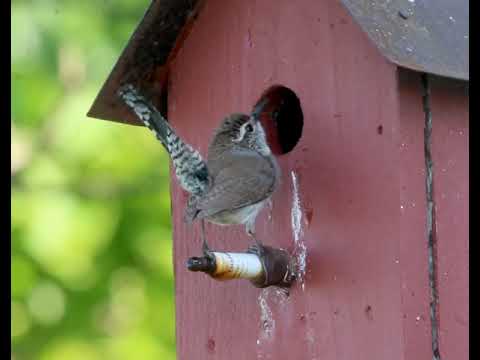
Like its cousins, the Bewick’s Wren nests in natural cavities, nest boxes, flowerpots, boots, and garage shelves. The male may start several nests; the female finishes one with a soft cup. A yard with two or three cavity options is prime real estate.
Problem: “Bewick’s Wrens Used to Nest Here — Now I Only See House Wrens. What Happened?”
If you are east of the Rockies, you are watching one of the best-documented songbird shifts in North America:
Over the last century the House Wren spread east and north as forests were broken into farms and suburbs, and the Bewick’s Wren retreated from most of its eastern range at the same time. House Wrens compete hard for the same cavities — they are documented to pierce eggs and remove nest material of other cavity nesters, including Bewick’s Wrens — and most ornithologists consider that competition a major part of the story, alongside habitat change. If you still have both species, give them separation: place boxes far apart, with the Bewick’s box tucked into denser, brushier cover and the House Wren box at the more open garden edge, and use a 1-1/8 inch entrance to keep starlings and House Sparrows out of both. In the West, where the two species overlap in yards, the same spacing rule keeps the peace.
Method 1: Feeder Setup — Suet Crumbles, Mealworms & Chips
Bewick’s Wrens are insect hunters first; feeders work when they mimic that diet near cover:
-
Hang a Suet Cage by the Brush
A wire suet cage on a trunk or shrub-side hook is the most reliable draw — Bewick’s Wrens cling and chip off bits like miniature woodpeckers. Crumble a little suet onto a stump below for birds that prefer to feed low.
-
Serve Mealworms in a Low Dish
Live or dried mealworms in a shallow covered dish on a low platform near dense shrubs can turn a passing pair into daily visitors — offer them in the morning and keep the dish out of open lawn.
-
Scatter Sunflower Chips Low
In winter, hulled sunflower chips and finely chopped peanuts on a ground tray or stump supplement the insect shortage — wrens take small pieces readily, while whole seeds in tubes go ignored.
-
Smear Peanut Butter in Bark
A trick matched to their foraging style: plain peanut butter pressed into rough bark crevices or a log feeder lets a wren probe for it exactly as it probes for spiders. Small smears, unsalted, refreshed before they dry out.
Method 2: Cover, Cavities & Water
Structure decides whether a pair settles; food only sweetens the offer:
-
Keep One Wild Corner
A brush pile, an untrimmed shrub border, or a stack of old prunings is Bewick’s Wren habitat in miniature — foraging ground, escape cover, and nesting shelter. Big branches on the bottom, fine twigs on top, and leave it alone.
-
Hang a Small-Hole Nest Box
A wooden box with a 1-1/8 to 1-1/4 inch entrance, mounted 5–10 feet up near brushy cover, fits the species exactly and excludes House Sparrows and starlings. Put it up by February; the male may start nests in more than one cavity, which is normal.
-
Leave the Leaf Litter
An unraked layer under shrubs and along fences shelters the spiders and beetles a wren flips leaves to find — the closest thing to wild foraging a yard can offer, especially in winter.
-
Offer Shallow Water Near Cover
A birdbath or ground dish an inch or two deep, beside dense shrubs, brings wrens in to drink and bathe — in dry western summers water can attract birds that ignore every feeder you own.
Tool Solution: Recommended Hardware for Bewick’s Wrens
Equipment matched to a low-foraging, cavity-nesting western wren:
Wren Nest Box (1-1/8 Inch Hole)
A small unpainted wooden box with a 1-1/8 to 1-1/4 inch entrance, mounted near brushy cover — the exact fit for a Bewick’s Wren and too tight for starlings and House Sparrows.
- • Entrance: 1-1/8 to 1-1/4 in
- • Mount: 5–10 ft, brush edge
- • Timing: Up by February
Suet Cage & Mealworm Dish
A wire suet cage hung beside cover plus a shallow dish for mealworms on a low platform — the two feeder foods a Bewick’s Wren reliably accepts, served the low, sheltered way it prefers.
- • Food: Suet, mealworms
- • Style: Cage + covered dish
- • Placement: Low, beside shrubs
Heated Birdbath
A shallow heated bath near dense cover — in the colder parts of the wren’s range, open water through freezes keeps a resident pair close, and it serves every bird in the yard year-round.
- • Depth: 1–2 in, gently sloped
- • Feature: Thermostat-controlled
- • Placement: Beside cover
Frequently Asked Questions
- Species Profile: The Bewick’s Wren (Thryomanes bewickii) is a 5.1-inch, 0.3–0.4-ounce songbird (Troglodytidae), band code BEWR — the slim, long-tailed wren of western brushy yards.
- ID in One Look: Brown above, gray-white below, bold white eyebrow, and a long tail with white corners that flicks constantly — slimmer and longer-tailed than any other yard wren.
- The Sound: A high, thin, buzzy warble in local dialects, like a delicate Song Sparrow — plus flat jit scolds; three real field recordings above.
- Range & Habit: Resident across the West from the Pacific coast to the southern Great Plains; vanished from most of the East over the past century, with House Wren competition among the causes.
- Attraction Formula: Suet cage and mealworm dish near dense cover, sunflower chips on a low tray, a brush pile, leaf litter, a 1-1/8 inch nest box, and shallow water — insects and structure, not seed tubes.
- The Season: On territory year-round in most of the West; boxes up by February, and expect the male to start several nests before the female finishes one.

Bird Watching Log
Species: Bewick’s Wren (Thryomanes bewickii)
| Bewick’s Wren (White Eyebrow Seen: Yes / No — Tail Flicking: Yes / No — Buzzy Song Heard: Yes / No — Brush Pile Used: Yes / No) | |