
Calliope Hummingbird


Calliope Hummingbird (Selasphorus calliope): Complete Identification, Feeder Guide & Migration Handbook
Quick Answer: How to Attract & Identify Calliope Hummingbirds
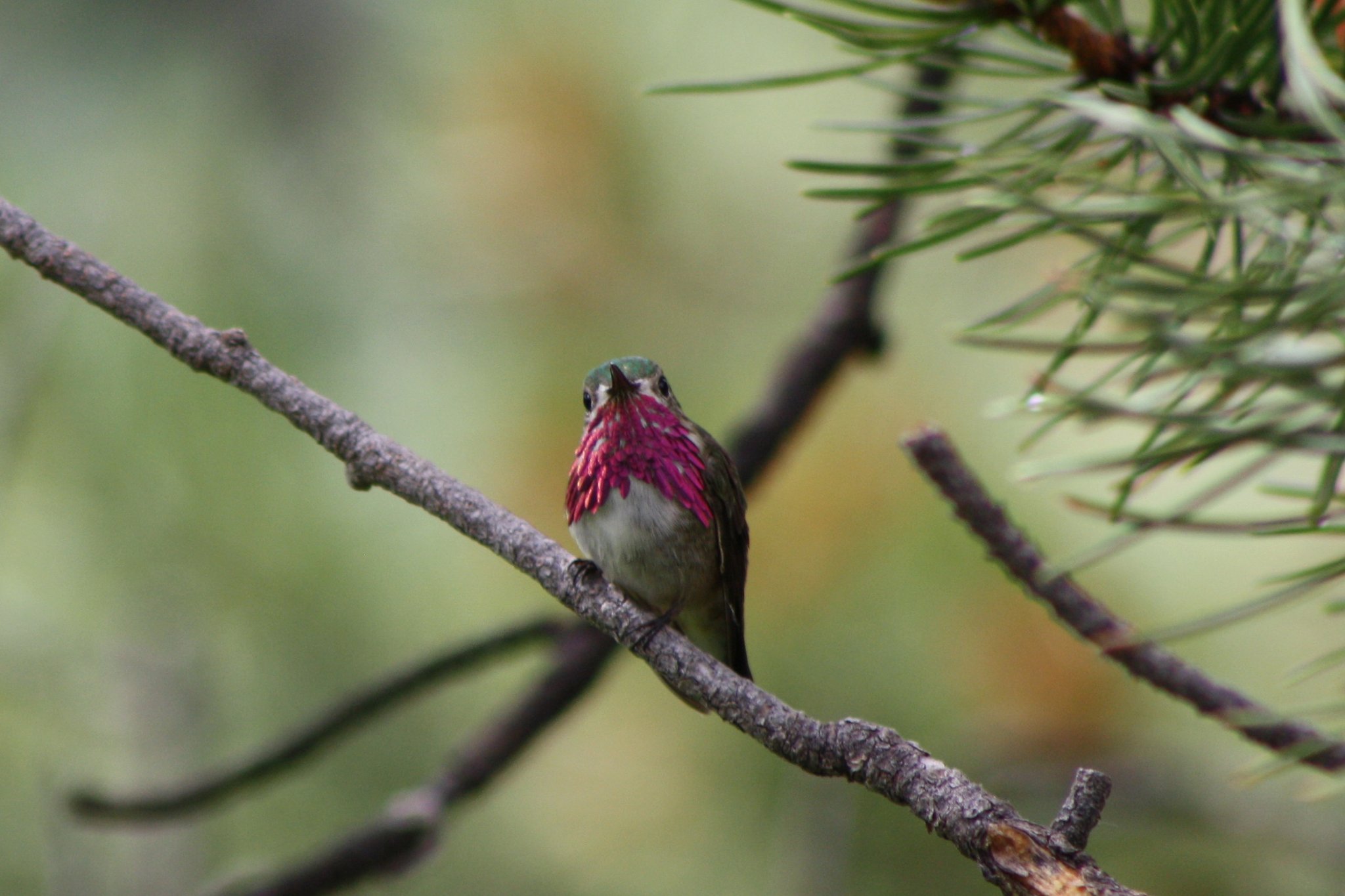
The Calliope Hummingbird (Selasphorus calliope) is the smallest bird in the United States and Canada — a 3-inch, 0.1-ounce sprite of the western mountains that migrates roughly 5,000 miles round trip between mountain meadows in the Rockies and Cascades and the highlands of southwestern Mexico. The male wears a gorget like no other: long magenta-purple streaks fanning across a white throat; the female is emerald above with a peachy wash on her flanks. To attract them: hang red feeders of 4:1 white-sugar water along their migration route — several of them, out of sight of each other — and plant the mountain wildflowers they follow, from Indian paintbrush to penstemon. It shares mountain yards with the Broad-tailed Hummingbird and the Rufous Hummingbird.
Species Physical Profile & Morphometrics
The Calliope Hummingbird is the tiniest member of the hummingbird family (Trochilidae) breeding north of Mexico — compact, short-billed, and short-tailed even by hummingbird standards. John Gould named it for Calliope, the Greek muse of epic poetry — the “beautiful-voiced” one — a generous title for a bird whose real glory is visual.
The identification formula: thumbnail size + short straight bill + green back + (on the male) magenta streaks fanning over a white throat. The genuine look-alike problem is the green-backed female and juvenile, easily confused with female Rufous and Broad-tailed Hummingbirds. The Calliope is smaller and daintier, its flanks washed buffy-peach rather than rusty, and on a perched bird the folded wingtips reach nearly to the end of the short tail — a Rufous carries a longer tail that extends well past the wings.
Essential Morphometric Field Marks:
- Body Length & Mass: about 2.75 to 3.25 inches (7–8 cm) and roughly 0.1 ounce (2.5–3.4 grams) — the smallest breeding bird in the United States and Canada, and the smallest long-distance migrant in the world.
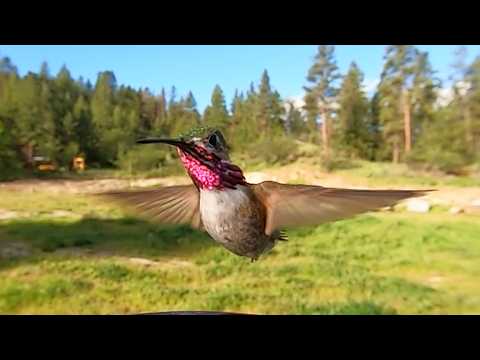
- Wingspan: about 4.1 inches (10.5 cm); flight is light and darting, with a loud wing hum that seems impossible for a bird this size.
- Bill Structure & Color: A short, straight black bill — noticeably stubbier than a Rufous’s — matched to the small tubular wildflowers of mountain meadows.
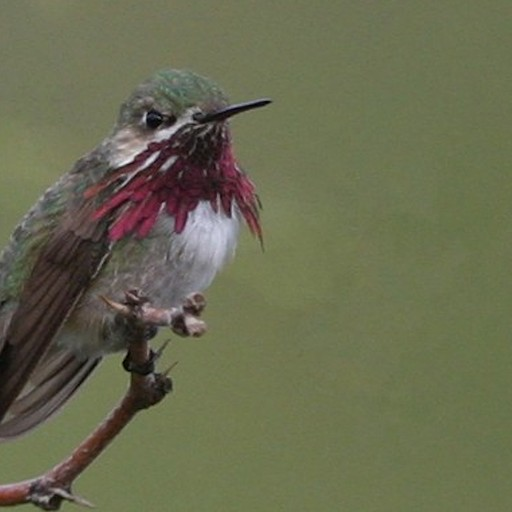
- Color Pattern: Male: iridescent green crown and back, white chest, and the signature gorget of elongated magenta-purple feathers that fan out in separate streaks like a tiny fiery beard; flanks carry a warm buff wash.
- Male vs. Female: The female is green above and whitish below with peachy-buff flanks, a finely speckled throat, and white tips on the outer tail feathers. Juveniles resemble her; young males show their first magenta streaks by late summer.
The streaked flame: green-and-white with that unmistakable whiskered gorget. He arrives on the mountain breeding meadows in April and May, claims a territory, and advertises it with a U-shaped display dive traced in front of females — wings buzzing, magenta streaks flared wide. On migration he feeds low and quiet, easy to overlook among bigger hummingbirds.
The mountain architect: emerald and buff, slightly plainer than her mate. She alone builds the nest — a thimble-sized cup of plant down bound with spider silk and roofed with lichen, usually saddled on a conifer branch — lays 2 eggs, incubates about 15–16 days, and raises the chicks entirely solo.
Calliope Hummingbird Vocalization Guide (3 Field Recordings)
A Calliope has no true song — its soundtrack is the high, thin “tsip” call, the sputtering chatter of chases, and a surprisingly loud wing hum for a bird this small. All three recordings below are real field audio, shared under commercial-use licenses via Wikimedia Commons and iNaturalist — no simulations. For a deeper library, browse xeno-canto: Calliope Hummingbird.
1. The Mountain Voice
2. The Wingbeat Hum
3. The Walla Walla Male
Habitat, Range & the Human Landscape
The Calliope Hummingbird is a bird of the western mountains: open pine and fir forest, aspen groves, willow and alder thickets along mountain streams, and above all wildflower meadows — plus any mountain backyard with a feeder along the route. It winters far to the south, in the pine-oak highlands of Mexico.

Mountain Meadows to the Mexican Highlands
The breeding range (yellow) follows the mountain spine of the West — from southern British Columbia and Alberta down the Cascades and Sierra Nevada and through the northern Rockies. The winter range (blue) lies in the highlands of southwestern Mexico. Between the two, Calliopes run one of migration’s great pound-for-pound feats: north through low-elevation valleys with the early spring bloom, south along high mountain meadows from July to September — roughly 5,000 miles round trip on a body that weighs less than a nickel.
Backyards score best along the migration corridor: valley yards catch the northbound wave in April and May, and mountain and foothill yards — especially in the Southwest — host the southbound flood in August and September.
Backyard Behavioral Patterns & Social Dynamics
The Calliope packs a continental migration into the smallest body of any bird on the continent. Four behaviors explain most backyard encounters:
🏅 The Smallest Long-Hauler
The Calliope is the smallest long-distance migrant in the world: a bird of about 3 grams flying roughly 5,000 miles round trip every year between Rocky Mountain meadows and the Mexican highlands. Ounce for ounce, few journeys in the bird world compare.
🎭 The Streaked-Gorget Display
A courting male flares his magenta streaks into a glowing fan and launches into a U-shaped display dive in front of a female, wings adding a sharp buzzy “zing” at the bottom of the swoop. Watch a perched male tilt his head — the streaks ignite from black to magenta with the angle of light.
🥶 The Torpor Trick
Mountain nights on migration regularly drop below freezing — lethal for a bird this small without torpor: a controlled shutdown in which body temperature and heart rate plunge, saving enough energy to greet the dawn, and the feeder, alive. A puffed-up, motionless Calliope at daybreak is not sick; it is rebooting.
🌸 The Quiet Trapliner
Unlike the brawling Rufous, a Calliope often feeds by traplining — working a quiet circuit of flowers and feeders on a repeatable schedule, staying low and slipping in when the local tyrant is busy chasing someone else. Learn its circuit and you can set your watch by it.
Problem: “A Thumb-Sized Green Hummingbird Visited My Feeder for Two Days and Vanished. Was It a Baby?”
The three most common Calliope Hummingbird puzzles all have proven answers:
First, the “baby hummingbird” misidentification: no hummingbird species visits feeders as a dependent baby — that tiny green bird is a full-grown adult, and in the West a suspiciously small one is very likely a Calliope. Confirm it with size (barely 3 inches), the short bill, the buffy — not rusty — flank wash, and folded wingtips that reach the end of the tail. Second, the vanishing act: Calliopes are passage migrants for most yards, present for days or weeks each spring and fall rather than all season — that is normal, not a failure; keep feeders fresh through both corridor windows (April–May and July–September) and your yard may become a scheduled stop on next year’s circuit. Third, the bully problem: a resident Rufous or Anna’s will run a Calliope off a single feeder every time — hang two or three feeders around corners and on different sides of the house, so the little trapliner always has an unguarded option. Add the usual nectar hygiene — dump, scrub, and refill weekly, and every 2–3 days in hot weather — and your yard becomes a dependable fuel stop on the smallest great migration on Earth.
Method 1: Mix & Serve Perfect Nectar
Design for the smallest long-distance migrant on Earth — it arrives hungry and remembers everything:
-
The 4:1 Recipe
Mix 1 part plain white sugar to 4 parts water — ¼ cup of sugar per 1 cup of water — stirred until clear (brief boiling helps it dissolve; cool before filling). This matches the sweetness of the wildflower nectar hummingbirds evolved on.
-
Never Red Dye, Never Honey
Skip red food coloring entirely — the red parts of the feeder itself are all the advertising needed. Honey is dangerous: it grows a fungus that is fatal to hummingbirds. White sugar only — no brown sugar, no raw sugar, no sweeteners.
-
Time It to the Corridor
Get feeders up before each migration wave — by early April in western valleys and by early July in mountain and foothill yards — and hang two or three out of sight of each other. A Calliope that fuels up safely at your yard once will list it as a stop for years.
-
Clean on a Schedule
Empty, scrub, and refill every week — every 2–3 days in hot weather — whether or not the feeder looks empty. High-altitude sun ferments nectar fast; a weekly 10% bleach rinse (rinsed thoroughly) keeps the ports mold-free.
Method 2: Plant the Mountain Meadow Garden
Feeders win the visit; the right bloom dates hold the route:
-
Early Bloomers for the Northbound Wave
The spring migration rides the first tubular blooms of the year through the valleys: flowering currant, columbine, coral honeysuckle, and penstemon. A yard that blooms in April and May catches the males pushing north toward the breeding meadows.
-
Late Bloomers for the Southbound Rush
The fall migration rides the mountain-meadow bloom: Indian paintbrush, scarlet gilia, penstemon, larkspur, and bee balm. July-to-September flowers catch the southbound flood — males first, then a second wave of females and juveniles.
-
Leave the Cobwebs and the Fluff
Nesting females build from spider silk and plant down — willow fluff, dandelion clocks, thistledown — and camouflage the cup with lichen. Leave eave cobwebs standing and a patch of seed heads untrimmed, and a female may saddle her thimble-sized nest on a conifer branch within view of your window.
-
Skip the Pesticides, Add a Mister
Hummingbirds need tiny insects and spiders for protein — nectar alone cannot raise chicks — so a pesticide-free garden feeds them twice. On hot afternoons a mister on foliage draws them in to bathe between feeding circuits.
Tool Solution: Recommended Hardware for Calliope Hummingbirds
Equipment matched to the smallest long-distance migrant — and the bigger birds that bully it:
Red Hummingbird Feeder (with Ant Moat)
A red feeder with a built-in ant moat and bee-proof ports that comes apart easily for scrubbing — the fuel station a migrating Calliope will pencil into its 5,000-mile route year after year.
- • Food: 4:1 white-sugar water, no dye, no honey
- • Style: Easy-clean reservoir, ant moat, bee guards
- • Routine: Scrub and refill weekly — sooner in heat
Second & Third Feeders (Out of Sight)
The only reliable answer to Rufous and Anna’s bullying: spare feeders hung around corners and on different sides of the house, so a tiny Calliope always has an unguarded port. Window-mounted versions double as close-up viewing stations.
- • Placement: Out of sight of the main feeder
- • Style: Window-mount for close viewing
- • Effect: Gives small species a safe fuel stop
Mister or Shallow Bird Bath
Hummingbirds bathe in fine spray and on wet leaves rather than deep pools — a mister aimed at foliage, or a bath with a very shallow edge, gets heavy use from thirsty migrants on hot mountain afternoons.
- • Depth: Fine spray or under 1 in of water
- • Extras: Timer or dripper for dry spells
- • Placement: Near perching shrubs, in view of flowers
Frequently Asked Questions
- Species Profile: The Calliope Hummingbird (Selasphorus calliope) is a 2.75–3.25 inch, 2.5–3.4 gram hummingbird (Trochilidae) of the western mountains — the smallest bird in the United States and Canada, band code CAHU.
- ID in One Look: Thumbnail size + short bill + green back; the male’s magenta-purple streaked gorget over a white throat is unique. Perched wingtips reach the end of the short tail — the key to separating green-backed birds from female Rufous.
- The Record Migration: The smallest long-distance migrant in the world — roughly 5,000 miles round trip between western mountain meadows and the Mexican highlands, with no wintering in the United States.
- The Sound: No true song — thin “tsip” calls, sputtering chase chatter, a buzzy display “zing,” and a loud wing hum; three real field recordings above.
- Feeder Formula: 4:1 white-sugar water, no dye and no honey, scrubbed weekly — and two or three feeders hung out of sight of each other, so this tiny trapliner can eat despite Rufous bullies.
- Garden Formula: Plant the corridor — columbine and currant for spring, paintbrush and penstemon for fall — no pesticides, cobwebs and lichen left standing, and a mister for bathing.
Bird Watching Log
Species: Calliope Hummingbird (Selasphorus calliope)
| Calliope Hummingbird (Magenta Streaks Seen: Yes / No — Feeder Visits: ___ — Tiny Size Noted: Yes / No — Tail Past Wingtips: Yes / No) | |