
Scarlet Tanager
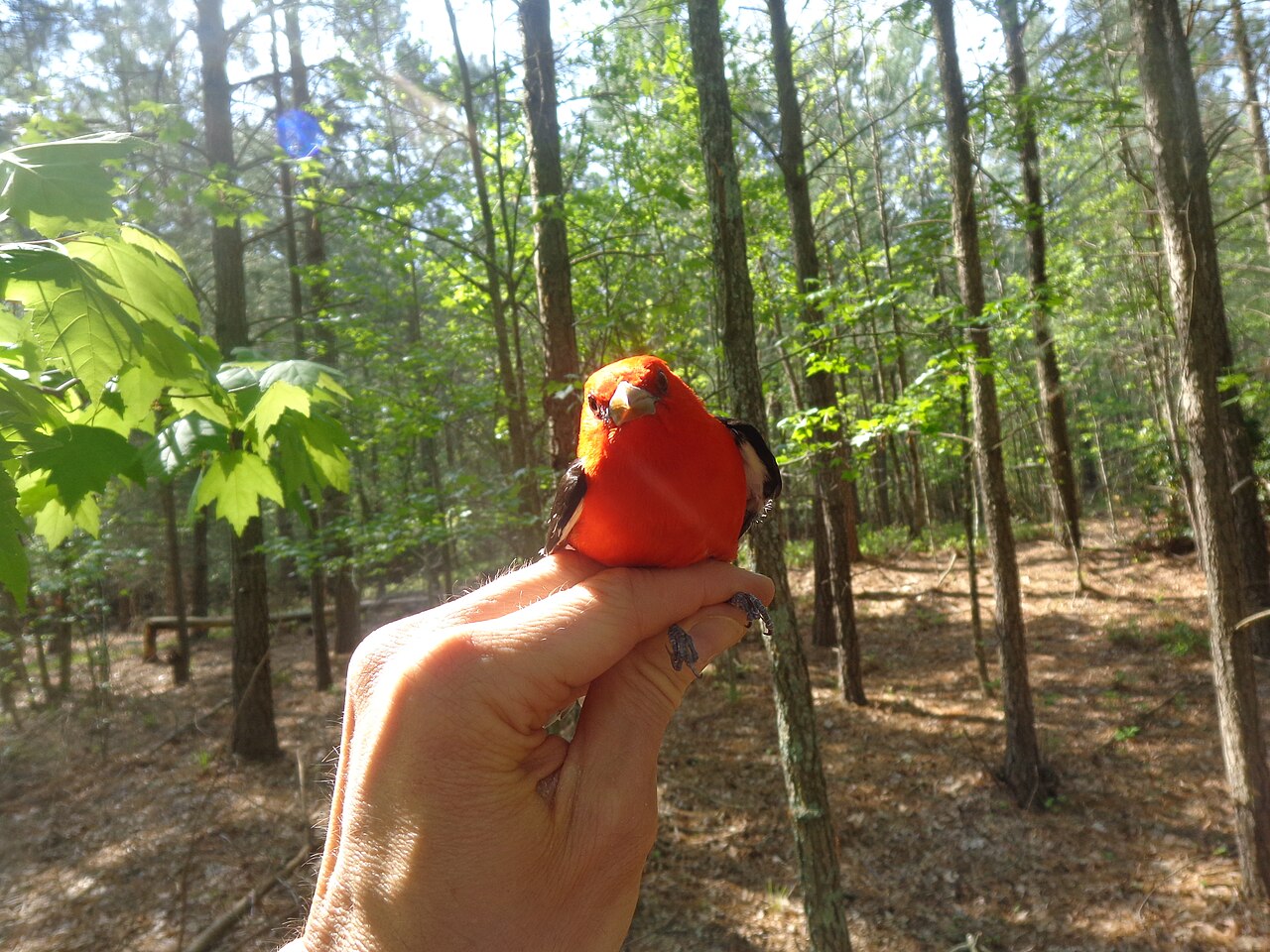


Scarlet Tanager (Piranga olivacea): Complete Identification, Habitat Guide & Song Library
Quick Answer: How to Attract & Identify the Scarlet Tanager
The Scarlet Tanager (Piranga olivacea) is the most stunning color combination in the eastern forest — a breeding male is blood-red with jet-black wings and tail — yet it lives high in the canopy where it stays maddeningly hard to see. The female is yellow below, olive above; fall males molt to her colors but keep the black wings. The song is a burry, robin-like caroling — a robin with a sore throat — and the call is a distinctive chick-burr. Eastern yards adjoining mature forest can attract them with moving water, fruiting shrubs, and spray-free trees. They summer alongside the Yellow-rumped Warbler and the Northern Cardinal.
Species Physical Profile & Morphometrics
The Scarlet Tanager belongs to the cardinal family (Cardinalidae) — DNA studies moved the Piranga tanagers out of the true tanagers, which explains the thick bill and rich song. It breeds across the eastern deciduous forest and winters in the northwestern Andes of South America.
The identification formula: red body + jet-black wings and tail. The Summer Tanager male is red everywhere including the wings; the Northern Cardinal has a crest and black face; only the Scarlet pairs a scarlet body with black wings. Females are yellowish below and olive above with dark wings and no strong wing bars — and fall males, molting green, still flash those black wings in flight.
Essential Morphometric Field Marks:
- Body Length & Mass: 6.3 to 7.5 inches (16–19 cm) and 0.8 to 1.3 ounces (23–38 grams) — robin-built but sleeker, with a big-headed, thick-necked look.
- Wingspan: 9.8 to 11.4 inches (25–29 cm); flight is swift and direct, with deliberate hops and short sallies among high canopy branches.
- Bill Structure & Color: A thick, rounded, pale horn-colored bill — heavier than a warbler’s, finer than a cardinal’s — built for snatching insects and crushing berries.
- Color Pattern: Breeding male: scarlet body, jet-black wings and tail. Female: yellow below, olive above, dark wings. Fall male: female-green body but the wings and tail stay black — the definitive giveaway.
- Male vs. Female: The sexes are so different that beginners log them as two species — scarlet-and-black versus yellow-and-olive — and both sing: she answers softly from the nest, a low cup on a high horizontal branch.
The canopy flame: blood-red body between jet-black wings, singing burry phrases from the top of a mature oak — a bird more often heard than seen, and unforgettable when the light finally finds him.
The quiet olive half — yellow below, olive above, slipping through the foliage to the nest: a shallow saucer of twigs and stems on a horizontal limb, twenty to fifty feet above the forest floor.
Scarlet Tanager Vocalization Guide (3 Field Recordings)
The Scarlet Tanager’s song is a burry, robin-like caroling — short phrases with a husky, tired edge, as if a robin had a sore throat — and the signature call is a brisk chick-burr. All recordings below are real field audio via Wikimedia Commons — no simulations. For a deeper library, browse xeno-canto: Scarlet Tanager.
1. The Burry Caroling
2. The Chick-Burr Call
3. Dawn Song in the Oaks
Habitat, Range & the Forest Canopy
The Scarlet Tanager breeds in mature deciduous and mixed forest: big oak, maple, beech, and hickory woods across the East, plus forested parks and large wooded lots. It is a forest-interior bird — territories need unbroken canopy — so it favors yards adjoining extensive mature woods rather than isolated trees.

The Eastern Canopy’s Hidden Flame
The breeding range covers the eastern deciduous forest — from the southern Great Lakes and southern New England south to the Gulf states, west through the Ohio Valley to the edge of the Great Plains. Winter takes the entire population to northwestern South America, mostly the forested foothills of the Andes.
For backyard birders: May through August, any yard backing onto large mature woods can host a singing male — and during May and September migration, fruiting trees and dripping water in even modest suburban lots pull tired travelers down from the sky.
Backyard Behavioral Patterns & Social Dynamics
The Scarlet Tanager is a canopy insect-hunter with feeder potential — a forest bird that rewards the patient yard. Four behaviors explain most of what you will observe:
🐛 The High Forager
Tanagers hunt insects among canopy leaves — caterpillars, beetles, bees, and wasps gleaned from foliage or snatched in short sallies — moving deliberately along horizontal limbs, easy to overlook at eighty feet up.
🎵 The Hoarse Robin
The song so resembles a tired American Robin’s that birders separate them by ear: the tanager’s phrases are shorter, huskier, and evenly burry — and they come from high in mature oaks where robins rarely sing.
🍒 The Fruit Switch
In late summer and migration, tanagers shift heavily to fruit — mulberries, cherries, dogwood berries, and pokeweed — and passage birds drop into yard fruit trees, sometimes at eye level.
🌳 The Forest-Interior Need
Pairs defend territories in large unbroken tracts of mature forest — fragmentation by cowbird-friendly edges is the species’ chief threat — so a big-woods backyard is the surest habitat gift.
Problem: “I Hear the Burry Song but the Red Bird Never Shows Itself. What Should I Do?”
The three most common Scarlet Tanager puzzles all have proven answers:
First, the canopy ghost: tanagers sing from high fixed perches and sit motionless — learn the chick-burr call, scan horizontal limbs just inside the leaf line at dawn, and check the canopy edge over clearings where sunlight reaches. Second, the feeder question: they are not seed birds — a dripping or misting water feature is the strongest draw, with fruiting natives (mulberry, wild cherry, dogwood) the close second, most effective during May and September passage. Third, the wrong-colored bird: from August on, males are green-and-yellow with black wings — trust the wings; black wings and tail on a green tanager-shaped bird is still a Scarlet, and logging it correctly is half the fun.
Method 1: Set the Table — Moving Water & the Fruit Pantry
Design for a canopy insect-eater that loves fruit on passage:
-
Run a Dripper or Mister
Moving water — a dripper or mister on a bath near shrub cover — is the single most reliable way to pull a passage tanager down into the open, especially at dawn.
-
Plant Native Fruit Trees & Shrubs
Mulberry, wild black cherry, flowering dogwood, elderberry, and pokeweed — the late-summer fruit that fuels the flight to the Andes, and the reason migrants visit yards at all.
-
Keep Flying Insects Plentiful
The summer pantry is the air: skip yard fogging and broad insecticides — a canopy rich in caterpillars, bees, and beetles is what breeding birds actually need.
-
Offer Oranges During Passage
In May cold snaps, orange halves on spikes — the oriole setup — occasionally tempt a grounded tanager when insects are scarce; worth a try in migration weeks.
Method 2: Build the Habitat — Mature Canopy & Water
Feed the canopy, and the flame returns each May:
-
Preserve Mature Oaks & Maples
Territories center on large veteran trees in unbroken canopy — protect the oldest trees on your lot and the forest edge adjoining it; canopy takes a lifetime to replace.
-
Keep the Mid-Story Connected
Tanagers move between canopy and mid-story along connected horizontal limbs — resist over-thinning; layered structure is nest and forage space.
-
Watch the Passage Windows
Late April–May and August–September: keep the water dripping, fruit shrubs standing, and binoculars by the window — passage birds concentrate on cool, wet mornings.
-
Leave Leaf Litter Under Trees
Fallen leaves feed the caterpillars and beetles that tanagers harvest all summer — a tidy-to-the-bone yard is a pantry with empty shelves.
Tool Solution: Recommended Hardware for Scarlet Tanager
Equipment matched to a canopy fruit-and-insect specialist:
Bath with Dripper or Mister
Moving water audible from the canopy — the proven way to bring a singing or migrating tanager down to eye level.
- • Feature: Dripper or mister
- • Placement: Near shrub edge
- • Times: Dawn & dusk
Orange & Jelly Feeder
A cup-and-spike fruit feeder for May cold snaps and September passage — worth running through the migration windows.
- • Food: Orange halves, jelly
- • Style: Cup & spike feeder
- • Peak: Migration weeks
Native Fruiting Trees
Mulberry, wild cherry, dogwood, elderberry — the late-summer fuel for the flight to South America.
- • Plants: Cherry, dogwood, mulberry
- • Season: Late summer–fall
- • Bonus: Thrushes & waxwings too
Frequently Asked Questions
- Species Profile: The Scarlet Tanager (Piranga olivacea) is a 6.3–7.5 inch, 0.8–1.3 ounce cardinal-family songbird (Cardinalidae), band code SCTA — the scarlet-and-black flame of the eastern canopy.
- ID in One Look: Breeding male: red body, jet-black wings and tail; female: yellow-olive with dark wings; fall male: green body, black wings — trust the wings.
- The Sound: Burry, robin-like caroling from high canopy perches, plus the brisk chick-burr call; real field recordings above.
- Range & Habit: Breeds in mature eastern deciduous forest; winters in the Andean foothills of South America; a yard bird mainly in May and September passage.
- Feeder Formula: Dripping water, native fruiting trees, spray-free canopy, and orange halves in cold-snap migration weeks.
- The Hidden Flame: More often heard than seen — learn the chick-burr call and the canopy will start giving up its scarlet secret.
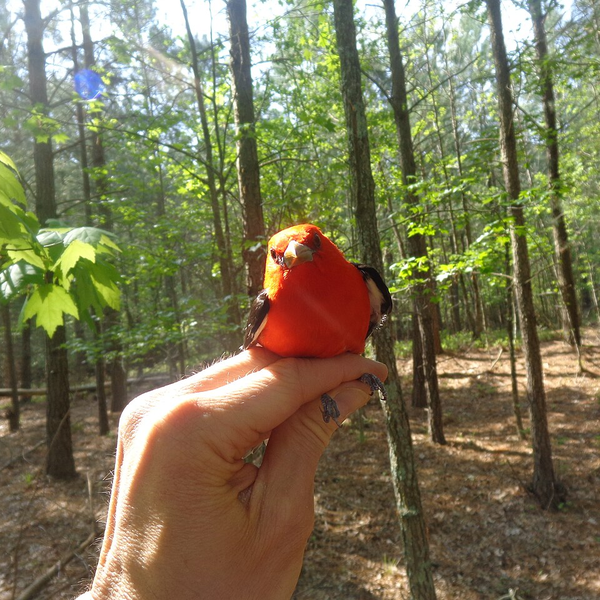
Bird Watching Log
Species: Scarlet Tanager (Piranga olivacea)
| Scarlet Tanager (Male Scarlet / Female Olive / Fall Green — Song Heard: Yes / No — Chick-Burr Heard: Yes / No — At Water: Yes / No — Date & Time: ___ — Weather Front: Yes / No) | |