
Boat-tailed Grackle


Boat-tailed Grackle (Quiscalus major): Complete Identification, Habitat Guide & Sound Library
Quick Answer: How to Attract & Identify the Boat-tailed Grackle
The Boat-tailed Grackle (Quiscalus major) is the big grackle of the Atlantic and Gulf coasts — the male glossy blue-black with a huge boat-shaped tail; the female half his size and rich brown. Coastal birds wear dark eyes; Florida birds wear yellow. The voice is a harsh jeeb-jeeb and clattering display calls. It lives in salt and brackish marshes, docks, and beach towns year-round. At feeders it takes corn and sunflower from platforms — manage with weight-sensitive feeders if flocks dominate. Compare with the inland Great-tailed Grackle and the eastern Common Grackle.
Species Physical Profile & Morphometrics
The Boat-tailed Grackle belongs to the blackbird family (Icteridae) and is a year-round resident of Atlantic and Gulf coastal marshes — from Long Island around Florida to Texas, never far from salt water.
The identification formula: coastal address + boat-folded tail + big iridescent male. The Great-tailed Grackle is inland-southwestern with a longer keel tail and bright yellow eye everywhere; coastal Boat-tails show dark eyes except in Florida, where both species can share a dock.
Essential Morphometric Field Marks:
- Body Length & Mass: Males 14.6 to 16.5 inches (37–42 cm) and 5.6 to 8.8 ounces (160–250 grams) — females half the size at 10 to 13 inches.
- Wingspan: 15.4 to 19.7 inches (39–50 cm); flight is strong and level, the boat tail trailing wide.
- Bill Structure & Color: A long, heavy black dagger bill — omnivore hardware for crabs, insects, grain, and picnic scraps.
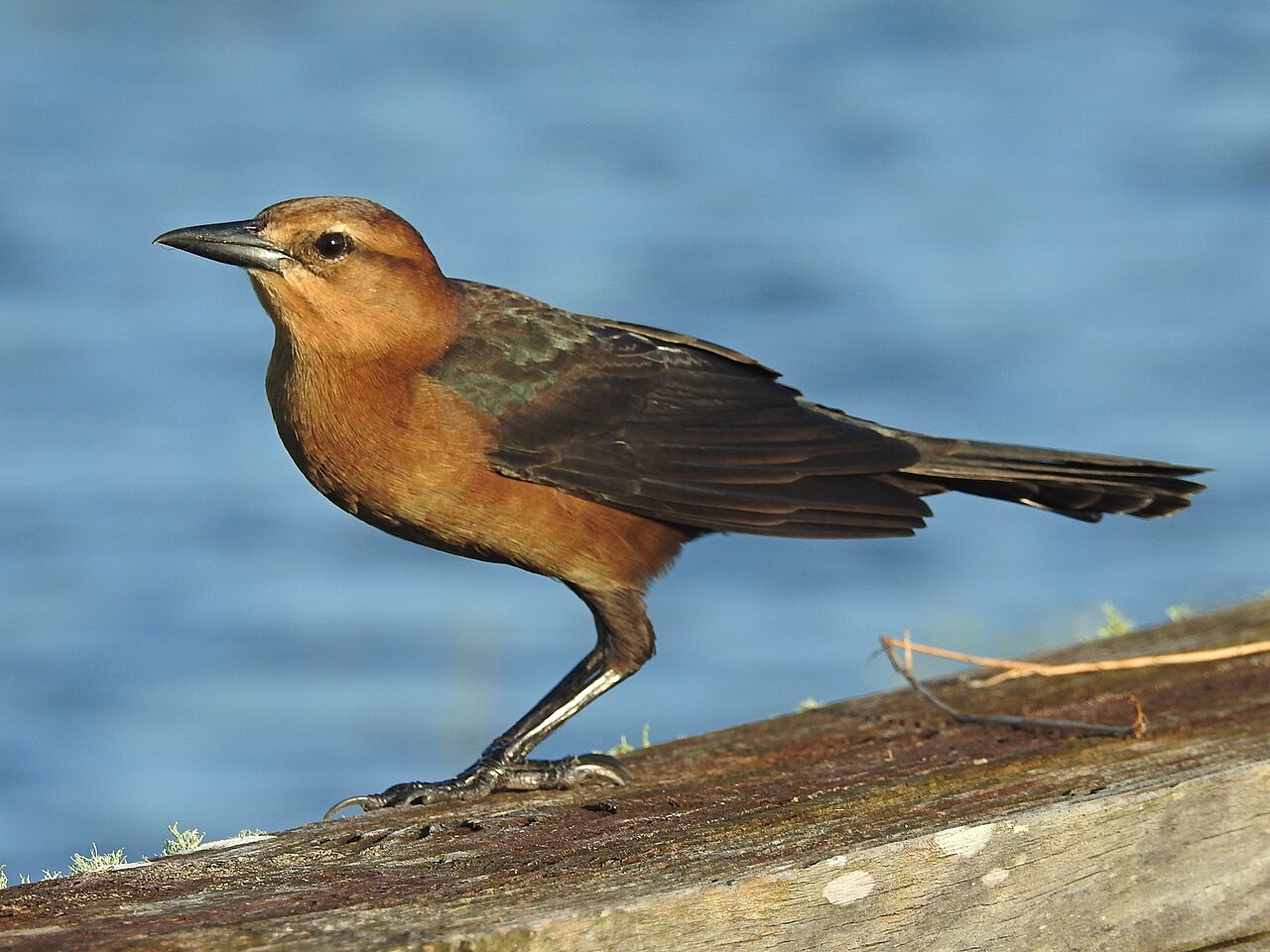
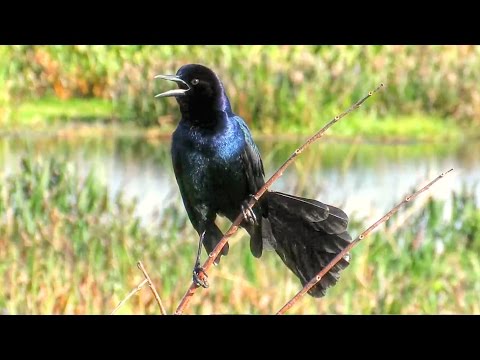
- Color Pattern: Male — iridescent blue-black; female — warm brown with paler underparts; eye color runs dark on most of the coast, yellow in Florida.
- Male vs. Female: Strongly dimorphic in size and color — he is the glossy showboat; she is the brown worker of the marsh edge.
The boardwalk showboat: strutting the railing with tail fanned and bill skyward, clattering his display at anything that passes.
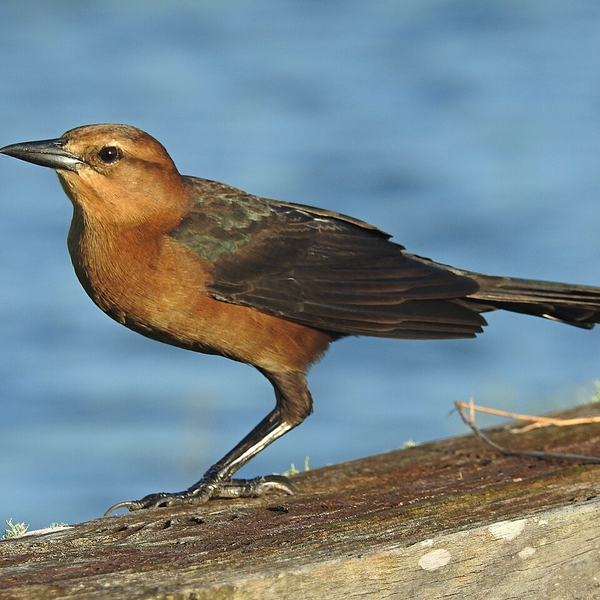
Half-sized and brown — she weaves the nest into marsh reeds and raises the brood on fiddler crabs and insects.
Boat-tailed Grackle Vocalization Guide (0 Field Recordings)
The Boat-tailed Grackle’s voice is a harsh jeeb-jeeb-jeeb plus clattering, squeaking display calls. All recordings below are real field audio via Wikimedia Commons — no simulations. For a deeper library, browse xeno-canto: Boat-tailed Grackle.
1. The Jeeb-Jeeb
2. The Display Clatter
3. The Roost Noise
Habitat, Range & the Salt Marsh
The Boat-tailed Grackle lives in coastal salt and brackish marshes — and the boardwalks, docks, marinas, and beach towns built beside them — along the Atlantic and Gulf coasts.

The Resident of the Waterfront
Range hugs the coast from New York’s Long Island around Florida to eastern Texas — resident all year, almost never inland; Florida’s birds carry the famous yellow eyes.
For backyard birders: coastal yards with marsh edge, docks, or waterfront lawns are grackle territory year-round — bold, noisy, and endlessly entertaining.
Backyard Behavioral Patterns & Social Dynamics
The Boat-tailed Grackle is a coastal opportunist with a flair for display. Four behaviors explain most of what you will observe:
🦚 The Boat Display
The male displays with tail spread into its boat shape, wings drooped, head skyward — waterfront theater all spring.
🦀 The Marsh Forager
It walks the mud at low tide picking fiddler crabs, snails, and insects — a shorebird’s menu on blackbird feet.
🍟 The Bold Beggar
It scavenges boardwalks and picnics fearlessly — habituated birds will take food from an open hand (never encourage it).
👁️ The Eye-Color Map
Dark eyes on most of the coast, yellow in Florida — a geographic quirk visible through binoculars.
Problem: “How Do I Live with Boat-tailed Grackles? What Should I Do?”
The three most common Boat-tailed Grackle puzzles all have proven answers:
First, the grackle split: on the coast it is Boat-tailed; inland Southwest it is Great-tailed — check the eye (dark on the coast, yellow in Florida and in Great-tails) and the address. Second, the begging birds: boardwalk grackles are habituated by handouts — secure food, never feed them, and the boldness fades back to normal wariness. Third, the feeder takeover: flocks empty open trays — weight-sensitive feeders and safflower keep the songbirds fed while the grackles patrol elsewhere.
Method 1: Set the Table — Songbird Feeders, Grackle-Resistant
Design feeding for the birds you want to keep:
-
Use Weight-Sensitive Feeders
Perch-closing mechanisms — a grackle’s weight shuts the port; small songbirds feed freely.
-
Serve Safflower
Grackles dislike safflower — cardinals and chickadees take it without competition.
-
Stop Ground Scatter
No open trays or scattered corn — open platforms are grackle buffets.
-
Secure Trash & Pet Food
Covered bins and indoor feeding — open calories train the flock to your yard.
Method 2: Understand the Bird — Native & Coastal
This is a native marsh bird with a public-relations problem:
-
Enjoy the Displays
Spring boat-tail displays are world-class — the boardwalk is the theater.
-
Watch the Eye Color
Dark north, yellow in Florida — a geography lesson on the railing.
-
Leave the Marsh Wild
Cordgrass and reed edges feed the flock — healthy marsh means birds spread out naturally.
-
Never Hand-Feed
Habituation makes aggressive beggars — admire at arm’s length.
Tool Solution: Recommended Hardware for Boat-tailed Grackle
Equipment matched to life with a coastal grackle:
Weight-Sensitive Feeder
Perch-closing feeders — songbirds dine; the grackle’s own weight locks the door.
- • Feature: Adjustable weight
- • Effect: Grackle-resistant
- • Bonus: Squirrel control too
Safflower Seed
Bitter to grackles, beloved by cardinals — the seed that ends feeder wars.
- • Feed: Safflower
- • Users: Cardinals & finches
- • Decliners: Grackles
A Marsh-Edge Bench
A seat near the reeds at dawn and dusk — the boardwalk show, no equipment required.
- • Time: Dawn & dusk
- • Season: Year-round
- • Bonus: Herons & rails too
Frequently Asked Questions
- Species Profile: The Boat-tailed Grackle (Quiscalus major) is a 14.6–16.5 inch, 5.6–8.8 ounce icterid (Icteridae), band code BTGR — the salt marsh showboat.
- ID in One Look: Coastal address, boat-folded tail, glossy male; brown female half the size.
- The Sound: Harsh jeeb-jeeb calls and clattering displays; real field recordings above.
- Range & Habit: Atlantic and Gulf coastal marshes and towns, resident all year.
- Feeder Formula: Weight-sensitive feeders and safflower — the standard grackle defense.
- The Eye-Color Map: Dark-eyed north, yellow-eyed in Florida — binoculars settle the geography.
Bird Watching Log
Species: Boat-tailed Grackle (Quiscalus major)
| Boat-tailed Grackle (Boat Tail Seen: Yes / No — Eye Color: Dark / Yellow — Jeeb Calls Heard: Yes / No — Marsh Present: Yes / No — Date & Time: ___) | |