
Mountain Quail
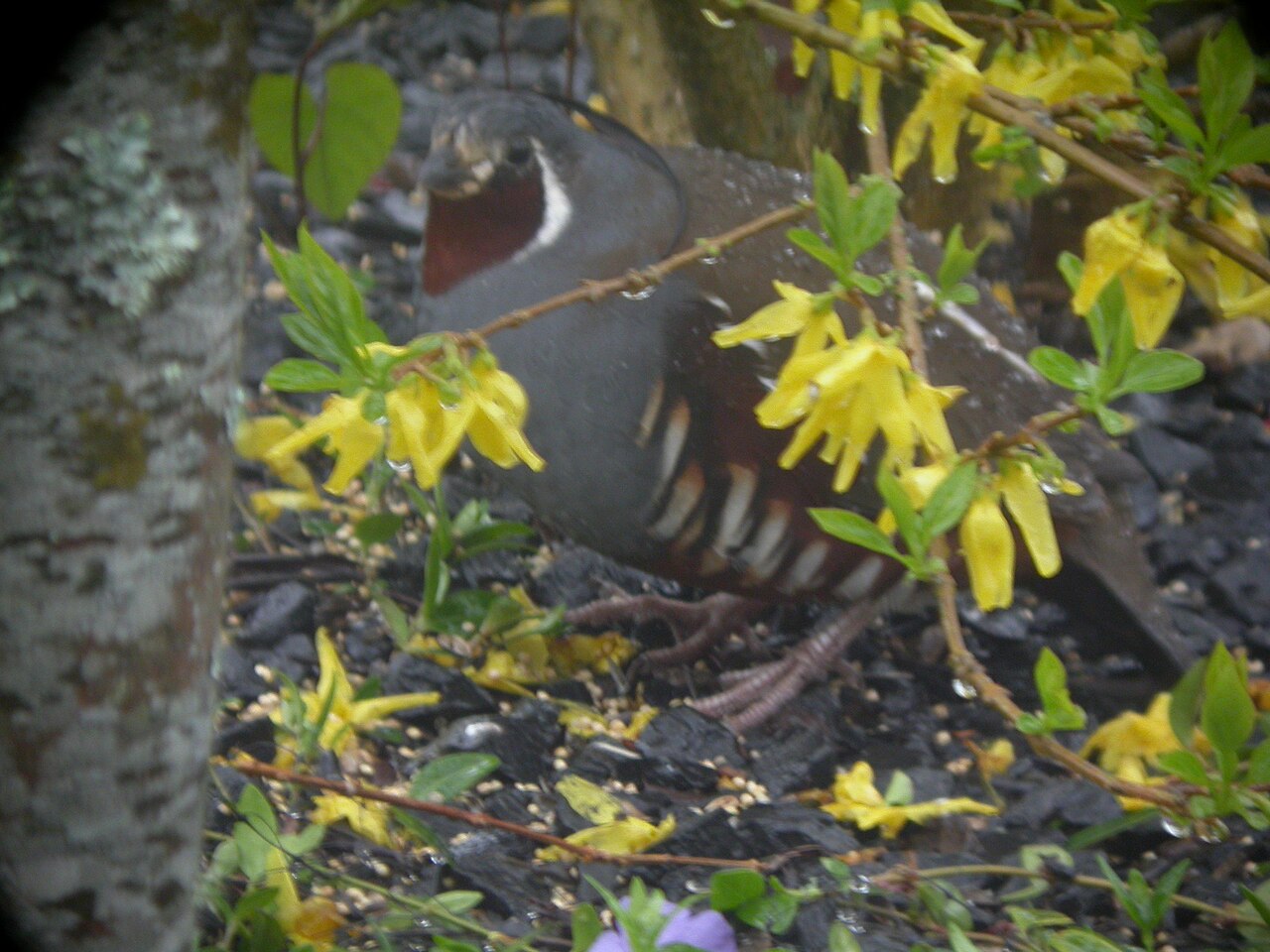


Mountain Quail (Oreortyx pictus): Complete Identification, Habitat Guide & Sound Library
Quick Answer: How to Attract & Identify the Mountain Quail
The Mountain Quail (Oreortyx pictus) is America’s largest quail — slate-gray with a long straight black head plume, a chestnut throat framed in white, and bold white bars on the flanks. It is a bird of mountain brush, not desert, slipping through chaparral and open pine woods from Washington to California. The voice is a loud, far-carrying quee-ARK whistle echoing off the slopes. Western mountain yards attract them with scattered millet, ground water, and dense brushy cover. They share the slopes with the California Quail and the Spotted Towhee.
Species Physical Profile & Morphometrics
The Mountain Quail belongs to the New World quail family (Odontophoridae) and is the largest quail in the United States. It lives in the mountains of the West — from Washington and Idaho south through Oregon, California, and Nevada — favoring dense brush on slopes rather than open desert.
The identification formula: slate-gray body + long straight black plume + chestnut throat + white flank bars. The California Quail has a scaled belly and a forward-curling comma plume; the Mountain Quail’s plume stands straight back like a single feather antenna, and its flanks carry unmistakable white bars.
Essential Morphometric Field Marks:
- Body Length & Mass: 10.4 to 11.4 inches (26.5–28.5 cm) and 6.7 to 9.2 ounces (190–262 grams) — the bulkiest American quail, round-bodied and strong-legged.
- Wingspan: Wings are short and rounded — built for an explosive uphill flush into cover, not for sustained flight.
- Bill Structure & Color: A short, stout, dark bill for husking seeds and digging bulbs with the feet — quail-standard equipment.
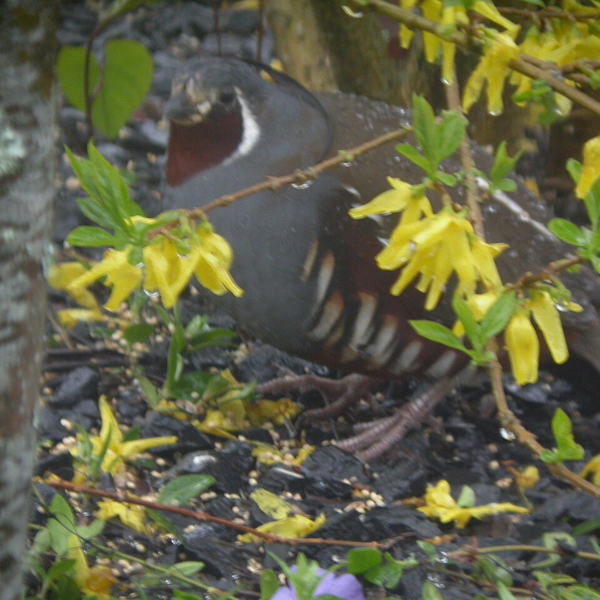
- Color Pattern: Slate-gray head, back, and breast; chestnut throat bordered in white; flanks chestnut with bold vertical white bars; the straight black plume of two feathers slopes back from the crown.
- Male vs. Female: The sexes look alike — both wear the full pattern; the male’s plume averages slightly longer, and pairs stay together inside the covey.
The gray sentinel: slate body, chestnut bib, and a plume like a single black antenna, calling quee-ARK from a brushy slope while the covey feeds out of sight below.
Identically dressed — plume, bib, and flank bars in full — she scratches a hidden ground nest under dense brush and leads the chicks on foot downslope as summer dries the heights.
Mountain Quail Vocalization Guide (2 Field Recordings)
The Mountain Quail’s voice is a loud, far-carrying quee-ARK or quark whistle — a ventriloquial note that locates birds across a whole canyon. All recordings below are real field audio via Wikimedia Commons — no simulations. For a deeper library, browse xeno-canto: Mountain Quail.
1. The Quark Whistle
2. The Covey Chorus
3. Soft Contact Notes
Habitat, Range & the Brushy Slope
The Mountain Quail lives in dense brush on mountain slopes: chaparral, brushy clearcuts, open pine and oak woods with thick undergrowth, and streamside thickets — from near sea level in the north to high elevations in the south. Yards adjoining brushy hillsides or recovering burns sit squarely in its country.

The West’s Mountain Quail
The range follows the western mountain spine: Washington, Oregon, California, Nevada, and western Idaho, with a few introduced populations elsewhere. It is not a true migrant, but coveys walk downslope in fall and back up in spring — an altitudinal migration done on foot.
For backyard birders: foothill and mountain yards with brushy edges, ground water, and scattered seed can host a covey — especially in fall and winter when birds move to lower elevations and approach rural homes.
Backyard Behavioral Patterns & Social Dynamics
The Mountain Quail is a secretive brush-dweller with a voice bigger than its courage. Four behaviors explain most of what you will observe:
🌿 The Brush Ghost
It rarely leaves dense cover — feeding inside brush, dust-bathing under shrubs, and flushing only when nearly stepped on; patience and a quiet window seat are the observer’s tools.
📢 The Ventriloquist
The quee-ARK whistle is famously hard to locate — it seems to come from everywhere and nowhere; trust the direction of the loudest note and scan the brush edge, not the open.
🥾 The Walking Migration
Coveys migrate altitudinally on foot — walking miles downslope in single file each fall and back up in spring, one of the few birds that migrates without flying.
🌱 The Bulb Digger
With strong feet it scratches up bulbs, tubers, and buried seeds — a digging quail; turned-over soil and small pits in the yard mark a covey’s breakfast table.
Problem: “The Quark Whistle Echoes All Morning but I Never See the Bird. What Should I Do?”
The three most common Mountain Quail puzzles all have proven answers:
First, the invisible whistler: Mountain Quail call from inside brush — watch the brush edge at dawn with binoculars, seated and still; the caller often steps onto a log or rock between bouts. Second, the feeder refusal: they will not cross open lawn — scatter millet within feet of dense cover and put water at the brush line; shrink the open gap and the covey appears. Third, the seasonal disappearance: a covey that vanishes in spring has walked upslope to breed — expect it back in fall when the first cold pushes birds to lower ground, and keep the water running through snow season.
Method 1: Set the Table — Seed & Water at the Brush Line
Design for a brush-bound mountain ground-feeder:
-
Scatter Millet at the Cover Edge
White millet scattered at the brush line — never in the open — refreshed at dawn; coveys feed within a body-length of escape cover.
-
Provide Ground Water in Cover
A shallow ground dish tucked beside dense brush — in dry summers this is the strongest draw on the mountain.
-
Keep Feed Fresh & Quiet
Approach feeding spots on a fixed quiet route — predictable human rhythm teaches the covey the yard is safe.
-
Offer Grit Near Water
A pinch of fine gravel grit near the water dish — seed-eaters need grinding grit, and it costs nothing.
Method 2: Build the Habitat — Dense Brush on the Slope
Keep the brush thick, and the covey winters at your door:
-
Preserve Dense Brush Patches
Ceanothus, manzanita, snowberry, and thicket edges — the living cover Mountain Quail never stray far from.
-
Build Brush Piles on Slopes
Stacked brush on the hillside margin doubles as escape cover, midday shade, and night roost.
-
Leave Leaf Litter & Soil
Undisturbed leaf litter and soft soil under shrubs hold the bulbs and seeds a digging covey works for.
-
Keep Winter Access Open
In snow, clear a small feeding patch beside cover — a shoveled square of ground can carry a covey through a storm week.
Tool Solution: Recommended Hardware for Mountain Quail
Equipment matched to a brushy-slope covey bird:
Ground Seed Station
Millet scattered at the brush line on a daily schedule — the quiet, reliable station that wins a covey’s trust.
- • Food: White millet, cracked corn
- • Placement: Brush line, never open
- • Timing: Dawn refresh
Ground Water Dish in Cover
A shallow dish tucked beside dense brush, kept full through summer drought and winter freeze — the covey’s anchor point.
- • Depth: One to two inches
- • Placement: Beside dense cover
- • Winter: Keep ice-free
Native Brush Plantings
Ceanothus, manzanita, and snowberry thickets — the structure that turns a pass-through slope into a home range.
- • Plants: Ceanothus, manzanita
- • Structure: Dense, knee-to-shoulder high
- • Bonus: Towhees & wrens too
Frequently Asked Questions
- Species Profile: The Mountain Quail (Oreortyx pictus) is a 10.4–11.4 inch, 6.7–9.2 ounce New World quail (Odontophoridae), band code MOUQ — America’s largest and most elusive quail.
- ID in One Look: Slate-gray body, straight black plume, chestnut throat, white flank bars — unmistakable when seen.
- The Sound: A far-carrying quee-ARK whistle across the slopes; real field recordings above.
- Range & Habit: Western mountain brush; walks downslope in fall, back up in spring; rarely leaves cover.
- Feeder Formula: Millet at the brush line, ground water in cover, dense native thickets, and a quiet routine.
- The Walking Migrant: A bird that migrates on foot — the covey at your feeder in January climbed down from the heights in October.
Bird Watching Log
Species: Mountain Quail (Oreortyx pictus)
| Mountain Quail (Covey Size: ___ — Plume Seen: Yes / No — Quark Heard: Yes / No — At Brush-Line Seed: Yes / No — At Water: Yes / No — Date & Time: ___) | |